But the answer comes with a critical caveat: the retaining wall must be permanent, professionally engineered, and aesthetically integrated into the property design. A rotting timber wall held together by rusting landscape spikes does not increase property value. It decreases it—because every potential buyer who sees that wall sees a $25,000-$60,000 repair bill waiting to happen. A leaning, cracked poured concrete wall does not increase value either. It communicates deferred maintenance, structural neglect, and unpredictable future expense.
The property value increase comes from a retaining wall that accomplishes three things simultaneously: it creates flat, usable land; it permanently eliminates erosion and drainage risk; and it looks like a deliberate, luxury architectural element rather than a utilitarian afterthought. When all three conditions are met, the retaining wall delivers one of the highest returns on investment of any exterior improvement in the GTA market.
The Liability of a Slope: Why Unusable Land Costs You Money
Let’s start with the financial reality of a sloping property in Concord. The residential neighbourhoods south of Highway 7 and west of Keele Street—the mature, established streets running through the heart of Concord—sit on terrain that was shaped by glacial deposits and the natural drainage contours feeding into the Don River and Black Creek watershed systems. Many of these properties have significant rear-yard slopes—drops of 600mm to 1,500mm (2-5 feet) or more across the depth of the backyard, sometimes steeper.
A steeply sloping backyard is a financial liability in four distinct ways:
- Zero entertaining capacity: You cannot place a dining table on a slope. You cannot safely position a BBQ on uneven ground. You cannot install a fire table, a lounge zone, or a hot tub on a grade that drops 100mm over every metre. The outdoor entertaining revolution that has redefined GTA real estate values over the past decade—the outdoor kitchens, the fire features, the four-season pavilions—requires flat, stable, engineered surfaces. A slope provides none of that. The backyard is visually present but functionally unusable. Buyers see a big yard on paper but a yard they cannot actually use in practice
- Soil erosion and property degradation: On an unretained slope, rainfall and snowmelt run downhill across the exposed grade, carrying topsoil, planting bed material, and mulch with it. Over years, the grade steepens as the upper soil is stripped and deposited at the base. Root systems become exposed. Planting fails. The yard looks progressively worse each spring. In Concord’s heavy clay soil, erosion channels (rills and gullies) form quickly during heavy rainfall, cutting visible trenches into the slope that are expensive to repair and impossible to maintain without structural intervention
- Foundation and grading risk: The Ontario Building Code and municipal grading bylaws require that surface water drain away from the home’s foundation. On a property where the rear yard slopes toward the house (a reverse grade or a side-hill condition), uncontrolled surface runoff concentrates against the foundation wall, increasing the risk of basement moisture infiltration, hydrostatic pressure on the foundation, and accelerated deterioration of the foundation waterproofing membrane. A home inspection that identifies “negative grading” or “uncontrolled surface water flow toward the foundation” is a red flag for buyers—it signals potential water damage, mould risk, and a costly grading correction that could run $15,000-$40,000+
- Reduced comparable value: When a real estate appraiser evaluates a property, they compare it to similar properties in the same neighbourhood. A Concord property with a flat, fully landscaped backyard featuring an outdoor kitchen, a fire table, and an interlocking paver patio will appraise dramatically higher than an identical-footprint property next door with a steeply sloped, eroding, unusable backyard. The difference is not theoretical. In the GTA market, the appraised value differential between a fully functional outdoor living space and an unimproved, sloping yard can be $40,000-$120,000+—depending on lot size, neighbourhood comparables, and the quality of the installed outdoor living amenities
“A 50-foot backyard that drops five feet from the house to the fence line looks like a big yard on the survey. But it functions like no yard at all. A retaining wall turns that slope into a 400-square-foot flat patio that buyers can immediately picture themselves using. That is the moment the property value changes.”
Manufacturing Square Footage: The ROI of Flat Land
Here is the core financial argument for a retaining wall, and it is one of the most powerful value propositions in residential landscaping: a retaining wall is one of the only exterior improvements that literally creates new usable real estate.
A new kitchen renovation makes an existing room more attractive. A new roof protects an existing structure. A new driveway replaces an existing surface. None of these improvements create new space. A retaining wall carves into a hillside, holds back thousands of pounds of earth, and transforms what was a steep, unusable grade into a perfectly flat, structurally stable platform that can support an outdoor kitchen, a dining terrace, a fire feature lounge, or a full outdoor living room.
From a real estate valuation perspective, this is transformative. You are not improving existing functionality. You are adding functionality that did not exist.
The Math: Concord Property Example
Consider a typical Concord residential property with a
45-foot-wide by 55-foot-deep rear yard
that slopes 1,200mm (4 feet) from the
house down to the rear fence line. In its current state,
the yard is:
• Unusable for entertaining (too steep for furniture
or features)
• Eroding during heavy rain (clay soil, no structural
retention)
• Aesthetically unappealing (patchy grass, visible
erosion channels, failed planting)
The retaining wall solution creates a two-tier backyard:
- Upper terrace (adjacent to the house): A 1,200mm (4-foot) retaining wall is constructed approximately 20-25 feet from the house, holding back the lower grade and creating a flat, level upper terrace of approximately 45’ × 22’ = 990 square feet. This upper terrace is surfaced with Warm Off-White interlocking pavers with Deep Charcoal borders and becomes the primary outdoor living zone—outdoor kitchen, dining area, fire table lounge, and seating walls
- Lower terrace (toward the rear fence): The remaining 45’ × 30’ = 1,350 square feet at the lower grade is re-graded to flat, with proper drainage directed to the rear and sides. This zone becomes the garden, play area, or secondary entertaining space—a green lawn panel, planting beds, or a lower patio extension
The total cost of this retaining wall project (excavation, base, drainage, geogrid-reinforced segmental block wall, cap stones, re-grading, and upper terrace paver installation) is typically in the range of $55,000-$95,000 depending on access, soil conditions, and the scope of the patio and features above the wall.
The Appraised Value Increase
The value increase is driven by multiple factors that appraisers and buyers evaluate simultaneously:
- Usable outdoor living space: The property now has 990+ square feet of flat, finished outdoor living area that did not exist before. In the GTA market, professionally installed outdoor living space (patio, outdoor kitchen, fire feature) typically returns 60-80% of the installation cost at resale—one of the highest ROI percentages of any exterior improvement, comparable to kitchen and bathroom renovations
- Erosion and drainage resolution: The retaining wall and re-grading permanently resolve the erosion and surface water management issues. A buyer viewing the property no longer sees a risk. They see a solved problem. The home inspection report will note positive grading, controlled drainage, and structural earth retention rather than flagging erosion, negative grading, or foundation water risk. This removes a significant psychological and financial barrier to buyer confidence
- Curb appeal and first-impression premium: For front-yard or side-yard retaining walls, the visual impact is immediate. A Deep Charcoal segmental block wall with a natural stone cap, integrated landscape lighting, and a precisely graded lawn above it communicates investment, permanence, and design intentionality. Buyers respond to properties that look cared for, engineered, and finished—and a luxury retaining wall is one of the most powerful visual signals of all three
- Comparable pricing advantage: In a Concord neighbourhood where the comparable properties are split between homes with flat, fully improved backyards and homes with unimproved slopes, the flat-yard properties consistently sell for $40,000-$100,000+ more than the sloped-yard properties—after adjusting for house size, age, and interior condition. The retaining wall is the structural intervention that moves the property from the low-comp category to the high-comp category
On a typical Concord property, a retaining wall investment of $55,000-$95,000 can generate a $40,000-$120,000+ appraised value increase—a return that ranges from approximately 50% to over 100% depending on the neighbourhood, the scope of the outdoor living build-out, and the condition of the competing inventory at time of sale.
The Aesthetic Premium: The Signature Triad
The financial return of a retaining wall is not driven by the structure alone. It is driven by how the wall looks—and what it enables visually on the property above it.
The Negative Signal: Timber and Failing Walls
A rotting pressure-treated timber retaining wall does not merely fail to add value. It actively subtracts value from the property. Every buyer who walks the backyard and sees leaning, warped, moss-covered timbers held together by rusting spikes mentally deducts the replacement cost from their offer price. That deduction is not the actual cost of building the new wall—it is their perceived cost, which is almost always higher than reality because buyers overestimate repair costs as a risk premium. A failing timber wall that would cost $40,000 to replace is perceived by buyers as a $50,000-$60,000 problem, and their offer is reduced accordingly.
A cracked, leaning poured concrete wall generates the same response. Buyers see structural failure, potential engineering requirements, potential permit issues, and unknown cost. The wall becomes a negotiation weapon used to drive the purchase price downward.
The Positive Signal: The Three-Tone Luxury Composition
The opposite effect occurs when a buyer walks into a backyard that features a permanent, architecturally integrated retaining wall built from high-density Deep Charcoal split-face segmental blocks, capped with a natural stone coping, and framing an expansive upper terrace surfaced in Warm Off-White interlocking pavers with Charcoal soldier-course borders.
Add a Rich Walnut timber pergola or pavilion structure over the dining zone. Add under-cap LED wash lighting along the retaining wall face. Add a natural stone-veneer fire table on the patio. The buyer is no longer evaluating a backyard. They are standing in an outdoor living room that rivals a five-star resort terrace.
The three-tone palette—Deep Charcoal base, Warm Off-White field, Rich Walnut accents—is the Cinintiriks signature composition, and it is engineered for precisely this response:
- Charcoal (the base): The retaining wall, the paver borders, the step risers, and the fire table veneer are all specified in Deep Charcoal. This dark, saturated tone grounds the composition visually, absorbs visual weight, and communicates permanence, solidity, and architectural seriousness. The Charcoal wall is the foundation of the design—literally and visually
- Off-White (the field): The patio surface, the seating wall caps, and the step treads are specified in Warm Off-White. This lighter tone creates expansiveness—the patio feels larger, brighter, and more open because the dark Charcoal base beneath it provides tonal contrast. The Off-White field is the living surface where the entertaining happens
- Walnut (the accent): Overhead pergola beams, privacy screen panels, and ceiling-mounted fan housings are specified in Rich Walnut composite or natural wood. This warm, organic mid-tone bridges the dark and light, introduces natural warmth, and prevents the space from feeling cold or overly mineral. The Walnut accent is the human element—it makes the stone and concrete feel inviting rather than institutional
This three-tone composition is not decorative. It is value engineering for real estate. Properties with this level of outdoor design cohesion routinely sell at the top of their comparable range in Concord and across the GTA, because they photograph well for listings, they show well during tours, and they create an immediate emotional response in buyers that translates directly to higher offers.
“Buyers don’t calculate value in a backyard. They feel it. A three-tone outdoor living space with a permanent retaining wall, a fire feature, and landscape lighting says ‘this home is finished.’ That single feeling is worth $50,000 on the offer.”
The Commercial ROI: Tenant Attraction and Retention
For commercial property owners in Concord—particularly along the Highway 7 commercial corridor, Keele Street, and the Concord Road industrial-commercial zone—retaining walls serve a different but equally powerful value function: tenant and customer attraction.
A commercial property with sloping, eroding grades, ponding water, and exposed soil looks neglected. High-quality tenants—the medical practices, the professional offices, the boutique retailers who pay premium rents—choose spaces that reflect their brand. Cracking concrete and eroding grades do not communicate premium. A levelled, paver-surfaced plaza framed by architectural Charcoal segmental block walls with integrated bollard lighting communicates investment, care, and quality.
On the commercial side, the ROI is measured differently: in reduced vacancy rates, higher per-square-foot lease rates, and lower tenant turnover. A commercial property that invests $80,000-$150,000 in structural retaining walls, site grading, and premium hardscape surfaces can recover that investment within 3-5 years through increased rental income—and the walls themselves require zero maintenance for 50+ years.
The Engineering Behind the Value: What Makes It Permanent
The property value increase is only permanent if the retaining wall is permanent. A wall that fails in 10 years does not increase long-term value—it creates a deferred liability that the next owner inherits. The wall must be engineered to outlast the property.
The critical engineering components that determine permanence:
- High-density segmental concrete blocks: Minimum 28 MPa compressive strength, air-entrained for 300+ freeze-thaw cycle resistance, dry-stacked with lip/pin interlock for controlled flexibility during frost heave. The blocks themselves have no practical expiration date in Ontario’s climate when properly installed
- Geogrid reinforcement: High-tensile polymer mesh sheets installed every 2-3 block courses, extending 60-70% of the wall height into the reinforced soil zone behind the wall. The geogrid ties the wall to the earth mass, creating a mechanically stabilised earth (MSE) system that can resist lateral pressures far beyond what the block weight alone can handle. The geogrid polymer is inert—it does not biodegrade, corrode, or weaken over time
- Full drainage assembly: Perforated weeping tile at the wall base, 300-600mm of 19mm clear stone backfill behind the full wall height, and non-woven geotextile filter fabric separating the clear stone from the native soil. The drainage system prevents hydrostatic pressure from building behind the wall. In Concord’s clay-dominant soil, which drains poorly and holds water for extended periods, the drainage system is the single most critical component—without it, the clay’s moisture load will push even a well-built wall forward over 5-10 years
- Proper base and compaction: 150-300mm compacted HPB granular base pad beneath the first course, compacted in 100mm lifts to 98% Standard Proctor density, founded below the 1.2-metre frost line. The base determines whether the wall remains level for 50 years or develops differential settlement in 5
The Cinintiriks Approach: Engineered Value, Not Just Stacked Blocks
At Cinintiriks, we do not build retaining walls as standalone structural projects. We build retaining walls as integrated components of complete outdoor living transformations—because the property value increase comes not from the wall alone, but from the wall plus the usable space it creates plus the luxury amenities installed on that space.
The Cinintiriks Standard: Value-Engineered Retaining Walls
1. Design Integration from Blueprint Stage: Every Cinintiriks retaining wall is designed as part of the complete property plan, not as an isolated structural element. The wall height, position, and alignment are determined by the spatial requirements of the outdoor living zones above it—the kitchen footprint, the dining zone dimensions, the fire feature clearances, the traffic flow paths. The wall serves the design. The design does not accommodate the wall.
2. Deep Charcoal Block with Three-Tone Integration: Our standard retaining wall specification uses Deep Charcoal split-face segmental blocks that integrate with the Charcoal paver borders, the Charcoal step risers, and the Charcoal fire table veneer across the property. The wall is a design element, not a hidden utility. When the buyer walks the backyard, the wall reads as part of a unified, high-end architectural composition—not as an afterthought.
3. Full Heavy-Civil Engineering: Every Cinintiriks wall includes geogrid-reinforced segmental block construction, perforated weeping tile, 300-600mm clear stone backfill, geotextile filter fabric, compacted granular base below frost line, and P.Eng. stamped drawings for walls over 1.0 metre. The wall is engineered to stand permanently—which means the value it adds to the property is permanent, not temporary.
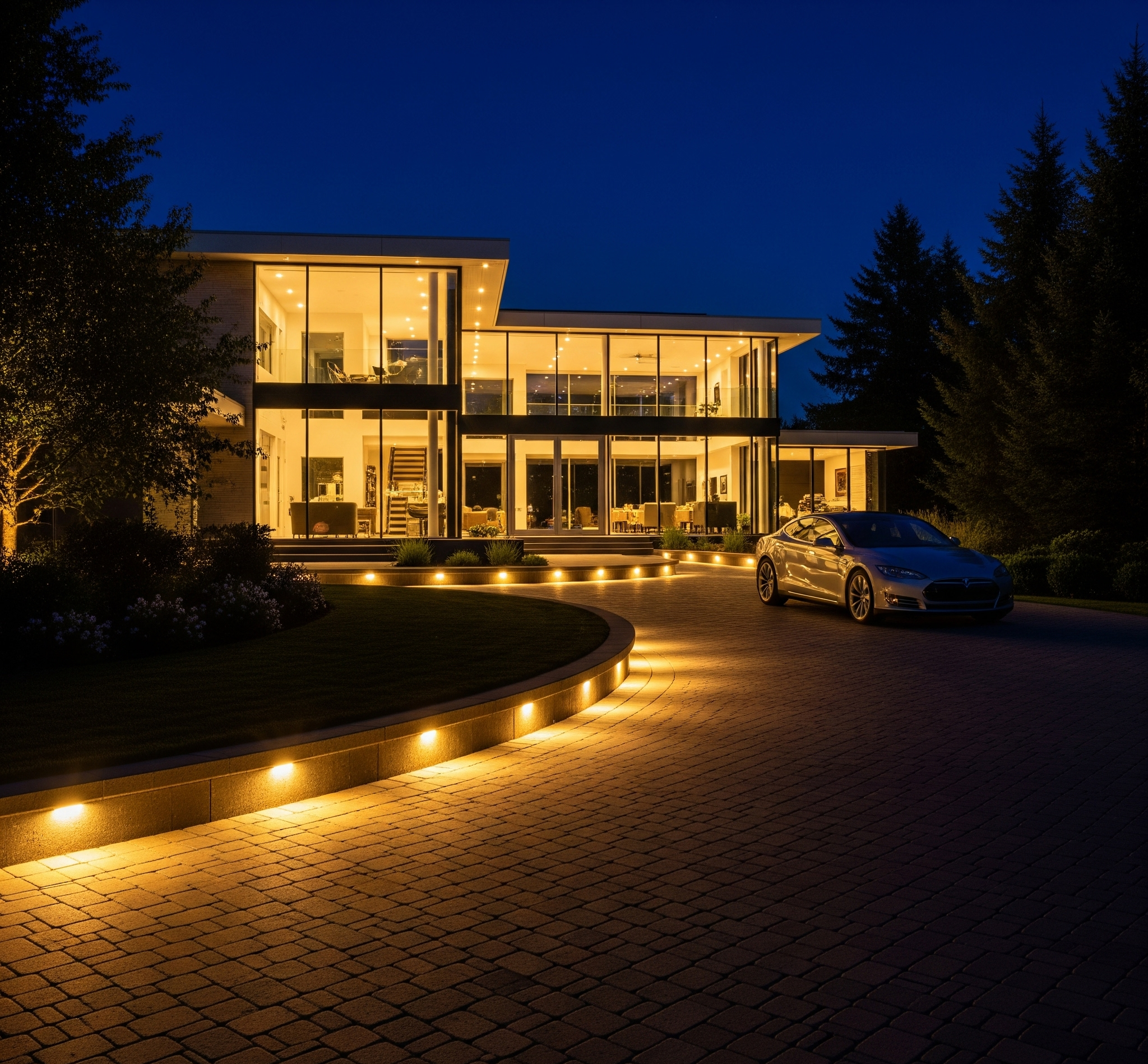
4. Integrated Lighting and Utilities: Low-voltage LED lighting conduits, speaker wire chases, and irrigation penetrations are built into the wall structure at construction. Under-cap wash lighting transforms the wall into a dramatic evening feature that photographs beautifully for real estate listings. Night photography of a luxury backyard with under-cap retaining wall lighting, fire table glow, and pathway illumination is the most powerful single image a real estate listing can present.
5. Permit and Engineering Documentation: Every Cinintiriks retaining wall project that requires a building permit (walls over 1.0m in exposed height) includes full permit documentation, P.Eng. stamped drawings, and inspection sign-off. This documentation package becomes a permanent asset of the property—it provides the next owner with proof that the wall was engineered, permitted, inspected, and built to Ontario Building Code standards. This documentation is enormously valuable at resale because it eliminates buyer uncertainty about the structural integrity of the wall.
6. Post-Construction Property Photography: As part of our project completion process, we provide Concord clients with high-resolution day and evening photography of the completed outdoor living space. These images are designed to be listing-ready—professional compositions that capture the three-tone palette, the lighting, the fire features, and the scale of the space in a format that translates directly to MLS listing photography when the property is eventually marketed for sale.
Don’t let a sloped yard drag down your property value. Contact Cinintiriks to engineer a permanent, value-adding luxury retaining wall in Concord.
FAQ: Retaining Walls and Property Value
How much does a new retaining wall typically add to a home’s resale value in Ontario?
The answer depends on three variables: how much usable space the wall creates, the quality of the outdoor living build-out on that space, and the neighbourhood comparable pricing. A retaining wall that transforms an unusable sloped backyard into a flat, finished outdoor living zone with a paver patio, outdoor kitchen, fire feature, and integrated lighting typically returns 60-100%+ of the total project investment at resale—making it one of the highest-ROI exterior improvements in the GTA market. The retaining wall alone (without the patio and features above it) returns approximately 40-60% because it creates the flat land and eliminates erosion and drainage risk. The patio, kitchen, and fire features add the experiential value that drives the return above 60%. Combined, a $70,000-$120,000 retaining wall and outdoor living project on a Concord property can generate a $50,000-$120,000+ appraised value increase—and in a competitive market where outdoor living space is a top buyer priority, the investment often pays for itself entirely at the point of sale.
Will fixing an eroding backyard slope lower my home insurance premiums?
It may, indirectly. Home insurance premiums in Ontario are influenced by the insurer’s assessment of the property’s risk profile, including the risk of water damage to the foundation. A property with negative grading (surface water flowing toward the foundation), visible erosion, and uncontrolled drainage is assessed as a higher water-damage risk than a property with engineered grading, structural retaining walls, and a controlled drainage system. Some insurers offer premium reductions or improved terms for properties that have addressed grading and drainage deficiencies, particularly if the improvements are documented with engineering drawings and permit sign-off. The premium reduction itself is typically modest (5-15% on the water damage component of the policy), but the more significant benefit is avoiding a denied claim. If your basement floods and the insurer determines that the cause was foreseeable surface water mismanagement (which uncontrolled slope erosion and negative grading represent), the claim may be denied or reduced. Fixing the slope with a retaining wall and engineered grading eliminates the root cause of the water infiltration risk, protecting both the foundation and the insurance coverage.
Does adding a retaining wall to level a yard require a municipal permit?
In most cases, yes. In the City of Vaughan (which includes Concord), retaining walls exceeding 1.0 metre (3.3 feet) in exposed height require a building permit and P.Eng. stamped structural drawings. The permit application must include the engineering drawings, a site plan showing the wall location relative to property lines and structures, and a description of the drainage system. Additionally, if the property is within a Toronto and Region Conservation Authority (TRCA) regulated area (properties near watercourses, floodplains, or valley lands), the retaining wall may also require a TRCA permit under Ontario Regulation 166/06. Some Concord properties near the Don River tributaries and Black Creek fall within TRCA jurisdiction. The grading work associated with the retaining wall (moving and re-distributing soil to create the flat terrace) may also require a grading permit from the municipality, particularly if the soil volume being moved exceeds the municipal threshold or if the grading changes affect drainage onto adjacent properties. At Cinintiriks, all permit applications, engineering submissions, and regulatory consultations are handled by our team as part of the project scope. The client does not need to navigate the permitting process independently.
The Final Word
A slope is dead space. A retaining wall converts dead space into living space. Living space, in the GTA real estate market, is the highest-value asset a property can possess.
The wall must be permanent (segmental concrete blocks, not timber). It must be properly drained (weeping tile, clear stone, filter fabric). It must be properly reinforced (geogrid for walls over 600mm). And it must be aesthetically integrated (three-tone palette, integrated lighting, finished cap stones) to deliver the full emotional and financial impact at resale.
When all of those conditions are met, a retaining wall is not a cost. It is an investment that manufactures real estate, eliminates risk, transforms aesthetics, and delivers one of the highest ROIs in exterior property improvement.
That is The Cinintiriks Standard. Not just retained. Reclaimed.