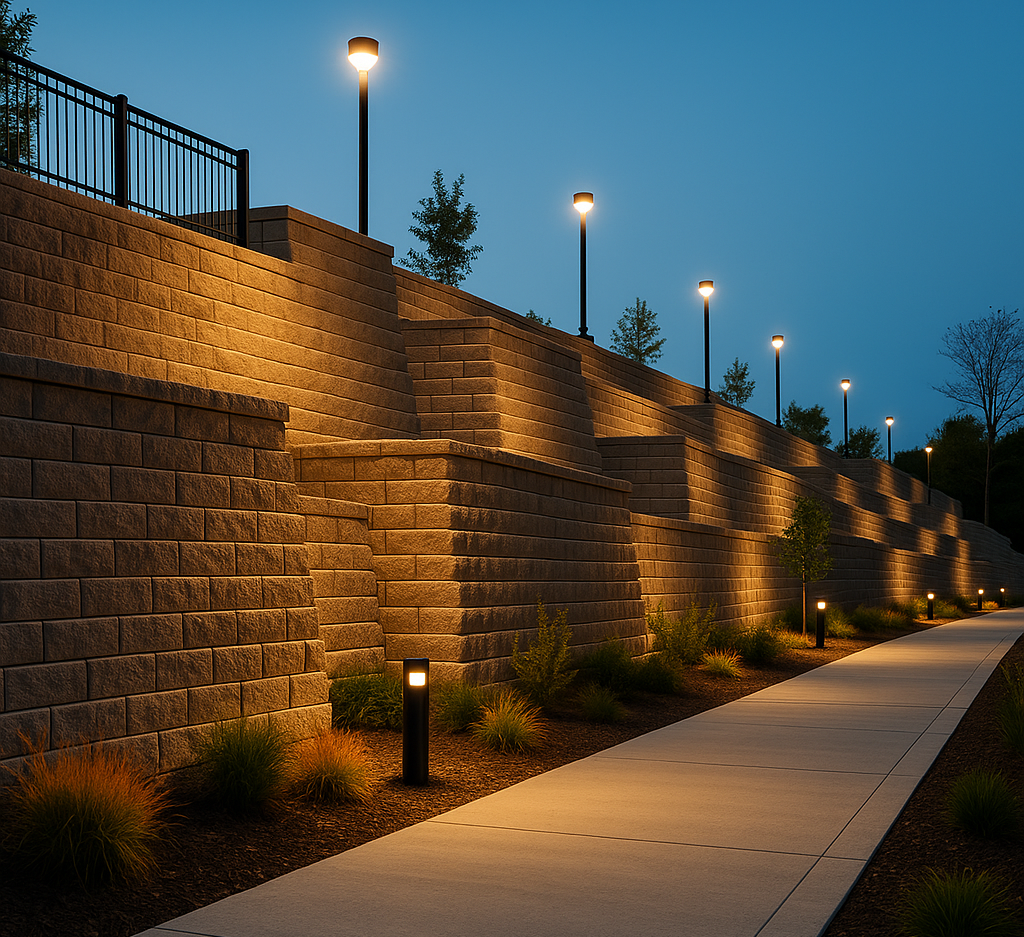
A standard landscape retaining wall is engineered to do one thing: resist the lateral earth pressure of the soil behind it. That is its only structural obligation. It holds back dirt. It is not designed to hold back dirt while simultaneously supporting the weight of a concrete slab, 2 inches of paver bedding, 80mm interlock pavers, an outdoor kitchen island, twelve dinner guests, a 2,000 kg hot tub, and the snow load of a GTA winter sitting on top of it. Adding those loads transforms the wall from a simple earth-retention structure into a load-bearing structural element—and that transformation changes everything about how the wall must be designed, built, inspected, and permitted.
This guide explains the engineering principles, the structural requirements, the waterproofing systems, and the regulatory framework for building a usable space above a retaining wall in the GTA. It is not a how-to manual for a weekend project. It is a consultation on what the project involves so you can make an informed decision about whether it is right for your property and your budget.
The Vertical Expansion: Why Property Owners Want This
The appeal is straightforward and powerful. Land in the GTA is expensive, and many properties—particularly in established neighbourhoods built along the Humber River valley, the Don River valley, the Rouge River ravine system, and the escarpment-adjacent areas of north Mississauga and Oakville—have significant grade changes that render large portions of the lot unusable as outdoor living space. A backyard that drops 6 feet from the house to the property line is a backyard where half the square footage is a slope that you look at but cannot use.
An engineered retaining wall with a usable terrace above it converts that unusable slope into a flat, functional extension of the living space. The terrace can support everything a grade-level patio can: dining areas, lounging zones, fire features, outdoor kitchens, planters, lighting, and in many designs, a hot tub or plunge pool. The visual effect is dramatic —a cantilevered or elevated living platform that creates a sense of architectural intention rather than a yard that merely follows the contours of the land.
The same engineering applies to building over existing subterranean structures. In Vaughan, where walk-out basement designs and below-grade garages are common in the newer custom-home developments across the Kleinburg and Vellore corridors, homeowners frequently want to create a usable patio, terrace, or driveway above the garage roof or the lower-level walkout. The structure below already exists. The question is whether it can support the weight of a finished hardscape and the people who will use it—and if not, what structural modifications are required to make it capable.
The Physics of Surcharge Loads
In structural engineering, a surcharge load is any load applied to the surface behind or above a retaining wall, in addition to the weight of the retained soil itself. It is the single most critical variable in determining whether a retaining wall can support a usable space above it.
What Surcharge Does to a Retaining Wall
A retaining wall resists lateral earth pressure—the horizontal force that soil exerts against the wall as gravity tries to pull it downhill. This pressure increases linearly with depth: the deeper the soil behind the wall, the higher the pressure at the base. A standard 4-foot retaining wall holding back compacted granular fill exerts approximately 2,400-3,200 kg of lateral force per linear metre at its base. The wall's footing, reinforcement, and mass are designed to resist exactly this force.
Now add a surcharge. Place a 200mm concrete slab, 2 inches of bedding, 80mm pavers, an outdoor kitchen, and a group of people on top of the retained soil directly behind and above the wall. This additional weight presses down on the soil, which transmits the force laterally against the wall. The surcharge does not simply add downward force. It adds lateral force—additional horizontal pressure pushing the wall outward. For a uniform surcharge load (like a patio slab), the additional lateral pressure is approximately 30-40% of the surcharge's vertical load, distributed along the full height of the wall.
A residential terrace surcharge (slab, pavers, furniture, occupants) typically adds 500-1,500 kg/m² of vertical load. At 30-40% lateral transmission, that adds 150-600 kg/m² of additional horizontal pressure to the wall. On a 4-foot wall, this can increase the total lateral force at the base by 25-50% beyond the earth pressure alone. A wall designed only for earth pressure that is then asked to carry a 40% higher load is a wall that is overstressed. And an overstressed retaining wall does not bend. It does not flex. It fails—suddenly, catastrophically, and with the full mass of the retained soil and everything on top of it following it downhill.
"A retaining wall does not know the difference between soil pressure and surcharge pressure. It feels them both as the same force pushing it over. The question is whether it was designed for both."
The Structural Response: Designing for Surcharge
A retaining wall that will carry surcharge loads must be designed from the footing up to accommodate the increased forces. This is not a matter of "building it stronger" in a general sense. It requires specific, calculated engineering responses to each force component:
Deeper, wider footing. The footing (the base of the wall, buried below grade) must be deeper to resist sliding forces and wider to provide a greater moment arm against overturning. For a surcharge-loaded wall, the footing width is typically 60-100% of the wall height (versus 40-60% for a standard earth-retention wall). In the GTA, the footing must also extend below the frost line (minimum 1.2 metres / 4 feet below finished grade) to prevent frost heave from displacing the wall seasonally.
Heavier reinforcement. The vertical and horizontal reinforcement (rebar) in the wall stem and footing must be sized to resist the increased bending moments and shear forces produced by the combined earth and surcharge pressures. A standard 4-foot retaining wall might use 15M rebar at 400mm centres. The same wall designed for a terrace surcharge might require 20M rebar at 200mm centres—four times the steel content—to achieve the required structural capacity.
Thicker wall stem. The wall itself must be thick enough to house the required reinforcement with proper cover (minimum 50mm of concrete outside the rebar for exposure protection) and to resist the shear forces at the base without cracking. A surcharge-loaded wall stem is typically 250-400mm (10-16 inches) thick, versus 200-250mm (8-10 inches) for a standard earth-retention wall.
Higher-strength concrete. The concrete specification increases from a standard 25-28 MPa mix to a minimum 32 MPa mix (and often 35 MPa for walls above 6 feet with heavy surcharges), with air entrainment for freeze-thaw resistance and a maximum water-to-cement ratio of 0.45 for durability and impermeability.
The Structural Slab: Engineering the Terrace Surface
The usable surface above the wall is not simply pavers laid on dirt. It is a structural slab—a reinforced concrete deck that spans between the retaining wall and the adjacent structure (house foundation, garage wall, or an opposing retaining wall) and carries all of the live and dead loads of the terrace.
Dead Loads (Permanent Weight)
The structural slab must support its own weight plus the weight of every permanent component installed on it:
- Reinforced concrete slab: 200-250mm thick = 480-600 kg/m²
- Waterproofing membrane and protection board: 5-10 kg/m²
- Drainage layer (clear stone or drainage mat): 20-50 kg/m²
- Bedding material (HPB or levelling screed): 30-50 kg/m²
- Paver surface (80mm concrete pavers): 160-180 kg/m²
- Landscaping soil (if planters are integrated): 800-1,200 kg/m² per metre of soil depth
Total dead load for a typical elevated terrace: 700-1,100 kg/m² without integrated planters, or 1,500-2,300 kg/m² with deep planter beds. These are enormous loads —comparable to a commercial office floor—and they are permanent. The slab carries them 24 hours a day, 365 days a year, for the life of the structure.
Live Loads (Variable Weight)
In addition to the permanent dead loads, the slab must support the variable weight of occupants, furniture, snow, and any moveable heavy objects:
- Occupant load (Ontario Building Code, Section 4.1.5): 4.8 kPa (approximately 490 kg/m²) for assembly areas; 2.4 kPa for residential terraces
- Snow load (GTA): 1.1 kPa (approximately 110 kg/m²) ground snow load; higher on sheltered terraces where drifting accumulates
- Concentrated point loads: hot tubs (2,000-3,000 kg fully loaded), outdoor kitchen islands (500-1,500 kg), large planters (200-800 kg each)
The structural engineer designs the slab to carry the combined maximum of dead loads plus live loads plus snow loads, with a safety factor (typically 1.5x for live loads and 1.25x for dead loads per the Ontario Building Code). The slab is never designed for the "expected" load. It is designed for the worst-case combination of all loads occurring simultaneously.
Water Management: The Invisible Enemy
If surcharge loads are the structural challenge of an elevated terrace, water management is the durability challenge. Water is the single most destructive force acting on any buried or enclosed concrete structure, and an elevated terrace above a retaining wall creates a water management environment that is extraordinarily demanding.
Hydrostatic Pressure Behind the Wall
Water that accumulates in the soil behind a retaining wall generates hydrostatic pressure—the pressure of a standing column of water acting horizontally against the wall face. Hydrostatic pressure is significantly higher than earth pressure for the same depth: a 4-foot column of saturated soil generates approximately 2,400 kg/m of lateral force, but a 4-foot column of water generates approximately 2,000 kg/m on its own, in addition to the soil pressure. If the soil behind the wall becomes fully saturated (because the drainage system has failed or was never installed), the total lateral force on the wall can double.
This is why drainage behind a retaining wall is not optional or supplemental. It is as structurally critical as the rebar. The wall is designed for earth pressure and surcharge, not for earth pressure plus surcharge plus a 4-foot column of water. If the drainage fails and the water accumulates, the wall is carrying loads it was never designed for, and failure becomes a matter of time rather than probability.
The Drainage System
A retaining wall supporting an elevated terrace requires a multi-layer drainage system that manages water at three levels:
Level 1: Behind the wall (subdrain). A 150mm (6-inch) perforated drainage pipe (weeping tile) is installed at the base of the wall, along the full length, embedded in a minimum 300mm (12 inches) of clear drainage stone (19mm or 3/4-inch washed clear stone). The clear stone replaces the native soil directly behind the wall face, creating a high-permeability zone that intercepts groundwater before it can build hydrostatic pressure against the wall. The weeping tile conveys the collected water to a daylight outlet or to the municipal storm sewer. A non-woven geotextile fabric wraps the clear stone envelope to prevent fine soil particles from migrating into the drainage zone and clogging it over time.
Level 2: Above the structural slab (deck drain). Water that falls on the terrace surface (rain, snowmelt) must be captured and removed before it penetrates through the paver joints and into the slab assembly. The terrace surface is graded at a minimum 2% fall toward perimeter drains or scupper openings in the wall cap, which discharge the water over the wall face or through embedded pipes to grade level. This is identical to the surface drainage design on a commercial flat roof—because structurally, an elevated terrace is a flat roof with a hardscape finish.
Level 3: Between the slab and the surface (interstitial drain). Despite surface grading, some water will inevitably penetrate through the paver joints and reach the membrane layer on top of the structural slab. A drainage layer—either a dimpled HDPE drainage mat or a 50-75mm (2-3 inch) layer of 19mm clear stone— sits above the waterproofing membrane and below the bedding layer. This drainage layer provides a pathway for water that has penetrated the surface to flow laterally to the perimeter drains without sitting on the membrane and building static head pressure. The drainage layer is the last line of defence before the membrane, and the membrane is the last line of defence before the structural slab.
The Waterproofing Membrane
If the structural slab spans over a habitable or enclosed space (a garage, a basement, a storage area), the waterproofing membrane is the most critical component in the entire assembly. A single membrane failure —a puncture, a seam separation, a detachment at a wall junction —allows water to enter the structure below, where it causes reinforcement corrosion, concrete deterioration, mould growth, and damage to anything stored or used in the space beneath.
Membrane specification:
- Hot-applied rubberised asphalt membrane (minimum 3mm thickness) or cold-applied, self-adhering modified bitumen membrane (minimum 1.5mm thickness) applied to the primed concrete surface
- All membrane seams lapped a minimum of 100mm (4 inches) and sealed with manufacturer-specified adhesive or heat welding
- Membrane turned up at all wall junctions a minimum of 200mm (8 inches) above the highest anticipated water line, secured with termination bar and sealed with polyurethane caulk
- Protection board (semi-rigid fibreboard or HDPE dimple mat) placed over the membrane to prevent damage during backfill and surface installation
- Flood-tested before any protective layers are installed: the membrane surface is flooded with 50-75mm of water for 24-48 hours and the space below is inspected for any evidence of penetration
The Cinintiriks Approach: Engineered Elevated Terraces
At Cinintiriks, elevated terraces and usable spaces above retaining walls are among the most complex projects we undertake—and among the most rewarding, because they transform properties in ways that few other hardscaping investments can match. Our Cinintiriks Standard for Elevated Terrace Construction integrates structural engineering, waterproofing, drainage, and finish hardscaping into a single coordinated system.
1. Structural Engineering Partnership: Every elevated terrace project begins with our structural engineering partner. The engineer performs a geotechnical assessment (soil bearing capacity, groundwater level, frost depth), designs the retaining wall (dimensions, reinforcement schedule, footing geometry) for the specific earth pressures and surcharge loads of the project, and designs the structural slab (thickness, reinforcement, span, deflection limits) for the full combination of dead, live, and snow loads. We do not estimate structural requirements. We calculate them.
2. Deep, Frost-Protected Footings: Every retaining wall footing is excavated to a minimum of 1.5 metres (5 feet) below finished grade—well below the GTA's 1.2-metre frost penetration depth. The footing is poured on undisturbed native soil or on engineered compacted fill, and is sized per the structural engineer's design to resist overturning, sliding, and bearing failure under the combined earth and surcharge loading.
3. Poured Concrete Construction: We build elevated terrace retaining walls exclusively from poured-in-place reinforced concrete—not landscape block, not segmental retaining wall units, and not timber. Poured concrete is the only material that can be reinforced to the structural engineer's specification, waterproofed with a bonded membrane, and inspected by a building official prior to backfill. The concrete is specified at a minimum 32 MPa with 5-7% entrained air and a 0.45 maximum w/c ratio.
4. Multi-Layer Waterproofing and Drainage: Every elevated terrace receives the full three-level drainage system (subdrain, deck drain, interstitial drain) and a hot-applied or self-adhering waterproofing membrane that is flood-tested before any protective layers are placed. We do not allow any component of the finish assembly to contact the membrane directly—protection board is always installed between the membrane and the drainage/ bedding layers.
5. Building Permit and Inspection Compliance: Every elevated terrace project is permitted through the local municipality. We coordinate the permit application, structural drawings submission, and all required inspections (footing, rebar placement before pour, waterproofing before backfill, drainage before surface installation). The permit and inspection process is not a bureaucratic burden. It is a quality assurance system that verifies the structure meets the Ontario Building Code before it is covered, backfilled, and inaccessible.
6. Premium Finish Hardscaping: Once the structural, waterproofing, and drainage systems are complete and inspected, we install the finish surface: premium interlock pavers (60mm or 80mm, Techo-Bloc, Unilock, or equivalent), natural stone, or stamped concrete. The finish is installed on the same specification we use for grade-level hardscaping—compacted HPB bedding, polymeric sand joints, edge restraint—because the terrace surface must perform identically to any other Cinintiriks installation, with the added engineering beneath it to ensure it performs at elevation.
The Regulatory Framework: Permits, Engineers, and Inspections
An elevated terrace above a retaining wall is not a landscaping project in the eyes of the Ontario Building Code. It is a structural construction project that falls under Part 4 (Structural Design) and Part 9 (Housing and Small Buildings) of the OBC, depending on the scale and application.
When a Building Permit Is Required
In virtually all GTA municipalities, a building permit is required for any retaining wall that:
- Exceeds 1.0 metre (3.3 feet) in exposed height
- Supports a surcharge load (any usable surface, driveway, or structure above it)
- Is located within 1.5 metres of a property line
- Supports or is attached to a building or structure
An elevated terrace above a retaining wall triggers at least two of these conditions (height and surcharge) in every case. A building permit is required. Structural engineering drawings, stamped by a licensed Professional Engineer (P.Eng.) registered in Ontario, must accompany the permit application.
Required Inspections
The building permit will specify mandatory inspections at key construction stages, typically including:
- Footing inspection: Confirming the excavation depth, soil bearing conditions, and footing form dimensions before concrete is placed
- Rebar inspection: Confirming the reinforcement size, spacing, cover, and placement match the structural engineer's drawings before the wall and slab concrete is placed
- Waterproofing inspection: Confirming the membrane is correctly installed, lapped, sealed at all penetrations and junctions, and flood-tested before protective layers are applied
- Drainage inspection: Confirming the weeping tile, clear stone, and geotextile are installed per specification before backfill
- Final inspection: Confirming the completed structure complies with the approved drawings, the OBC, and any conditions of the building permit
These inspections are not optional checkboxes. They are the only opportunity to verify that the concealed structural, waterproofing, and drainage components are correctly installed before they are permanently buried. Errors discovered after backfill require demolition to correct.
What This Costs: Setting Realistic Expectations
An engineered elevated terrace above a structural retaining wall is a significant capital investment. The cost reflects the structural engineering, the volume of reinforced concrete, the waterproofing system, the multi-layer drainage, and the premium finish hardscaping.
Structural retaining wall (poured concrete, engineered): $400-$800 per linear foot of wall, depending on height, reinforcement schedule, and soil conditions. A 40-foot wall at 5 feet exposed height: $16,000-$32,000.
Structural slab: $25-$45 per square foot, including forming, rebar, concrete, and finishing. A 400 sqft terrace slab: $10,000-$18,000.
Waterproofing and drainage: $8-$15 per square foot for the membrane, protection board, drainage layer, and perimeter drain system. A 400 sqft terrace: $3,200-$6,000.
Finish hardscaping (premium interlock or stone): $25-$50 per square foot installed. A 400 sqft terrace: $10,000-$20,000.
Structural engineering and permits: $5,000-$15,000.
Total for a typical 400 sqft elevated terrace with a 5-foot retaining wall: $44,200-$91,000. Average: $60,000-$75,000.
This is 3-5x the cost of a grade-level patio of the same size, because the structural, waterproofing, and drainage systems beneath the surface represent 60-70% of the total project cost. The finish surface—the part you see and walk on—is the least expensive component. The investment is in the invisible infrastructure that makes the visible surface possible.
Don't risk a catastrophic wall failure. Contact Cinintiriks for heavily engineered, structural retaining walls and elevated luxury terraces.
FAQ: Structural Retaining Walls and Elevated Terraces
Do I need a structural engineer and a building permit to build a usable patio on top of a retaining wall in the GTA?
Yes. Both are legally required and structurally essential. In every GTA municipality, a retaining wall that supports a surcharge load (which includes any usable patio, terrace, driveway, or structure above it) requires a building permit. The permit application must include structural engineering drawings prepared and stamped by a Professional Engineer (P.Eng.) licensed in Ontario. The engineer's drawings specify the wall dimensions, footing geometry, reinforcement schedule, concrete specification, and drainage design based on the specific soil conditions, wall height, and surcharge loads of your project. Building without a permit exposes you to municipal enforcement (stop-work orders, mandatory demolition), insurance voidance (your homeowner's insurance will not cover damage caused by unpermitted structures), and personal liability if the structure fails and causes injury or property damage. The engineering and permit process typically costs $5,000-$15,000 and takes 4-8 weeks—a modest investment relative to the total project cost and the structural certainty it provides.
Can I use standard landscaping blocks to hold back a load-bearing driveway or terrace?
No. Standard landscaping retaining wall blocks (Allan Block, Versa-Lok, and similar interlocking concrete block systems) are not designed to support surcharge loads. These are gravity-wall systems that resist earth pressure through mass alone—their weight and the friction between stacked courses holds the soil back. They do not contain internal reinforcement (rebar), they cannot be waterproofed with a bonded membrane (the joints between blocks are inherently permeable), and their structural capacity is limited by the block dimensions and the wall geometry. A gravity block wall supporting a driveway or terrace will experience progressive outward rotation under the surcharge load, opening gaps between courses, allowing soil to migrate through the joints, and eventually collapsing as the retained soil pushes through the compromised wall face. For any retaining wall that will carry a surcharge load, the wall must be poured-in-place reinforced concrete, designed by a structural engineer, and inspected to the Ontario Building Code. There are engineered segmental wall systems (large-format commercial units with geogrid reinforcement) that can support limited surcharges, but these are specialty products that require engineering design and are typically used for infrastructure applications (highway embankments, bridge abutments) rather than residential terraces.
How much weight can an engineered elevated concrete terrace hold?
The load capacity depends entirely on the structural engineer's design
for the specific project. However, as a general reference, the Ontario
Building Code requires the following minimum design loads for exterior
terraces and assembly areas:
Residential terrace (private use): 2.4 kPa live load
(approximately 245 kg/m² or 50 lbs/sqft)
Assembly area (accessible to the public or more than 100
occupants): 4.8 kPa live load (approximately 490 kg/m²
or 100 lbs/sqft)
Snow load (GTA): 1.1 kPa (approximately 110
kg/m² or 23 lbs/sqft), added to the live load
These are live loads only—the variable weight of
people, furniture, snow, and moveable objects. The dead loads
(structural slab, waterproofing, drainage layer, pavers) are
calculated and supported separately. A residential terrace designed to
code can safely support approximately 355 kg/m² (73
lbs/sqft) of combined live and snow load at every point on its
surface. For concentrated loads (hot tubs, outdoor kitchens, large
planters), the structural engineer designs localised reinforcement
beneath the point load to distribute the weight into the slab without
exceeding the slab's capacity. A 2,500 kg hot tub, for example,
requires a thickened slab section or a dedicated footing beneath the
tub location, designed for the specific load and contact area.
The Final Word
A structural retaining wall can absolutely be used to create a usable rooftop, terrace, or elevated living space. The engineering exists. The materials exist. The construction methods are well-established. And the result—a flat, functional, beautifully finished outdoor living platform where there was once an unusable slope or a bare structural roof—is one of the most transformative improvements a property can receive.
But the difference between a terrace that performs for 50 years and a catastrophic structural failure is entirely in the engineering beneath the surface. The structural calculations. The reinforcement schedule. The footing depth. The waterproofing membrane. The three-level drainage system. The building permit and mandatory inspections. Every one of these invisible components must be correct, because once the terrace is finished and occupied, there is no practical way to access, inspect, or repair them without demolishing the surface above.
Get the invisible right, and the visible takes care of itself.