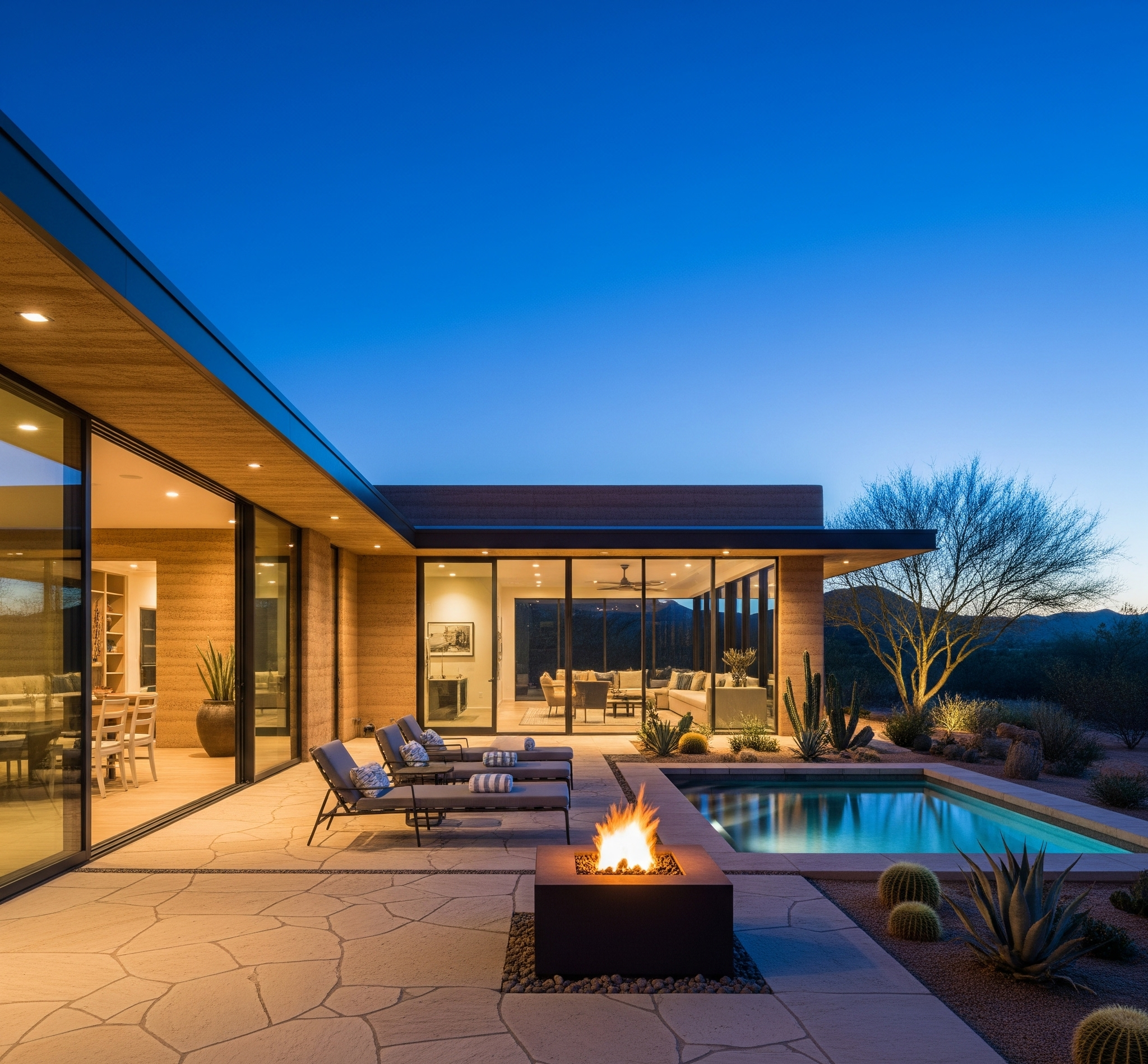
The Backyard Oasis Challenge: Why Pool Decks Play by Different Rules
Before we discuss decorative options, you need to understand what makes the pool environment uniquely hostile to concrete. A typical backyard patio deals with rain, snow, and foot traffic. A pool deck deals with all of that plus a relentless combination of stresses that no other residential surface endures simultaneously:
Constant water saturation. The splash zone around a pool—roughly the first 3-5 feet from the coping—is wet virtually every day the pool is in use. This isn't occasional rainwater that evaporates in an hour. It's sustained, repeated wetting from splashing, dripping swimmers, and pool water overflow. The concrete in this zone absorbs more water, more frequently, than any other surface on the property.
Chemical exposure. Pool water is not clean water. Whether the pool uses a traditional chlorine system or a modern saltwater chlorine generator (which we will discuss in detail), the water that lands on the deck surface is a dilute chemical solution. Over years of repeated exposure, these chemicals attack the cement paste and aggregate bond within the concrete, particularly at the surface where concentration is highest due to evaporation.
Intense UV radiation. Pool decks are, by design, in full sun for most of the day. The UV exposure degrades sealers at an accelerated rate compared to shaded surfaces, requiring more frequent resealing to maintain protection and colour vibrancy.
Wet barefoot traffic. This is the safety factor that distinguishes pool deck design from every other hardscaping application. People walk on this surface without shoes, on wet skin, often running, often children. The slip-resistance requirement is not a nice-to-have—it is a liability and life-safety imperative.
Any material that cannot withstand all four of these stresses simultaneously, year after year, has no business surrounding a pool. Decorative concrete can handle all of them. But only if the mix, the reinforcement, the sealer, and particularly the anti-slip treatment are specified and executed to the correct standard.
The Slip Factor: Addressing the Biggest Fear First
"Isn't stamped concrete too slippery for a pool?" This is, without question, the most common concern homeowners raise when they consider decorative concrete for their pool deck. And it's a legitimate concern—but one with a definitive engineering solution.
Why Sealed Concrete Can Be Slippery
Let's be transparent about the physics. A stamped concrete surface, when sealed with a standard high-gloss solvent-based acrylic sealer, is smooth. The sealer fills the microscopic pores and texture valleys of the concrete, creating a continuous, low-friction film on the surface. When that film gets wet—whether from pool splash, rain, or condensation—it develops a thin water layer that dramatically reduces the coefficient of friction between the surface and a bare foot. This is the same physics that makes a waxed floor slippery when wet. The result, if uncorrected, is genuinely dangerous: a sealed, wet stamped surface without anti-slip treatment can have a coefficient of friction below 0.3, well under the 0.5 minimum recommended by the National Floor Safety Institute for wet pedestrian surfaces.
This is the reality that cheap installations ignore and that professional installations solve completely.
The Anti-Slip Solution: Grit Additives in the Sealer
The solution is simple in concept but demands precision in execution: a commercial-grade anti-slip additive is mixed directly into the topcoat of the sealer before it is applied. These additives are fine granular particles—typically aluminum oxide (corundum), polymer microbeads, or silica grit (brands like SharkGrip and SureGrip are industry standards in Ontario)—that are suspended in the wet sealer and become embedded in the cured film. When the sealer dries, these particles protrude microscopically from the surface, creating thousands of tiny grip points that interrupt the water film and provide traction for bare feet.
The result, when properly applied, is a surface that feels textured but not abrasive underfoot—comparable to the feel of fine sandpaper, but gentler. The coefficient of friction rises to 0.6-0.8 when wet, well above the safety threshold. The visual impact is minimal: the surface retains its colour depth and sheen, with only a slight reduction in reflective gloss (from a mirror-like finish to a satin finish) that most homeowners actually prefer around a pool anyway, as it reduces glare.
The critical detail is the mixing ratio. Too little additive and the anti-slip effect is negligible. Too much and the surface feels rough, collects dirt in the texture, and becomes uncomfortable for bare feet and beach towels. The correct ratio is product-specific (typically 4-8 ounces per gallon of sealer) and must be confirmed by the manufacturer's technical data sheet. We mix to the upper end of the recommended range for pool decks, because the consequence of under-dosing around a pool is not a slightly smoother surface—it is a slip-and-fall injury.
Anti-Slip Is Not Optional Around a Pool
Let us be absolutely clear: applying a standard sealer without anti-slip additive to a pool deck is professional negligence. It creates a surface that is demonstrably hazardous when wet. Any contractor who seals a pool deck with a standard gloss sealer and no grit additive has compromised the safety of every person who walks on it. At Cinintiriks, anti-slip additive is included in every pool deck sealer application as a standard, non-negotiable component of the installation—not an upgrade, not an add-on. It is built into the specification from day one.
The Saltwater Threat and the Freeze-Thaw Accelerator
The rise of saltwater chlorine generators (salt chlorinators) has been one of the most significant trends in the GTA pool industry over the past decade. These systems are marketed—accurately—as gentler on skin and eyes, and they eliminate the need for manual chlorine dosing. They work by converting dissolved sodium chloride (common salt) in the pool water into hypochlorous acid (the active sanitizer) through electrolysis.
What is less widely understood is the impact of that salt on the surrounding hardscape.
How Salt Attacks Concrete
The salt concentration in a typical saltwater pool is approximately 3,000-4,000 parts per million (ppm)—roughly one-tenth the salinity of seawater. It sounds mild. It is not. When saltwater splashes onto a concrete deck surface, it sits, evaporates under the sun, and the salt crystallises within the pores of the concrete. This process is called salt crystallisation, and it is one of the most aggressive deterioration mechanisms in concrete science. As the salt crystals grow within the pore structure, they exert a physical expansive pressure on the pore walls—similar in mechanism to frost damage, but occurring at any temperature.
In Ontario, this salt crystallisation damage is then amplified by the freeze-thaw cycle. The salt-laden moisture in the concrete pores freezes in winter and expands, driving the crystals deeper and widening the pore structure. Come spring, the salt dissolves again, migrates further into the matrix, and re-crystallises in a new location. Each cycle—crystallise, dissolve, freeze, thaw—advances the deterioration front deeper into the concrete. On an unsealed or poorly sealed surface, the visible result is surface scaling: thin layers of the top surface flake off in progressive sheets, exposing the aggregate beneath and destroying any decorative texture or stamp pattern.
We have inspected pool decks in Oakville that were less than four years old and already exhibiting severe scaling within the splash zone—surfaces that looked like they'd been sandblasted. In every case, the root cause was the same: a non-air-entrained concrete mix (or an improperly air-entrained mix), an inadequate sealer, or both. The salt did what salt does. The concrete simply wasn't specified to resist it.
The Defence: Mix + Sealer + Maintenance
Surviving the saltwater-plus-freeze-thaw assault requires a three-layer defence strategy:
Layer 1: The Concrete Itself. The mix must be a minimum 32 MPa (4,600 PSI) air-entrained formulation with 5-7% entrained air. The entrained air voids provide internal pressure relief for both ice expansion and salt crystal growth. The water-to-cement ratio must be no higher than 0.45 to minimize porosity and reduce the number of pathways salt can infiltrate. This is not an upgraded mix—it is the minimum acceptable specification for any exterior concrete in Ontario. Pouring a non-air-entrained or low-strength mix around a saltwater pool is engineering malpractice.
Layer 2: The Sealer. A high-solids (25-30% solids content) solvent-based acrylic sealer, applied in two coats at the manufacturer's coverage rate, creates a continuous moisture-barrier film on the surface that prevents saltwater from penetrating into the pore structure in the first place. The sealer is the first line of defence. When it is intact, the salt crystallisation mechanism is starved of the moisture pathway it requires. When the sealer degrades (and it will, typically within 2-3 years in the harsh UV environment of a sun-exposed pool deck), the concrete beneath is immediately vulnerable.
Layer 3: Maintenance. The sealer must be reapplied every 2-3 years without exception. This is not optional maintenance. It is the ongoing cost of protecting a premium concrete investment from chemical degradation. Skipping a resealing cycle on a saltwater pool deck is the single most common homeowner error we encounter, and it is the one that leads to irreversible scaling damage within seasons.
"A pool deck is not a set-it-and-forget-it surface. It is a living investment that demands seasonal attention. Neglect it, and the chemistry will not forgive you."
Decorative Options for Pool Decks
With the structural and safety fundamentals established, let's explore the decorative possibilities. Each option brings a distinct aesthetic, and each has specific considerations in the pool environment.
Stamped Concrete
Stamped concrete is the dominant decorative choice for pool decks across the GTA, and for good reason. It offers an unbroken, seamless surface that mimics natural stone (Ashlar Slate, flagstone, travertine patterns are perennial pool deck favourites) without the joints, gaps, and weed pathways of individual pavers. The continuous surface is easier to clean, drains more uniformly, and provides a visual grandeur around the pool that perfectly complements a luxury backyard design.
For pool applications, the stamp pattern selection involves a practical consideration beyond aesthetics: texture depth. Patterns with deeper texture— rough-hewn flagstone, cobblestone, natural slate—inherently provide more grip underfoot than shallow-texture patterns like smooth travertine or large-format tile simulations. The deep valleys create drainage channels that move water off the contact surface more quickly, and the textured peaks provide natural traction points even before the anti-slip sealer is applied. We guide every pool deck client toward patterns in the "medium to deep texture" category, where beauty and grip coexist without compromise.
Exposed Aggregate
Exposed aggregate concrete is an outstanding pool deck material and, in many respects, the most naturally slip-resistant decorative concrete option available. The process involves pouring standard or coloured concrete and then, before it fully hardens, washing away the top cement paste layer to reveal the decorative aggregate (small, rounded or angular stones) just below the surface. The resulting texture is a dense, pebbled surface with thousands of individual grip points created by the protruding aggregate particles.
The inherent texture of exposed aggregate provides excellent wet-weather traction even without a sealer. When a breathable sealer is applied (either a penetrating sealer or a thin-film acrylic), the aggregate remains tactile and grippy. This makes exposed aggregate a particularly strong choice for homeowners who want maximum slip resistance with minimal reliance on sealer additives.
The aesthetic is different from stamped concrete—it reads as a natural, organic, river-stone texture rather than a simulated stone pattern—and it carries a distinct mid-century modern warmth that pairs beautifully with contemporary pool designs. The aggregate can be specified in virtually any combination of stone types and colours: local pink granite and quartz blends, imported black basalt chips, warm gold limestone, or classic mixed river pebble. The palette is essentially unlimited.
Coloured Concrete (Broom Finish)
For homeowners who prefer a clean, understated aesthetic over a stamped or aggregate pattern, a broom-finished coloured concrete deck is a refined alternative. The concrete is integrally coloured (pigment mixed into the batch), placed, floated, and then given a medium broom finish—directional texture lines that provide excellent slip resistance when wet. It is the simplest decorative approach, and it is elegant in its understatement. A charcoal or pewter broom-finished deck surrounding a dark-bottom pool has a sleek, architectural quality that stamped patterns cannot replicate.
The broom texture, when combined with an anti-slip sealer, produces one of the grippiest pool deck surfaces available. The linear texture channels also promote water drainage off the surface—if the broom strokes are oriented perpendicular to the pool edge, water flows along the grooves away from the pool and toward the deck's drainage slope.
The Over-Dig Zone: The Hidden Foundation Challenge
There is an engineering challenge specific to pool deck construction that most homeowners are never told about until it manifests as a problem: the over-dig zone.
When a pool shell (whether fibreglass, vinyl liner with concrete walls, or shotcrete/ gunite) is installed, the excavation for the pool is larger than the pool itself. The excavator digs a hole 2-4 feet wider than the pool shell on all sides to provide working room for the installation crew to set the shell, connect plumbing, and backfill around the perimeter. This backfilled zone—the "over-dig"—is filled with material that is, by definition, disturbed, loosened, and not compacted to the same density as the undisturbed native soil beyond it.
When a concrete pool deck is poured across this over-dig zone, the section of deck sitting on undisturbed native soil is stable. The section sitting on the backfilled over-dig zone settles. Sometimes slowly over years; sometimes dramatically within the first season. The result is a crack that runs parallel to the pool edge, exactly tracing the boundary between disturbed and undisturbed soil. The outer deck holds level. The inner deck sinks toward the pool. The crack widens progressively with each freeze-thaw cycle.
This is one of the most common pool deck failures in the GTA, and it is almost entirely preventable with proper sub-base engineering in the over-dig zone.
The Cinintiriks Approach: Engineering the Pool Deck from the Ground Up
At Cinintiriks, every decorative concrete pool deck is built to our Cinintiriks Standard for Aquatic Hardscaping—a protocol specifically engineered for the unique stresses of the pool environment.
1. Over-Dig Zone Remediation: We do not accept the pool installer's backfill as a suitable sub-base. Period. We excavate the over-dig zone down to a minimum of 16 inches below the underside of the deck slab, remove the loose backfill, and replace it with engineered Granular A installed in 4-inch lifts and compacted to 95%+ Standard Proctor Density. This brings the bearing capacity of the over-dig zone to parity with the undisturbed native soil, eliminating the differential settlement that causes parallel-to-pool cracking.
2. Cantilevered Concrete Coping: Rather than using separate coping stones (which create joints that trap water and separate over time), we pour seamless cantilevered concrete coping that is monolithically integrated with the deck slab. The coping extends 1.5-2 inches over the pool edge, creating a clean, drip-free overhang that directs splash water back onto the deck rather than behind the pool wall. The coping is formed with a smooth, rounded bullnose profile that is comfortable to grip when entering or exiting the pool, and it eliminates the maintenance burden of resetting individual coping stones that frost-heave has displaced.
3. 32+ MPa Air-Entrained Concrete with Integral Colour: Our pool deck mix is the same premium specification we use for all exterior concrete: 32 MPa minimum, 5-7% entrained air, 0.45 maximum w/c ratio, with integral colour for through-body pigmentation. The concrete is reinforced with 10M rebar on 12-inch centres in both directions to resist the thermal cracking stresses of full-sun exposure.
4. Two-Coat Anti-Slip Sealed Finish: We apply two coats of high-solids solvent-based acrylic sealer. The first coat penetrates and seals the pore structure. The second coat, mixed with aluminum oxide anti-slip additive at the manufacturer's maximum recommended dosage, provides the wear surface. The two-coat system ensures both maximum moisture protection and maximum slip resistance. Coefficient of friction is field-verified on the completed surface with a wet-foot test before the deck is released for use.
5. Drainage Engineering: The deck is sloped at a minimum of 1/4 inch per foot away from the pool edge and toward perimeter drains or landscape areas. Splash water and rainwater are actively directed off the deck surface, minimizing standing water time and reducing the duration of chemical exposure. On larger decks, we install flush linear drains at strategic locations to manage high-volume water events.
6. Expansion and Isolation Joints: A full-depth compressible isolation joint is placed at the interface between the deck slab and the pool coping, and at any point where the deck meets the house foundation, retaining walls, or other fixed structures. These joints allow each element to move independently under thermal expansion and frost forces without transmitting stress that would cause cracking.
Colour Selection for Pool Decks: Function Meets Aesthetics
Colour selection for a pool deck is not purely an aesthetic decision—it has significant practical implications for both surface temperature and visual comfort.
Light colours (sandstone, buff, light grey, warm beige) reflect more solar radiation and remain cooler underfoot in direct sun. On a 32°C August afternoon, a light-coloured stamped surface may reach 50-55°C, which is warm but tolerable for a few seconds of barefoot contact. A dark-coloured surface (charcoal, dark walnut, black) under the same conditions can reach 65-70°C—hot enough to cause genuine discomfort and, in sustained contact, mild burns on sensitive skin. For pool decks, we strongly recommend medium-to-light integral colours, reserving dark accents for borders, feature bands, and shaded lounging areas where direct barefoot contact is less frequent.
Colour also affects visual glare. A very light, glossy-sealed surface in full sun reflects enough light to be visually uncomfortable without sunglasses. The ideal pool deck colour sits in the middle range—warm enough to reflect heat, dark enough to absorb glare—typically in the sandstone, mocha, or pewter family. Combined with a satin-finish (rather than high-gloss) sealer, this mid-tone palette provides the perfect balance of thermal comfort, visual comfort, and aesthetic richness.
Don't risk a slippery or crumbling pool deck. Contact Cinintiriks for heavily engineered, slip-resistant luxury decorative concrete pool surrounds.
FAQ: Decorative Concrete Pool Decks
Is stamped concrete too hot for bare feet in the summer compared to interlock?
Stamped concrete and interlocking pavers of similar colour will reach approximately the same surface temperature under identical sun exposure—the heat absorption is primarily a function of colour and material density, not the surface type. However, there is a practical difference in perceived heat. Interlock pavers, particularly those with textured or tumbled surfaces, have more surface area variation and micro-shadows that reduce the area of direct sole contact, making the surface feel slightly less hot underfoot. Stamped concrete, with its smoother, more continuous surface, has more direct skin contact per step. Both surfaces become uncomfortably hot in dark colours under direct sun. The solution for both is the same: choose a light to medium integral colour (sandstone, buff, light grey). A light-coloured stamped deck will remain within the range of 50-55°C on a peak summer afternoon—warm, but tolerable for brief barefoot contact. Dark colours on any material should be avoided in the primary traffic zones around a pool.
Does a saltwater pool ruin stamped concrete faster than chlorine?
Yes, if the concrete is not properly specified and maintained. Saltwater systems deposit sodium chloride on the deck surface with every splash. That salt crystallises within the concrete pores as the water evaporates, creating an internal expansive pressure that compounds the damage from Ontario's freeze-thaw cycles. Traditional chlorine (hypochlorous acid) is a chemical oxidizer that can degrade sealers over time, but it does not produce the same aggressive salt crystallisation mechanism. The net result is that saltwater pool decks experience faster sealer degradation and more aggressive surface scaling than chlorine pool decks, particularly in the splash zone. The defence is straightforward: use air-entrained concrete (5-7%), apply a high-solids sealer, and reseal religiously every 2-3 years. With these protections in place, a properly built stamped concrete deck around a saltwater pool will perform beautifully for 20+ years. Without them, visible scaling damage can appear within 3-5 winters.
Can I use exposed aggregate around my pool instead of stamped concrete?
Absolutely, and it's an excellent choice. Exposed aggregate is one of the most naturally slip-resistant decorative concrete surfaces available, making it inherently well-suited for pool environments. The protruding aggregate particles provide thousands of natural grip points even without anti-slip sealer additives (though we still recommend sealing for UV and chemical protection). The texture is comfortable underfoot—akin to walking on a smooth pebble beach—and it resists the "hot plate" effect slightly better than a smooth stamped surface because the textured profile reduces the area of direct skin contact. Aesthetically, exposed aggregate offers a natural, organic look with virtually unlimited colour options depending on the aggregate blend selected. The one consideration unique to pool applications: the aggregate selection should favour rounded rather than sharp, angular stones, as rough edges can be uncomfortable for bare feet that are spending extended time on the surface. We typically specify a blend of smooth river pebble and polished quartz for pool deck exposed aggregate—beautiful tonal variation with a surface that is firm, grippy, and pleasant underfoot.
The Final Word
Decorative concrete is not just acceptable for pool surrounds in the GTA— it is one of the finest materials available for the application, provided every element of the installation is specified to meet the extraordinary demands of the pool environment. The concrete must be air-entrained and high-strength. The sub-base must account for the over-dig zone. The sealer must be high-solids, UV-resistant, and renewed on schedule. And the anti-slip treatment must be treated not as an option but as a life-safety requirement.
When all of these elements converge in a single, meticulously executed installation, the result is a pool deck that rivals the beauty of anything you'd find at a five-star resort—with the engineering to survive 25 Ontario winters without flinching.