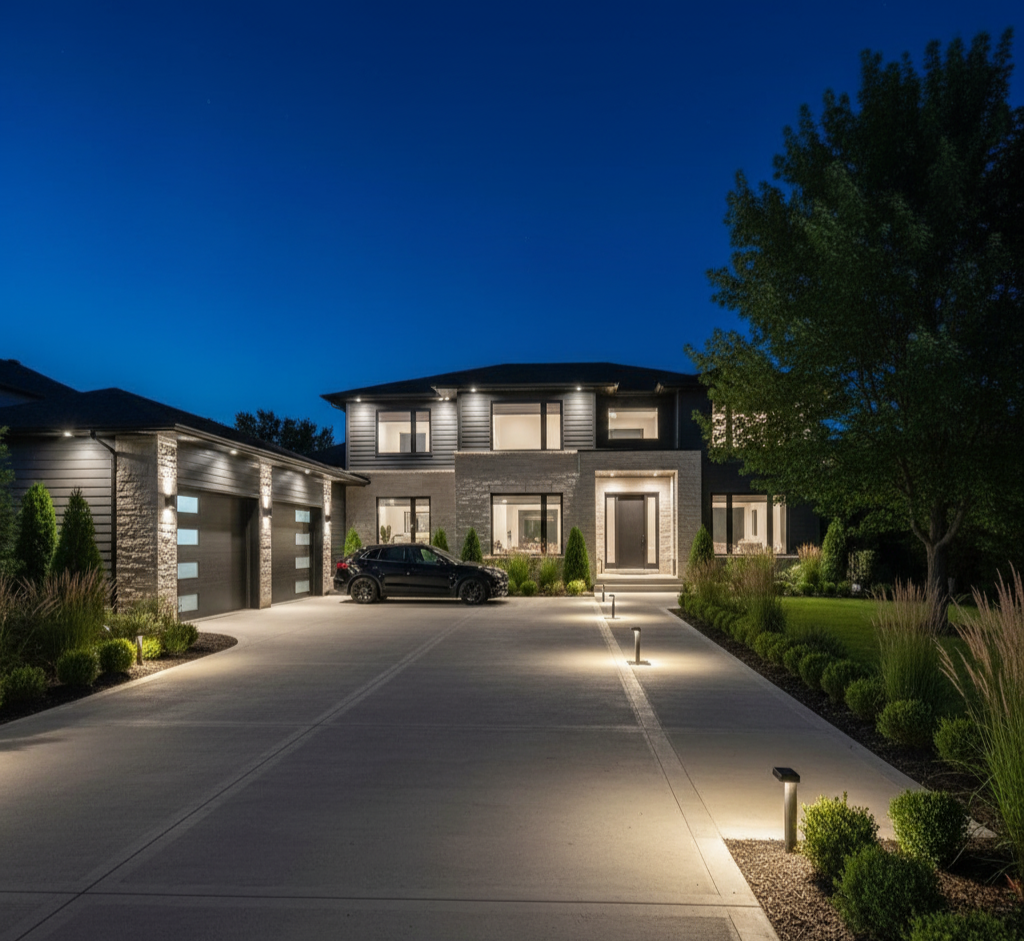
For the homeowner in Toronto, Etobicoke, or Oakville, the question is often not "should I replace my concrete?" but "how can I elevate it?" Whether you are planning a new pour or looking to transform an existing slab, adding colour and texture is not a cosmetic application—it is an engineering process that fundamentally alters the character of your property.
At CININTIRIKS, we separate these transformations into two distinct engineering categories: Integral Design (for new pours) and Architectural Resurfacing (for existing slabs).
Scenario A: The Blank Canvas (New Pours)
When starting from scratch, the opportunities for customization are structural. We do not apply colour; we infuse it.
Integral Colour: The "Rolls-Royce" Standard
The superior method for colouring concrete is "Integral Tinting." Iron oxide pigments are added directly into the ready-mix truck at the batch plant. The colour is not a surface layer; it is consistent through the entire 5-inch thickness of the slab.
The Advantage: If a snowplow chips the surface 15 years from now, the concrete underneath is the same charcoal or slate tone. There is no white scar. It is colour permanence.
Dry Shake Hardeners: Durability Meets Design
For industrial-chic or high-traffic driveways, we use "Dry Shake" colour hardeners. A concentrated pigment powder is broadcast onto the wet surface and floated in. This creates a surface layer that is significantly denser and harder than the underlying concrete, offering incredible abrasion resistance while delivering vibrant, opaque colours that integral mixes cannot achieve.
"We do not paint concrete. We engineer its surface identity."
Scenario B: The Transformation (Existing Slabs)
If your existing concrete is structurally sound (no heaving or deep structural cracks) but visually tired, demolition is often unnecessary. However, a warning is required.
The Big Box Warning
Do not use "concrete paint" or DIY resurfacers from a hardware store. In Ontario's climate, moisture migrates up through the concrete. A topical paint traps this moisture, causing the coating to bubble and peel within one winter cycle. It is a temporary bandage, not a solution.
The Solution: Polymer-Modified Overlays (Jewel Stone)
The only permanent resurfacing option for the GTA climate is a Polymer-Modified Cementitious Overlay. This is not paint; it is a thin, high-strength layer of concrete fortified with acrylic polymers.
These polymers allow the new layer to chemically bond to the old slab, creating a surface that is actually stronger than the original concrete. This "skim coat" can be textured to look like flagstone, slate, or tile, providing a "Jewel Stone" finish that is imperious to salt and freeze-thaw cycles.
Reactive Acid Staining
For a truly organic, marble-like finish, we use acid stains. These are metallic salts in an acidic solution that react with the hydrated lime in the concrete. The result is a variegated, translucent mottling of earth tones—umber, tan, and terracotta—that looks like natural stone patina rather than a coated surface.
The "GTA Torture Test"
Not all upgrades survive Toronto. When designing a finish, we filter choices through the lens of our environment:
UV Stability: Dark organic pigments (blues and greens) fade rapidly under UV exposure. We rely on inorganic iron oxides (reds, browns, charcoals, and buffs) which are chemically stable and will hold their tone for decades.
The Snowplow Factor: A deeply textured "aggressive" stamp might look rugged, but it catches the plow blade. We prefer "seamless skins"—textures that provide grip without distinct ridges that can chip.
Design Philosophy: Less Is More
Just because you can add texture doesn't mean you should add every texture. The most sophisticated driveways in Mississauga utilize restraint.
A simple, dark charcoal border (smooth-troweled) framing a light grey, broom-finished field (integral colour) creates a clean, architectural line that frames the house without competing with it. We coordinate these tones to complement—not match—the brick or stone veneer of the fa�ade.
Getting Quotes: The Trap of "Resurfacing"
Resurfacing is often sold as a "cheaper alternative" to replacement. This is a half-truth. While it saves on demolition and disposal fees, a proper polymer overlay is labour-intensive. It requires grinding the old surface, crack repair, primer application, and skilled trowel work.
Critical Rule: If the underlying concrete is heaving or moving, resurfacing is a waste of money. The overlay will mirror the cracks of the base. We only recommend resurfacing on stable, verified substrates.
FAQ: Expert Insights
Can I stamp over old concrete?
Yes, using a "Stampable Overlay." We apply a thicker layer (1/4 to 1/2 inch) of polymer cement and imprint it with texture mats before it cures. It offers the look of new stamped concrete without the excavation.
Will the colour fade?
Integral colours and dry shakes do not fade significantly. However, surface sealers can degrade. A faded driveway usually just needs a good cleaning and a fresh coat of solvent-based acrylic sealer to restore its "wet look" depth.
Is coloured concrete more expensive?
Yes. Integral colour adds roughly 10-15% to the material cost of the concrete. Decorative finishing (stamping, borders) adds to the labour cost. However, compared to natural stone or interlock, it remains a highly cost-effective premium surface.
The Final Transformation
Concrete is no longer a passive background element; it is an active participant in your home's curb appeal. Whether through the depth of integral colour or the artistry of a polymer overlay, the potential to transform "grey" into "grand" is limited only by design.
At CININTIRIKS, we do not guess. We assess your substrate, understand your aesthetic goals, and engineer a transformation that is permanent.