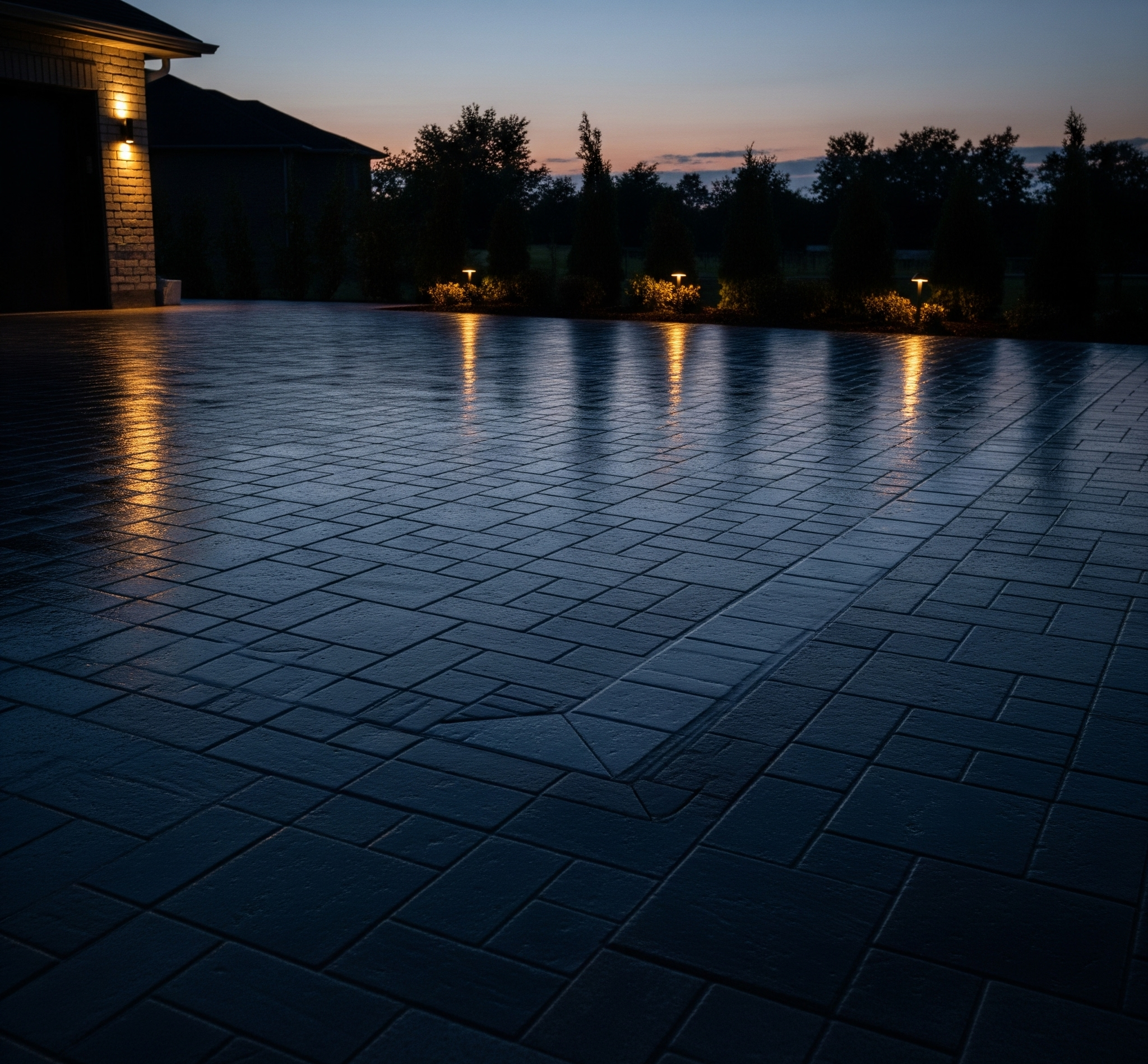
The Painting Illusion
The fundamental mistake that homeowners make—and, candidly, that many underqualified contractors make—is treating sealer application like a painting project. It is not. Painting a wall is forgiving. You can go back over a missed spot. You can feather out an uneven edge. You can apply three coats if the first two looked patchy. The paint dries slowly enough to allow correction, and the surface you are finishing is vertical, smooth, and uniform.
Sealer application is the opposite of all of these things. You are working on a horizontal surface in direct sunlight. The sealer—particularly solvent-based acrylic formulations—begins curing the moment it contacts the warm stone. On a 25°C day, you have approximately 90 to 120 seconds before the leading edge of your application begins to tack. On a 30°C day, that window shrinks to 60 seconds or less. There is no going back. There is no feathering. Every stroke, every pass, every overlap is permanent. The sealer bonds to whatever it touches, in whatever thickness it was deposited, in whatever pattern it was laid down. If that pattern includes roller marks, puddles, or dry edges where two passes failed to blend, those defects are now part of the surface for the next three to five years.
Understanding this time pressure is essential to understanding why the application tool matters so profoundly.
The Roller: A Tool Built for Walls, Not for Hardscape
Let us be direct about this. A paint roller is an exceptional tool for interior walls, for commercial painting jobs, for priming flat surfaces before finish coats. It is a terrible tool for sealing interlocking pavers. And the reasons are mechanical, chemical, and aesthetic.
The Mechanical Problem: Joint Sand Displacement
This is the first and most immediate disaster that occurs when a roller contacts an interlock surface. An interlocking paver driveway is not a flat, continuous slab. It is a field of individual units separated by joints filled with polymeric sand. When you press a roller loaded with liquid sealer across this surface, three things happen simultaneously.
First, the nap of the roller—that fibrous sleeve that holds and distributes the product—physically drags across the joint lines. The roller doesn't skip over them the way a spray mist would. It bridges the gap, contacts the polymeric sand, and pulls. Even if the sand is cured, the suction and friction of the saturated roller nap is enough to dislodge grains from the top layer of the joint. These grains are then carried across the paver face on the next rotation of the roller, embedding themselves into the wet sealer film. The result is a gritty, rough texture scattered randomly across the paver surface—permanently bonded into the cured sealer. On a premium Warm Off-White paver, these displaced Charcoal sand grains are spectacularly visible and completely irremovable without a full chemical strip.
Second, the downward pressure of the roller compresses the sealer into the joints rather than across them. On a sprayed surface, the sealer settles lightly over the joint, forming a thin bridge between the paver edges and the cured sand surface. On a rolled surface, the roller forces an excessive volume of sealer deep into the joint channel, saturating the polymeric sand far beyond what is necessary or desirable. This over-saturation can soften the polymer matrix, compromise the sand's structural integrity, and create a thick, glossy line of pooled sealer along every joint that looks dramatically different from the field of the paver face.
Third, on pavers that have any degree of edge chamfer or bevel (which virtually all modern interlocking units do), the roller naturally concentrates product in the chamfer valley between adjacent pavers. The roller cannot conform to this geometry the way it can to a flat wall. It bridges the V-shaped channel, dumps excess sealer into the low point, and skips across the raised edges. The result is uneven coverage: oversaturated chamfers with thick, dark, glossy lines and undersaturated paver faces with thin, patchy coverage. Under direct sunlight, this disparity is dramatic and unmistakable.
The Chemical Problem: Mil-Thickness and Solvent Trapping
Beyond the mechanical disruption of the joints, the roller creates a fundamental chemical problem: uncontrolled film thickness.
Professional sealers are formulated to perform at a specific mil-thickness—the dry film thickness measured in thousandths of an inch (mils). A quality solvent-based acrylic paver sealer is designed to be applied at approximately 1.5 to 2.5 mils per coat. At this thickness, the solvent (typically xylene or acetone) evaporates efficiently through the thin film, allowing the acrylic resin to cure into a clear, hard, optically transparent coating. The physics are straightforward: a thin film allows the volatile solvent to escape quickly and uniformly. A thick film traps the solvent beneath a rapidly curing surface skin.
A roller, by its nature, deposits an uncontrolled and non-uniform volume of product. The nap holds a reservoir of sealer and releases it under pressure, laying down a film that varies wildly from point to point depending on how much product was loaded, how hard the operator is pressing, and how fast the roller is moving. In practice, this means some areas receive 1 mil of product and others receive 5 or 6 mils—a variation of four hundred percent across the same surface.
In the areas where the film is too thick, the solvent cannot escape. The surface of the sealer skins over and begins to cure while the solvent beneath is still in liquid form. As temperatures fluctuate and moisture vapour from the concrete pores pushes upward, the trapped volatiles create micro-bubbles within the curing film. These bubbles scatter light, turning the clear, glossy coating a cloudy, hazy, milky white. This is the same blushing phenomenon that occurs when sealer is applied over a damp surface, except in this case the cause is not moisture—it is trapped solvent from over-application. The fix is the same either way: chemical strip and reapplication. A thousand-dollar correction for a ten-dollar mistake in technique.
The Aesthetic Problem: Lap Marks
Even on a perfectly flat, joint-free concrete surface where the mechanical joint problems do not apply, the roller still produces a characteristic aesthetic failure: lap marks.
Lap marks occur when the edge of one roller pass dries before the adjacent pass overlaps it. The dry edge of the first pass sits at a different thickness and gloss level from the overlapping fresh sealer. When the entire surface cures, these overlap lines are permanently visible as faint, parallel streaks running the length of the driveway. On a matte-finish sealer, they appear as subtle variations in sheen. On a high-gloss sealer, they appear as dramatic, clearly defined lines that catch the light at different angles—visible from the street, visible from the curb, visible every single time the homeowner looks at their driveway.
We have been called to properties in Bolton where the homeowner paid a contractor to seal their interlock and the lap marks were so pronounced that the driveway appeared to have been painted with a giant comb. The homeowner assumed the sealer was defective. It was not. The product was excellent. The application was the problem. And the correction required a full xylene strip of the entire surface—hours of chemical work and labour—before a proper spray application could even begin.
The Sprayer: Precision Engineering for a Chemical Application
A commercial-grade sprayer—specifically an HVLP (High Volume, Low Pressure) system or a professional airless pump sprayer with a low- pressure tip—solves every single problem that the roller creates. And it does so through a single, elegant mechanism: atomization.
How Atomization Works
When sealer passes through the spray tip under controlled pressure, it is broken into an extraordinarily fine mist of microscopic droplets. Each droplet is measured in microns. This mist settles onto the paver surface under gravity in a uniform, even layer. The operator controls the thickness by adjusting three variables: the distance of the spray tip from the surface (typically 250 to 400 millimetres), the speed of the pass, and the pressure at the pump. With these three parameters calibrated correctly, the sealer is deposited at a mathematically consistent mil-thickness across the entire surface.
There is no mechanical contact with the surface. The spray mist settles like dew. It does not touch the joints. It does not drag sand. It does not compress into chamfer valleys. It lands on the paver face, flows into the surface texture by capillary action, and begins curing immediately as an even, unbroken film.
Because the film thickness is uniform, the solvent evaporates at a consistent rate across the entire surface. There are no thick pools trapping volatiles. There are no thin spots where the coating is too sparse to provide adequate protection. The cured film is optically clear, uniformly glossy (or uniformly matte, depending on the formulation), and free of bubbles, blushing, or haze.
The Back-Roll: The Professional Hybrid
Now, here is where the nuance lives. Professional applicators do not simply spray and walk away. The gold-standard technique is called spray-and- back-roll, and it combines the precision of atomization with the surface contact of a roller in a carefully controlled sequence.
The sprayer lays down the initial coat—a fine, uniform mist at the correct mil-thickness. Immediately behind the sprayer, within seconds of the spray pass, a crew member follows with a 3/8-inch nap, solvent-resistant roller. This roller does not add more product. It is dry. Its sole purpose is to work the freshly sprayed sealer into the surface texture and to smooth out any minor inconsistencies: tiny puddles in texture depressions, micro-pooling at chamfer edges, or slight variations in mist density caused by wind or tip geometry.
The critical distinction is this: the back-roll happens immediately while the sprayed sealer is still fully wet. There are no dry edges to create lap marks. The roller is not depositing product; it is redistributing a controlled volume that was already laid down precisely by the sprayer. And because the roller passes over the joints while the sealer is still liquid (not tacky or partially cured), the friction is minimal—insufficient to dislodge cured polymeric sand. The roller glides over the wet film rather than gripping and pulling at the substrate beneath it.
Spray-and-back-roll is the professional standard for luxury hardscape sealing. It is the method we use on every single interlock project across Bolton and the GTA. It produces a finish that is indistinguishable from factory-applied coating: uniform, optically clear, streak-free, and flawless from every viewing angle.
When Is a Roller Acceptable?
To be fair and technically complete, there are specific conditions under which a roller is an appropriate primary application tool—but they are narrow, and they do not apply to the vast majority of residential or commercial interlock projects.
Penetrating sealers on poured concrete: A penetrating silane/siloxane sealer applied to a broom-finish or trowel-finish poured concrete surface can be rolled effectively. Penetrating sealers are absorbed into the concrete rather than forming a surface film, so film thickness, lap marks, and surface aesthetics are irrelevant—the product disappears into the substrate. The roller simply provides a convenient way to distribute the product across the surface before it absorbs. There are no joints to disrupt, no polymeric sand to displace, and no glossy film to show roller marks. In this specific scenario, the roller is a perfectly adequate tool.
Small, textured concrete surfaces: On small areas of heavily textured concrete (such as a stamped concrete landing pad), a roller can be used as the primary application tool if the operator is experienced enough to maintain a wet edge throughout the application. The heavy texture of the stamped pattern actually helps to mask the minor thickness variations that a roller produces, and the absence of sand-filled joints eliminates the displacement problem. However, even on stamped concrete, we prefer the spray-and-back-roll method for the superior uniformity it delivers.
For interlocking pavers—any size, any pattern, any paver type—the roller as a primary application tool is categorically unacceptable to us. The risk to the joints, the film quality, and the aesthetic outcome is simply too high.
"A roller is a deposit tool. A sprayer is a precision instrument. You don't use a shovel when the job calls for a scalpel."
Equipment Selection: Not All Sprayers Are Equal
The decision to spray rather than roll is the critical first step. But the type of sprayer matters enormously, and not all spray equipment is appropriate for sealer application.
Hardware Store Pump Sprayers: Inadequate
The inexpensive plastic pump sprayers sold at hardware stores for $30 to $60 are designed for herbicide application and light garden watering. They produce an inconsistent, coarse spray pattern with large droplet sizes and wildly variable pressure. The seals and gaskets in these units are typically not solvent-resistant; a solvent-based acrylic sealer will dissolve the internal seals within minutes, causing the sprayer to fail mid-application and potentially contaminating the sealer with dissolved rubber particles. Even if the sprayer survives the application, the spray pattern it produces is so inconsistent that the result will be nearly as uneven as a roller.
We have seen homeowners in Bolton attempt to seal their interlock with a garden pump sprayer. The outcome is always the same: an erratic, splotchy application with heavy spots, dry spots, and a finish that looks like the driveway was sneezed upon rather than professionally sealed. The $30 savings on equipment translates directly into a $2,000 correction.
Commercial Airless Sprayers: Powerful but Risky
Professional-grade airless sprayers generate extremely high pressures and produce a fine, consistent spray pattern. They are excellent for large- scale commercial applications where speed and coverage are paramount. However, they require an experienced operator. The high pressure can over-atomize certain sealer formulations, creating excessive airborne mist that drifts onto adjacent surfaces (house siding, garage doors, vehicles, landscaping). The tip selection is critical: too fine a tip at too high a pressure generates drift; too coarse a tip produces large droplets and uneven coverage. For residential work, where adjacent surfaces are often within metres of the application zone, airless sprayers require careful pressure adjustment and operator expertise.
HVLP (High Volume, Low Pressure) Systems: The Professional Standard
The optimal equipment for residential and most commercial paver sealing is an HVLP system. These units deliver a high volume of product at low pressure, producing a controlled, directed spray fan with minimal overspray and drift. The droplet size is fine enough to achieve uniform mil-thickness but large enough to settle directly onto the target surface without becoming airborne mist. Transfer efficiency (the percentage of sprayed product that actually lands on the surface versus being lost to drift) exceeds 80 percent on a quality HVLP system, compared to 50 to 65 percent on some airless configurations.
For our work in Bolton and across the GTA, we use commercial-grade HVLP pump rigs with solvent-resistant internals, adjustable fan-width tips, and integrated pressure regulation. The investment in this equipment is substantial, but the precision it delivers is unmatched by any other application method.
The Cinintiriks Standard for Sealer Application
At Cinintiriks, we refuse to roll sealers over luxury interlocking pavers. Every interlock sealing project we execute in Bolton and across the GTA follows a strict spray-and-back-roll protocol engineered for factory-grade precision. Here is exactly how we apply sealer.
1. Environmental Verification: Before any sealer is opened, we verify ambient conditions. Air temperature must be between 10°C and 30°C. Concrete surface temperature must be above the dew point (measured with an infrared thermometer) to prevent condensation-induced blushing. Sustained winds must be below 15 km/h to prevent spray drift. No rain in the forecast for a minimum of 24 hours. If any condition fails, we reschedule.
2. Adjacent Surface Masking: Before spraying, we mask all surfaces adjacent to the treatment zone: house siding, foundation walls, garage doors, retaining walls, garden beds, vehicles, and any concrete surfaces that are receiving a different sealer product. Heavy-duty kraft paper, polyethylene sheeting, and contractor-grade tape create a physical barrier against overspray. Masking extends a minimum of 300 mm beyond the spray zone.
3. First Coat — Spray Application (Penetrating Coat): Using a commercial HVLP system with a solvent-resistant fan tip, we spray the first coat at low pressure in a uniform, overlapping fan pattern. Tip distance from the surface is maintained at 300–400 mm. This first coat is the penetrating coat: it saturates the pore structure of the paver face, flowing into the surface texture and anchoring the acrylic resin into the stone. The mil-thickness of this coat is deliberately thin—approximately 1.5 mils—to maximise pore penetration and minimise surface build.
4. First Coat — Immediate Back-Roll: Within seconds of the spray pass, a crew member follows with a dry, solvent-resistant 3/8-inch nap roller. The roller works the wet sealer into the paver texture, smooths minor inconsistencies, and ensures complete contact between the sealer and the stone surface. No additional product is added. The roller redistributes only what the sprayer has already deposited.
5. Flash-Off Period (2–4 Hours): The first coat is left to flash off—allowing the solvent to evaporate fully before the second coat is applied. Applying the second coat before the first has flashed traps solvent between the two layers, causing blushing and delamination. We never rush this step.
6. Second Coat — Spray Application (Building Coat): The second coat is sprayed at the same parameters as the first. This is the building coat: it creates the surface film that provides the gloss, the color enhancement, and the UV protection. Mil-thickness is approximately 2 to 2.5 mils. For projects requiring an anti-slip finish, a polymer-based microsphere additive is mixed into the sealer at this stage—invisible to the eye but dramatically effective at increasing wet traction.
7. Second Coat — Immediate Back-Roll: The second coat is back-rolled identically to the first. The roller ensures the anti-slip additive (if used) is evenly distributed and the final surface film is smooth, uniform, and bubble-free.
8. Cure and Final Inspection: The sealed surface is left undisturbed for a minimum of 24 hours to achieve full cure. We then walk the entire installation, verifying gloss uniformity, joint stability, color enhancement consistency, and the absence of any blushing, bubbling, or lap marks. Any imperfection is addressed immediately before the masking is removed and the property is returned to service.
This is The Cinintiriks Standard for sealer application. It is what separates a precision chemical encapsulation from a paint job. The spray system delivers the product at the correct mil-thickness. The back-roll refines the wet film to factory-grade uniformity. The two-coat protocol creates depth, protection, and aesthetic brilliance. And the environmental controls ensure the chemistry performs exactly as the manufacturer intended, every single time.
The True Cost Comparison
Homeowners sometimes ask whether the spray method is worth the additional cost over a simple rolled application. The question itself reveals a misunderstanding of the value equation.
A rolled application costs less in labour because it requires less skilled operators and less expensive equipment. A typical roll-only sealing job on a 600-square-foot Bolton driveway might cost $800 to $1,200. But if that application produces lap marks, blushing, or joint sand displacement —and with a roller, the probability is significant—the correction involves a full chemical strip (xylene or methylene chloride), surface preparation, possible polymeric sand replacement, and a complete resealing with proper spray equipment. That correction costs $2,500 to $4,000. The homeowner has paid for the project twice, and the total spend is triple what a professional spray application would have cost the first time.
A properly executed spray-and-back-roll application on the same 600-square-foot driveway costs $1,500 to $2,200 from a qualified contractor. It is done once. It is done right. It lasts three to five years. And it looks flawless from the day it cures.
The cheapest option is always to do it correctly the first time. The most expensive option is always to do it cheaply and then pay someone to fix it.
FAQ: Roller vs. Sprayer Sealer Application
Why did my paver sealer dry with cloudy, white, milky patches after I rolled it on?
This condition is called blushing, and when it occurs after a roller application, it is almost always caused by over-application trapping solvent or moisture beneath the curing film. A roller deposits sealer in uncontrolled, variable thicknesses. In areas where the roller laid down an excessively thick coat (which is unavoidable with a roller on textured surfaces), the surface of the sealer cures first, forming a hard skin while the solvent beneath is still volatile. That trapped solvent, or moisture vapour rising from the concrete pores, collects at the interface and creates microscopic water or solvent droplets that scatter light, turning the clear coating cloudy white. The fix depends on severity. For mild, localized blushing, a targeted application of xylene (the solvent) alone—without additional sealer—can re-dissolve and re-level the film, releasing the trapped moisture and restoring clarity. For widespread or severe blushing, the only reliable remedy is a full chemical strip to bare stone followed by proper resealing with a spray system at controlled mil-thickness.
Can I use a cheap plastic pump sprayer from a hardware store to apply professional-grade sealer?
No. Consumer-grade plastic pump sprayers are designed for water-based herbicides and garden solutions. Their internal seals, gaskets, and hoses are typically made from standard rubber or plastic compounds that are not resistant to the solvents used in professional acrylic and polyurethane sealers. Xylene and acetone—common solvent carriers in paver sealers—will dissolve these components within minutes, causing the sprayer to leak, fail, and potentially contaminate the sealer with dissolved rubber particles that deposit as dark streaks on the paver surface. Beyond the material incompatibility, the spray pattern produced by a pump sprayer is coarse, inconsistent, and impossible to calibrate to the mil-thickness precision required for a quality result. If you are committed to a DIY application, invest at minimum in a solvent-resistant pump sprayer specifically labelled for use with solvent-based coatings. These units use Viton seals and chemical-resistant hoses. However, even a quality hand-pump sprayer cannot match the consistency and transfer efficiency of a professional HVLP or low-pressure airless system.
How do professionals prevent sealer from drifting onto house siding or garage doors when spraying?
Through a combination of physical masking, equipment selection, and environmental discipline. Before any sealer is sprayed, we mask every adjacent surface with heavy-duty kraft paper or polyethylene sheeting, secured with pressure-sensitive tape. This masking extends a minimum of 300 millimetres beyond the spray zone to catch any drift. We use HVLP (High Volume, Low Pressure) spray equipment rather than high-pressure airless systems; HVLP produces a directed, controlled fan pattern with minimal overspray because the lower pressure creates larger droplets that settle directly onto the surface rather than becoming airborne particles. We also refuse to spray on windy days. If sustained winds exceed 15 km/h, we defer the sealing phase. During application, the spray tip is held 300 to 400 mm from the surface at a consistent angle, oriented so the fan pattern directs any residual mist away from adjacent structures rather than toward them. At building perimeters, we reduce the spray width and slow the pass speed to maintain precision. For extremely tight areas—such as the narrow strip between a paver walkway and a foundation wall—we may use a solvent-resistant foam applicator pad for the final 150 millimetres rather than spray, eliminating drift risk entirely. This level of care is standard on every project we execute.
The Final Word
The application method is not a matter of personal preference. It is a technical decision that directly determines the quality, durability, and aesthetic integrity of the sealed surface. A roller produces uncontrolled film thickness, joint sand displacement, lap marks, and an elevated risk of blushing and solvent trapping. A professional spray system produces mathematically precise mil-thickness, zero joint disruption, seamless coverage, and a factory-grade finish.
For interlocking pavers, there is no debate. Spray-and-back-roll is the professional standard. It is the method used by every reputable hardscape contractor in the industry. And it is the method we use exclusively, on every project, without exception.
Don't ruin your luxury hardscaping with streaky roller marks and pulled sand. Contact Cinintiriks for heavily engineered, precision-sprayed paver restoration in Bolton.