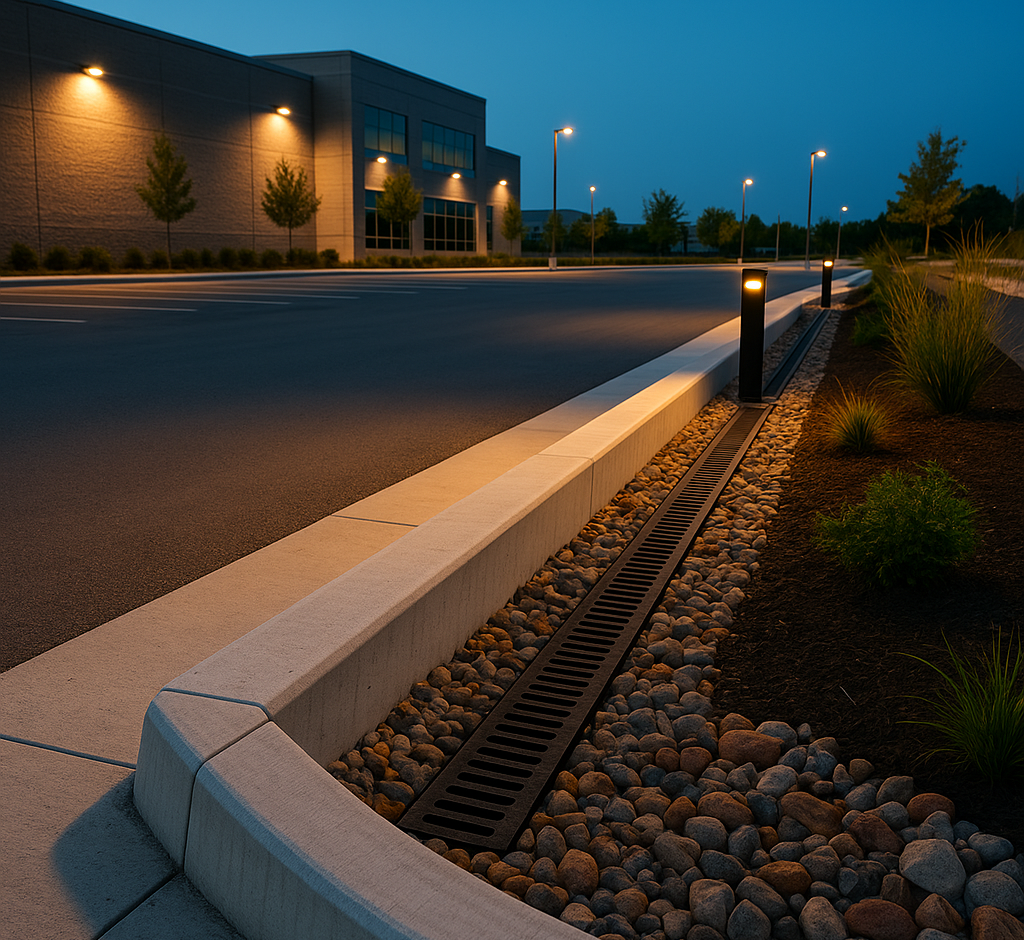
This guide explains why commercial grading belongs inside the scope of the hardscaping contractor—not as an add-on or a concession, but as a fundamental structural necessity—and how executing the entire project under a single contract, a single team, and a single chain of accountability eliminates the delays, disputes, and deficiency notices that plague multi-contractor commercial hardscaping projects.
The Subcontractor Nightmare: Where Projects Break
The traditional commercial hardscaping model works like this: the property owner or general contractor hires an excavation company to strip the site, remove organics, and rough-grade the subgrade. Then they hire a separate granular supplier and compaction crew to place and compact the road base. Then they hire a concrete contractor (or an asphalt paver, or an interlock installer) to place the finished surface. Three companies. Three contracts. Three schedules. Three separate understandings of what the finished elevations are supposed to be.
And three companies who, when the final grading inspection fails, each point at the other two.
The Blame Triangle
Here is how it unfolds—and it unfolds on commercial sites across the GTA with depressing regularity:
The excavation company strips the site and rough-grades the subgrade. They work from a grading plan, but their tolerance is ±50mm (2 inches)—acceptable for rough grading. They leave the site and submit their invoice.
The base crew arrives a week later. They place Granular B and Granular A, compact it, and grade it to their interpretation of the plan. But the subgrade was already 30-40mm off in several areas, and the base crew didn't shoot the subgrade elevations before placing material—they assumed the excavation company hit the targets. The base is now 30-40mm off in the same areas, compounded by the base crew's own ±15mm tolerance. Total cumulative error at top of base: 45-55mm.
The concrete contractor arrives two weeks later. They set forms on the base and pour 175mm of structural concrete. The forms are set to the plan's finished surface elevations. But the base beneath the forms is 45-55mm off. The concrete appears to be at the right elevation (because the forms were set correctly), but the concrete thickness is now variable: 130mm in the high spots (40% thinner than specified) and 220mm in the low spots (drawing excess concrete and cost). The catch basins are at the right elevation, but the surface 5 metres from each basin is 40mm higher than the plan specifies, reducing the slope from the designed 2.0% to an actual 1.2%—which pools water after every rain.
The grading inspection fails. The inspector identifies three catch basins with inadequate surface slope and two areas of visible ponding.
The concrete contractor says, "The base wasn't right. I formed to grade." The base crew says, "The subgrade was off when we got here. We built on what we were given." The excavation company says, "We were within our tolerance. The base crew should have verified before placing."
Everyone is partially right. Nobody is contractually responsible. And the property owner pays $60,000-$150,000 to tear out, re-grade, and re-pour the deficient areas—plus 3-6 weeks of occupancy delay.
"Three contractors means three tolerances stacked on top of each other. ±50mm plus ±15mm plus ±10mm doesn't equal ±75mm. It equals a failed inspection and a phone call nobody wants to take."
The Turnkey Advantage: One Team, One Tolerance, One Outcome
When the grading and the finished surface are executed by the same contractor—the same crew, the same project manager, the same laser equipment, and the same accountability—the cumulative tolerance problem vanishes. There is no handoff. There is no assumption. There is no "I built on what I was given." Every layer is built by the team that builds the next layer, and the team that pours the final concrete is the team that graded the base it sits on.
Elevation Continuity
The single most important advantage of turnkey execution is elevation continuity—the unbroken chain of elevation control from the subgrade through every granular layer to the finished surface. When Cinintiriks grades a commercial site, we know exactly what is going on top of that base, because we are the ones putting it there. The base is not graded to an abstract plan elevation. It is graded to the exact elevation that our concrete forms will be set to, minus the exact thickness of our specified concrete.
If the concrete specification is 175mm, the top-of-base elevation at every point is the finished surface elevation minus 175mm. Not approximately. Not within the base contractor's tolerance. Exactly. Because the crew that shoots the base elevation is the crew that will set the forms on it 48 hours later.
This is not something that can be replicated by handing a separate base contractor a drawing and telling them to grade it to the plan. The base contractor grades to the plan as they understand it, and any variance between their interpretation and the paving contractor's interpretation becomes a built-in deficiency that is invisible until the concrete is poured and the inspector arrives.
Material Integration
Turnkey execution also eliminates a more subtle but equally costly problem: material specification misalignment.
On multi-contractor projects, each contractor specifies their own materials. The excavation company selects a geotextile. The base crew orders granular from their preferred supplier. The concrete contractor specifies a concrete mix. Each specification is individually correct, but they are not coordinated.
Example: the base crew places Granular A with a higher-than-expected fines content (still within OPSS specification, but at the fine end of the gradation range). When the concrete contractor's crew sets forms on this base during a rain event, the fine-heavy Granular A turns soft at the surface, the forms shift, and the finished concrete is 15mm off the plan elevation at one section. The base is technically in spec. The concrete forming was technically correct. But the combination produced a deficiency because neither contractor accounted for the other's material behaviour.
When Cinintiriks executes the entire project, we select every material in the system as a coordinated assembly: the geotextile weight matches our subgrade conditions, the Granular B gradation matches our drainage requirements, the Granular A gradation matches our forming and finishing methods, and the concrete mix matches the base support and the anticipated traffic loads. There is no misalignment because there is no interface between contractors.
Streamlining the Commercial Schedule
Time is money on commercial construction, and "time" on a multi-contractor hardscaping project is dominated not by the work itself, but by the gaps between the work.
The Multi-Contractor Timeline
A typical multi-contractor commercial parking lot project unfolds like this:
- Week 1-2: Excavation company mobilises, strips topsoil, rough-grades subgrade. Demobilises.
- Week 2-3 (gap): Base contractor's earliest availability. Weather delays. Scheduling conflicts with the base contractor's other projects. The subgrade sits exposed to rain, saturating the surface and requiring re-compaction before base placement.
- Week 3-5: Base contractor mobilises, places and compacts Granular B and Granular A. Demobilises.
- Week 5-6 (gap): Concrete contractor's earliest availability. The base sits uncovered. More rain. More saturation. Delivery trucks for adjacent trades drive across the base, rutting the carefully compacted surface.
- Week 6-9: Concrete contractor mobilises, discovers the base is damaged and off-tolerance, re-grades affected areas (at additional cost), sets forms, pours concrete.
- Week 10-12: Grading inspection. Fails. Deficiency corrections. Re-inspection.
Total: 10-12 weeks. Of which approximately 40% is idle gap time, re-work, or inspection remediation.
The Cinintiriks Turnkey Timeline
The same project under single-source execution:
- Week 1-2: Cinintiriks mobilises. Strip topsoil, proof-roll subgrade, remediate soft spots, install geotextile, begin Granular B placement.
- Week 2-3: Complete Granular B, place and compact Granular A, laser-grade base to finished elevation minus concrete thickness. Surveyor verifies top-of-base elevations.
- Week 3-5: Set concrete forms on same-crew-verified base, pour concrete, install curbs, set catch basin frames. No re-grading required because the base was built by the crew now forming on it.
- Week 5-6: Concrete curing, joint cutting, accessible ramp verification, pre-inspection as-built survey. Request grading inspection.
- Week 6: Grading inspection passes.
Total: 6 weeks. Half the multi-contractor timeline. Zero idle gap time. Zero re-work. The base is never sitting exposed because the next phase starts the same day the previous phase ends. The base is never damaged by third-party traffic because there are no third parties on the hardscaping area.
In Maple, where the explosive residential and commercial development along the Major Mackenzie Drive and Jane Street corridors has produced a construction environment where subcontractor schedules are stretched weeks beyond capacity, the gap-time problem is particularly acute. We have seen commercial hardscaping projects in the Maple industrial parks sit idle for 3-4 weeks between the grading phase and the paving phase because the concrete contractor was committed to two other projects that ran over schedule. Those 3-4 weeks of idle time cost the developer $40,000-$80,000 in carrying costs and delayed lease revenue—more than the entire cost difference between multi-contractor and turnkey pricing. Our turnkey approach eliminates the dependency on third-party scheduling entirely. The crew that finishes the base on Friday sets forms on Monday.
The Financial Reality: Turnkey vs. Fragmented
Property owners often assume that multi-contractor procurement is cheaper because they can "bid each phase separately" and "get the best price on each one." This assumption is mathematically correct and financially wrong.
The Hidden Costs of Fragmentation
Multi-contractor projects carry costs that do not appear on any individual contractor's bid:
Mobilisation and demobilisation (×3). Each contractor mobilises equipment to the site, sets up, performs the work, cleans up, and demobilises. Three contractors means three mobilisation charges (typically $2,000-$8,000 each for commercial equipment). Turnkey execution: one mobilisation.
Surveyor verification (×3). Each contractor requires a surveyor to verify their finished elevations before handing the site to the next contractor. Three contractors, three separate survey visits (typically $1,500-$3,000 each). Turnkey execution: the surveyor visits are integrated into the project flow, with one comprehensive as-built survey at the end.
Base damage and re-work. The gap between the base contractor's departure and the paving contractor's arrival is the period during which the base is most vulnerable: exposed to rain (which saturates the surface layer and reduces its compaction), to construction traffic from adjacent trades (which ruts the surface and damages catch basin frames), and to erosion (which displaces fine-graded surfaces). Re-work to restore the base to tolerance after a 2-3 week gap typically costs $5,000-$20,000 on a commercial parking lot. Turnkey execution: zero gap time, zero base damage, zero re-work.
Elevation disputes and corrections. When the concrete contractor discovers that the base is off-tolerance, the project stops while the property owner, the base contractor, and the concrete contractor negotiate who pays for the correction. This negotiation typically takes 1-2 weeks (during which the project is idle), and the correction itself may cost $10,000-$40,000 depending on the area and the magnitude of the deviation. Turnkey execution: there is no interface between contractors, so there is no tolerance mismatch, no negotiation, no correction.
Inspection failure and remediation. The probability of a failed grading inspection is significantly higher on multi-contractor projects because cumulative tolerance drift is higher, drainage continuity is less controlled, and no single party has verified the complete system before requesting the inspection. Remediation of inspection deficiencies costs $15,000-$150,000+ depending on the severity. Turnkey execution: we verify the system ourselves (with a pre-inspection as-built survey) before requesting the municipal inspection. Our commercial grading inspections pass on the first review.
The Bottom Line
When you add the hidden costs of fragmentation to the individual contractor bids, the total project cost of the multi-contractor approach is typically 15-25% higher than the turnkey approach—not lower. And that calculation does not include the occupancy delay cost, which can dwarf all construction costs combined.
The Cinintiriks Approach: End-to-End Commercial Hardscaping
When we say "turnkey," we mean it literally: we hand you the keys to a finished, inspected, certified commercial surface that is ready for traffic and tenants. Every phase between bare earth and final pavement is executed by Cinintiriks, under one contract, one project manager, one insurance policy, and one warranty.
1. Site Assessment and Engineering Coordination: We begin with a comprehensive site review: geotechnical conditions, existing utilities, municipal grading plan requirements, drainage design, and traffic loading analysis. We coordinate directly with the civil engineer and municipal planners to ensure the approved site plan is constructible, and we flag any conflicts between the plan and the site conditions before mobilisation—not during construction when changes are 10x more expensive.
2. Deep Excavation and Subgrade Preparation: Our own heavy equipment fleet (20-30 tonne excavators, D6 dozers, 10-15 tonne vibratory rollers) strips the site, removes all organics, exposes the native subgrade, and proof-rolls 100% of the paved area. Soft spots are remediated immediately—excavated and replaced, bridged with geogrid, or stabilised with geotextile and additional base thickness. There is no handoff. There is no gap time for the remediation decision. The crew on the excavator is the crew that decides and executes the repair, under the same project manager who will oversee the concrete pour.
3. Engineered Road Base Construction: Full-coverage geotextile separation, Granular B sub-base in proper lift thicknesses (max 300mm loose), Granular A base course compacted to 98% Standard Proctor Density, nuclear densometer-verified at every lift. The laser grading is conducted to the finished surface elevation minus the exact concrete thickness we are about to pour—not to a generic plan elevation that a separate paving contractor may interpret differently.
4. Drainage Infrastructure: Catch basins, weeping tile, under-drains, storm connections—all installed during the base construction phase by the same crew. Basin rim elevations are set by our crew using our survey control points, and verified against the exact finished surface elevation we will deliver. There is no "the basin company set them, we just pave around them." The basins are ours. The rims are ours. The surface grade around them is ours. The drainage function is ours.
5. Structural Concrete and Finishing: 32+ MPa air-entrained concrete, steel-reinforced per the structural engineer's specification, poured onto a base that our crew graded for this specific pour. Forms are set on elevations our crew verified. Concrete trucks are scheduled by our logistics team. Finishing, joint cutting, and curing are managed by our crew. There is no moment when the concrete contractor discovers the base is wrong, because the people who built the base are the people pouring the concrete.
6. Pre-Inspection Verification and Certification: Before requesting the municipal grading inspection, our licensed surveyor shoots the as-built finished elevations at every inspection-critical point: catch basins, building entrances, accessible ramps, property lines, curb transitions. Any deviation exceeding our internal ±6mm tolerance (tighter than the municipal ±10-15mm standard) is corrected before the inspector is invited. The inspection is a formality because we have already verified compliance at a higher standard than the municipality requires.
What "Single Source" Actually Means for Liability
Beyond schedule and cost, the most significant advantage of turnkey execution is undivided liability.
On a multi-contractor project, establishing liability for a deficiency requires determining which contractor's work caused the problem. Was the ponding caused by incorrect subgrade elevation (excavation contractor)? Incorrect base grade (base contractor)? Incorrect form elevation (concrete contractor)? Settling due to inadequate compaction (base contractor, but which lift)? Each contractor's liability is limited to their scope of work, and the interstitial zones between scopes—where most deficiencies originate—have no clear owner.
On a Cinintiriks turnkey project, the liability question is simple: Cinintiriks is responsible. For every layer, every elevation, every drainage function, every slope, every ramp, every catch basin. If the grading inspection fails, it is our deficiency. If water pools, it is our surface. If the concrete cracks at a thin spot over an off-grade base, it is our base and our concrete. There is no arbitration. There is no mediation. There is no six-month legal negotiation between two contractors' insurance companies while the property owner's parking lot floods every time it rains.
One contract. One warranty. One phone call. That is what single-source liability means in practice, and it is worth more than any percentage point on the contract price.
The Scope: What Is Included in a Cinintiriks Turnkey Commercial Project
To be explicit about what "turnkey" encompasses, a comprehensive Cinintiriks commercial hardscaping project includes:
- Topsoil stripping and organic removal across the entire paved area plus working margins
- Subgrade evaluation including proof-rolling with loaded dump truck and geotechnical verification
- Soft spot remediation (excavation and replacement, geogrid stabilisation, or under-drain installation)
- Geotextile separation fabric across 100% of the paved area
- Granular B sub-base placed and compacted in proper lifts to 95%+ SPD with nuclear densometer verification
- Granular A base course placed and compacted to 98% SPD with nuclear densometer verification
- Laser grading to approved site plan elevations
- Catch basins, weeping tile, and under-drains installed and elevation-set
- Concrete curbs and gutters formed and poured to elevation
- Structural concrete or asphalt pavement placed and finished
- Accessible ramps formed and poured to AODA compliance
- Surveyor verification at subgrade, top-of-base, and finished surface
- Pre-inspection as-built survey documenting compliance with approved plan
- Municipal inspection coordination and deficiency response (though our target is zero deficiencies)
- Complete documentation package (compaction test results, survey data, concrete delivery tickets, as-built drawings)
The only elements typically outside the Cinintiriks hardscaping scope are: underground municipal services (water, sanitary sewer, gas, hydro —these are specialty trades with separate utility permits), the building construction itself, and landscaping/softscape (which we handle through our landscape division if included in the project).
Stop juggling subcontractors and risking your project timeline. Contact Cinintiriks for comprehensive, turnkey commercial grading and hardscaping in Maple and across the GTA.
FAQ: Turnkey Commercial Grading
Is it cheaper to hire a separate excavation company before bringing in a concrete contractor?
Almost never, when total project cost is calculated honestly. A separate excavation bid may appear lower than the excavation portion of a turnkey bid, because the excavation-only contractor is pricing a narrower scope: strip, rough-grade, leave. They are not pricing the survey verification that a turnkey contractor includes (to confirm subgrade elevation before proceeding). They are not pricing the proof-rolling that identifies soft spots (because remediation is someone else's problem). They are not pricing base damage repair caused by the 2-4 week gap between their departure and the next contractor's arrival. And they are not liable for the elevation mismatch that occurs when their rough-grading tolerance (±50mm) compounds with the base contractor's tolerance (±15mm). When you add the duplicate mobilisation costs ($2,000-$8,000 per contractor × 3 = $6,000-$24,000), the separate survey visits ($1,500-$3,000 × 3 = $4,500-$9,000), the base re-work after gap-time damage ($5,000-$20,000), and the probability-weighted cost of inspection failure remediation ($15,000-$150,000 × the significantly higher probability on fragmented projects), the total cost of the fragmented approach is typically 15-25% higher than a turnkey contract. The only scenario where separate excavation is genuinely cheaper is when the site requires massive earthmoving (10,000+ cubic metres) that is far outside the hardscaping contractor's equipment capacity, and the excavation can be completed and verified before the hardscaping scope begins.
Do you handle the city grading permits and inspections as part of the full project?
We handle the inspection coordination and compliance verification. The grading permit is typically part of the building permit or site plan agreement, which is the property owner's or developer's responsibility to obtain. Here is the distinction: the building permit and site plan approval (including the approved grading plan) are obtained by the owner's team (typically the architect, civil engineer, and planning consultant) before construction begins. Once we have the approved plan, we take full responsibility for building to the plan, verifying compliance with the plan, commissioning the as-built survey, and coordinating the municipal grading inspection. We schedule the inspection, we are present for the inspection, we respond to any deficiency items (though our pre-inspection verification process is specifically designed to identify and correct deficiencies before the inspector arrives), and we provide the municipality with all required documentation (compaction test results, survey data, concrete certifications). In practice, we are the contractor the municipal inspector deals with on site, and we are the contractor who ensures the grading certificate is issued. The property owner's involvement in the inspection process is typically limited to receiving the certificate confirmation from us.
How does keeping grading and concrete with one contractor prevent project delays and disputes?
Two mechanisms: elimination of gaps and elimination of interfaces. Gaps are the idle periods between contractors' work phases—typically 1-4 weeks per gap on multi-contractor projects (scheduling conflicts, weather windows, equipment availability). A typical three-contractor project has two gaps, adding 2-8 weeks of idle time that extends the project duration by 30-60%. During these gaps, the exposed base deteriorates (rain saturation, construction traffic damage), requiring re-work that adds cost and further delay. Under turnkey execution, there are zero gaps—the crew that finishes the base starts forming the concrete the next working day. Interfaces are the handoff points between contractors where different tolerances, different survey references, and different material specifications create mismatches. Each interface is a potential dispute point: "the base was off," "the forms were off," "the basin wasn't set right." Resolving these disputes requires investigation (who did what, when), negotiation (who pays for the correction), and remediation (physically fixing the deficiency)—a process that typically adds 2-6 weeks and $10,000-$50,000 per dispute. Under turnkey execution, there are zero interfaces. Every layer is built by the team that builds the next layer, using the same survey control, the same laser reference, and the same project manager. There is nothing to dispute because there is no handoff where a mismatch could originate.
The Final Word
Commercial grading is not a standalone service. It is the first chapter of a physical document—written in crushed stone, compacted to engineered density, and graded to millimetre tolerances—that every subsequent chapter (the base, the curbs, the catch basins, the concrete, the inspection) must reference, align to, and depend on.
When one contractor writes every chapter, the document is coherent. The elevations flow from subgrade to finished surface without drift, the drainage runs from pavement to catch basin without pooling, and the inspection passes because the system was built and verified as a single, integrated system by a single, accountable team.
When three contractors each write their own chapter independently, they produce three documents that almost—but not quite—align. And the "not quite" is measured in millimetres that the inspector catches, in puddles that the tenants photograph, and in invoices that the property owner absorbs.
The question is not whether you can get commercial grading done as part of a larger Cinintiriks project. The question is why you would consider doing it any other way.