The High-Traffic Brand Statement
Consider the entrance plaza of a mid-size arena in Woodbridge on a Friday evening. An OHL game is about to start. Three thousand fans arrive within a 45-minute window. They stream across the entrance from parking lots, transit stops, and drop-off zones, converging on the main gates. That is three thousand pairs of shoes—boots, sneakers, heels, work boots—crossing the same 200-square-metre entrance surface in under an hour. Tomorrow morning, a maintenance crew will drive a skid-steer loader across the same surface to clear snow. Next week, a 12,000 kg broadcast production truck will park on it for a televised event. And on the day after that, an ambulance or fire truck may need to cross it at speed for an emergency response.
This is the traffic profile of a stadium entrance. It is not a driveway. It is not a hotel porte-cochère. It is a surface that endures concentrated pedestrian loads that would wear down a residential installation in months, combined with vehicle loads that exceed anything a standard commercial parking lot would experience. And directly in the centre of this hostile environment, you want to install an intricate, multi-colour, precision-cut team logo composed of hundreds of individual paver pieces.
That sounds like a contradiction. It is not. It is an engineering challenge, and it is entirely solvable. But only if the engineering is treated with the same seriousness as the design.
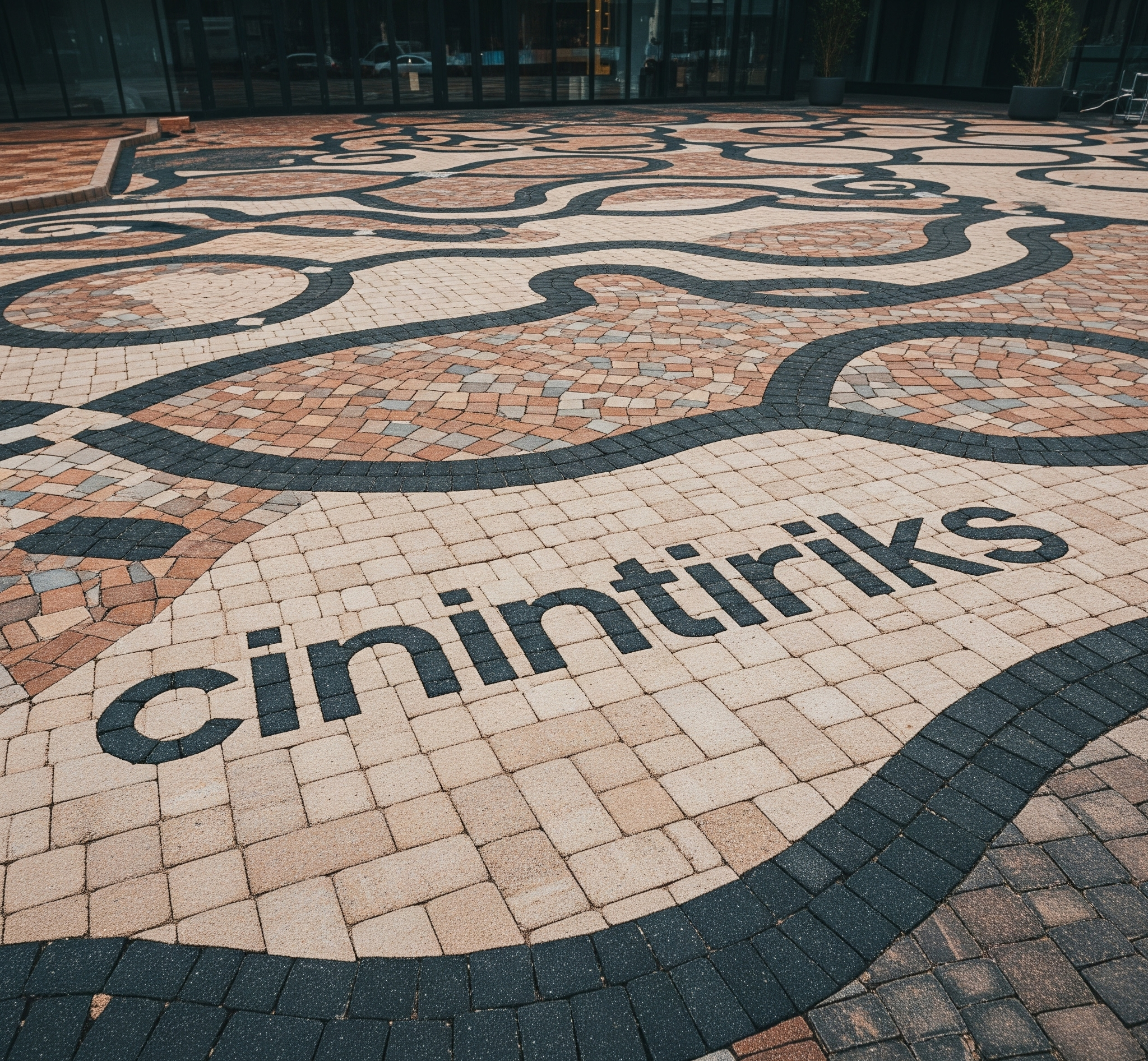
A bespoke paver logo at a stadium entrance is the ultimate brand statement in commercial hardscaping. Unlike painted graphics, which degrade under traffic and weather, a stone inlay is the surface itself. The logo is not applied to the pavement; it is the pavement. You cannot scrape it off because there is nothing on top to scrape. The colour goes all the way through the stone. The design is as permanent as the building behind it. And every fan who crosses it on their way in—whether they look down consciously or register it peripherally—receives a message that this facility takes its identity seriously enough to carve it into stone.
The Engineering: Hyper-Precision Under Massive Loads
The Foundation: Stadium-Grade Sub-Base
The sub-base beneath a stadium entrance logo must be engineered to a standard that exceeds even highway-grade specifications, because the loading profile is more complex than a typical roadway. A road surface carries vehicles in predictable, directional traffic patterns. A stadium entrance carries omnidirectional pedestrian traffic (thousands of people crossing in every direction simultaneously), combined with heavy vehicles that may approach from multiple angles, turn, park, and reverse across the surface.
For a facility in Woodbridge, the sub-base specification begins with a full geotechnical assessment of the subgrade conditions. The native soil bearing capacity determines the total depth of the granular base required. Typically, a stadium entrance demands 450 to 600 millimetres of Granular A aggregate base, placed in controlled lifts of no more than 150 mm and compacted to a minimum of 98 percent Standard Proctor Density. Each lift is verified with a nuclear density gauge. The finished surface of the base is graded to a tolerance of ±3 millimetres over a 3-metre straightedge.
These are not arbitrary numbers. The 98 percent compaction threshold exists because at lower densities, the base retains enough void space to allow settlement under repeated heavy loads. Settlement of even 3 to 5 millimetres in a standard herringbone field is visually imperceptible. Settlement of 3 to 5 millimetres within a custom logo is immediately visible as misaligned joints, lipped edges, and a distorted pattern. And at a stadium, where accessibility compliance is rigorous, a lipped paver edge exceeding 6 millimetres constitutes a trip hazard under the Accessibility for Ontarians with Disabilities Act (AODA). A trip hazard at the entrance to a facility that processes thousands of pedestrians per event is not an aesthetic problem. It is a liability problem.
Precision Cutting at Scale
A sports team logo is typically more graphically complex than a compass rose or a geometric medallion. Team logos incorporate curves, letterforms, enclosed shapes, and sometimes photographic-style renders of animal mascots or symbolic elements. Translating these shapes into interlocking paver geometry requires a process that is equal parts graphic design and structural engineering.
The logo begins as a vector artwork file—the scalable digital master supplied by the team's brand management office. This vector is imported into CAD software and scaled to the installation dimensions, which for a stadium entrance can range from 4 to 10 metres in diameter. At this scale, details that are 1 millimetre wide in the original artwork become 40 to 100 millimetres wide in the installation —large enough to be executed in stone, but still demanding precision that most landscape contractors have never been asked to achieve.
The CAD template maps every individual cut piece: the shape, the colour zone it belongs to, and its position within the overall composition. A typical 6-metre team logo may contain 300 to 600 individual cut pieces, each one unique in geometry. Every piece is cut on a commercial wet saw with a diamond blade, to a tolerance of ±1 millimetre. Wet cutting is mandatory: the water stream prevents thermal stress cracking at the cut edges, which would cause micro-fractures that propagate under freeze-thaw cycling and lead to premature spalling.
Curves present a particular challenge. A straight cut is simple geometry. A curve requires the operator to guide the paver through the blade on a continuously changing radius, maintaining a precise line and a clean edge through the entire arc. Complex curves—the flowing lines of an animal mascot, the sweep of a hockey stick, the arc of a basketball—may require multiple passes to achieve the finished shape, with each pass removing material incrementally rather than attempting the full profile in a single cut. This is slow, skill-intensive work. A single logo installation can consume two to three full days of cutting before a single piece is placed on the bedding layer.
Every cut piece is test-fitted against its neighbours on a staging surface before installation. Pieces that fail the ±1 mm tolerance are re-cut. Pieces that show edge chipping, thermal stress marks, or wavering cut lines are rejected. There is no tolerance for defects in a feature that will be examined by thousands of eyes at close range, under daylight, stadium lighting, and camera flash.
The Bedding Layer: Flatness as Safety
The bedding layer beneath the logo zone is screeded to an absolute uniform thickness of 25 to 30 millimetres using precision rails and verified with a laser level. For a stadium logo, bedding flatness is not merely an aesthetic requirement; it is a safety requirement. An inconsistent bedding layer creates height variations between adjacent cut pieces, producing lipped edges that catch shoe soles. In a residential driveway, a 3 mm lip is negligible. In a stadium entrance with three thousand pedestrians crossing in rapid succession, a 3 mm lip across a high-traffic path is a statistically significant trip risk. Every edge must sit flush with its neighbour. The bedding layer is the only way to guarantee this.
The Structural Lock: Polymeric Sand as Engineering
Once the logo pieces and surrounding field pavers are placed and compacted, the joints must be filled with a material that transforms the assembly from a collection of loose stone into a unified, load-bearing surface. For a stadium logo, this is not optional. It is structurally critical.
Premium polymeric sand is swept into every joint —the standard field joints and the intricate, often narrower joints within the logo. The sand is mechanically compacted with a rubber-padded plate compactor, meticulously cleaned from the paver faces, and water-activated to trigger the polymer cross-linking reaction. As the polymeric sand cures, it hardens into a semi-rigid matrix that bonds to the paver walls on both sides of the joint, creating a continuous, interlocking web of bonded material that locks every piece in position.
This bonded matrix provides three critical functions in a stadium environment:
Lateral shear resistance: When a heavy vehicle turns across the logo, the tire generates torsional forces that try to twist individual paver pieces out of alignment. The polymeric sand matrix resists this force by distributing it across the joint network rather than allowing individual pieces to rotate.
Vertical load transfer: When a concentrated point load (such as a truck wheel) lands on a small custom-cut piece, the polymeric sand transfers a portion of that load to the adjacent pieces through the bonded joint, preventing the loaded piece from being driven down into the bedding while its neighbours remain at grade. This is what prevents the differential settlement that creates trip hazards.
Edge protection: The sharp edges of custom-cut pieces are the most vulnerable points in the assembly. Without joint fill, these edges are exposed to direct impact from shoe soles, vehicle tires, and snowplough blades. The polymeric sand fills the gap and cushions adjacent edges, preventing the chipping and spalling that would gradually destroy the crisp geometry of the logo.
For stadium logos with very narrow joint widths (which intricate cuts inevitably produce), we specify a fine-grade polymeric sand engineered for joints as narrow as 1 mm. Standard-grade polymeric sand contains aggregate particles that are too coarse to fully penetrate narrow joints, leaving unbonded voids that compromise the structural lock.
Color, Contrast, and Brand Fidelity
The visual success of a stadium logo inlay depends on two disciplines working in concert: colour accuracy and contrast dominance.
Colour Matching to Brand Standards
Sports teams operate under rigorous brand guidelines that specify exact colour values for every element of the visual identity: primary colour, secondary colour, accent tones, and background fields. These are defined in Pantone, CMYK, and RGB specifications intended for print and digital reproduction. Translating these specifications into interlocking paver colours requires working within the palette offered by premium paver manufacturers, which—while extensive—is not infinite.
We work from the team's brand guideline documentation, matching the specified colours as closely as the available paver ranges allow. Deep reds, navy blues, forest greens, and blacks are achievable through the through-body-coloured ranges offered by major manufacturers. Lighter tones—whites, creams, silvers—are available in our signature Warm Off-White and Ivory Cream palettes. Where an exact Pantone match is not available in a standard production paver, custom-batch manufacturing can be arranged with certain suppliers for large-scale commercial installations. This adds lead time but delivers exact colour fidelity.
Through-body colouring is non-negotiable. If the pigment is only a surface treatment, any edge chipping, cut face, or surface wear will expose the raw grey concrete core, destroying the colour integrity of the logo within the first season of heavy traffic.
Contrast Against the Field
The logo achieves visual dominance through contrast with its surrounding field. Our standard approach for stadium installations in Woodbridge and across the GTA places the multi-colour logo against an expansive field of Warm Off-White commercial pavers. The light, neutral field acts as a clean canvas, allowing the branded colours of the logo to read with maximum vibrancy and legibility from distances of 20 metres or more—critical for a feature that must be visible to fans approaching from across a parking lot or transit plaza.
A premium film-forming sealer applied over the completed installation deepens every colour it contacts: blues become richer, reds become more saturated, the Warm Off-White field gains a warm, luminous depth. The sealer locks that colour enhancement permanently (for the lifespan of the sealer coat) and provides the UV protection necessary to prevent differential fading between the logo colours and the field pavers.
The Cinintiriks Standard for Stadium Logo Inlays
At Cinintiriks, we execute bespoke paver logos as heavy civil commercial hardscape architecture. Every stadium and arena logo installation we design in Woodbridge and across the GTA follows a rigid, sequenced protocol that addresses structural integrity, brand fidelity, accessibility compliance, and long-term durability under extreme traffic.
1. Brand Consultation & Vector Acquisition: We work directly with the team's brand management office, marketing department, or licensing authority to obtain high-resolution vector artwork and brand guideline specifications. Colour values, minimum clear space requirements, and any proportional restrictions are documented before design translation begins.
2. CAD Translation & Full-Scale Template: The vector artwork is imported into CAD and scaled to the installation dimensions. Curves and fine details are evaluated for structural viability at the paver scale—very fine lines (below ~40 mm) are discussed with the client and adjusted if necessary to ensure each piece can withstand traffic and freeze-thaw cycling. The completed CAD template maps every cut piece, colour zone, and joint line. A physical or plotted full-scale template is produced for on-site reference.
3. Paver Selection & Colour Matching: We specify high-density, through-body-coloured commercial pavers from premium manufacturers. Colours are matched to team branding as closely as available ranges permit. For exact-match requirements, custom-batch manufacturing is coordinated with the paver supplier. Compressive strength must exceed 50 MPa for all units in the logo and field.
4. Stadium-Grade Sub-Base Construction: Excavation to the full calculated depth (450–600 mm minimum). Granular A aggregate placed in 150 mm lifts and compacted to 98% Standard Proctor Density, verified by nuclear density testing on every lift. Finished base graded to ±3 mm tolerance.
5. Precision Bedding Layer: Concrete sand or fine HPB screeded to a uniform 25–30 mm depth using precision rails. Flatness verified with laser level across the entire logo zone. This is the accessibility guarantee: uniform bedding = flush paver edges = zero trip hazards.
6. Wet-Saw Cutting & Staged Test Fitting: Every custom piece cut on a commercial wet saw with a diamond blade to ±1 mm tolerance. Curves executed in incremental passes for clean, chip-free edges. All pieces test-fitted on a staging surface before installation. Non-conforming pieces re-cut or rejected.
7. Logo Installation (Centre-Out Sequence): Custom-cut logo pieces installed from the centre of the design outward, following the CAD template precisely. Each piece individually set, levelled, and aligned to its neighbours. Border bands and transition pieces installed to create a clean, architecturally defined edge between the logo and the field.
8. Field Paver Installation: Commercial-grade field pavers installed around the completed logo, extending to the edge restraints. Interface cuts individually measured and wet-cut for seamless integration.
9. Compaction & Fine-Grade Polymeric Sand: Entire surface plate-compacted with a rubber-padded compactor. Premium fine-grade polymeric sand swept into every joint (including the narrow logo joints), compacted, meticulously cleaned from paver faces, and water-activated. Sand colour selected to complement the design: dark sand within dark logo elements, neutral sand in the field.
10. Cure Period & Premium Sealer Application: Polymeric sand fully cured (24–72 hours). Premium film-forming sealer applied via spray-and-back-roll, two coats with flash-off time. The sealer deepens colour, enhances contrast, stabilises joints, and provides UV, stain, and abrasion protection for the commercial environment.
11. AODA Compliance Verification & Documentation: The completed installation is inspected for accessibility compliance. Every paver edge within the logo zone is verified for flush alignment (no lips exceeding the AODA threshold). Surface texture is assessed for adequate slip resistance when wet. Complete project documentation —including CAD templates, compaction test results, material specifications, and as-built photographs—is provided to the facility operator for records and compliance purposes.
This is The Cinintiriks Standard for stadium-grade paver logos. It is precision art married to heavy civil engineering, executed under the constraint of public safety in a high-traffic commercial environment. The surface is brand identity. The infrastructure beneath it is industrial. And the result is a stadium entrance that announces the team's presence with permanence, precision, and the kind of material confidence that paint can never achieve.
"Paint says it for a season. Stone says it forever."
Maintenance in a Stadium Environment
A stadium paver logo operates under maintenance conditions that are significantly more demanding than a typical commercial installation. The surface is cleaned frequently (often after every event), subjected to snow clearing in winter, and exposed to high concentrations of food and beverage spills, de-icing chemicals, and vehicle fluids.
The sealer is the first line of defence. A properly applied, high-solids film-forming sealer repels spills and prevents staining for the duration of its service life. In a stadium environment, the sealer should be recoated every 2 to 3 years (shorter than the 3 to 5 year interval typical of residential installations) due to the elevated abrasion from foot traffic volume and mechanical snow clearing.
The polymeric sand requires monitoring and periodic replenishment. In high-traffic zones, the surface layer of the sand wears under foot traffic and is depleted by seasonal power washing. We recommend a formal joint inspection annually and spot replenishment of any joints showing sand loss. A full joint resand is typically required every 4 to 6 years in a stadium environment.
Snow clearing requires specific protocols. Rubber-edged snowplough blades are mandatory. Steel blades will catch paver edges, chip chamfers, and scrape the sealer film. De-icing products containing calcium chloride or potassium chloride are preferred over sodium chloride at facilities in Woodbridge and across the GTA; they are less aggressive to concrete surfaces and less likely to cause surface scaling.
Scale and Ambition: What Is Possible
The question is often asked: how large can a paver logo be? The answer, practically, is that there is no upper limit. The modular nature of interlocking pavers means the design can be scaled to any dimension. We have seen installations ranging from 2-metre residential crests to 15-metre institutional coats of arms. The engineering principles are identical at every scale; only the volume of material, the number of cut pieces, and the construction timeline scale up.
For a major arena or stadium in the GTA, a 6 to 10 metre logo is the typical range—large enough to be legible from across the entrance plaza but proportional to the surrounding architecture. At this scale, the logo is not just a ground graphic. It is a landscape-scale architectural element that orients the entire arrival sequence, telling every fan, every visitor, and every broadcast camera exactly where the centre of this place is.
FAQ: Sports Team Logo Paver Inlays
Can you match specific sports team branding colors using interlocking pavers?
In most cases, yes—to a degree that is visually faithful to the team's brand guidelines, though not always to an exact Pantone match. Premium paver manufacturers offer extensive through-body colour palettes that include deep reds, navy blues, forest greens, blacks, charcoals, warm whites, ivory creams, and a range of grey tones. These standard production colours satisfy the vast majority of team branding requirements. For installations where brand management demands an exact colour match (which is common at professional-level facilities), custom-batch manufacturing is available from select suppliers. The manufacturer produces a limited run of pavers in the exact specified pigment formulation, which adds 6 to 12 weeks of lead time but delivers true brand fidelity. We always recommend through-body colouring for all logo pavers: the pigment extends through the full depth of the concrete unit, ensuring that cut edges, surface wear, and minor chipping do not expose a contrasting grey core. Surface- pigmented pavers will lose their colour integrity within the first season of heavy stadium traffic.
Will a custom paver logo shift or sink under the weight of emergency and broadcast vehicles?
Not if the sub-base is engineered to commercial-grade specifications. The pavers themselves are manufactured to compressive strengths exceeding 50 MPa (7,250 psi) —they will not crack or crush under emergency vehicle or broadcast truck wheel loads. The risk of shifting or sinking comes entirely from the foundation beneath the surface, not the surface itself. A Granular A base compacted to 98% Standard Proctor Density, graded to ±3 mm tolerance, and screeded with a uniform bedding layer will support repeated passes by vehicles weighing 15,000 kg or more without measurable settlement. We verify compaction on every lift with nuclear density testing. The polymeric sand in the joints provides additional lateral stability by distributing shear forces across the joint network, preventing individual pieces from rotating or displacing under torsional loads from turning vehicles. Stadium paver logos engineered to this standard routinely support fire trucks, ambulances, broadcast production rigs, and heavy maintenance equipment throughout their service life.
How do you ensure intricate paver cuts don't become a trip hazard for thousands of fans?
Through three layers of engineering control. First, the sub-base is compacted to 98% density to eliminate any possibility of differential settlement beneath the logo zone. If the foundation does not move, the surface does not move. Second, the bedding layer is screeded to an absolutely uniform depth and laser-verified for flatness, ensuring that every piece—regardless of its shape or size—sits at precisely the same elevation as its neighbours. There are no high edges or low edges because the bedding beneath them is uniform to within 1 to 2 mm. Third, the polymeric sand in the joints bonds adjacent pieces together and prevents differential vertical movement under concentrated loads. The result is a logo surface where every edge sits flush, every joint is filled and bonded, and no piece can be driven down or pushed up independently of its neighbours. On completion, we verify every edge within the logo zone against the AODA trip hazard threshold—any edge lip exceeding the allowable limit is identified and corrected before the installation is accepted. This is standard practice on every commercial project we execute in Woodbridge and across the GTA.
The Final Word
A sports team logo rendered in interlocking stone at a stadium entrance is the most permanent, most prestigious, and most physically commanding brand statement available in the hardscape vocabulary. It says something that no banner, no digital screen, and no painted graphic can say: this is carved in stone.
But it is not a decoration. It is a piece of heavy civil infrastructure that must survive emergency vehicles, broadcast trucks, snowplough blades, and the collective weight of tens of thousands of fans, season after season, year after year. The cuts must be millimetre-perfect. The sub-base must be highway-grade. The joints must be structurally bonded. And the colours must be true to the brand that the stone represents.
Don't let amateur cuts and a weak foundation create a trip hazard at your facility's entrance. Contact Cinintiriks for heavily engineered, bespoke paver logos in Woodbridge.