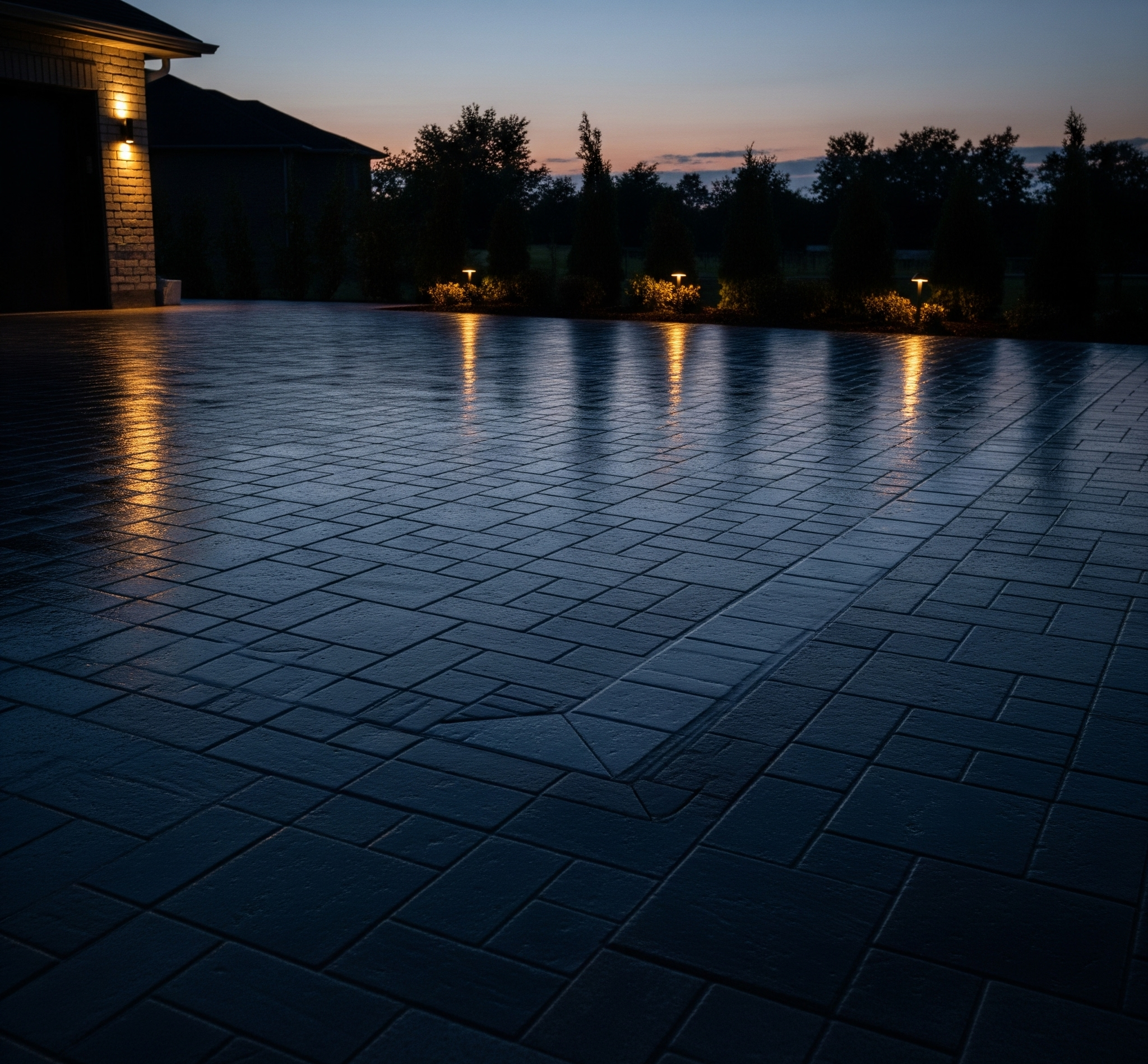
The “One-Bucket” Catastrophe
Let us describe a scenario that plays out across Bolton and the broader GTA every single spring. A homeowner looks at their property: a poured concrete front porch connects to a broomed concrete walkway that meets an interlocking paver driveway. All three surfaces are showing wear. The concrete has salt scaling and a chalky white dusting of efflorescence. The interlock joints are eroding. Everything needs attention. So they call a contractor—typically the one offering the lowest bid—who arrives with a single pressure washer, a single pump sprayer, and a single five-gallon bucket of sealer. He washes everything indiscriminately, sprays that one sealer over every surface on the property, collects his payment, and moves to the next job.
Within three weeks, the front porch is a sheet of ice-slick plastic every time the morning dew settles. The concrete walkway has turned a milky, opaque white along the edges where the sealer pooled in the broom-finish grooves. And the interlocking driveway? The joints are already beginning to wash out because the sealer he used was never designed to stabilize polymeric sand—it was a concrete penetrating sealer, invisible on the pavers, with zero film, zero color enhancement, and zero joint-binding capability.
By the following spring, the concrete sealer is peeling off the porch in brittle, white sheets. The walkway is scarred with ugly delamination patches. And the driveway looks exactly like it did before the project started, except now the homeowner has spent $2,000 on a service that delivered precisely nothing of value. The correction—stripping the wrong sealer, cleaning the residue, and resealing with the correct products—will cost three to four times more than doing it properly the first time.
This is the one-bucket catastrophe. And it is entirely avoidable with a basic understanding of what these two surfaces actually are and what they actually need.
Understanding the Two Surfaces
To grasp why different sealers are required, you need to understand how profoundly different poured concrete and interlocking pavers are as materials, despite both being broadly classified as “concrete.”
Poured Concrete: The Monolithic Slab
A poured concrete driveway, walkway, or porch is a single, continuous, monolithic slab. It was placed as a liquid mix of Portland cement, water, aggregate, and air-entraining admixtures, screeded level, finished with a broom or trowel, and left to cure into a rigid, unbroken mass. It has no joints between individual units. It has no sand bedding layer. It does not flex. It transfers load across its entire footprint as a single structural element. Its surface is relatively smooth—even a broom finish is far smoother than the textured face of a pressed interlocking paver—and its porosity is determined by the water-to- cement ratio and the finishing technique employed during placement.
The primary threats to poured concrete in Ontario are freeze-thaw cycling and de-icing salt penetration. Water enters the pore structure of the concrete, freezes, expands by approximately nine percent, and generates enormous hydraulic pressure within the matrix. This is what causes spalling—the progressive flaking and pitting of the surface layer. Road salt (sodium chloride and calcium chloride) exacerbates this process by dramatically increasing the number of freeze-thaw cycles the surface endures during a single winter, and by drawing additional moisture into the pores through osmotic pressure.
What poured concrete needs from a sealer is internal protection. It needs a product that penetrates deep into the pore structure and blocks water and chloride ions from entering the matrix in the first place. It does not need a surface film. In fact, a surface film on poured concrete is often counterproductive and potentially dangerous.
Interlocking Pavers: The Flexible System
Interlocking pavers are the opposite in almost every structural dimension. They are individual, discrete units—pressed, vibro-compacted concrete or natural stone elements—set into a sand bedding layer over a granular base, separated by engineered joints filled with polymeric sand. The system is designed to flex. Each paver can move independently, accommodating thermal expansion, frost heave, and point loads without cracking. The joints are not cosmetic lines; they are structural hinges that allow the surface to articulate under stress.
The primary threats to interlocking pavers in Ontario are joint erosion, color fading, and organic contamination. The polymeric sand in the joints degrades under UV exposure and moisture cycling, eventually losing its binding capacity and allowing water penetration, weed growth, and insect excavation. The paver faces themselves lose color depth and vibrancy as UV radiation breaks down the surface pigments. And organic matter—leaf tannin, algae, moss—stains the surface and embeds in the texture.
What interlocking pavers need from a sealer is surface protection and joint stabilization. They need a product that sits on top of the paver face, forming a protective film that blocks UV, repels stains, enhances the color depth, and—critically—physically bonds to the cured polymeric sand in the joints, adding an additional layer of stabilization that prevents erosion and washout. This is a fundamentally different engineering objective from what poured concrete requires.
The Chemical Engineering: Penetrating vs. Film-Forming
Now that we understand what each surface needs, let us examine the chemistry of how those needs are met.
Penetrating Sealers for Poured Concrete: Silane and Siloxane
The appropriate sealer for poured concrete in Ontario's climate is a penetrating silane/siloxane blend. These are not coatings. They are reactive molecular impregnators.
Silane molecules are extremely small—among the smallest of any sealer chemistry—which allows them to penetrate deep into the concrete pore structure, often reaching depths of 3 to 6 millimetres below the surface. Siloxane molecules are slightly larger, providing near-surface protection and bridging the wider capillaries that silane alone might not fully treat. Once inside the concrete, both compounds undergo a chemical reaction with the moisture and alkalinity naturally present in the cementitious matrix. They bond covalently to the pore walls, converting the hydrophilic (water-attracting) mineral surfaces into hydrophobic (water-repelling) ones.
The result is invisible. There is no film. There is no gloss. There is no color change. The concrete looks exactly the same as it did before treatment. But at the molecular level, the pore structure has been fundamentally transformed. Water beads on the surface and sheds rather than absorbing. Chloride ions from road salt can no longer migrate into the matrix. Freeze-thaw damage is dramatically reduced because the moisture content within the slab remains far below the critical saturation threshold needed for expansive ice formation.
This is the gold standard for poured concrete protection in the Canadian climate. Provincial and federal infrastructure authorities specify silane/siloxane sealers for highway bridges, parking structures, and municipal sidewalks across Ontario. It is proven, well-documented chemistry with decades of field performance data.
And it is completely useless on interlocking pavers.
Film-Forming Sealers for Interlock: Acrylic and Polyurethane
The appropriate sealer for interlocking pavers is a film-forming, joint- stabilizing acrylic or polyurethane sealer—a product that behaves in almost exactly the opposite way from its penetrating counterpart.
A film-forming sealer is applied to the paver surface and dries as a continuous, thin, transparent coating that sits on top of the stone. A high-quality solvent-based acrylic deposits its resin directly into the surface pores and across the face, creating both a mechanical anchor into the texture and a smooth, glossy (or matte, depending on formulation) surface film. This film serves multiple functions simultaneously.
First, it provides UV protection and color enhancement. The acrylic film filters ultraviolet radiation, dramatically slowing the pigment degradation that causes pavers to fade. And because the film is transparent but refractive, it deepens the apparent color of the stone—the same way a wet stone looks richer and more vivid than a dry one. This is the “wet look” that property owners in Bolton and across the GTA consistently request. It transforms a faded, washed-out driveway into something that looks freshly installed.
Second, and this is the function that has no equivalent in the penetrating sealer world, a film-forming paver sealer provides joint stabilization. When the sealer is applied to a properly prepared interlock surface with freshly installed and cured polymeric sand, the sealer flows into the junction between the paver edge and the sand surface. As it cures, it forms a thin but remarkably strong bond across this interface, effectively gluing the top layer of the polymeric sand to the paver edges. This additional adhesion dramatically increases the joint's resistance to water erosion, foot traffic abrasion, and the displacement forces generated by vehicle tires turning on the surface. It is a secondary structural reinforcement that works in concert with the polymeric sand's own polymer matrix.
A penetrating silane/siloxane sealer provides none of this. No film. No UV filtering. No color enhancement. No joint stabilization. Applied to interlocking pavers, it makes the pores water-resistant—which is marginally useful—but fails to address the three primary concerns that interlock owners actually care about: fading, staining, and joint erosion. It is the wrong tool for the job.
The Liability of Cross-Contamination: The Ice Rink Effect
Now we arrive at the scenario that creates genuine safety hazards and structural failures, and it is the direct consequence of the one-bucket approach.
Film-Forming Sealer on Poured Concrete: A Dangerous Mistake
When a glossy, film-forming acrylic paver sealer is applied to a smooth poured concrete surface, something deceptively simple happens: it cannot absorb. The surface of properly placed and finished poured concrete is significantly denser and less porous than the textured face of an interlocking paver. The sealer has nowhere to go. It sits on top as a continuous, unanchored plastic film.
In dry conditions, this film feels smooth and looks glossy. It may even appear acceptable initially. But the problems emerge immediately with the first rain, and they become genuinely dangerous with the first frost.
A smooth, glossy acrylic film on a broomed concrete surface reduces the coefficient of friction to startlingly low levels. When that surface gets wet—from rain, morning dew, garden irrigation, or snowmelt—it becomes slippery enough to cause falls. We have assessed properties in Bolton where the front porch had been sealed with a leftover paver sealer and the homeowner could not safely walk to their front door in their socks after a rainstorm. The surface was, for all practical purposes, a wet tile floor. This is not an exaggeration. It is a genuine slip-and-fall liability that exposes the property owner to serious risk.
In winter, the situation escalates from hazardous to potentially catastrophic. Water that collects on the non-absorbing acrylic film freezes into a thin, transparent sheet of black ice. Because the sealer prevents the water from draining into the concrete pores (which is what happens on a properly sealed or unsealed concrete surface), the water pools on the surface and freezes in place. The result is what we candidly call the ice rink effect: a front porch, walkway, or garage apron that is coated in a nearly invisible layer of ice that is as slippery as any skating surface you will find in the GTA.
Beyond the safety hazard, the film itself fails rapidly. Because it is not mechanically anchored into the dense concrete matrix (the way it would be on a porous, textured paver face), the sealer begins to delaminate. Moisture trapped beneath the film freezes and lifts the coating in sheets. UV exposure degrades the acrylic from above. Within a single Ontario winter, the film turns cloudy, white, and begins to peel in brittle, unsightly patches. The concrete now looks worse than it did before treatment: scarred with peeling sealer residue, uneven in gloss, and visually ruined.
Penetrating Sealer on Interlocking Pavers: The Invisible Waste of Money
The reverse mistake is less visually dramatic but equally wasteful. When a penetrating silane/siloxane sealer is applied to interlocking pavers, it absorbs into the stone and does… almost nothing useful. The paver pores become hydrophobic, yes. Water will bead on the surface for a season or two. But there is no color enhancement. No gloss. No UV protection for the pigments. And critically, no joint stabilization whatsoever.
The polymeric sand in the joints receives no additional protection or bonding. It remains exposed to erosion, foot traffic, and the displacement forces of vehicle tires. The pavers continue to fade at the same rate. Organic stains embed slightly less readily, but only in the short term, as the silane/siloxane treatment degrades under UV exposure faster on a horizontal paver surface than it does within a protected concrete slab. Within 12 to 18 months, the treatment has effectively worn off, and the homeowner has paid for a product that delivered no visible or structural benefit.
They don't know they wasted their money because they can't see the difference. And that may be the most insidious outcome of all.
"The question is never whether you can seal both surfaces. The question is whether you understand that each surface speaks a different chemical language."
The Correct Approach: Chemical Staging on a Multi-Surface Property
A property with both poured concrete and interlocking pavers is not a problem. It is, in fact, the norm. Nearly every residential property in Bolton has some combination of the two: a poured concrete front porch with interlocking driveway pavers. A broomed concrete walkway leading to a paver patio. A poured concrete garage floor meeting a paver apron at the threshold. These transition zones are where the engineering precision matters most.
The correct approach is chemical staging: treating each surface with its own dedicated product, applied in a deliberate sequence that prevents cross-contamination at the transition zones.
Step 1: Unified Cleaning Phase
The cleaning and preparation phase can—and should—be performed across the entire property simultaneously. Commercial-grade power washing with targeted chemical pre-treatments for each contamination type (degreasers for oil, oxidisers for organic growth, acid washes for efflorescence) is universal. The equipment and technique are the same regardless of the surface material. The old joint sand in the interlock is extracted during this phase, and the concrete surfaces are cleaned of all surface contamination.
Step 2: Polymeric Sand Installation (Interlock Only)
After the drying period, fresh polymeric sand is installed into the interlock joints, compacted, cleaned from the paver faces, and water-activated. The concrete surfaces are left alone during this phase—they require no joint work.
Step 3: Penetrating Sealer on Concrete (First)
Once the polymeric sand has achieved its initial cure (and the concrete surfaces have dried sufficiently), the penetrating silane/siloxane sealer is applied to all poured concrete surfaces. We do the concrete first for a specific tactical reason: penetrating sealers are invisible and do not leave a surface film. If a small amount of overspray lands on the adjacent interlock pavers during application, it absorbs harmlessly into the stone without affecting the subsequent film-forming sealer's adhesion. The reverse is not true—acrylic overspray on concrete creates exactly the delamination and ice-rink problems we described above.
Step 4: Masking the Transition Zones
Before the film-forming paver sealer is applied, we mask off the transition zones. Where the interlock meets the concrete—at the porch apron, at the walkway junction, at the garage threshold—we apply a physical barrier (typically heavy-duty kraft paper or polyethylene sheeting secured with contractor-grade tape) to prevent any acrylic overspray from contacting the concrete surface. This is not optional. It is a non-negotiable step in our protocol. Even a fine mist of acrylic sealer on a smooth concrete porch will create a localized slippery patch that is both a safety hazard and a cosmetic defect.
Step 5: Film-Forming Sealer on Interlock (Second)
With the concrete protected, the film-forming acrylic or polyurethane sealer is applied to the interlock surfaces via the spray-and-back-roll method. Two thin coats with proper flash-off time between them. The sealer encapsulates the paver faces and the cured polymeric sand joints as a unified, aesthetically enhanced, structurally reinforced system.
The result is a property where every surface is protected by the chemistry specifically engineered for its material, its porosity, its structural requirements, and its aesthetic function. The concrete is internally sealed against salt and moisture. The interlock is surface-sealed for color enhancement, UV protection, and joint stabilization. Both treatments coexist on the same property, applied during the same project, by the same crew—but with strict chemical separation at every transition zone.
The Cinintiriks Standard for Multi-Surface Sealing
At Cinintiriks, multi-surface properties are not an exception. They are the majority of our residential projects in Bolton and across the GTA. Nearly every home has both poured concrete and interlocking pavers in some configuration, and our protocol is engineered specifically for this reality. Here is precisely how we execute a multi-surface restoration.
1. Full Property Assessment: We walk and document every surface on the property—concrete and interlock alike. We identify the specific material, finish type, condition, contamination profile, and joint status of each zone. We map the transition points where surfaces meet and develop a chemical staging plan tailored to the specific layout of the property.
2. Unified Chemical Cleaning & Power Wash: The entire property is cleaned in a single, coordinated phase. Targeted chemical pre-treatments are applied to each contamination type: degreasers for oil, sodium hypochlorite for biological growth, dilute acid for efflorescence. Commercial-grade hot-water washing at 3,500+ PSI extracts all contaminants and opens interlock joints to full depth.
3. Monitored Drying Period: All surfaces are left to dry completely. We monitor weather and will not proceed until both the concrete slabs and the paver joints are verified dry.
4. Polymeric Sand Installation (Interlock Zones): Fresh premium-grade polymeric sand is installed into all interlock joints, mechanically compacted, cleaned from paver faces, and water-activated. Sand color is selected to complement the paver color as an architectural accent—deep Charcoal against Warm Off-White pavers, or Granite Grey against darker units.
5. Polymeric Sand Cure Period (24–72 Hours): The sand is left to fully cure before any sealer is applied to any surface.
6. Penetrating Sealer Application (Concrete Zones First): A professional-grade silane/siloxane blend is applied to all poured concrete surfaces. This is done first to eliminate cross-contamination risk, as penetrating sealer overspray on pavers is harmless.
7. Transition Zone Masking: All junctions where interlock meets concrete are physically masked with protective sheeting and tape to prevent film-forming overspray from reaching concrete surfaces.
8. Film-Forming Sealer Application (Interlock Zones Second): A high-solids, joint-stabilizing acrylic or polyurethane sealer is applied to the interlock surfaces via spray-and-back-roll. Two thin coats with proper flash-off time. The sealer encapsulates paver faces and joints as a unified system.
9. Masking Removal & Final Walkthrough: All masking is carefully removed. We walk the completed property with the homeowner, verifying sealer uniformity, joint stability, transition zone cleanliness, and overall finish quality. Detailed maintenance guidance is provided for both surface types—including de-icing product recommendations tailored to each material.
This is The Cinintiriks Standard for multi-surface work. It is methodical. It is chemically precise. It respects the fundamental engineering differences between the two surfaces and treats each with the product it was designed for. The result is a property where every square foot of hardscape is protected, enhanced, and built to survive the Bolton winter.
A Note on Stamped Concrete: The Grey Area
Stamped concrete occupies an unusual position in this discussion because it is, structurally, a poured concrete slab, but it is finished and colored to resemble interlocking stone. It typically does receive a film-forming sealer—usually a high-solids solvent-based acrylic—because the stamp pattern and integral color require surface protection and enhancement that a penetrating sealer cannot provide.
However, and this is a critical nuance, the film-forming sealer used on stamped concrete is formulated differently from the joint-stabilizing sealer used on interlocking pavers. Stamped concrete sealers are optimized for adhesion to a dense, machine-finished surface. Paver sealers are optimized for penetration into a porous, textured surface and for joint-bridging capability. They are not interchangeable, though they belong to the same broad chemical family.
If your property in Bolton includes stamped concrete in addition to poured broomed concrete and interlocking pavers, you may require three different sealer products. This is exactly the kind of multi-surface complexity that makes professional execution essential.
FAQ: Sealing Concrete and Interlock Together
Why is the sealer on my poured concrete porch turning white and peeling off in sheets?
This is almost certainly the result of a film-forming acrylic sealer being applied to a poured concrete surface rather than the correct penetrating sealer. Poured concrete—particularly a broom-finished or trowel-finished surface—is denser and smoother than interlocking pavers. A film-forming acrylic cannot anchor deeply into this dense matrix the way it can into the open, textured pores of a paver. The result is a surface film that is adhered by surface tension alone, without meaningful mechanical bond. When moisture migrates through the slab (which it always does in Ontario's climate), it collects beneath the film, scatters light (causing the white clouding effect known as blushing), and lifts the coating away from the concrete. Freeze-thaw cycling accelerates this delamination dramatically, causing the sealer to crack and peel in large, brittle sheets by spring. The correction requires a full chemical strip of the failed acrylic, followed by cleaning and application of a proper penetrating silane/siloxane sealer that works within the concrete rather than on top of it.
Can you use a color-enhancing wet-look sealer on standard broomed concrete?
Technically, yes—but with significant caveats and limitations that most homeowners are not aware of. Wet-look color-enhancing sealers are film-forming products, and the same adhesion and safety concerns outlined above apply to any film-forming product placed on poured concrete. The smoother the concrete finish, the greater the risk of poor adhesion, blushing, and slipperiness when wet. If you absolutely want a color-enhanced finish on broomed concrete, the product must be specifically formulated for dense concrete substrates (not a paver sealer repurposed), must incorporate an anti-slip additive to maintain safe traction when wet, and must be applied in extremely thin coats to minimize moisture entrapment. Even then, the lifespan on a horizontal concrete surface in Ontario’s climate is typically shorter than on interlocking pavers, and maintenance intervals will be more frequent. In most cases, we recommend the penetrating silane/siloxane approach for standard broomed concrete and reserve the film-forming, color-enhancing treatment for interlocking pavers, where the material is engineered to receive it.
How do professionals prevent interlock sealer from overspraying onto adjacent concrete walls?
Through physical masking and controlled application technique . Before any film-forming sealer is sprayed on an interlock surface, we mask every adjacent surface that should not receive the product. This includes poured concrete porches, walkways, retaining walls, foundation walls, garage floors, and any stone or masonry elements that border the interlock zone. We use heavy-duty kraft paper, polyethylene sheeting, or contractor-grade plastic secured with pressure-sensitive tape along the transition line. The masking extends a minimum of 300 millimetres beyond the spray zone to account for mist drift. During application, we use a low-pressure, high-volume pump sprayer rather than a high-pressure atomising unit, which generates a controlled, directed spray pattern with minimal airborne mist. The back-roll technique immediately behind the sprayer further contains the product. On windy days (sustained winds above 15 km/h), we defer the sealing phase entirely rather than risk overspray. This level of control is standard practice for every project we execute. It is not difficult; it simply requires discipline and the willingness to invest the time in proper preparation—which is, fundamentally, what separates a professional service from a spray-and- go operation.
The Final Word
Yes, you can absolutely seal concrete and interlock surfaces in the same project. You should, in fact, because a comprehensive property restoration addresses every surface simultaneously, ensuring visual consistency, structural integrity, and efficient scheduling. But you cannot do it with one product. You cannot do it with one technique. And you cannot do it without understanding that these two surfaces—despite looking superficially similar—require fundamentally different chemical treatments to achieve proper protection.
The penetrating sealer protects your concrete from within. The film-forming sealer protects your interlock from above. Each product does its job brilliantly when applied to the correct surface. Each product creates serious problems when applied to the wrong one.
Don't let a generic sealer ruin your mixed hardscaping surfaces. Contact Cinintiriks for heavily engineered, chemically specific property restoration in Bolton.