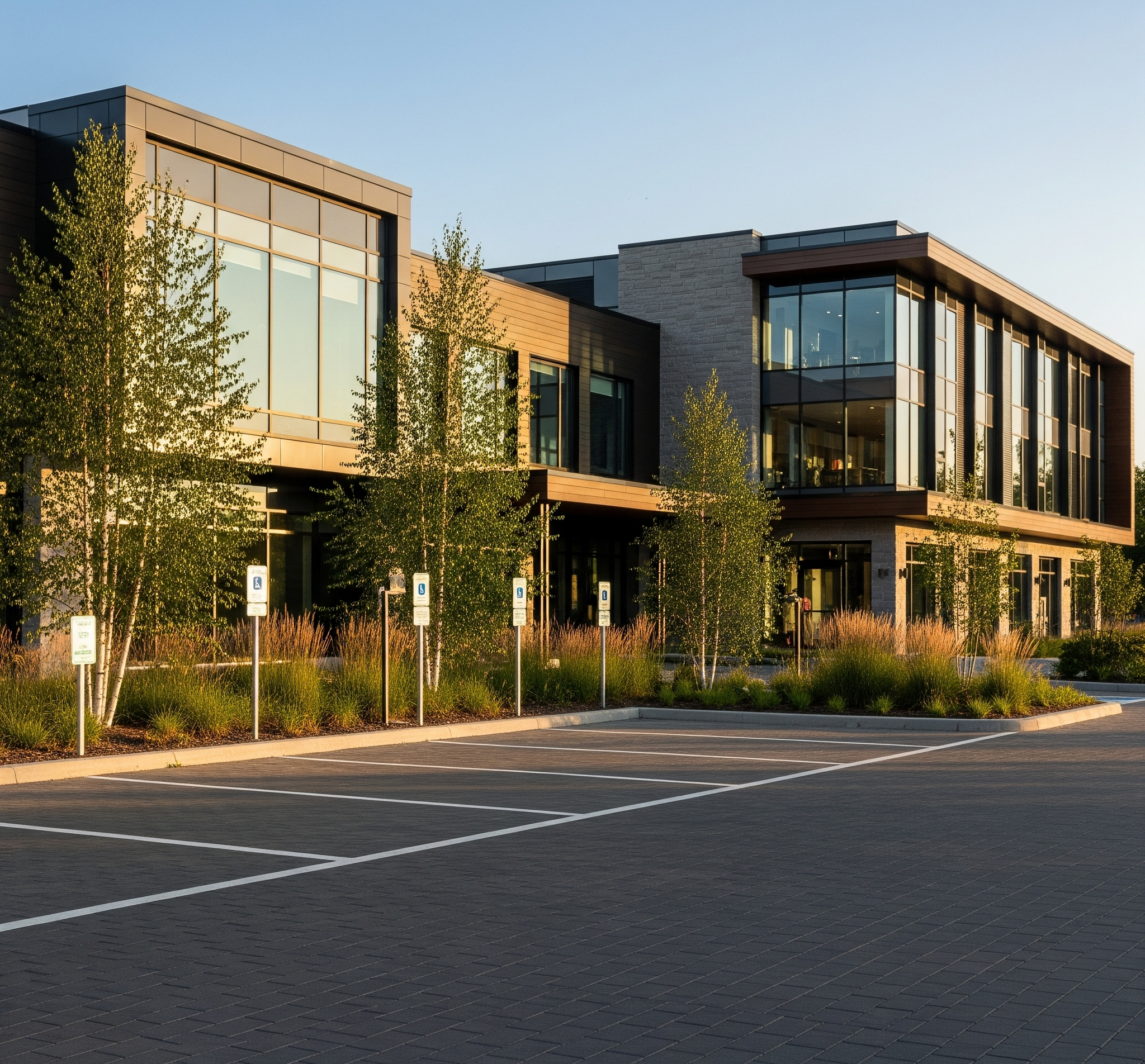
You know the problem. You know the risk. And you have already received the quote from a paving contractor who wants to rip up the entire lot—9,000 square metres of asphalt, removed to the subgrade, re-graded, re-based, and repaved. The number on the quote has six figures. Maybe seven. And the project timeline shuts down your parking lot for six to eight weeks during the busiest season of the year.
So you do the math. The insurance deductible on the next slip-and-fall claim is $10,000. The full repave is $600,000. And you ask yourself the question that every commercial property owner in Toronto eventually asks: is there a way to fix the drainage without tearing up the entire lot?
The answer, in most cases, is yes. But the solution is not simple, and it is not cheap. It is a surgical, precision-engineered intervention that requires a contractor who understands heavy civil drainage infrastructure at the same level as the contractors who build new lots from scratch. Done correctly, a drainage retrofit permanently eliminates the ponding problem, connects into the existing stormwater system, and preserves the vast majority of your existing paved surface. Done incorrectly, it creates new problems, damages existing infrastructure, and wastes the money you were trying to save by avoiding the full repave.
This guide explains what is possible, what is not, and how the engineering works.
The Flooding Liability: Why Standing Water Cannot Be Ignored
Before we discuss the engineering solution, let us quantify precisely why standing water in a commercial parking lot is not a nuisance issue you can defer. It is an active liability that compounds with every passing season.
Under Ontario’s Occupiers’ Liability Act, the occupier of a commercial premises has a statutory duty to take reasonable care to ensure that persons entering the premises are reasonably safe. Standing water in a parking lot creates liability exposure across three vectors:
- Slip-and-fall injuries. Standing water that freezes during Toronto’s extended freeze-thaw season (November through April) produces sheet ice that is nearly invisible to pedestrians. A single slip-and-fall claim on a commercial property in Ontario typically settles between $25,000 and $150,000 for soft-tissue injuries, and can exceed $500,000 for fractures or permanent disability. Defence costs alone (legal fees, expert reports) routinely exceed $15,000–$30,000 even if the claim is ultimately defeated
- Vehicle damage. Water-filled potholes are invisible to drivers. A concealed pothole hit at parking-lot speed (15–20 km/h) causes tire, rim, suspension, and alignment damage ranging from $200 to $2,000+ per incident. Standing water that freezes and expands accelerates pothole formation by forcing cracks open with each freeze-thaw cycle. A ponding zone that exists for three winters will develop structural surface failures that would not have occurred on a properly drained surface
- Accelerated pavement deterioration. Standing water is the primary destructor of asphalt. Water infiltrates surface cracks, saturates the binder, and creates hydraulic pressure during freeze events that fractures the asphalt from the inside out. The process is self-accelerating: cracks admit more water, which creates more cracks, which admit more water. A ponding zone on a Toronto parking lot will deteriorate three to five times faster than a properly drained area of the same lot. The drainage problem is literally eating your pavement
The cost of ignoring the drainage problem is not zero. It is the cumulative total of slip-and-fall claims, vehicle damage claims, accelerated pavement repair costs, increased insurance premiums, and tenant dissatisfaction—compounding every year. Against that cumulative cost, a targeted drainage retrofit at a fraction of the full-repave price is not an expense. It is a financial circuit breaker.
The Surgical Solution: When Retrofit Works
A drainage retrofit is effective when the structural integrity of the existing pavement is generally sound, and the ponding problem is caused by specific, identifiable drainage deficiencies rather than a systemic failure of the entire lot’s grade.
The most common scenarios where surgical drainage upgrades are the correct solution:
- Localised ponding zones. One or two specific areas of the lot where water collects due to low spots, inadequate catch-basin coverage, or surface settlement that has created depressions over time. The surrounding pavement is in acceptable condition and drains normally. The problem is localised, and the solution can be localised
- Failed or insufficient catch basins. The existing catch basins have settled below the surrounding grade, are blocked internally due to sediment accumulation or root intrusion, or are simply too few in number or too widely spaced to handle the lot’s runoff volume. The surface grading is adequate (water flows toward the basin locations), but the basins themselves are not functioning
- Missing interceptor drainage. The lot was originally designed with adequate catch basins but lacks interceptor drainage at critical locations: the base of ramps, the transition between building entrances and the parking surface, or the property-line interface where runoff from an adjacent property flows onto the lot. These locations experience concentrated water flow that overwhelms the sheet-drainage capacity of the asphalt surface
- Grade settlement along specific zones. Over time, differential settlement of the sub-base (particularly common over utility trench backfills and in areas of poorly compacted fill) creates linear depressions that trap water in channels running perpendicular to the intended drainage direction. The lot’s original grading was adequate, but localised settlement has disrupted the drainage path
The scenarios where a retrofit is not the correct solution:
- Systemic grade failure. The entire lot surface is flat or negatively graded, with no defined drainage direction on any significant portion of the surface. This typically results from an original installation that was never properly graded, or from decades of mill-and-overlay resurfacing that has progressively flattened the original drainage slopes. In this case, no number of added drains will solve the problem because the water has no slope driving it toward the drains. Full surface re-grading (which typically requires milling, re-grading, and repaving) is the only effective solution
- Structural pavement failure. If the existing asphalt is alligatored, rutted, and crumbling across more than 30–40% of the lot surface, the pavement has exceeded its structural service life and adding drainage will not prevent its continued deterioration. The lot needs reconstruction, and the drainage should be redesigned as part of that reconstruction
“The question is not whether you can retrofit drainage. The question is whether the existing surface is structurally worth saving. If it is, surgical drainage is the smartest money you will spend on that property.”
The Heavy Civil Mechanics: How Retrofit Drainage Works
Drainage retrofitting is not a cosmetic patch job. It is heavy civil work executed within the constraints of an existing paved surface. Each retrofit method involves precision cutting, excavation, structural installation, and restoration of the paved surface to a condition that is both functional and visually integrated.
Method 1: Trench Drain (Channel Drain) Installation
A trench drain is a linear drainage channel installed flush with the pavement surface, covered by a heavy-duty grate, that intercepts surface water flowing across a paved area and channels it underground to the stormwater system. It is the most effective retrofit tool for intercepting sheet-flow water at specific problem locations.
The installation process:
- Step 1: Precision saw-cutting. A diamond- blade concrete saw cuts a straight, clean channel through the existing asphalt or concrete along the planned trench alignment. The cut width is determined by the drain body width (typically 150–300 mm for commercial applications) plus 50–75 mm on each side for the concrete haunching that anchors the drain body. Total cut width: 250–450 mm. Saw-cutting is the critical precision step. The cut must be straight, clean, and at the exact alignment determined by the drainage survey. A crooked or wandering cut wastes material, weakens the adjacent pavement, and produces a finished installation that looks amateurish
- Step 2: Excavation. The cut strip of asphalt and the sub-base material beneath it are excavated to the depth required for the drain body, the concrete encasement, and the outlet piping. For a standard commercial trench drain, this is typically 400–600 mm below the finished surface elevation
- Step 3: Sub-base preparation. The trench bottom is compacted and graded at the precise 1–2% fall toward the outlet connection. This gradient is critical: the trench drain collects water along its entire length, and the internal channel must slope toward the outlet point to prevent standing water inside the drain body itself. The gradient is verified with a laser level before the drain body is placed
- Step 4: Drain body installation. The pre-cast concrete or polymer-concrete drain channel sections are placed in the trench, connected end-to-end, aligned to grade, and encased in a structural concrete haunching (minimum 150 mm of 30 MPa concrete on all four sides) that locks the drain body in position and distributes vehicle loads around the channel. Without this concrete encasement, the drain body will shift under heavy traffic and the grate-to-surface alignment will fail
- Step 5: Outlet piping. The drain channel connects to a 100–150 mm diameter smooth-wall PVC or HDPE outlet pipe that runs underground from the drain to the nearest catch basin or stormwater connection point. This pipe is laid at a minimum 1% gradient (10 mm of fall per metre of horizontal run) and bedded in granular material. The pipe must be sized to handle the design flow rate from the trench drain, which depends on the length of the drain and the tributary area it is collecting from. Undersized piping causes the trench drain to back up during heavy rain events —exactly when you need it most
- Step 6: Surface restoration. The asphalt on either side of the trench drain is saw-cut clean, the contact faces are tack-coated with asphalt emulsion, and fresh hot-mix asphalt is placed and compacted to match the surrounding surface elevation. The finished installation presents a clean, linear grate set flush with the adjacent pavement, with a narrow band of fresh asphalt on either side that will be visually unified at the next seal-coat cycle
Method 2: Additional Catch Basin Installation
Where the problem is insufficient catch-basin coverage rather than missing interceptor drainage, the solution is adding one or more catch basins at the low points of the ponding zones and connecting them to the existing storm-sewer network.
The installation process:
- Step 1: Ponding survey. A topographical survey using a laser transit or total station identifies the exact low point of each ponding zone, confirming where a new basin will be most effective. The survey also determines the elevation relationship between the new basin location and the nearest existing catch basin or storm-sewer manhole, which dictates the pipe gradient and feasibility of the connection
- Step 2: Saw-cutting and excavation. A 1,200 mm × 1,200 mm (minimum) section of asphalt is saw-cut and removed at the basin location. The excavation extends to the required depth for the pre-cast concrete catch-basin structure (typically 1,200–1,500 mm below finished grade, depending on the pipe invert elevation of the existing system the new basin will connect to). The pipe trench is excavated from the new basin location to the existing connection point, following the alignment and gradient determined by the survey
- Step 3: Basin and pipe installation. The pre-cast catch-basin sections (base slab, riser sections, and grade-ring adjustment) are set on a compacted granular bed, levelled, and sealed at joints. The outlet pipe (typically 200 mm PVC or HDPE for commercial applications) is laid in the pipe trench at the specified gradient, bedded in clear stone, and connected to the existing stormwater system through a core-drilled or night-plugged entry into the existing basin or manhole. The new basin is fitted with a heavy-duty cast-iron grate rated for the traffic loading (H-20 for standard vehicle traffic; H-25 for lots servicing heavy vehicles)
- Step 4: Backfill and surface restoration. The pipe trench is backfilled with Granular A, compacted in lifts, and the asphalt surface is restored with fresh hot-mix. The basin grate is set flush with the surrounding pavement, and the adjacent asphalt is feathered to blend the repair into the existing surface
Method 3: Catch-Basin Rehabilitation
In many cases, the existing catch basins are in the right locations but have settled, collapsed internally, or become blocked. Rehabilitation is faster and less disruptive than new installation:
- Grate and frame adjustment. If the basin structure is sound but the grate has settled below the surrounding pavement (creating a depression and a trip hazard), the frame can be raised by adding concrete grade rings and resetting the frame flush with the surface. This is a half-day operation per basin with minimal pavement disturbance
- Internal cleaning and pipe jetting. Sediment, debris, and root intrusion in the basin sump and outlet pipes are removed by vacuum truck extraction (for the basin sump) and high-pressure water jetting (for the outlet pipes). Root intrusion is addressed with a mechanical root cutter run through the pipe to restore full bore diameter. On Toronto properties with mature trees adjacent to parking lots, root intrusion into stormwater pipes is one of the most common causes of sudden catch-basin backup and surface flooding
- Structural rebuild. If the basin walls have cracked, shifted, or collapsed, the basin is excavated, the failed sections are removed, and new pre-cast sections are installed on the existing base (if sound) or on a new footing. The cost is typically 40–60% of a new basin installation because the excavation and pipe connections already exist
Pitch, Flow, and the Aesthetic Finish
The engineering reality that most property owners do not appreciate until a knowledgeable contractor explains it is that you cannot simply drop a drain into a low spot and expect it to work. The drain body itself is only the collection point. The water that enters the drain must go somewhere, and getting it there requires gravity-driven flow through underground pipes that must maintain a continuous downward gradient from the drain to the stormwater discharge point.
In Toronto’s typically flat commercial lots, achieving adequate pipe gradient can be the most challenging aspect of a retrofit. The new pipe must maintain a minimum 1% gradient (10 mm of fall per metre of horizontal run). If the connection point (the existing catch basin or stormwater manhole) is 30 metres away, the pipe needs 300 mm of total fall between the new drain outlet and the connection invert. If the existing system’s invert elevation is too high to accommodate this fall, the options are limited: either the pipe run must be shortened (by connecting to a closer access point), or the new drain must be set higher (which may mean it does not fully drain the ponding zone), or a pump station must be installed to lift the collected water to the stormwater system (which adds cost, complexity, and a mechanical system that requires maintenance).
This is why a topographical survey is the non-negotiable first step of any drainage retrofit. Without knowing the exact elevations of the ponding surface, the new drain location, and the existing stormwater system inverts, you cannot determine whether a gravity-flow connection is feasible. A contractor who skips the survey and starts cutting is gambling with your money.
The Aesthetic Dimension
There is a persistent assumption that retrofit drainage work looks like what it is: a patch job. Saw-cut lines visible in the asphalt. A utilitarian metal grate sitting awkwardly in the middle of a parking lot. Fresh black asphalt next to weathered grey asphalt. The visual signal that “something was fixed here” rather than “this was designed to be here.”
That assumption is valid when the work is done by contractors who view drainage retrofit as a plumbing job rather than a hardscape installation. It is not valid when the retrofit is executed as a design-integrated element.
Consider the aesthetic possibilities:
- Trench drain grates are available in cast iron, ductile iron, stainless steel, and architectural bronze finishes. A deep Charcoal cast-iron grate with a heel-safe slot pattern set into precision- cut asphalt is not an eyesore—it is a deliberate design element that communicates engineered sophistication
- Concrete borders framing the drain grate— a 150 mm Warm Off-White structural concrete band saw-cut and poured on either side of the grate—create a clean, architectural frame that transforms the drain from a utilitarian fixture into a design accent. The contrast of dark iron against warm white concrete against black asphalt reads as intentional, premium, and permanent
- Paver borders. Where the property uses interlocking pavers in pedestrian zones, the drain can be bordered with matching paver banding rather than poured concrete, integrating it seamlessly into the existing material palette
- Seal-coat integration. If the retrofit is timed to coincide with or immediately precede a full-lot seal coat, the fresh asphalt patches around the drain installation will be visually unified with the surrounding surface under the seal coat. After the seal coat cures, the saw-cut repair lines are essentially invisible. The entire lot presents as a uniform, freshly maintained surface with clean, intentional drainage features
“A drainage retrofit done right does not look like a repair. It looks like an upgrade the property should have had from the beginning.”
The Cinintiriks Approach: Surgical Precision, Permanent Results
At Cinintiriks, drainage retrofit is not a side service. It is a core competency of our commercial hardscape division. We execute surgical drainage upgrades on active commercial properties across Toronto and the GTA, and the methodology is the same on every project: survey, engineer, execute, restore.
1. Laser-Transit Topographical Survey: Before any solution is proposed, we conduct a full topographical survey of the affected area using a laser transit or robotic total station. We map the exact surface elevations across the ponding zone, identify the flow direction (or lack thereof), locate all existing catch basins and measure their grate and invert elevations, and determine the feasibility and gradient of gravity-flow pipe connections. This survey produces a grading plan that documents exactly what the water is doing, why it is ponding, and where the intervention must occur. The survey is the foundation of the engineering. Without it, any solution is a guess.
2. Engineered Drainage Design: Based on the survey data, we design the retrofit solution: drain type (trench drain, additional catch basin, basin rehabilitation, or combination), drain location and alignment, pipe routing and gradient, connection method to the existing stormwater system, and required pavement restoration. The design is documented in a written scope that specifies every component, dimension, and material. The client knows exactly what is being installed, where, and why, before we mobilise a single piece of equipment.
3. Precision Execution: Saw-cutting is performed with diamond-blade flat saws guided by string lines and chalk marks—no freehand cutting. Excavation is performed with compact excavators sized for the work zone, minimising disturbance to the surrounding pavement. Drain bodies are set in 30 MPa structural concrete encasement poured against form-built edges for clean, straight lines. Pipes are bedded in clear stone and compaction-tested. Every gradient is laser-verified before backfill. Every connection is tested with a flow test (water introduced at the drain and confirmed at the outlet) before the trench is closed.
4. Aesthetic Restoration: The paved surface is restored with hot-mix asphalt placed and compacted to match the elevation and density of the surrounding surface. We recommend scheduling the retrofit to precede the property’s next full-lot seal coat (which we can execute as a combined scope), so the repair patches are visually unified with the entire lot surface. Trench drain grates are specified in dark cast iron with architectural-grade finish. Where the client requests it, we pour Warm Off-White concrete accent borders framing the drain for a premium aesthetic that transforms a functional drainage element into a design feature.
5. Minimal Operational Disruption: We plan and execute retrofit work in phases that allow the property to remain operational throughout the project. We barricade and cone the active work zone (typically a strip 3–5 metres wide), maintain pedestrian and vehicle access around it, and complete each phase before opening it to traffic and moving to the next. On a typical single-drain retrofit, the active work zone is closed for 2–3 days; on a multi-drain project, phases are staggered across 1–2 weeks with no single phase closing more than 10–15% of the lot capacity. Your tenants stay open. Your customers keep coming. The drainage problem disappears.
Stop ignoring standing water and winter ice liabilities. Contact Cinintiriks for heavily engineered, surgical commercial drainage upgrades in Toronto and across the GTA.
FAQ: Commercial Drainage Retrofits
Can a retrofit trench drain handle the weight of transport trucks and snowplows?
Yes, if it is specified and installed correctly. Commercial trench drains are manufactured in a range of load classes defined by international standard EN 1433, which rates drainage channels by the maximum wheel load they can sustain. For commercial parking lots in Toronto, the relevant load classes are: Class C (25 tonnes) for standard vehicle traffic and light commercial delivery; Class D (40 tonnes) for lots servicing heavy delivery trucks, waste haulers, and fire apparatus; and Class E (60 tonnes) for lots subject to highway-class loading or heavy industrial equipment. Most retail and commercial plazas in the GTA require Class C or Class D rated drains. The critical factor is not just the drain body and grate rating, but the concrete encasement that transfers loadng from the grate frame into the surrounding pavement structure. A properly encased trench drain with a minimum 150 mm haunching of 30 MPa concrete on all sides distributes vehicle loads through the concrete mass into the sub-base, not through the drain body. This is why the concrete encasement is non-negotiable: a drain body dropped into a bare gravel trench without structural encasement will crack, shift, and fail under repeated heavy-vehicle loading, regardless of the drain’s rated load class. With proper encasement, a Class D trench drain will handle snowplow blades, loaded waste trucks, and fully laden delivery trailers without deflection, cracking, or grate displacement. We have installed retrofit trench drains on Toronto commercial properties that have been in service for over a decade under continuous heavy- vehicle traffic with zero structural failures.
Will adding a new catch basin fix a parking lot that has completely lost its slope?
No. This is one of the most important distinctions in drainage retrofit engineering, and getting it wrong wastes the entire investment. A catch basin collects water that flows to it. If the surrounding pavement is flat—with no defined slope directing surface water toward the basin location—the water will not reach the basin. It will sit on the surface exactly where it lands, ponding in every micro-depression across the flat zone, regardless of how many basins are installed. Adding a catch basin to a flat surface is like installing a drain in the floor of a room with no sloped floor: the drain is there, but the water has no reason to travel to it. In this scenario, the correct solution is localised re-grading: milling the asphalt surface in the ponding zone to introduce a 1.5–2% slope toward the new or existing basin, then overlaying with fresh hot-mix asphalt to restore the surface at the corrected grade. This is more invasive than a simple basin addition—it disturbs a larger area of the existing surface—but it is still dramatically less disruptive and less expensive than a full-lot repave. And it actually works, because it addresses the cause (no slope) rather than just adding more collection capacity to a system that has no delivery mechanism. The topographical survey that precedes any Cinintiriks drainage retrofit identifies exactly which areas have adequate slope and which do not, so the solution is engineered to the actual condition of the surface rather than assumptions about it.
How long does it take to install a surgical drainage upgrade in an active retail plaza?
Timeline depends on scope, but typical Toronto commercial drainage retrofits fall into these ranges: Single trench drain (3–10 metres long) with pipe connection to an existing catch basin: 2–4 working days from saw-cut to surface restoration. Single new catch basin with pipe connection: 3–5 working days, including excavation, basin installation, pipe installation, backfill, and asphalt restoration. Multiple drains and/or basins across a larger lot: 1–3 weeks, phased to minimise disruption, with each individual work zone typically active for 2–4 days before being reopened. Catch basin rehabilitation (grate raising, cleaning, jetting): 1 day per basin. All timelines assume normal working conditions (no significant rain delays, no unexpected underground utility conflicts). We schedule commercial drainage work during the dry season (typically late May through September in Toronto) to minimise weather-related delays and to ensure that concrete encasements and asphalt patches cure under optimal conditions. On active retail plazas where peak customer hours must be avoided, we can arrange early-morning or evening work windows for the noisiest operations (saw- cutting, excavation) while performing quieter work (pipe installation, concrete pouring, backfill) during standard hours. The goal is always the same: permanent drainage improvement with minimal disruption to your tenants’ business operations and your customers’ experience.
The Final Word
Standing water in a commercial parking lot is not a nuisance. It is an active liability, an accelerating pavement destructor, and a customer-experience failure that compounds every season it is ignored. And the solution, in most cases, does not require tearing up and rebuilding the entire lot.
Surgical drainage retrofit—precision saw-cutting, heavy- duty trench drains, additional or rehabilitated catch basins, laser-graded subsurface piping—can permanently eliminate ponding zones at a fraction of the cost and disruption of a full repave. But the solution must be engineered, not improvised. It must be based on a topographical survey, not a visual guess. And it must be executed by a contractor who understands heavy civil drainage infrastructure, not just asphalt patching.
The water knows where to go. It follows gravity with absolute precision. The contractor’s job is to give it the path. And the path must be engineered with the same precision that gravity demands.