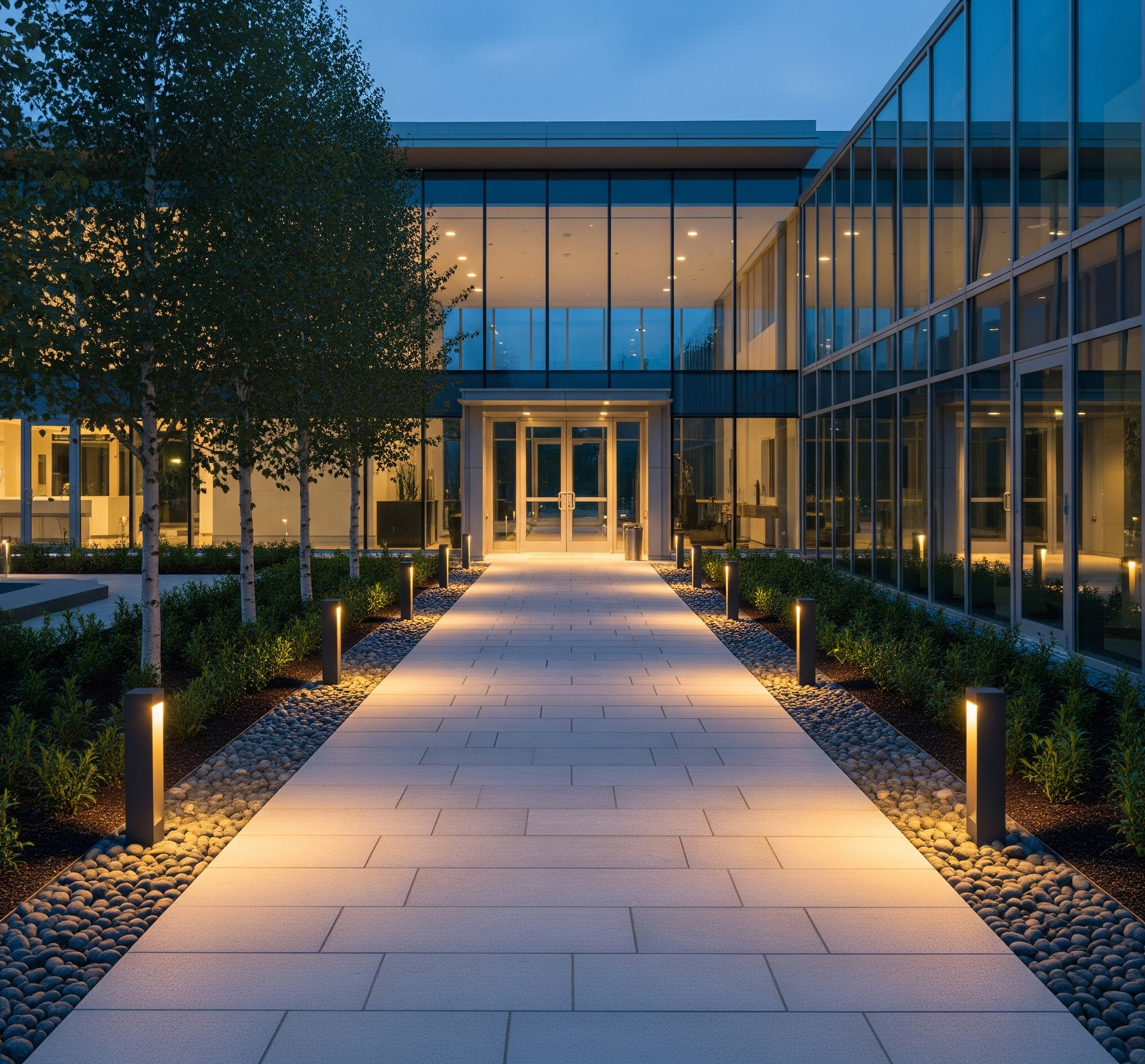
Here is the scenario that plays out across the GTA every spring. A property manager walks the perimeter of a retail plaza after the snow melts. The walkways that looked pristine last September are now peppered with pockmarks, surface pop-outs, and jagged, raised concrete chips where the top 10-20mm of the surface has literally blown off. The concrete is not cracking from below. It is delaminating from the top down—a process called spalling—and every spalled zone creates an abrupt, irregular elevation change on what is supposed to be a perfectly flat, ADA-compliant pedestrian surface.
A 15mm spall on a commercial walkway is not a cosmetic problem. It is a trip hazard. An elderly customer catches a shoe edge on the jagged lip. A delivery driver pushing a loaded dolly hits the raised edge and loses control. A parent with a stroller jolts over the uneven surface and the stroller tips. Each of these scenarios is a personal injury claim waiting to happen, and Ottawa courts, Toronto courts, and insurance adjusters across Ontario have a well-established precedent of finding commercial property owners liable for foreseeable hazards on their premises under the Occupiers’ Liability Act.
The question is not whether sealing can help prevent this liability. The question is why any commercial property owner would choose not to seal.
The Invisible Threat: Water, Salt, and the Chemistry of Destruction
To understand why sealing prevents trip hazards, you must first understand the precise mechanism that creates them. It is not random deterioration. It is not age. It is not traffic wear. It is a predictable, repeatable chemical and physical process that follows the same sequence on every unsealed concrete or paver surface exposed to Ontario’s climate.
Step 1: Absorption
Concrete and manufactured interlocking pavers are porous materials. Standard concrete has a porosity of approximately 10-15% by volume. Manufactured concrete pavers typically have a porosity of 5-8%. Natural stone pavers (limestone, sandstone) can range from 3% to 20% depending on the stone type. This porosity means the materials behave like hard sponges—they absorb water from rainfall, snowmelt, and ground moisture through the surface and through the pore network that extends from the surface deep into the material body.
On a commercial walkway in Bolton, where the rolling terrain of the Humber River valley and the surrounding agricultural lowlands produces high water tables and heavy spring runoff, concrete and paver surfaces are exposed to sustained moisture contact for extended periods during fall, winter, and spring. The surface is wet. The pores are saturated. The material is holding water.
Step 2: Salt Intrusion
During winter operations, commercial property managers apply de-icing salts (sodium chloride, calcium chloride, magnesium chloride, or blended products) to the walkway and plaza surfaces to maintain safe pedestrian traction. This is a legal and practical necessity—the Occupiers’ Liability Act requires property owners to take reasonable steps to maintain safe walking surfaces during winter conditions, and salt application is the industry-standard method.
The salt dissolves in the surface moisture and creates a brine solution that is drawn deep into the concrete pore network by capillary action. The brine penetrates far deeper than clean water because the dissolved salt lowers the surface tension of the liquid, allowing it to wick into finer pores and tighter capillary channels. On a heavily salted commercial walkway, the brine can penetrate 15-25mm below the surface within the first few hours of application.
Step 3: Freeze-Thaw Expansion
When the temperature drops below 0°C, the water trapped in the concrete pores begins to freeze. Water expands by approximately 9% when it transitions from liquid to ice. In a confined pore network, this 9% expansion generates enormous internal hydraulic pressure—pressures that can exceed the tensile strength of the concrete matrix itself.
But the damage is not caused by a single freeze. It is caused by repeated cycling. In a typical Bolton winter, the temperature oscillates above and below 0°C 40 to 60+ times between November and April. Each cycle is a micro-event: water freezes, expands, pushes against the pore walls; water thaws, contracts, allows more water to be drawn into the expanded pore; water freezes again, expands further, pushes the pore walls apart a little more. Cycle after cycle, the pore network progressively fractures the concrete matrix from the inside out.
Salt makes this dramatically worse. The brine solution has a lower freezing point than clean water (as low as -21°C for saturated sodium chloride brine), which means the brine in deeper pores may remain liquid while the clean water in shallower pores freezes. This creates a differential freezing front—ice forming on the surface traps liquid brine below, and the expanding ice drives the liquid brine deeper into the pore network under pressure, accelerating the penetration and intensifying the internal hydraulic stress. The result: salt-exposed concrete spalls 3 to 5 times faster than concrete exposed only to clean water freeze-thaw.
Step 4: Surface Delamination (Spalling)
After sufficient freeze-thaw cycles (typically 2-5 winters on unsealed concrete in Ontario climate), the cumulative internal damage reaches the point where the top 10-25mm of the concrete surface separates from the material below. This separation is called spalling. The surface layer pops off in irregular patches ranging from coin-sized pop-outs to dinner-plate-sized delaminations, exposing the rough, aggregate-filled interior of the concrete below.
Each spall zone creates an abrupt elevation change on the walking surface. A 15mm spall (barely the thickness of a coin stack) is classified as a trip hazard under most commercial liability standards. The jagged, rough edge of the spall is far more dangerous than a smooth surface crack because it catches shoe soles, cane tips, wheelchair castor wheels, and stroller wheels. On a high-traffic commercial plaza with hundreds or thousands of pedestrian crossings per day, even a single spall zone represents a statistically significant injury risk.
“The spall doesn’t announce itself. One spring morning it’s just there—a jagged lip on a walkway that 10,000 people will cross this week. That is the moment it becomes a $250,000 liability question.”
How Sealing Prevents the Damage Chain
Sealing breaks the damage chain at Step 1: Absorption. If water and salt brine cannot penetrate the concrete pore network, the freeze-thaw expansion cannot occur, the internal hydraulic stress does not build, and the surface does not spall. No spalling means no trip hazards. No trip hazards means no liability exposure. The logic is a straight line from sealer to lawsuit prevention.
But the type of sealer matters—critically.
Penetrating vs. Topical Sealers: The Traction Factor
There are two fundamentally different categories of concrete and paver sealers, and choosing the wrong one on a commercial walkway does not merely fail to solve the problem. It creates a new, potentially worse problem.
Topical Sealers (Film-Forming): The Dangerous Choice
Topical sealers—also called film-forming sealers—sit on top of the surface as a thin polymer film. They are available in high-gloss (“wet look”), semi-gloss, and matte finishes. They darken the surface colour, enhance aggregate visibility, and produce the shiny, just-sealed appearance that many property owners find appealing.
On a residential driveway or backyard patio, a quality topical sealer can be an acceptable choice under controlled conditions. On a commercial walkway, a topical sealer is a liability accelerator. Here is why:
- Reduced traction when wet: The polymer film creates a smooth, low-friction surface when wet. On a rainy day, a walkway sealed with a high-gloss topical sealer becomes dangerously slippery—approaching the coefficient of friction of polished tile. On a commercial surface that sees hundreds of pedestrians in leather-soled shoes, running shoes, heels, and wet boots, this reduced traction is a slip-and-fall hazard that replaces the trip hazard you were trying to prevent. You have traded one liability for another
- White hazing and delamination: Topical sealers trap moisture beneath the film. If the concrete has residual moisture at the time of application, or if moisture migrates upward through the slab from the sub-base (common on commercial slabs without a vapour barrier), the trapped moisture causes the sealer film to whiten, haze, and eventually peel in irregular patches. A peeling topical sealer on a commercial walkway looks worse than no sealer at all—it communicates neglect, not maintenance
- Short recoat cycle: Topical sealers wear through under foot traffic. On a high-traffic commercial walkway (1,000+ pedestrian crossings per day), the sealer film wears unevenly—fast in the main traffic line, slower on the edges. The result is a visible wear path where the sealer has been abraded away, surrounded by glossy, still-sealed zones. The surface looks patchy and neglected within 12-18 months. Recoating requires stripping the old sealer (chemical or mechanical), cleaning, and reapplying—a disruptive, expensive process on an active commercial property
Penetrating Sealers (Silane/Siloxane): The Professional Choice
Penetrating sealers do not sit on the surface. They soak into the concrete pore network and chemically bond to the pore walls, creating a hydrophobic (water-repelling) barrier inside the material itself. The surface appearance is unchanged. The surface texture is unchanged. The surface traction is 100% unchanged. The sealer is invisible.
The two primary chemistries:
- Silane: Small molecular size, penetrates 3-6mm into dense concrete. Ideal for high-quality, low-porosity manufactured pavers and dense poured concrete. Silane molecules are small enough to penetrate tight pore networks that larger molecules cannot reach. Provides excellent salt resistance and freeze-thaw protection. Typical service life on commercial surfaces: 5-7 years
- Siloxane: Larger molecular size, penetrates 1-3mm into porous materials. Better suited for natural stone, highly porous precast concrete, and exposed aggregate surfaces where the pore openings are larger. Siloxane molecules bridge larger pores more effectively than silane. Typical service life: 3-5 years
- Silane/Siloxane blends: The industry standard for commercial hardscape sealing. The blended formulation provides both deep penetration (silane) and near-surface pore bridging (siloxane), creating a comprehensive hydrophobic barrier from the surface down to 3-6mm depth. This is the product category specified by Cinintiriks for all commercial hardscape sealing projects. Typical service life: 5-8 years depending on traffic volume, salt exposure, and UV intensity
The critical performance characteristics of a penetrating silane/siloxane sealer on a commercial surface:
- Water absorption reduction: 85-95%. Sealed concrete absorbs less than 1/10th the water of unsealed concrete. The pore network is still physically present, but the hydrophobic chemical lining prevents water from adhering to the pore walls and being drawn deeper by capillary action. Rainwater beads on the surface and evaporates or runs off rather than soaking in
- Chloride ion penetration reduction: 80-90%. The hydrophobic barrier blocks de-icing salt brine from penetrating into the pore network, preventing the salt intrusion that accelerates freeze-thaw damage by 3-5x. This is the single most impactful protection against spalling on salt-treated commercial surfaces
- Surface traction: Unchanged. Because the sealer is inside the pore network, not on top of the surface, the surface micro-texture that provides pedestrian traction is completely preserved. The coefficient of friction in wet and dry conditions is identical to the unsealed surface. There is zero increase in slip risk. Zero
- Appearance: Unchanged. A penetrating sealer does not darken, gloss, or colour-shift the surface. The Warm Off-White paver field and Deep Charcoal border system on a Bolton commercial plaza look exactly the same before and after sealing. The sealer is invisible. The colour palette is preserved. The aesthetic investment is protected without alteration
- Breathability: Maintained. Penetrating sealers are vapour-permeable. They block liquid water from entering the pore network but allow water vapour to escape from the interior of the concrete outward. This prevents moisture entrapment beneath the sealed zone—a critical advantage over topical sealers, which trap moisture and cause hazing and delamination
The Commercial Liability Equation
For commercial property owners in Bolton and across the GTA, the sealing decision is fundamentally a risk management calculation, not a maintenance decision.
The Cost of Sealing
Commercial-grade penetrating sealer application on interlocking paver or poured concrete surfaces typically costs $1.50-$3.50 per square foot (depending on surface type, condition, and access logistics), with a service life of 5-8 years. For a typical Bolton commercial plaza with 5,000 square feet of walkway and plaza surface, the sealing cost is approximately $7,500-$17,500 per application, or $1,000-$2,200 per year amortised over the service life.
The Cost of Not Sealing
The alternative is absorbing the consequences of unprotected surface degradation:
- Spall repair: Patching individual spall zones on a commercial walkway costs $50-$200 per patch (grinding, filling, colour-matching). On a plaza with 50-100 spall zones after 3-5 winters, the cumulative repair cost reaches $5,000-$20,000—and the patches never match the surrounding concrete colour, producing a permanently mottled appearance
- Full surface replacement: When spalling becomes systemic (covering more than 20-30% of the surface area), patching is no longer economically viable. Full removal and replacement of a commercial paver plaza or poured concrete walkway costs $15-$30 per square foot installed. For a 5,000 sq ft plaza: $75,000-$150,000
- Personal injury liability: The average slip-and-fall settlement in Ontario ranges from $25,000 to $250,000+ depending on injury severity, medical costs, lost income, and pain and suffering. A single serious fall on a spalled walkway can exceed the cost of a decade of preventive sealing by an order of magnitude. And insurance premiums increase after a claim, compounding the cost indefinitely
- Insurance defence costs: Even if a claim is successfully defended, the legal costs of defending a slip-and-fall claim through to trial typically range from $30,000-$80,000. The property owner’s insurance deductible, increased premiums, and management time consumed by the litigation process add further cost. A property owner who can demonstrate a documented, proactive sealing maintenance program has substantially stronger defence in an Occupiers’ Liability Act claim than an owner with no maintenance documentation
In Bolton, where commercial properties along King Street, Queen Street, and the Highway 50 commercial corridor experience heavy pedestrian and vehicle traffic, and where winter salt application is aggressive due to the Peel Region’s winter maintenance standards, the rate of freeze-thaw spalling on unsealed commercial surfaces is among the highest in the GTA. Bolton properties face the full Ontario climate spectrum: heavy October-November rain saturates the concrete, aggressive December-March salt application drives brine deep into the pore network, and 50+ freeze-thaw cycles progressively fracture the material from the inside out. An unsealed Bolton commercial walkway begins showing spalling damage as early as winter two or three.
“A $2,000-per-year sealing program prevents a $150,000 surface replacement and a $250,000 injury claim. The math is not complicated. The decision should not be either.”
The Application Process: What Commercial Sealing Looks Like
Professional commercial sealer application is not a quick spray-and-walk-away operation. It is a multi-step process that requires surface preparation, environmental conditions monitoring, and controlled application to achieve the specified penetration depth and coverage rate.
Step 1: Surface Preparation
The surface is pressure washed (3,000-4,000 PSI with a surface cleaner attachment) to remove dirt, biological growth, oil stains, de-icing salt residue, and any existing topical sealer remnants. The surface must be absolutely clean—any contaminant on or in the pore openings will prevent the penetrating sealer from entering the pore network and bonding properly. On commercial surfaces with embedded oil stains (common near drive-through lanes, loading areas, and parking zones), a degreaser pre-treatment is applied before pressure washing.
Step 2: Drying Period
After pressure washing, the surface must dry for a minimum of 24-48 hours (longer in cool or humid conditions) to allow the pore network to release absorbed wash water. Applying penetrating sealer to a saturated surface prevents proper penetration—the pore network is already full of water, and the sealer sits on the surface rather than soaking in. Professional applicators use a moisture meter (calcium chloride test or electronic probe) to verify that the surface moisture content is below the sealer manufacturer’s maximum specification (typically below 4-5% surface moisture) before proceeding.
Step 3: Application
The penetrating sealer is applied by low-pressure sprayer (airless or pump sprayer at 20-40 PSI) in two coats, wet-on-wet, to achieve the manufacturer’s specified coverage rate (typically 100-200 sq ft per gallon per coat). The first coat saturates the surface pores. The second coat is applied 10-15 minutes later (before the first coat fully dries) to drive additional sealer into the pore network, maximising penetration depth. Any excess sealer remaining on the surface after 15-20 minutes is back-rolled or squeegeed off to prevent surface residue that could create localised slippery spots.
Step 4: Cure Period
The sealed surface must remain dry and free of traffic for 4-6 hours (24 hours for heavy vehicle traffic) to allow the sealer to complete its chemical bond to the pore walls. During this period, the walkway section is cordoned off with barricades and signage. On active commercial properties, the sealing work is typically scheduled in sections to maintain pedestrian access through alternative routes while each section cures.
Environmental Requirements
Penetrating sealers require specific environmental conditions for proper performance:
- Air temperature: 5°C-35°C during application and for a minimum of 4 hours after
- Surface temperature: 5°C-40°C. Surfaces in direct summer sun can exceed 50°C, which causes the sealer solvent to flash-evaporate before the active chemistry has time to penetrate. In hot conditions, application is scheduled for early morning or late afternoon when surface temperatures are below 40°C
- No rain forecast for 6-12 hours after application. Rain on uncured sealer washes the active chemistry off the surface before it bonds to the pore walls, completely negating the application
In Bolton, the optimal sealing window is typically late May through September, when overnight lows remain above 5°C and the extended dry periods between summer rainfall events provide adequate cure time. Sealing in October or November is possible but carries increased scheduling risk due to early frost events and more frequent rainfall in the Humber River valley microclimate.
The Cinintiriks Approach: Sealing as Structural Protection
At Cinintiriks, sealing is not an optional add-on that we mention at the end of a project proposal. It is a mandatory component of every commercial hardscape installation and a core element of our long-term maintenance protocols. We do not build commercial plazas and walkways and then leave them unprotected against the very climate conditions that we know, with certainty, will destroy them.
The Cinintiriks Standard: Commercial Sealing Protocol
1. Initial Sealing at Installation: Every commercial interlock paver plaza, poured concrete walkway, and natural stone surface we install receives a full penetrating silane/siloxane sealer application within 28 days of installation (after the concrete or paver system has completed its initial cure). The sealer is applied before the first winter, before the first salt application, and before the first freeze-thaw cycle. The surface enters its first Ontario winter fully protected.
2. Commercial-Grade Silane/Siloxane Chemistry: We specify 40%+ solids-content silane/siloxane blends from industrial-grade manufacturers (not diluted consumer-grade products from hardware stores). Higher solids content means more active chemistry per application, deeper penetration, and longer service life. The products we use are DOT-approved for bridge deck and highway infrastructure sealing—the same chemistry that protects the 401 overpasses and the Gardiner Expressway concrete from salt-induced spalling.
3. Two-Coat Wet-on-Wet Application: Every Cinintiriks commercial sealing project receives a two-coat, wet-on-wet application at the manufacturer’s maximum coverage rate. The first coat saturates. The second coat drives deeper. We do not dilute. We do not single-coat. We do not rush the back-rolling. Coverage rate is measured and documented by tracking material consumption against surface area to verify that the specified coverage (litres per square metre) has been achieved.
4. Resealing Schedule Documented in Maintenance Plan: Every Bolton commercial client receives a written maintenance plan that specifies the resealing frequency (typically every 5-7 years for standard pedestrian traffic, 3-5 years for heavy traffic zones and areas with aggressive salt exposure). The plan includes scheduled inspection dates, water bead test dates (to verify remaining hydrophobic performance), and pre-booked resealing windows. The maintenance plan is a liability defence document—it demonstrates that the property owner has a proactive, documented surface maintenance program, which is a powerful factor in Occupiers’ Liability Act defence.
5. Zero Topical Sealers on Commercial Walkways: Cinintiriks does not apply topical (film-forming) sealers on any commercial pedestrian surface. No exceptions. The slip risk associated with film-forming sealers on high-traffic, wet-weather-exposed commercial walkways is incompatible with our professional liability standards and our clients’ risk management requirements. Penetrating sealers only. Full traction preserved. Zero compromise.
6. Surface Condition Documentation: Before and after every sealing application, we produce photographic documentation of the surface condition, including close-up images of representative areas showing coverage, bead test results (water droplets beading on the sealed surface), and material consumption records. This documentation package is provided to the property owner and should be retained as part of the property’s maintenance and liability defence file.
Don’t let unsealed concrete turn into a massive liability. Contact Cinintiriks for commercial-grade hardscape installation and penetrating sealing solutions in Bolton.
FAQ: Commercial Surface Sealing and Liability
Will sealing a commercial concrete walkway make it dangerously slippery in the rain?
Only if you use the wrong type of sealer. Topical (film-forming) sealers—the high-gloss “wet look” products commonly sold at hardware stores—create a smooth polymer film on the concrete surface that dramatically reduces traction when wet. On a commercial walkway with hundreds of daily pedestrian crossings, this is a slip-and-fall hazard that is potentially worse than the spalling the sealer was intended to prevent. You are trading a trip hazard for a slip hazard. Penetrating sealers (silane/siloxane blends) do not create any surface film. They soak into the concrete pore network and bond to the pore walls, creating a hydrophobic barrier inside the material. The surface texture, surface micro-profile, and coefficient of friction are completely unchanged in both wet and dry conditions. The surface looks and feels identical to unsealed concrete. There is zero increase in slip risk. This is why every highway department, airport authority, and commercial infrastructure agency in Ontario specifies penetrating sealers, never topical sealers, for pedestrian and vehicular surfaces. The rule is simple: on any surface where people walk, penetrating sealers only.
How often does a high-traffic commercial plaza need to be resealed in Ontario?
For a commercial-grade penetrating silane/siloxane sealer (40%+ solids content, two-coat wet-on-wet application), the typical resealing cycle depends on traffic intensity and salt exposure: Standard pedestrian traffic (office lobbies, retail frontages, low-density walkways): every 5-7 years. Heavy pedestrian traffic (transit stops, major retail plaza entrances, restaurant patios with chair drag): every 3-5 years. Vehicle-exposed surfaces (parking areas, loading zones, drive-through lanes): every 3-4 years due to mechanical abrasion from tire contact and heavier salt application rates. The most reliable method for determining when resealing is needed is the water bead test: pour a small amount of water on the sealed surface. If the water beads up into distinct droplets and does not darken the concrete, the sealer is still performing. If the water soaks in and darkens the surface within 30-60 seconds, the hydrophobic barrier has been depleted and resealing is due. A proactive property manager performs this test annually in September or October, before the first winter salt application, to verify that the surface enters each winter season with adequate protection. The cost of resealing on the documented schedule is a fraction of the cost of repairing the spalling damage that will occur if the schedule is missed.
Can applying a sealer fix a concrete sidewalk that is already cracked and spalling?
No. A sealer is a preventive measure, not a repair. Sealing prevents future damage by blocking water and salt penetration into the pore network. It cannot reverse damage that has already occurred. If the concrete surface is already spalled, the internal pore network is already fractured, and the delaminated surface layer has already separated from the material below. Applying sealer to a spalled surface will protect the remaining intact concrete from further deterioration, but it will not re-bond the delaminated surface layer or fill the spall craters. For existing spall damage, the repair sequence is: (1) Grind and patch the spalled zones with a polymer-modified concrete repair compound that bonds to the exposed substrate and restores the smooth, flat walking surface; (2) Pressure wash the entire surface to remove all contaminants and prepare the patched and intact areas for sealer adhesion; (3) Apply penetrating sealer to the entire surface (patched and unpatched zones) to protect against future freeze-thaw damage. The sealer protects the patches and the intact concrete equally, extending the service life of the repaired surface by 5-8 years before the next resealing cycle. The crucial point: if the surface is more than 20-30% spalled, patching becomes economically impractical. The repair patches eventually outnumber the original surface, the colour match between patches and original concrete degrades, and the surface looks permanently mottled. At that threshold, full surface replacement (removal and reinstallation) is the more cost-effective and aesthetically superior long-term solution. Either way, the new surface must be sealed within 28 days of installation to prevent the same spalling cycle from repeating.
The Final Word
Concrete spalling on a commercial walkway is not an act of nature. It is a predictable engineering failure with a well-understood cause (water and salt intrusion into unsealed pores) and a well-proven solution (penetrating silane/siloxane sealer). Every property owner in Bolton, across the GTA, and throughout Ontario has access to the same solution. The only variable is whether they apply it proactively (at a cost of $1,000-$2,200 per year) or reactively (at a cost of $75,000-$150,000 for surface replacement, plus $25,000-$250,000+ for a single personal injury claim).
The sealer is invisible. The protection is absolute. The traction is unchanged. The colour palette is preserved. And the documented maintenance record becomes the strongest asset in your liability defence file.
That is The Cinintiriks Standard. Not cosmetic. Structural.