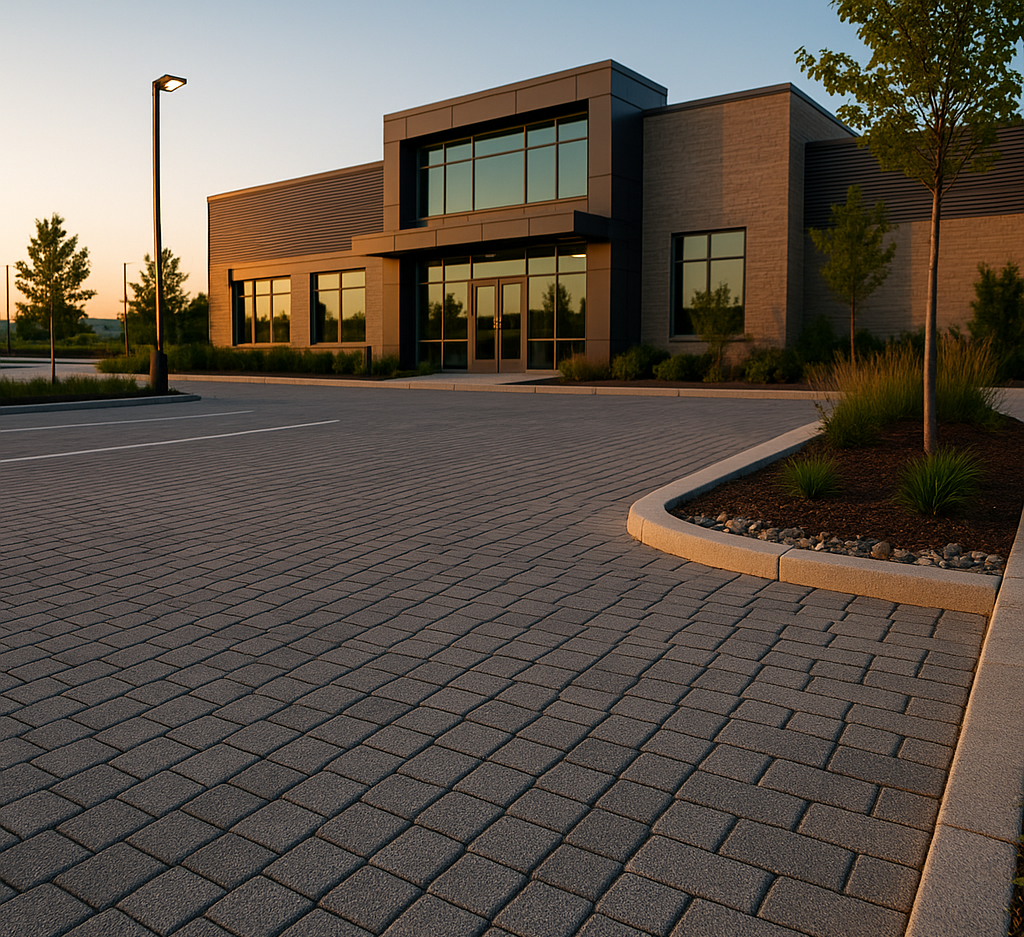
The First Impression Liability
Consider what happens at a Bolton hotel entrance on any given Friday evening. A shuttle bus pulls up from Toronto Pearson, fully loaded with guests. Behind it, a delivery truck idles, waiting to access the service lane. A BMW swings through the porte-cochère, pauses at the valet stand, and the driver steps out directly onto the pavement. In the space of five minutes, three different vehicle types have crossed the entrance surface, each with dramatically different wheel loads, turning radii, and contact pressures. And every single guest who exits those vehicles looks down.
They look down because the pavement is the threshold. It is the transition from the public world to the private world of the hotel. And what they see in that glance—consciously or not—sets the tone for the entire stay. A clean, striking, architecturally intentional surface reads as confidence. A cracked, shifted, faded surface reads as neglect. And a bespoke art feature in the centre of the arrival zone—a compass rose, a geometric inlay, a logo medallion rendered in contrasting high-density stone—reads as something that cannot be replicated by a budget contractor with a truck full of commodity pavers. It reads as investment. As permanence. As a brand that values its physical identity as much as its service.
But here is the liability that most property developers underestimate: a custom paver art feature is exponentially more demanding to engineer than a standard paver installation. Every variable that matters in conventional interlock—sub-base compaction, bedding uniformity, joint stability, edge restraint—matters ten times more in a custom art feature. Because the tolerances are tighter. The cuts are more intricate. The visual consequences of any structural movement are more dramatic. And the traffic loads on a commercial hotel entrance are orders of magnitude greater than anything a residential driveway will ever experience.
Get the engineering right, and the art feature becomes the signature of the property for decades. Get it wrong, and it becomes its most visible embarrassment within a single winter.
The Engineering: Precision Cutting and the Sub-Base Imperative
The Sub-Base: Where Art Begins
Before a single paver is cut, before a single design line is drawn on stone, the foundation must be engineered to a standard that most residential contractors have never been asked to meet.
A hotel entrance in Bolton handles traffic loads that would destroy a typical residential paver installation within months. Airport shuttle buses generate point loads of 4,000 to 6,000 kg per axle. Delivery trucks exceed 8,000 kg. Even luxury SUVs, when turning slowly at the valet stand, concentrate their steering forces into a remarkably small contact patch, generating torsional shear on the paver surface that can twist individual units out of alignment if the bedding layer is not perfectly uniform and the base beneath it is not absolutely rigid.
The sub-base for a commercial hotel entrance art feature must be engineered to highway-grade specifications. This means a minimum of 300 to 400 millimetres of Granular A aggregate base, placed in controlled lifts of no more than 150 mm and mechanically compacted to a minimum of 98 percent Standard Proctor Density. Each lift must be tested with a nuclear density gauge or a plate load test to verify that the compaction target has been achieved. The finished surface of the base must be graded to a tolerance of ±3 millimetres over a 3-metre straightedge—a precision standard that approaches that of a finished floor slab.
Why does this precision matter so much for an art feature? Because a standard running bond or herringbone paver pattern is visually forgiving. If a section settles 5 millimetres over two years, the pattern absorbs the movement. The human eye does not easily detect minor undulations in a repetitive geometric field. But a custom art feature—a compass rose, a logo, a radial starburst—is composed of unique, non-repeating, precision-cut pieces that fit together like a jigsaw puzzle. If any section of the sub-base settles even slightly, the custom-cut pieces in that zone shift relative to their neighbours. Joints open. Edges misalign. The precisely fitted curves and angles that looked flawless on installation day develop visible gaps, steps, and mismatches that are dramatically apparent precisely because the design is intentional and detailed. The art feature amplifies structural movement rather than concealing it.
Precision Wet-Saw Cutting: Zero Margin for Error
The cutting phase is where the artistry and the engineering converge, and it is the phase that separates a genuine hardscape artisan from a contractor who can lay straight lines.
Every custom art feature begins as a full-scale template —a physical or digital pattern drawn at 1:1 scale that maps every cut, every angle, every curve, and every colour transition in the design. For a 3-metre diameter compass rose, this template contains hundreds of individual cut pieces, each one unique in shape and orientation. The template is the bible. Every measurement, every angle, every radius is taken from this document. There is no room for approximation.
The cuts themselves are performed on a commercial-grade wet saw fitted with a diamond blade rated for high-density concrete. Wet cutting is non-negotiable for two reasons. First, the water stream cools the blade and the paver during the cut, preventing the thermal stress cracking that occurs when dry-cutting generates excessive heat at the cut line. A thermally stressed cut produces micro-fractures along the edge of the paver that are invisible at installation but propagate under freeze-thaw cycling, causing the cut edge to spall and deteriorate within one to two winters. Second, the water suppresses the silica dust generated by cutting concrete —a serious occupational health hazard that responsible contractors manage rigorously.
The tolerance for each cut is ±1 millimetre. On a compass rose with 32 points, each point is composed of two converging cuts that must meet at a precise apex. If either cut is off by 2 millimetres, the point is visibly blunt or crooked. Multiply that error across 32 points, and the compass rose looks like it was drawn freehand rather than engineered. At Cinintiriks, we cut, test-fit, and adjust each piece individually before it is placed on the prepared bedding. Pieces that do not meet tolerance are re-cut. There is no forcing, no shimming, no filling oversized joints with extra sand to disguise a poor cut. Every piece fits. Period.
The Bedding Layer: Surgical Precision
Between the compacted sub-base and the paver surface sits the bedding layer—typically 25 to 30 millimetres of screeded concrete sand or, in some high-performance specifications, a fine HPB (High Performance Bedding) aggregate. For a custom art feature, the bedding layer must be screeded to an absolutely uniform thickness across the entire installation zone. Any variation in bedding depth translates directly into variation in the finished surface elevation—and in an art feature where pieces of different shapes and sizes must sit at precisely the same height, even a 2-millimetre bedding inconsistency creates a visible lip between adjacent pieces that catches heels, collects water, and looks unmistakably wrong.
We screed the bedding layer using precision rails set to a fixed height off the compacted base, then remove the rails and fill the voids by hand, trowelling the surface to a finish that is as flat and uniform as a concrete floor. This is not typical of standard interlock installations, where minor bedding variations are absorbed by the repetitive pattern. For art features, it is essential.
Color, Contrast, and the Luxury Aesthetic
The engineering guarantees that the art feature will survive. The colour design guarantees that it will command attention. And the colour design is not an afterthought—it is the primary visual architecture of the entire arrival zone.
The Principle of Contrast Dominance
A custom art feature achieves visual impact through contrast , not complexity. The most striking commercial inlays we have installed across Bolton and the GTA follow a deceptively simple colour strategy: a dark interior against a light field, or vice versa. Two colours. Maximum contrast. Maximum legibility from a distance.
Our signature approach uses deep Charcoal pavers for the intricate interior geometry of the art feature—the compass points, the logo lines, the border bands—set against an expansive field of Warm Off-White pavers that surround the feature and extend across the full width of the entrance. The dark art reads as a precisely rendered graphic element floating on a clean, luminous background. The contrast is dramatic from 30 metres away. Guests see the feature before they see anything else. It becomes the orienting focal point of the entire arrival sequence.
Conversely, a light interior (Warm Off-White or Ivory Cream) against a deep Charcoal or Onyx field creates an equally powerful but tonally inverted effect—a glowing, alabaster medallion emerging from a dark, architectural surround. This approach reads as more contemporary and more dramatic, particularly under evening lighting, where uplights or in-grade LEDs can wash the light-toned art feature while the dark field recedes into shadow.
What does not work is subtlety. A light grey art feature on a medium grey field disappears. The eye cannot resolve the pattern from any meaningful distance. The art becomes visible only when standing directly on top of it, which defeats its purpose as an arrival statement. For a hotel entrance, the feature must be legible, dramatic, and unmistakable from the moment the vehicle enters the property.
Sealer as the Final Colour Lock
Once the art feature is installed and the polymeric sand is cured, a premium film-forming sealer is applied across the entire installation—the art feature and the surrounding field pavers together, in a single unified application. The sealer deepens and enriches every colour it contacts: the Charcoal becomes a true, saturated black; the Warm Off-White gains a warm, creamy depth that reads as natural stone. The contrast between the art feature and its field intensifies dramatically. And the sealer locks that enhanced colour permanently (for the lifespan of the sealer coat) while providing UV protection that prevents the differential fading that would otherwise gradually reduce the contrast over time.
The sealed surface also provides stain resistance that is critical in a hotel environment: vehicle fluid drips, luggage wheel marks, coffee spills, and de-icing salt are repelled by the surface film rather than absorbed into the stone. The art feature remains as clean and vivid after a year of commercial traffic as it was on installation day.
The Cinintiriks Standard for Custom Paver Art Features
At Cinintiriks, we do not lay stones. We execute heavy civil hardscape architecture. Every custom paver art feature we design and install in Bolton and across the GTA follows a rigid, sequenced engineering protocol that addresses every structural, aesthetic, and durability requirement of a commercial hospitality environment.
1. Design Consultation & Full-Scale Templating: We work directly with the property owner, architect, or brand manager to develop the art feature concept. The design is translated into a full-scale template—physical or CAD-generated—that maps every cut piece, every colour zone, and every joint line at 1:1 scale. For corporate logos or brand marks, we work from vector artwork supplied by the client's design team, converting curves and letterforms into paver-compatible geometries that are legible and structurally sound at the installation scale.
2. Paver Selection & Material Procurement: We specify high-density, through-body-coloured interlocking pavers from premium manufacturers. Through-body colouring is essential for art features: if the colour is only a surface treatment, any edge chipping or surface wear from traffic will expose the raw grey concrete beneath, destroying the colour integrity of the design. Through-body pavers maintain their colour to the core, ensuring that cut edges, chamfers, and wear points remain visually consistent over the life of the installation.
3. Commercial-Grade Sub-Base Construction: The excavation is taken to the full calculated depth (typically 450–600 mm below finished grade for commercial traffic applications). Granular A aggregate is placed in controlled lifts and compacted to 98% Standard Proctor Density, verified by nuclear density testing. The finished base is graded to ±3 mm tolerance over a 3-metre straightedge.
4. Precision Bedding Layer: The bedding layer is screeded to a uniform 25–30 mm depth using precision rails. The finished surface is verified with a laser level to ensure absolute planarity across the art feature zone.
5. Wet-Saw Cutting & Test Fitting: Every custom piece is cut on a commercial wet saw with a diamond blade to ±1 mm tolerance. Pieces are test-fitted on a staging area before installation. Non-conforming pieces are re-cut. No piece is installed until it passes dimensional verification.
6. Art Feature Installation: The custom-cut pieces are placed in sequence according to the template, working from the centre of the design outward. Each piece is set into the bedding, aligned to its neighbours, and checked for height, joint width, and pattern accuracy. Border bands and transition pieces are installed to create a clean, defined edge between the art feature and the surrounding field pavers.
7. Field Paver Installation: The surrounding field pavers are installed around the completed art feature, working outward toward the edge restraints. Cut pieces at the interface between the field and the art feature are individually measured and wet-cut for a seamless transition.
8. Compaction & Polymeric Sand Installation: The completed surface is plate-compacted with a rubber-padded compactor to seat all units into the bedding layer. Premium polymeric sand is swept into every joint, compacted, cleaned from the paver faces, and water-activated. The polymeric sand is selected to complement the colour design: Charcoal sand in Warm Off-White field joints for maximum contrast; matching sand tones within the art feature for visual cohesion.
9. Cure Period & Sealer Application: After the polymeric sand has fully cured (24–72 hours), a premium film-forming sealer is applied via spray-and-back-roll across the entire installation. Two thin coats with proper flash-off time. The sealer deepens colour, enhances contrast, stabilizes joints, and provides UV and stain protection.
10. Final Inspection & Documentation: The completed installation is inspected for joint uniformity, sealer coverage, pattern accuracy, and structural soundness. We photograph the finished feature for the client's records and provide a detailed maintenance specification covering seasonal cleaning, re-sealing intervals, and de-icing product guidelines for the commercial environment.
This is The Cinintiriks Standard for bespoke hardscape art. It is precision cutting married to heavy civil engineering, executed with the patience and discipline that a commercial hospitality environment demands. The surface is art. The infrastructure beneath it is industrial. And the result is a hotel entrance that tells every arriving guest, before they say a word to the concierge, that this property does not compromise.
"A hotel entrance is not a driveway. It is the opening line of a story. Make sure the first thing your guests read in the pavement is confidence."
Design Possibilities: Beyond the Compass Rose
While the compass rose is perhaps the most iconic paver art feature—and for good reason, its radial geometry lends itself beautifully to the precision of interlocking stone—the vocabulary of custom paver art extends far beyond a single motif.
Corporate logos and brand marks: For hotel chains, a rendered logo embedded in the entrance pavement is a powerful brand reinforcement. The logo is visible to every guest, every visitor, and every vehicle that crosses the threshold. It is permanent, weatherproof, and impossible to ignore. We have translated complex vector logos into paver geometries for commercial clients across the GTA, working from brand guideline colour palettes and minimum size specifications to ensure the mark is legible and accurate at installation scale.
Geometric medallions and starbursts: Concentric circles, radial lines, and interlocking geometric patterns create a sense of order and intentionality that reads as classical architecture. These designs are particularly effective at large scales—3 to 5 metres in diameter—where the pattern fills the visual field of the arriving guest and establishes the entrance as a distinct architectural zone within the property.
Wayfinding borders and accent bands: Not all custom paver art needs to be a centrepiece. Contrasting border bands, directional arrows, and colour-delineated zones can guide vehicle and pedestrian traffic through a complex commercial entrance, combining functional wayfinding with aesthetic sophistication. A deep Charcoal border band separating the vehicular lane from the pedestrian walkway is simultaneously a safety feature and a design element—a line that says "this side is for guests on foot" without the need for painted markings or bollards.
Longevity Under Commercial Traffic
The question that every hotel developer and property manager asks is: how long will this last? The answer depends entirely on the quality of the engineering beneath the surface.
A custom paver art feature installed on a properly engineered commercial sub-base, with high-density through-body-coloured pavers, premium polymeric sand, and a properly maintained sealer program, will perform for 20 to 30 years with routine maintenance. The pavers themselves are rated for compressive strengths exceeding 50 MPa—they will not crush or fracture under commercial traffic loads. The sub-base, compacted to highway-grade density, will not settle or shift under normal loading conditions. The polymeric sand will require periodic replenishment (typically every 5 to 8 years in a high-traffic zone), and the sealer will require recoating every 3 to 5 years. These are predictable, budgetable maintenance inputs that preserve the original investment.
A custom art feature installed on a substandard base by a contractor who cut corners on compaction and bedding precision will begin showing distress within 2 to 3 years: joint separation, surface undulation, edge chipping from differential movement, and the slow, visible destruction of the pattern integrity. The correction is catastrophic: full removal, base reconstruction, and complete reinstallation. On a commercial hotel entrance, this means weeks of disruption to guest access and a cost that dwarfs the original installation.
The sub-base is the insurance policy. Every dollar invested in base engineering is a dollar that protects the art feature above it for decades.
FAQ: Custom Paver Art for Commercial Entrances
Can you create a custom corporate logo inlay using interlocking pavers for a commercial driveway?
Yes, absolutely. Any graphic element that can be expressed as a vector outline—a logo, a monogram, a brand mark, a crest—can be translated into a paver inlay. The process begins with the client's vector artwork (typically an AI, EPS, or SVG file from their brand guidelines). We convert the artwork into a full-scale paver template, simplifying curves and fine details as necessary to ensure the design is structurally executable at the installation scale. Very fine lines (less than approximately 40 mm wide) and very tight curves may need to be slightly adjusted, because interlocking pavers have a minimum practical cut width below which the piece becomes too fragile to survive traffic and freeze-thaw cycling. Within these constraints, the fidelity to the original artwork is remarkable. We select paver colours that match the brand palette as closely as the available manufacturer ranges allow, and we use through-body-coloured units to ensure the colour integrity survives decades of wear. The result is a permanent, weatherproof brand statement embedded directly into the entrance pavement—visible to every guest, every delivery driver, and every visitor who crosses the threshold.
Will a highly detailed paver art feature shift or crack under heavy commercial shuttle traffic?
Not if the sub-base and installation are engineered to commercial-grade specifications. The pavers themselves are rated for compressive strengths exceeding 50 MPa (7,250 psi) —they will not crack under the wheel loads of shuttle buses, delivery trucks, or any standard commercial vehicle. The risk of shifting or cracking comes entirely from the foundation, not the surface. If the sub-base is compacted to 98% Standard Proctor Density, graded to ±3 mm tolerance, and the bedding layer is screeded to uniform depth, the custom-cut pieces will remain locked in position under commercial traffic indefinitely. If the sub-base is undercompacted or the bedding layer is uneven, differential settlement will cause individual pieces to shift, open joints, and eventually spall at the edges as they grind against each other under load. This is why commercial paver art features must be installed by crews that understand heavy civil base construction—not by surface-only installers who treat the base as an afterthought. At Cinintiriks, we verify sub-base compaction with instrument testing on every commercial project. The base work is not assumed; it is measured.
What type of joint sand is required to lock intricate, custom-cut pavers permanently in place?
Premium polymeric sand is the only acceptable joint material for custom paver art installations. Standard kiln-dried sand provides no lateral locking force; it relies entirely on gravity and compression and will migrate out of intricate, narrow joints within the first season of traffic and weather exposure. Polymeric sand—a blend of calibrated quartz aggregate and chemical polymer binders—is water- activated to form a semi-rigid bonded matrix that locks each paver to its neighbours through the joint. This bonded matrix resists water erosion, prevents weed germination, deters insect excavation, and critically, provides the lateral shear resistance needed to prevent custom-cut pieces from shifting under the torsional loads generated by turning vehicles. For art features with very narrow joints (which intricate cuts often produce), we specify a fine-grade polymeric sand designed for joint widths as narrow as 1 mm—standard polymeric sand contains aggregate particles that are too coarse to fully penetrate narrow joints, leaving voids that compromise the bond. The polymeric sand must be fully cured (24–72 hours minimum) before the sealer is applied, and it must be replenished periodically (every 5–8 years) as it degrades under UV exposure and traffic wear.
The Final Word
A custom paver art feature is the single most impactful design element you can install at a hotel or commercial entrance. Nothing else in the hardscape vocabulary communicates permanence, precision, and brand confidence as immediately or as viscerally as a bespoke stone inlay under the wheels and feet of arriving guests.
But it is not a decoration. It is a piece of structural engineering that must be designed, cut, and installed to tolerances that most contractors never encounter. The sub-base must be highway-grade. The cuts must be millimetre-perfect. The colour contrast must be architecturally deliberate. And the joint material and sealer must be commercial-grade products applied with professional precision.
Don't let amateur cuts and a weak foundation ruin your commercial arrival experience. Contact Cinintiriks for heavily engineered, bespoke paver art installations in Bolton.