The patio is too big for the furniture. Or the furniture is too big for the patio. Or the dining table is so close to the lounge chairs that your dinner guests are bumping elbows with your after-dinner cocktail guests. Or there is no visual separation between the two areas, so the entire space reads as one disorganised blob of stone and furniture with no architectural hierarchy and no sense of purpose.
This is the most common and most expensive design failure in luxury residential hardscaping: building a patio as a flat, undifferentiated surface and then attempting to create “zones” by simply placing furniture on top of it. It does not work. No amount of gorgeous teak furniture or designer cushions can impose structure on a surface that has none. Zones are not created by furniture. Zones are engineered into the hardscape.
This guide explains how to engineer a patio that contains two distinct, intentional outdoor rooms—a formal dining zone and a casual lounge zone—that flow seamlessly into each other while maintaining clear spatial identity, comfortable circulation, and the architectural presence of spaces that were designed, not improvised.
The Art of Zoning: Why Flat Patios Feel Empty
Walk through any five-star resort. The pool terrace, the outdoor restaurant, the cocktail lounge, the sunset bar—each is a distinct space with its own character, its own furniture, its own lighting, and its own overhead plane. Yet they all exist on the same property, often on the same continuous surface, and they all feel like they belong together. The resort does not achieve this with furniture alone. It achieves it with spatial architecture: elevation changes, material transitions, overhead structures, focal anchors, and intentional circulation paths that tell the body and the eye exactly where one room ends and the next begins.
Your backyard is a smaller canvas, but the principles are identical. A luxury outdoor living space needs rooms. Not walls—you are outdoors; walls defeat the purpose. But definitive spatial cues that create the feeling of distinct rooms within a continuous outdoor environment. The dining zone should feel like a dining room. The lounge zone should feel like a living room. And the transition between them should feel natural, intuitive, and effortless.
In Toronto, where residential lot widths typically range from 25 to 40 feet in the established neighbourhoods of Etobicoke, North York, Scarborough, and the inner suburbs, and rear yard depths often sit between 30 and 60 feet, zoning discipline is not merely a design preference. It is a spatial necessity. On a 30-foot-wide lot, the available patio width after setbacks and side-yard access is typically 22 to 28 feet. That is enough for two well-proportioned zones—but only if the spatial engineering is precise. Wasted space, oversized circulation paths, or poorly proportioned zones will make the patio feel either cramped or empty. Neither is acceptable on a $100,000+ outdoor living investment.
The Spatial Engineering: Footprints, Clearances, and Flow
Before any creative design decisions are made—before pergola styles, fire feature shapes, or furniture collections are discussed—the hard math of spatial engineering must be resolved. These are the non-negotiable dimensional requirements that determine whether a zone is comfortable or dysfunctional.
The Dining Zone Footprint
A formal outdoor dining zone must accommodate the dining table, all chairs in the fully pulled-out position, and a minimum circulation clearance around the table perimeter so that a person can walk behind a seated guest without physical contact.
The critical dimensions:
- 6-person rectangular table (approx. 1800mm x 900mm): Minimum zone footprint of 3.6m x 3.0m (12’ x 10’). This provides 900mm of clearance on all sides of the table—enough for chairs to be pulled fully out (typically 600mm behind-chair depth) plus 300mm for a standing person to pass behind the seated guest
- 8-person rectangular table (approx. 2400mm x 1000mm): Minimum zone footprint of 4.2m x 3.0m (14’ x 10’). The table is longer, so the zone extends longitudinally, but the lateral clearance remains at 900mm per side
- 8-person round table (approx. 1500mm diameter): Minimum zone footprint of 3.3m x 3.3m (11’ x 11’). Round tables require equal clearance in all directions, creating a circular zone. The 11-foot diameter is the absolute minimum—below this, chairs at the rear of the table cannot be fully pulled out without hanging over the patio edge or encroaching into adjacent zones
These are minimums. A luxury dining zone with comfortable proportion typically adds 300-600mm additional clearance on the primary service sides (the sides where food is brought to the table from the kitchen zone), bringing the total footprint for an 8-person rectangular table to approximately 4.5m x 3.6m (15’ x 12’)—roughly 16 square metres of dedicated paver surface for the dining zone alone.
The Lounge Zone Footprint
The lounge zone is the counterpart to the dining room: a casual, low-seated gathering area designed for post-dinner drinks, conversation, and relaxation. The furniture is different—deep sectional sofas, low club chairs, a central coffee table or fire table—and the spatial requirements are different.
- L-shaped sectional sofa (approx. 2700mm x 2700mm): The sofa footprint alone consumes a 2.7m x 2.7m area. Add 600mm of front clearance (the distance between the sofa edge and the coffee table or fire table), the central table itself (typically 1200mm x 700mm), 600mm of clearance on the opposite side for access, and one or two club chairs—and the total lounge zone footprint extends to approximately 4.0m x 4.0m (13’ x 13’)—roughly 16 square metres
- Circular fire pit seating arrangement: A built-in fire pit (900-1200mm diameter) surrounded by curved seating walls or individual Adirondack-style chairs arranged in a circle requires a minimum 4.5m (15’) diameter zone to maintain comfortable distance from the flame and adequate passage behind the seating
The Transition Zone
Between the dining and lounge zones, a transition corridor of minimum 1.2m (4’) width must exist. This is the movement path that allows a person carrying a tray of drinks to walk comfortably from the kitchen or dining zone to the lounge zone without navigating through furniture. In practice, the transition zone is often wider—sometimes incorporating a built-in seating wall or a planting strip that doubles as a spatial divider and a rest point.
Total Patio Footprint
Adding the dining zone (~16m²), the lounge zone (~16m²), the transition corridor (~5m²), and any additional service circulation along the patio perimeter (~5-8m²), the minimum total patio footprint for a properly proportioned two-zone outdoor living space is approximately 42-45 square metres (450-480 square feet).
On a typical Toronto lot with a 25-foot rear yard width (after setbacks), this translates to a patio approximately 7.5m wide x 6.0m deep (25’ x 20’)—which is achievable on most established Toronto properties. On wider lots in areas like The Kingsway, Leaside, Lawrence Park, or the newer developments in Downsview and Willowdale, the patio can expand to 10-12m in width, allowing more generous zone proportions, wider transition corridors, and the addition of ancillary zones (a dedicated fire pit circle separate from the lounge, a reading nook, or a yoga/meditation pad).
“A two-zone patio that feels spacious on a 25-foot lot is not a question of magic. It is a question of mathematics. Every square metre has a job. None of them are wasted.”
Visual Zone Separation: Paver Banding and Elevation Changes
With the zone footprints established, the next question is how to make the zones visually distinct without building walls or disrupting the continuity of the outdoor experience. There are two primary techniques, and the most effective installations use both.
Paver Banding (Flush Colour Transition)
A 300-600mm band of Deep Charcoal pavers laid as a flush, continuous stripe between the dining and lounge zones creates a visual threshold that the eye reads as a room boundary. The banding sits at the same elevation as the surrounding Warm Off-White field—there is no trip hazard, no step, no physical barrier of any kind. But the tonal shift from Off-White to Charcoal and back to Off-White creates a floor pattern that the brain interprets as a doorway. You have crossed from one room into another.
This is the same technique that luxury hotels use in their lobby flooring: a band of dark marble running between the reception area and the lounge bar. No wall. No signage. Just a colour change in the floor. And every guest instinctively understands that they have moved from one space into another.
The banding should align with the Charcoal border system that frames the overall patio perimeter. When the interior zone-dividing band connects to the exterior perimeter border, the floor plan reads as a composed, intentional grid—a visual architecture that communicates design at every scale. The dining zone is a defined rectangle of Off-White within a Charcoal frame. The lounge zone is a second defined rectangle. Both sit within the larger Charcoal perimeter frame. The hierarchy is clear. The intention is unmistakable.
Structural Elevation Change (Step-Down Transition)
A more dramatic zone separation technique is a single step-down (typically 150mm/6”, which is one standard riser height) between the dining zone and the lounge zone. The dining zone, positioned adjacent to the house and typically at or near the door threshold elevation, becomes the upper terrace. A single structural step descends to the lounge zone, which becomes the lower terrace.
The elevation change accomplishes several things simultaneously:
- Definitive spatial separation: The step is a physical boundary that the body must negotiate. There is no ambiguity about where dining ends and lounging begins. The two zones are literally on different planes
- Improved sightlines: Guests seated in the upper dining zone can see over the lower lounge zone to the garden, fire feature, and landscape beyond. The elevation difference creates a stadium-like sightline that expands the perceived depth of the property. On a compact Toronto backyard, this depth perception is transformative
- Natural drainage direction: The step-down inherently directs surface water away from the house (from upper terrace to lower terrace) and toward the rear of the property, supporting the OBC-required grading away from the foundation. The elevation change is structural engineering and drainage engineering in a single detail
- Seating wall opportunity: The step-down can incorporate a built-in seating wall along the upper terrace edge, providing informal perimeter seating for the lounge zone. Guests sit on the wall cap with their feet on the lower terrace surface, facing the fire feature. This eliminates the need for additional lounge chairs and dramatically increases casual seating capacity without adding furniture
In Toronto, where the Ontario Building Code requires a guard (railing) at any elevation change exceeding 600mm, a single 150mm step-down is well below the guard threshold. Two consecutive step-downs (300mm total) still remain below the threshold. Three or more step-downs (450mm+) approach the guard requirement and must be evaluated on a project-specific basis. For most residential two-zone patios, a single 150mm step is the optimal balance of spatial impact and code compliance.
Anchoring the Zones: Overhead Structures and Focal Points
Zone boundaries defined by banding and elevation changes establish where each room is. Anchoring elements establish what each room feels like. They give each zone its character, its emotional identity, and its reason for existing.
The Dining Zone Anchor: The Overhead Structure
A formal outdoor dining experience requires a sense of enclosure. Not full enclosure—you are outdoors, and the openness is the point. But partial enclosure: a defined overhead plane that tells the brain, “This is a room.” Without an overhead element, the dining zone is furniture on a floor with an infinite ceiling. With it, the dining zone is an outdoor dining room with a sense of proportion, intimacy, and architectural intention.
The overhead structure for the dining zone is typically:
- A timber or composite pergola in Rich Walnut: Open-beam construction that allows dappled sunlight and rain to pass through while creating an architectural ceiling plane that defines the dining room. The Walnut finish ties to the broader outdoor colour palette (the Signature Triad) and introduces the organic warmth that counterbalances the mineral tones of the Off-White and Charcoal hardscape below
- A fully roofed pavilion with louvred or solid roof: A more protective structure that provides complete rain and UV coverage, extending the usable dining season from May through October in Toronto. A louvred roof (motorised slats that open for sun and close for rain) provides the ultimate flexibility—open-air dining on clear evenings, fully covered dining during summer thunderstorms. A pavilion requires P.Eng. stamped structural drawings for the City of Toronto building permit, and the post footings must be designed for Ontario wind and snow load requirements
The overhead structure should match the dining zone footprint precisely. A pergola that covers only half the dining table creates an awkward composition. A pergola that extends far beyond the dining zone clutters the visual hierarchy by blurring the boundary between dining and transition. The pergola outline is the dining room outline. They are the same shape on the plan.
The Lounge Zone Anchor: The Fire Feature
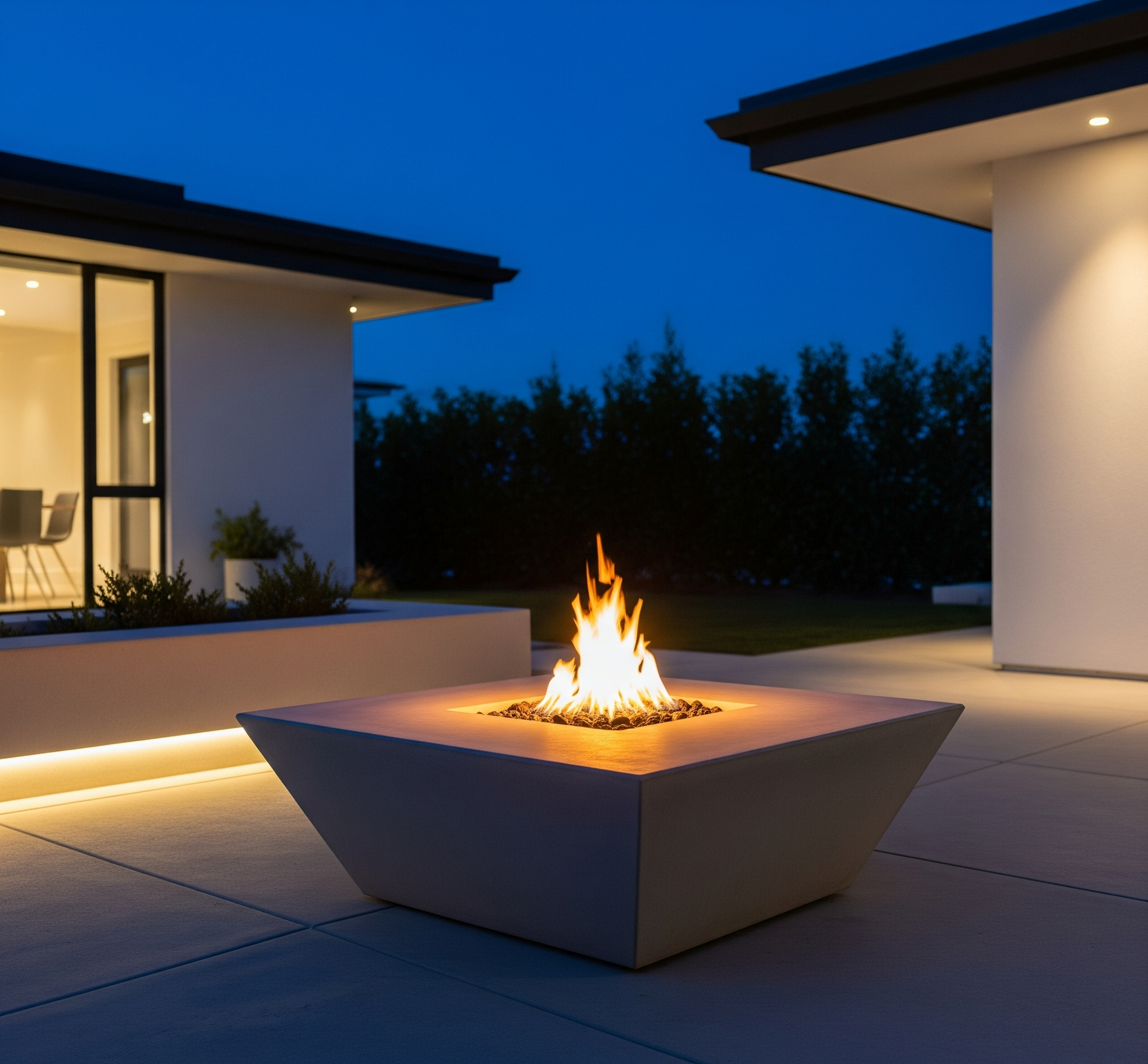
If the dining zone’s anchor is above (the overhead structure looking down), the lounge zone’s anchor is at the centre (the fire feature drawing everyone in). A custom-built, low-profile masonry fire table or fire pit positioned at the centre of the lounge zone creates a natural gravitational focal point—the element that every seat in the lounge faces, every conversation orbits, and every eye returns to.
The fire feature specification for a luxury lounge zone:
- Fuel type: Natural gas (connected to the house supply through a buried, pressure-tested gas line pre-run during Phase 1 earthwork) for clean, instant, unlimited-duration flame. Propane is an acceptable alternative but requires a concealed tank storage solution that does not compromise the visual aesthetics of the kitchen or lounge zone. Wood-burning fire pits are prohibited in many Toronto neighbourhoods under the City of Toronto Open Air Burning Bylaw (Chapter 423) and produce ash, smoke, and ember output that damages furniture, stains pavers, and creates nuisance complaints from neighbours on typical Toronto lot densities
- Construction: Built-in masonry construction on a dedicated structural concrete footing (identical in specification to the outdoor kitchen footing—200mm reinforced concrete, independent of the paver bedding system). The fire table shell is constructed from CMU block, clad in Deep Charcoal stone veneer that matches the patio border and retaining wall palette, and topped with a polished granite or concrete cap that surrounds the fire pan. The cap provides a flat surface for setting drinks—a functional detail that transforms the fire table from a sculpture into a piece of living furniture
- Scale: The fire table should be proportional to the lounge zone footprint. A 1200mm x 600mm rectangular fire table or a 900mm diameter round fire bowl is appropriate for a standard 4.0m x 4.0m lounge zone. Oversized fire features consume too much floor area and push seating to the zone perimeter, creating an uncomfortably wide gap between opposite seats. Undersized fire features lack visual presence and fail to anchor the zone
“The dining zone looks up and sees its pergola. The lounge zone looks in and sees its fire. Each zone knows what it is because each zone has an anchor that defines it.”
The Furniture Strategy: Permanent vs. Flexible
With the hardscape zones engineered and the anchoring elements in place, the furniture selection becomes a question of material quality, scale, and permanence.
Dining Furniture
Outdoor dining furniture for a luxury Toronto patio should be all-weather construction rated for year-round outdoor exposure. The most durable and visually appropriate options:
- Teak: Grade-A plantation teak weathers to a silver-grey patina over 12-24 months (which can be maintained in its original honey tone with annual teak oil application). Teak is naturally rot-resistant, insect-resistant, and dimensionally stable through humidity and temperature cycling. A quality teak dining set is a 20-year investment that ages gracefully on a Warm Off-White patio surface
- Powder-coated aluminium: Lightweight, rust-proof, and available in matte black or charcoal finishes that complement the Charcoal hardscape palette. Aluminium frames with Sunbrella-fabric cushioned seats provide the most comfortable outdoor dining experience and resist UV fading for 5-8 years before fabric replacement is needed
- Concrete composite tables: For a monolithic, architectural look, concrete-top dining tables (on powder-coated steel or aluminium bases) create a material conversation between the paver surface and the table surface. The concrete table becomes part of the hardscape rather than sitting on top of it
Lounge Furniture
Lounge zone seating should be low, deep, and inviting—the opposite of the upright, formal dining posture. Deep-seated sectional sofas (500-550mm seat depth) in weather-resistant wicker, aluminium-frame, or marine-grade HDPE construction provide the casual, reclined comfort that differentiates the lounge from the dining zone. The lower seating height (350-400mm vs. 450mm for dining chairs) creates a visual hierarchy that reinforces the zone distinction—the dining zone is upright and active, the lounge zone is reclined and relaxed.
On Toronto patios with a step-down between zones, the lounge furniture’s lower seat height combined with the lower terrace elevation creates a pronounced visual separation from the dining zone above. Guests in the dining zone look down at the lounge. Guests in the lounge look up at the dining. The two spaces are in visual contact but physically distinct—the same relationship as a sunken living room and an adjacent dining room in high-end interior architecture.
Lighting the Zones: Two Moods, One System
Each zone requires a lighting scheme that reinforces its character. The dining zone needs warm, even overhead illumination from fixtures integrated into the pergola or pavilion structure—pendant lights, recessed downlights, or suspended string lights at 2700K, providing comfortable brightness for seeing food and faces without producing the harsh glare of a task-lit kitchen. The atmosphere should feel like a candlelit restaurant.
The lounge zone needs low, ambient illumination from the fire feature’s natural flame, supplemented by subtle 2700K LED lighting sources: under-cap wash on seating walls, toe-kick glow on the fire table base, and soft uplighting in adjacent planting beds. The atmosphere should feel like a boutique hotel lobby bar—intimate, warm, and deliberately dim.
Both zones share the same 2700K colour temperature and the same smart transformer system with independent zone dimming. The dining zone operates at 60-80% brightness during dinner, then dims to 30% after the table is cleared. The lounge zone operates at 30-40% brightness all evening, letting the fire feature provide the primary illumination. The transition between “dinner mode” and “lounge mode” is a single tap on the smartphone app.
The Cinintiriks Approach: Exterior Architecture, Not Patio Decoration
At Cinintiriks, we do not build square patios and hope that furniture placement creates the zones. We engineer the zones into the hardscape itself—into the paver layout, the elevation changes, the structural footings, the overhead structures, and the lighting infrastructure—so that the zones exist with or without furniture on them.
The Cinintiriks Standard: Functionally Zoned Outdoor Living
1. Furniture Footprint Calculation at Design Phase: Before the patio shape is finalised, we calculate the exact spatial footprint for every piece of furniture that will occupy the space: dining table with all chairs in the fully extended position, lounge sectional at full depth, fire table with clearance, and all circulation paths at minimum 1.2m width. These footprints are drawn to scale on the master plan. The patio is sized to fit the furniture—the furniture is not forced to fit the patio.
2. Charcoal Banding Zone Separation: Every two-zone Cinintiriks patio includes a 300-600mm Deep Charcoal paver band at the dining-to-lounge transition, integrated into the Charcoal perimeter border system. The banding creates a visual floor plan that reads as composed architectural geometry—two defined rooms within a framed composition.
3. Structural Elevation Engineering: Where lot grading and budget permit, we engineer a single 150mm step-down from the dining terrace to the lounge terrace. The step incorporates a Charcoal tread with contrasting Off-White riser for high-visibility safety, and frequently integrates a built-in seating wall along the upper terrace edge that provides additional lounge seating without additional furniture.
4. Overhead Dining Structure: Every Cinintiriks dining zone is anchored by an overhead structure—pergola or pavilion—finished in Rich Walnut and proportioned to match the dining zone footprint exactly. P.Eng. stamped structural drawings are provided for all roofed structures, with the Toronto building permit managed entirely by our team.
5. Built-In Fire Feature on Dedicated Footing: Every Cinintiriks lounge zone includes a custom-built masonry fire table or fire pit on a dedicated 200mm reinforced concrete footing, clad in Deep Charcoal veneer to match the patio border palette, and plumbed with a natural gas supply line buried during Phase 1 earthwork. The fire feature is built into the hardscape, not placed on top of it.
6. Integrated Lighting with Zone Dimming: Dining zone overhead fixtures and lounge zone ambient fixtures operate on independent smart transformer zones at 2700K, with all wiring pre-run through sub-base conduits, CMU cores, and pergola/pavilion chases. The homeowner controls each zone independently via smartphone, transitioning the patio from dinner-party brightness to after-dinner lounge atmosphere with a single tap.
Don’t build a cramped, poorly planned patio. Contact Cinintiriks for flawlessly zoned, heavily engineered outdoor living spaces in Toronto.
FAQ: Outdoor Dining and Lounge Zones
How much patio space do I actually need to fit an 8-person outdoor dining table comfortably?
For an 8-person rectangular dining table (approximately 2400mm x 1000mm), you need a dedicated dining zone footprint of at least 4.2m x 3.0m (14’ x 10’)—approximately 13 square metres. This provides 900mm of clearance on all sides of the table: 600mm for the fully extended chair depth plus 300mm for a person to walk behind a seated guest carrying a plate or a drink. If you want a more generous, luxury-level dining experience—think restaurant spacing rather than cafeteria spacing—add 300-600mm to all sides, bringing the zone to approximately 4.8m x 3.6m (16’ x 12’) or roughly 17 square metres. For a round table seating 8 (1500mm diameter), the minimum zone is a 3.3m x 3.3m (11’ x 11’) square—approximately 11 square metres. Round tables are slightly more space-efficient than rectangular tables because the clearance is radial rather than rectilinear, but they require a more symmetrical patio shape to look intentional. Remember: the dining zone footprint is just the dining room. You still need the lounge zone (~16m²), the transition corridor (~5m²), and perimeter circulation—so a full two-zone patio with an 8-person dining table totals approximately 45-50 square metres (480-540 sq ft) of continuous paver surface. On a standard Toronto lot, this is a patio approximately 7.5-8m wide by 6-6.5m deep.
Can I use different colored paver borders to separate my lounge from my dining area?
Yes—this is exactly how professional outdoor living zones are visually defined, and it is one of the most effective and simplest techniques available. A 300-600mm band of Deep Charcoal pavers laid flush within the Warm Off-White patio field creates a visual threshold between zones. The colour shift is read by the eye as a room boundary—the same principle used in luxury hotel lobby flooring, where a band of dark marble separates the reception from the lounge. There is no trip hazard, no elevation change, no physical barrier. Just a colour change in the floor that the brain interprets as a doorway. The banding should connect to the Charcoal perimeter border that frames the overall patio. When the interior zone-dividing band ties into the exterior border, the plan reads as a composed, intentional grid—two rooms within a larger frame. Avoid using a third colour for the banding. Introducing a third paver colour (e.g., a brown or tan accent band between the Off-White and Charcoal) breaks the two-tone discipline and introduces visual noise. The Charcoal band works precisely because it is the same tone used in the borders, the retaining walls, and the kitchen island veneer. It is part of the established palette, not an addition to it. One banding colour. One purpose. Maximum impact.
Should my outdoor dining table be placed closer to the house doors than my lounge area?
Yes, in almost every case. The dining zone should be positioned adjacent to the house (typically directly outside the kitchen or patio doors) for two practical reasons. First, service flow: food, dishes, utensils, and drinks are carried from the indoor kitchen to the outdoor dining table. The shorter the distance, the more functional the dining experience. A dining table at the far end of the patio, with the lounge zone between the house and the table, forces the host to carry every plate, glass, and condiment through the lounge zone—stepping over lounge furniture, navigating around the fire table, and disrupting seated lounge guests with every trip. Second, elevation logic: on sloping Toronto lots (which are the majority, as properties are graded to drain away from the house), the dining zone adjacent to the house sits at a higher elevation than the lounge zone at the rear. This creates the natural step-down transition described earlier, with the dining terrace overlooking the lounge terrace and the garden beyond. The reverse arrangement (lounge near the house, dining at the rear) requires either stepping up from the house to the lounge (an unnatural elevation gain that fights the site grading) or reversing the drainage direction (directing water toward the house foundation, which violates the Ontario Building Code). The house-adjacent dining arrangement aligns function, grading, drainage, and spatial hierarchy into a single, natural layout.
The Final Word
A luxury outdoor dining and lounge space does not happen by accident. It does not happen by buying beautiful furniture and arranging it on a flat patio. It happens by engineering the zones into the hardscape—by calculating the exact footprints, by defining the boundaries with paver banding and structural elevation, by anchoring each zone with an overhead structure or a ground-level focal point, and by tying the entire composition together with a unified lighting system that transitions from dinner to after-dinner with a single tap.
The result is not a patio with furniture on it. It is an outdoor home—with a dining room, a living room, and the architectural intention that makes both feel like they were always meant to be exactly where they are.
That is The Cinintiriks Standard. Not furnished. Architected.