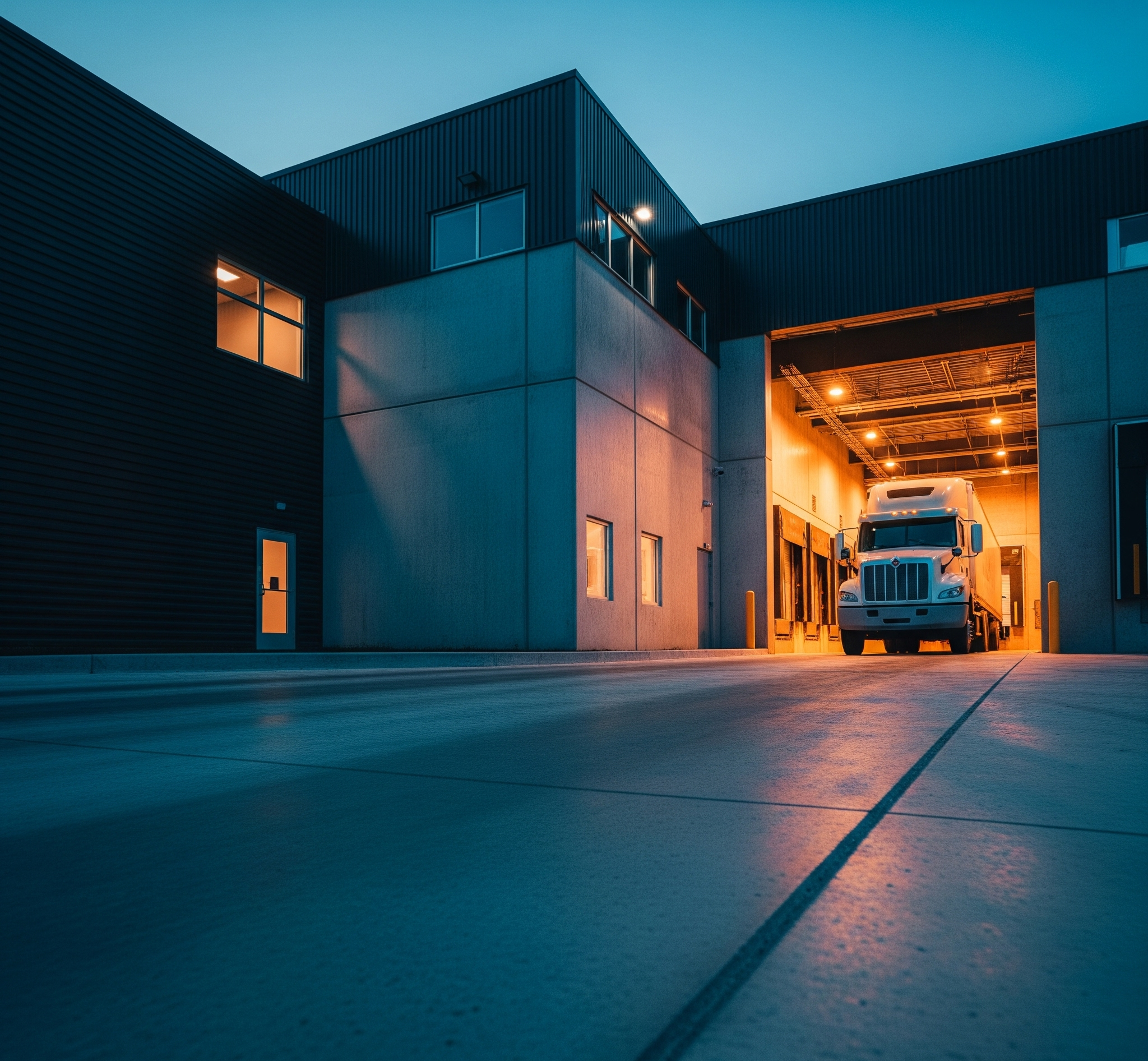
You manage an active commercial logistics yard. Every day, multi-ton equipment, long-haul transport trucks, and heavy civil machinery roll into your facility caked in frozen mud, heavy petrochemical greases, and highly corrosive winter de-icing salts. Cleaning this machinery is not optional; it is a critical maintenance requirement to prevent mechanical failure and ensure safe fleet operations. And as every facility manager in the Greater Toronto Area knows, cold water simply does not strip heavy grease or melt winter ice. You need boiling hot water under extreme pressure. But when you blast 200-degree boiler water onto a standard industrial pavement in the middle of a brutal Ontario winter, you initiate a violent chain reaction of thermal physics that will systematically destroy your yard.
Adding a dedicated hot water wash bay in Brampton is not a simple plumbing exercise. It is a highly specialized feat of commercial wash pad engineering. It requires managing the catastrophic forces of industrial concrete thermal shock, the immense static and dynamic point loads of the equipment, and the strict environmental compliance laws governing toxic runoff. This is not a project for a standard paving crew. It is a heavy civil engineering mandate. At Cinintiriks, we handle the deep excavation, the complex hydrology, and the structural concrete placement required to deliver a bulletproof, fully compliant heavy equipment cleaning station that keeps your fleet moving without shattering the ground beneath it.
The Thermal Shock Dilemma: Why Standard Asphalt Fails
To understand the engineering behind a hot water wash-down pad, you first must understand why you cannot simply park a transport truck on your existing asphalt lot and fire up a high-temperature pressure washer. The problem lies in the fundamental material science of asphalt and the brutal physics of temperature differentials.
Standard commercial asphalt is a viscoelastic material. It is composed of aggregate (stone) bound together by petroleum-based bitumen. Bitumen is highly temperature-sensitive. Under normal ambient conditions, it remains relatively stable. However, when you blast 200-degree Fahrenheit (93-degree Celsius) water onto an asphalt surface, the thermal energy instantly begins to melt and liquefy the bitumen binders holding the pavement together. The high-pressure stream then physically scours the liquefied binder away, unravelling the aggregate matrix and creating immediate, catastrophic potholes and surface degradation.
But the problem is even more violent during a Brampton winter. Imagine a scenario in late January: the ambient temperature of your logistics yard is -15°C. The asphalt or standard concrete surface has contracted, and frost has penetrated deep into the sub-grade. Suddenly, you introduce a sustained volume of 90°C water to melt a thousand pounds of ice off a dump truck. You are subjecting the pavement to an instantaneous temperature differential of over 100 degrees Celsius. This induces severe thermal shock.
Thermal shock occurs when a rapid change in temperature causes different parts of an object to expand by different amounts. The uppermost surface of the pavement, superheated by the boiling wash water, attempts to expand violently outward. Meanwhile, the core of the pavement and the frozen sub-grade below remain contracted and rigidly immobile. This massive differential in the coefficient of thermal expansion creates immense sheer stress within the material matrix. Standard asphalt cannot handle this stress; it unspools and delaminates. Standard poured concrete, which lacks the tensile strength to resist sudden sheer forces, simply shatters. The surface will crack, spall, and heave, rendering the area a structural liability within a single winter season.
Therefore, the very first rule of industrial wash-down capability is isolation. You cannot wash heavy equipment on your main yard. You must construct a dedicated, structurally isolated wash pad engineered specifically to absorb and dissipate these extreme thermal gradients without failing.
Architecting the Wash Bay: High-PSI Concrete and Boiler Integration
The core of your hot-water wash station is the concrete slab itself. This is not the standard 32 MPa concrete used for residential driveways or pedestrian walkways. To survive both the immense point loads of a fully loaded transport truck and the violent expansion and contraction cycles of thermal shock, you must utilize heavily reinforced, high-strength commercial concrete.
The engineering process begins with the sub-base. The excavation must extend far below the frost line. In Brampton, this often means excavating down to 1.2 metres (4 feet) to ensure the native clay soils do not heave beneath the pad. We install a massive engineered reservoir of clear, crushed limestone, compacted in rigid lifts to 98% Standard Proctor Density. This structural granular base provides the necessary bearing capacity to support the heavy civil loading and acts as a free-draining layer to prevent frost accumulation directly beneath the slab.
Next is the concrete mix design. A commercial wash pad requires a high-PSI concrete mix, typically exceeding 45 MPa (6,500 PSI) compressive strength. This high-density mix dramatically reduces capillary porosity, ensuring the concrete does not absorb the highly contaminated wash water. But compressive strength alone is insufficient to combat thermal shock. The slab must be heavily reinforced to increase its tensile strength.
This is achieved through a dual-reinforcement strategy. First, the concrete mix is dosed with structural macro-synthetic fibres during batching. These fibres create a three-dimensional reinforcing matrix throughout the entire depth of the slab, providing intrinsic resistance to micro-cracking caused by rapid thermal expansion. Second, a heavy-gauge epoxy-coated steel rebar grid is tied and chaired within the lower third of the slab. This steel reinforcement handles the massive flexural loads of the heavy equipment, preventing the pad from snapping under the localized weight of truck axles and bulldozer tracks.
Crucially, the architecting of the wash bay must accommodate the rapid thermal expansion. The pad is poured with precisely engineered isolation joints and expansion gaps, filled with specialized high-temperature, chemical-resistant elastomeric sealants. These joints act as thermal shock absorbers. When the superheated boiler water hits the slab and the concrete rapidly expands, the joints compress, allowing the slab to "breathe" horizontally without exerting destructive sheer forces on the surrounding pavement.
Managing the Runoff: Trench Drains and Oil-Grit Separators in Brampton
Structuring the concrete to survive the heat is only half the engineering challenge. The second, and arguably more critical, component is managing the toxic hydrology. When you wash a piece of heavy machinery with high-temperature water, you are not just removing dirt. The heat actively melts and strips heavy petrochemical greases, hydraulic fluids, transmission oils, and diesel residues off the undercarriage. This runoff is a highly concentrated toxic sludge.
Under strict Ontario environmental compliance laws and municipal bylaws in Brampton, it is highly illegal to allow this petrochemical runoff to flow across your yard, leach into the groundwater, or enter the municipal storm sewer system directly. Doing so carries devastating fines and immediate operational shutdowns from the Ministry of the Environment.
Managing this runoff requires a heavy-duty, integrated drainage infrastructure. The concrete wash pad must be micro-graded—poured with a highly precise, multi-directional slope that aggressively channels every drop of wash water toward a centralized collection point. We typically install extreme heavy-duty Class-F linear trench drains directly into the slab. A Class-F grate is heavily cast ductile iron, engineered to withstand wheel loads exceeding 90,000 kilograms (200,000 lbs)—meaning a fully loaded transport truck can turn its steering axle directly on top of the grate without crushing it.
But catching the water is only the first step. The toxic runoff captured by the trench drains must be treated before it can be legally discharged. This requires the deep excavation and installation of an underground Oil-Grit Separator (OGS) vault.
An Oil-Grit Separator is a massive, multi-chambered pre-cast concrete structure buried deep beneath the yard. It operates on the principles of fluid dynamics and specific gravity. As the hot, contaminated wash water flows from the trench drain into the OGS, the flow velocity is dramatically reduced within the first chamber. This calm environment allows the heavy solids—the grit, sand, and frozen mud—to settle to the bottom of the vault. Simultaneously, the lighter petrochemicals—the oils, greases, and diesel fuel—naturally separate from the water and float to the surface.
Baffle walls within the OGS trap the floating layer of oil and the sunken layer of heavy grit, while the treated, clean water from the middle of the water column is safely allowed to flow out of the vault and into the municipal sanitary sewer system. The OGS requires periodic vacuum-truck pumping to remove the accumulated toxic sludge, but it is the absolute legal requirement for operating a commercial hot-water wash bay in the GTA.
Heavy Civil Execution: Building Your Industrial Wash Station
Adding hot water wash-down capability to an industrial pavement is a severe heavy civil undertaking. It is a collision of thermal thermodynamics, structural load engineering, and complex environmental hydrology. It is not something you leave to a standard asphalt driveway paving company. It requires the precision and scale of true heavy civil execution.
This is The Cinintiriks Standard. We do not just pour concrete. We architect infrastructure. We handle the logistical nightmare of deep excavation in active commercial yards. We engineer the structural granular sub-base to prevent frost heave. We pour the high-PSI, heavily reinforced, thermal-resistant concrete required to withstand boiling water in January. We integrate the Class-F heavy-duty trench drains, and we coordinate the installation of the massive Oil-Grit Separators to ensure your facility remains 100% compliant with Brampton's strict environmental regulations.
Your fleet represents millions of dollars in capital investment. Keeping that equipment clean, de-iced, and maintained is essential to your operational logistics. But doing so shouldn't mean destroying your own pavement in the process. We deliver fully compliant, bulletproof hot-water wash stations engineered to survive the most punishing industrial conditions.
FAQ: Engineering Commercial Wash Pads
Why does hot water cause standard concrete to crack and spall during the winter?
The failure mechanism is driven by an extreme differential in the coefficient of thermal expansion, a phenomenon known as thermal shock. During a Canadian winter, a standard concrete slab is deeply cold and fully contracted. When boiling or high-temperature wash water is suddenly blasted onto the surface, the uppermost layer of the concrete absorbs that thermal energy and attempts to rapidly expand outward. However, the core of the concrete mass and the frozen ground beneath it remain cold and rigid, resisting this expansion. This intense tug-of-war creates massive sheer stresses within the rigid concrete matrix. Because standard concrete has relatively low tensile strength, these stresses overwhelm the material, causing the surface to fracture, delaminate, and spall violently. Engineered wash pads combat this by utilizing highly reinforced, high-tensile concrete mixes combined with specialized thermal expansion joints that absorb the movement.
What type of drainage grate is required to support the weight of a transport truck?
Standard municipal or residential grates will instantly collapse under industrial axle loading. For a commercial wash bay handling transport trucks and heavy machinery, a Class-F load-rated grate is the absolute mandatory requirement. Defined by the DIN 19580 standard, a Class-F grate is engineered to withstand a test load of 900 kN (approximately 200,000 lbs). These grates are typically manufactured from heavy-duty cast ductile iron and are set within steel-edged, reinforced concrete trench channels. This extreme rating ensures that a fully loaded truck can not only drive over the drain but can turn its steering axle directly on top of the grate—exerting immense twisting sheer forces—without warping or crushing the drainage infrastructure.
How does an Oil-Grit Separator (OGS) actually capture heavy grease from hot wash water?
An Oil-Grit Separator operates purely on the physical principles of fluid dynamics, retention time, and specific gravity; it uses no moving parts. When the hot, turbulent wash water—laden with mud and stripped grease—enters the underground OGS vault, it hits a baffle wall that dramatically slows the flow velocity. By calming the turbulence, the system allows specific gravity to take over. The heavy particulate matter (the sand, dirt, and grit) is heavier than water and settles to the floor of the vault. Conversely, the petrochemicals (the heavy greases, hydraulic fluids, and oils) have a lower specific gravity than water and naturally float to the surface. A series of skimmer walls and dip tubes trap this floating layer of oil and the sunken layer of sludge, allowing only the clean, intermediate column of water to exit the vault and flow safely into the municipal sewer system.
The Final Word
Don't let thermal shock and toxic runoff create a structural and legal nightmare. Contact Cinintiriks for heavily engineered, compliant hot-water wash bays in Brampton.