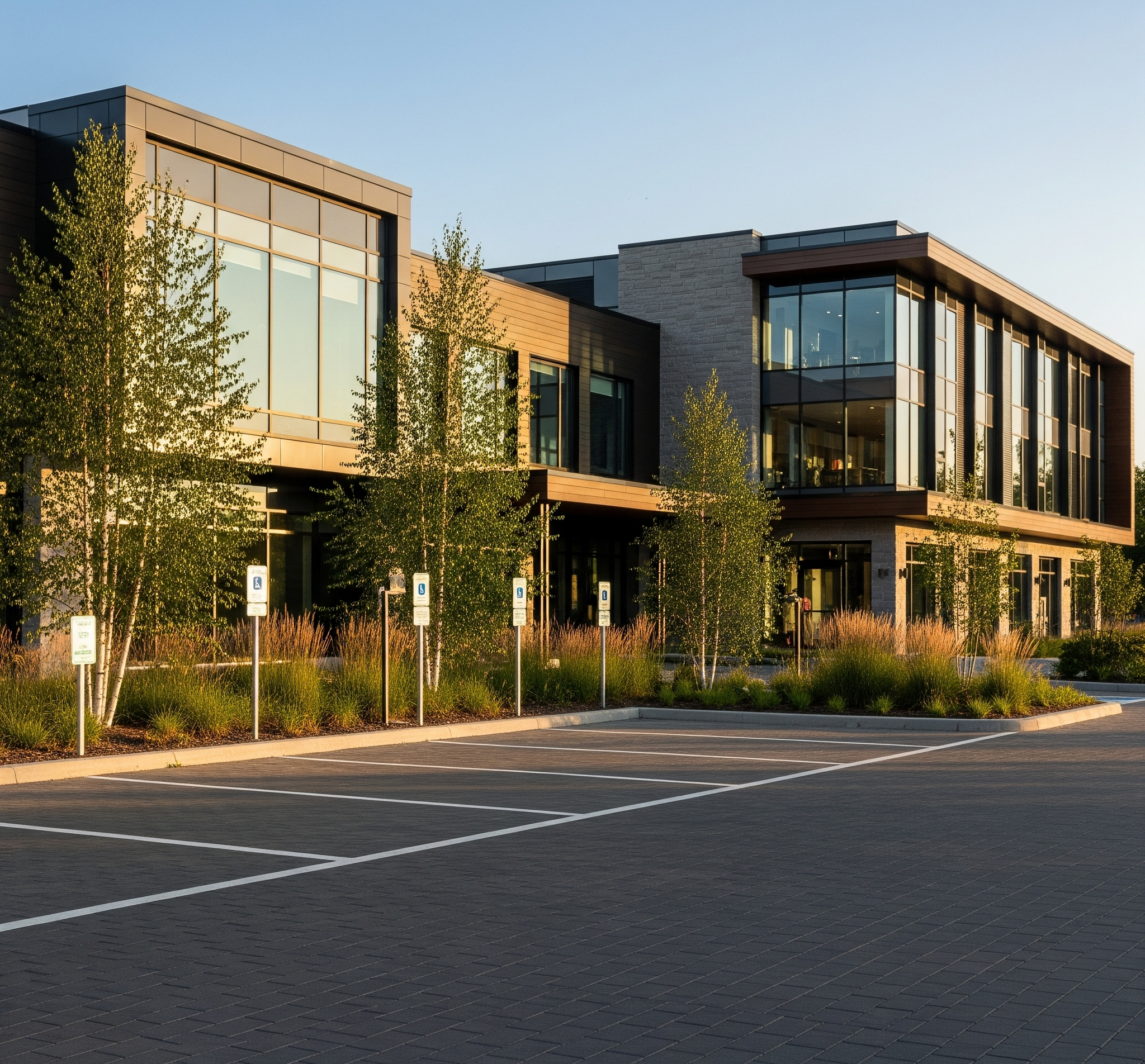
The problem is that the commercial paving industry in the Greater Toronto Area contains a spectrum of operators so wide that it is difficult for a non-specialist to distinguish between them. On one end, you have legitimate heavy civil engineering contractors with deep equipment fleets, geotechnical knowledge, municipal permitting experience, and a documented track record of multi-decade commercial installations. On the other end, you have residential driveway companies with a single hot-box trailer and a crew of three who will quote your 5,000 m² parking lot at half the price and deliver a surface that begins failing before the first winter.
Both will call themselves “paving contractors.” Both will hand you a quote. Both will promise quality work. And the difference between them will cost you $100,000 to $500,000+ in premature failure, rebuild costs, liability claims, and lost commercial revenue if you choose wrong.
This guide gives you the vetting framework to tell them apart. Every question. Every specification. Every red flag. If you are preparing to invest in a new or reconstructed commercial parking lot in Toronto, this is the contractor-selection process that protects that investment.
Beyond the Surface Level: What You Are Actually Building
Before you can evaluate a contractor, you need to understand what a commercial parking lot actually is—because the contractors who fail are the ones who treat it as a simple paving job, and the property owners who get burned are the ones who let them.
A commercial parking lot is a layered civil infrastructure system with five distinct components, each of which must be engineered, specified, and executed correctly for the lot to perform across its intended service life:
- Subgrade: The native soil beneath the lot. In Toronto, this is predominantly Leda clay and glacial till— soils with extremely poor drainage and high frost susceptibility. The subgrade must be proof-rolled (tested under heavy roller compaction) to identify soft spots, over-excavated where bearing capacity is insufficient, and brought to a uniform, stable condition before any granular material is placed. A contractor who does not proof-roll the subgrade is building on an unknown foundation, and the lot will settle wherever the soft spots exist
- Granular B sub-base: A layer of coarse, crushed aggregate (typically 50–150 mm particle size), placed at a minimum depth of 200– 300 mm (8–12 inches) directly on the prepared subgrade. This layer serves two functions: it distributes vehicle loads across the subgrade (preventing point-loading from individual wheel contact), and it provides a frost buffer that separates the frost- susceptible clay subgrade from the pavement surface. In Toronto’s climate, where frost penetration reaches 1.2–1.5 metres by late February, an inadequate Granular B depth allows frost to penetrate into the clay, causing differential heaving that cracks and displaces the pavement above. This is the primary failure mode of poorly built parking lots in Ontario
- Granular A base: A layer of finer, densely graded aggregate (0–19 mm particle size), placed at a minimum depth of 150 mm (6 inches) on top of the Granular B. This layer provides the smooth, precisely graded surface on which the asphalt or pavers will sit. It is compacted to 98%+ Standard Proctor density and laser- graded to the exact slope specifications required for surface drainage. If the Granular A is not properly compacted, the surface above it will deflect under heavy vehicle loads and develop rutting. If it is not properly graded, the surface drainage will fail
- Surface course: Either hot-mix asphalt (minimum 75 mm for standard vehicle traffic, 100 mm+ for heavy-vehicle zones) or interlocking concrete pavers (80 mm minimum for commercial vehicular applications, bedded on a 25 mm sand-setting bed). This is the visible surface—the layer the customer drives on, walks on, and judges the property by. It must be smooth, uniformly dense, properly pitched for drainage, and installed at the correct thickness to withstand the anticipated traffic loading without cracking, rutting, or delaminating
- Stormwater drainage system: Catch basins, drainage pipes, headwalls, and connections to the municipal storm sewer. This system must be designed to handle the design storm event specified by the municipal authority (typically a 5-year or 10-year return storm in Toronto), capture surface runoff efficiently through properly graded surface slopes, and discharge through adequately sized pipe infrastructure. A drainage system that is undersized, poorly connected, or graded incorrectly results in standing water, black ice, and accelerated pavement deterioration
That is what you are building. Five engineered layers, each dependent on the layer beneath it. A contractor who talks only about the surface—the asphalt thickness, the paver colour, the seal coat finish—without volunteering detailed specifications for the four layers beneath it does not understand what a commercial parking lot requires. And you should not trust them to build one.
“Ask a contractor to describe their sub-base specification before they describe their surface finish. If they cannot, they are selling you a surface, not a parking lot.”
Vetting the Engineering: The Questions That Separate Professionals from Pretenders
The following questions are not trick questions. They are standard civil engineering specifications that any contractor qualified to build a commercial parking lot should be able to answer immediately, from knowledge, without consulting a reference or calling someone back. If the contractor hesitates, deflects, or gives vague answers, they are not qualified for your project.
Question 1: “What is your sub-base specification?”
The answer should include specific depths for Granular B and Granular A, specified in millimetres, and the compaction standard they will achieve. A qualified commercial contractor in Toronto will specify something close to:
- Granular B: 250–300 mm, compacted in lifts of no more than 150 mm per lift
- Granular A: 150 mm, compacted to 98% Standard Proctor density, laser-graded to ±6 mm tolerance
- Total granular depth: 400–450 mm minimum for standard vehicle traffic; 500 mm+ for lots servicing heavy vehicles (delivery trucks, waste haulers, fire apparatus)
If the contractor quotes a total granular depth of less than 300 mm for a commercial lot in Toronto, they are under-specifying the frost protection. Their lot will heave. If they cannot specify the compaction standard (or don’t know what one is), they are not compacting the base to a verifiable standard. Their lot will rut and settle.
Question 2: “How do you verify compaction?”
The correct answer is nuclear density testing (NDT) or dynamic cone penetrometer (DCP) testing, conducted by a geotechnical firm or a qualified equipment operator, at multiple points across the lot. Compaction verification is not “we ran the roller over it until it looked good.” It is a measured, documented, numerically verified process that produces test reports confirming that the specified density was achieved at the specified lift depths.
On any commercial lot in Toronto valued at more than $200,000, you should require compaction test reports as a contract deliverable. If the sub-base is not compacted to specification and the surface fails prematurely, those reports (or the absence of them) become the central evidence in the warranty claim or the negligence action that follows.
Question 3: “What is your drainage grading specification?”
The answer should include a minimum surface gradient (typically 1.5–2% for asphalt, 2% for pavers) directed toward catch basins, with the grading verified by laser level or total station survey before and after paving. The contractor should be able to describe how many catch basins the lot requires (based on lot area and municipal stormwater requirements), where they will be positioned, how the pipe network connects to the municipal storm sewer, and what the design storm capacity of the system is.
A contractor who says “we grade for drainage” without specifying the gradient percentage, the verification method, or the catch basin coverage is not engineering the drainage. They are hoping the drainage works. Hope is not an engineering specification.
Question 4: “What is your asphalt specification?”
For hot-mix asphalt, the answer should include:
- Mix designation: Superpave 12.5 FC2 (fine course, friction surface) or equivalent MTO-approved designation for the surface lift; Superpave 19.0 or HL-8 for the base lift on heavy-traffic surfaces. If the contractor cannot specify the mix, they are using whatever the asphalt plant loads onto their truck
- Minimum thickness: 75 mm total for standard vehicle traffic; 100 mm+ for heavy-vehicle zones. This should be specified in compacted thickness, not loose thickness. A contractor who quotes “3 inches of asphalt” may be measuring the loose material on the truck, which compacts to approximately 75% of its loose volume. Clarify the measurement basis
- Compaction temperature: Hot-mix asphalt must be placed and compacted at minimum 130°C (measured at the mat, not at the plant). Asphalt that cools below compaction temperature before the rolling sequence is complete does not achieve the required density, resulting in a porous surface that admits water and deteriorates rapidly. A contractor who paves in late October or early November in Toronto, when ambient temperatures regularly drop below 10°C, needs to demonstrate that they are managing mat temperature through rapid placement and adequate roller coverage. Paving asphalt in cold weather without temperature management produces a surface that looks acceptable on installation day and begins ravelling within the first winter
Compliance, Liability, and the Paper Trail
Engineering competence is table stakes. The second tier of vetting is legal and financial: the paper trail that protects you when something goes wrong, or when someone gets hurt.
Commercial General Liability Insurance
Any contractor working on a commercial property in Toronto should carry a minimum of $5 million in commercial general liability (CGL) insurance. This is not optional. This is the standard requirement of virtually every commercial property management company, every major landlord, and every institutional property owner in the GTA. A contractor with $1 million or $2 million CGL limits is under-insured for commercial work. A contractor with no CGL at all is transferring 100% of the liability risk to you.
Request a Certificate of Insurance (COI) naming your property as an additional insured. This is standard practice. A legitimate commercial contractor will produce the COI within 24 hours of your request, because their insurance broker issues them routinely. If the contractor cannot or will not produce a COI, they do not have the coverage they claim.
WSIB Coverage
Under Ontario law, employers in the construction industry are required to register with the Workplace Safety and Insurance Board (WSIB) and maintain current premium payments. If a contractor’s employee is injured on your property and the contractor does not have valid WSIB coverage, you, the property owner, may be held liable for the worker’s injury costs—including medical expenses, lost wages, and disability benefits. The financial exposure from a single lost-time injury on a construction site can exceed $100,000.
Request a WSIB clearance certificate before any work begins. This document confirms that the contractor is registered with WSIB and that their premium account is in good standing. It takes the contractor five minutes to generate through the WSIB online portal. If they will not produce it, do not allow them on your property.
Municipal Permits and Utility Locates
Commercial paving projects in Toronto frequently require municipal permits for:
- Entrance/curb-cut modifications: Any changes to the property’s connection to the municipal road require a permit from the City of Toronto Transportation Services
- Stormwater connections: New or modified connections to the municipal storm sewer require approval from Toronto Water and may require an engineering submission demonstrating that the proposed discharge does not exceed the capacity allocated to the property
- Site alteration: Significant grading changes may trigger site alteration permit requirements under the municipal bylaw
A qualified commercial contractor knows which permits are required and builds the permitting timeline into the project schedule. A contractor who begins work without pulling required permits exposes the property owner to stop-work orders, fines, and forced removal of non-compliant work—at the property owner’s expense.
Similarly, Ontario One Call utility locates are legally required before any excavation. A contractor who begins digging without confirming utility locates is risking a gas line strike, a hydro cable hit, or a telecommunications conduit rupture—any one of which can halt the project for weeks, cost five figures in emergency repairs, and create life-safety hazards.
References and Portfolio Documentation
Request a minimum of three completed commercial parking lot projects of comparable size and scope, completed within the last five years, with contact information for the property owner or property manager. Then actually call them. Ask specifically:
- Was the project completed on time and on budget?
- How did the contractor handle unexpected conditions (soft subgrade, utility conflicts, weather delays)?
- How is the surface performing now, at the current age?
- Were there any warranty claims? How were they handled?
- Would you hire them again?
A contractor with a strong commercial portfolio will be eager to share references. A contractor who is evasive about past projects, who only provides residential driveway references for a commercial lot bid, or who cannot produce photographs of completed work is telling you something important about the depth of their commercial experience.
The Aesthetic Upgrade: Beyond Basic Asphalt
The vetting conversation should not end at engineering and compliance. For commercial property owners in Toronto who are building or reconstructing a parking lot on a high-visibility, customer-facing property, the surface material itself represents a strategic decision about brand positioning, property value, and lifecycle cost.
Standard hot-mix asphalt is the industry default. It is functional, cost-effective, and performs adequately when properly installed and maintained. But it is also visually generic, requires seal coating every 3–5 years to maintain appearance and waterproofing, and has a functional service life of 15–20 years before it requires full reconstruction—not patching, not overlaying, but excavation and complete rebuild.
The premium alternative is heavy-duty commercial interlocking concrete pavers. These are not the thin, residential pavers used on backyard patios. Commercial-grade pavers are:
- 80 mm thick (versus 60 mm for residential), designed to withstand H-20 highway loading—the same specification used for bridge decks and highway shoulders
- Through-mix colour (the colour extends through the entire body of the paver, not just a surface layer), meaning they do not fade, wear through, or show a different colour when chipped
- 50+ MPa compressive strength (compared to approximately 25 MPa for standard concrete and 3–5 MPa for asphalt), making them resistant to deformation under heavy loads and point-loading from vehicle jacks, trailer legs, and static parked loads
- Individual unit replacement: A damaged paver is removed and replaced individually, without saw-cutting the surrounding surface, without patching, and without the colour- mismatch that makes asphalt patches permanently visible. A 20-year-old paver lot that has had individual units replaced as needed looks virtually indistinguishable from a new installation. A 20-year-old asphalt lot looks like a patchwork of repairs
The cost premium for commercial pavers over hot-mix asphalt is typically 40–60% on initial installation. But when lifecycle cost is calculated over a 30-year horizon (including seal coating, patching, overlay, and eventually full reconstruction for asphalt; versus individual paver replacements and joint-sand re-application for pavers), the total cost of ownership is comparable—and the aesthetic, brand, and property-value benefits of pavers are dramatically superior.
A contractor who offers only asphalt for commercial work is not necessarily unqualified. But a contractor who cannot discuss, design, and install commercial-grade interlocking pavers as an alternative is limiting your options, and you may be leaving significant property value on the table.
For Toronto commercial properties where the parking lot is customer- facing—retail plazas, medical centres, corporate offices, hospitality properties—consider the hybrid approach: deep Charcoal commercial pavers in the high-visibility pedestrian zones (building entrances, crosswalks, outdoor seating areas), with Warm Off-White pavers delineating pedestrian safe zones and accessibility routes, and seal-coated asphalt in the standard vehicle-traffic areas. This delivers the luxury first impression where customers walk and linger, with the cost efficiency of asphalt where visual impact is lower.
“Any contractor can pour asphalt. The contractor worth hiring is the one who asks what your lot needs to do before they tell you what it should be made of.”
The Cinintiriks Approach: Heavy Civil Engineering, Not Paving
Cinintiriks is not a paving company. We are a heavy civil engineering contractor specialising in commercial and residential hardscape infrastructure across Toronto and the Greater Toronto Area. The distinction matters, because it defines the depth of engineering, the quality of execution, and the performance guarantee that our commercial clients receive.
1. Full-Depth Civil Excavation: Every Cinintiriks commercial parking lot begins with a complete removal of the existing surface and sub-base to the native subgrade. We do not overlay failed surfaces. We do not patch over unknown sub-base conditions. We excavate to virgin soil, proof-roll the subgrade with a 10-tonne vibratory roller to identify and remediate soft spots, and build upward from a verified foundation. The excavated material is hauled off-site and disposed of at licensed receiving facilities in compliance with Ontario Regulation 406/19.
2. Engineered Granular Foundation: Our standard commercial sub-base specification for Toronto lots is 300 mm Granular B (compacted in two 150 mm lifts) topped with 150 mm Granular A (compacted to 98% Standard Proctor density). Total granular depth: 450 mm minimum. For heavy-vehicle zones (loading docks, delivery areas, waste-collection pads), we increase Granular B depth to 400 mm and may specify geogrid reinforcement in areas with marginal subgrade bearing capacity. Compaction is verified by nuclear density testing at a minimum of one test per 500 m² of lot area. Reports are provided to the client as a contract deliverable.
3. Laser-Graded Drainage: Surface grading is established on the Granular A layer using a GPS-guided grading system or rotary laser level with survey-grade accuracy, ensuring uniform drainage slope to catch basins at the specified gradient (minimum 1.5% for asphalt, 2% for pavers). Catch basins are inspected, rebuilt if necessary, and set to the finished grade elevation before surface installation begins. We verify drainage performance with a hose test (applying water at multiple points across the lot and confirming complete run-off to catch basins within 60 seconds) before the site is released to the client.
4. Premium Surface Options: We install both hot-mix asphalt (Superpave 12.5 FC2 surface course, 75–100 mm compacted thickness) and 80 mm commercial-grade interlocking concrete pavers (H-20 rated, through-mix colour, installed on a 25 mm ASTM C-33 concrete sand setting bed with polymeric joint sand). We design and recommend the surface material based on the specific demands of the project: traffic loading, aesthetic requirements, lifecycle budget, and customer-facing visibility.
5. Full Compliance & Documentation: Every Cinintiriks commercial project is executed with $5 million CGL insurance (COI provided as standard), current WSIB clearance (certificate provided before mobilisation), municipal permits (pulled and paid as part of our scope), and Ontario One Call utility locates (confirmed before any excavation). Project documentation includes compaction test reports, as-built grading plans, material source certifications, and a written warranty on workmanship. This documentation is not optional. It is the standard Cinintiriks deliverable for every commercial lot we build in Toronto.
Don’t gamble your commercial property value on an unverified, unengineered quote. Contact Cinintiriks for a fully compliant, heavily engineered commercial parking lot in Toronto and across the GTA.
FAQ: Choosing a Commercial Parking Lot Contractor
Should a commercial paving contractor provide engineered drainage plans before starting?
Yes, absolutely. On any commercial parking lot project where the surface area exceeds approximately 1,000 m², the drainage design should be documented in an engineered plan that specifies surface grades (expressed as percentage slopes with directional arrows toward catch basins), catch basin locations and sizes, pipe diameters and invert elevations, and the connection point to the municipal storm sewer. For larger projects, the City of Toronto may require a stormwater management report prepared by a licensed Professional Engineer (P.Eng.) demonstrating that the proposed drainage system meets municipal runoff criteria and does not exceed the site’s permitted discharge rate. Even where the municipality does not formally require an engineered plan, a qualified contractor should produce one as a standard project deliverable, because the drainage design is the most critical performance parameter of the entire lot. A contractor who says “we’ll grade for drainage as we go” is not engineering the drainage. They are improvising. And on a 5,000 m² commercial lot with $200,000+ of paving investment riding on the outcome, improvisation is not an acceptable methodology. Insist on a grading plan before the first shovel of excavation. If the contractor cannot produce one, they are not qualified for the project.
What kind of insurance must a contractor have to build a commercial parking lot in Ontario?
At minimum, a commercial paving contractor in Ontario should carry three forms of coverage: (1) Commercial General Liability (CGL) insurance with a minimum limit of $5 million per occurrence. This covers third-party bodily injury and property damage claims arising from the contractor’s work. On a commercial property, a construction-related injury or damage event during the build (a pedestrian struck by a backing truck, a utility line rupture, damage to an adjacent building) can generate claims well into six figures. A $2 million policy may be sufficient for residential work but is considered under-insured for commercial projects by most property management standards. (2) Automobile liability insurance covering the contractor’s vehicles and equipment operating on the site. Heavy construction equipment (excavators, graders, pavers, rollers, dump trucks) operating in proximity to customer vehicles and pedestrian traffic creates significant collision and damage risk. The contractor’s auto coverage should carry a minimum $2 million limit. (3) WSIB coverage (Workplace Safety and Insurance Board). This is mandatory for Ontario construction employers and protects both the worker (through injury compensation) and the property owner (by preventing the property owner from being held secondarily liable for uninsured workers injured on-site). Request both the Certificate of Insurance (COI) for CGL and auto, and the WSIB clearance certificate, before signing any contract. Verify the COI directly with the issuing insurance broker (the broker’s contact information should be on the certificate) to confirm the policy is active and the limits are as stated. Fabricated COIs are not unheard of in the GTA construction market.
Are heavy-duty commercial interlocking pavers a better long-term investment than poured asphalt?
For customer-facing commercial properties where brand perception, property value, and lifecycle cost are priorities, yes. The comparison over a 30-year lifecycle is instructive: Hot-mix asphalt requires seal coating every 3–5 years ($2–$4/m² per application), crack sealing and pothole repair annually ($1,000–$5,000/year depending on lot condition), and a full mill-and-overlay or reconstruction at approximately year 15–20 ($80–$150/m² depending on scope). Total 30-year cost including the initial installation, maintenance, and one reconstruction: approximately $180–$280/m². Commercial interlocking pavers (80 mm, H-20 rated) have a higher initial installation cost ($120–$180/m² installed, versus $60–$100/m² for asphalt), but the ongoing maintenance is dramatically lower: joint sand re-application every 5–7 years ($3–$5/m²), individual paver replacements as needed ($15–$30 per paver including labour), and cleaning (pressure washing annually, $1–$2/m²). No seal coating. No overlays. No reconstruction. Total 30-year cost: approximately $160–$250/m²— comparable to asphalt in total cost of ownership, but with a dramatically superior aesthetic at every stage of the lifecycle. A 25-year-old paver lot that has been properly maintained is virtually indistinguishable from a new installation. A 25-year-old asphalt lot, regardless of maintenance, looks exactly its age. For properties where customer satisfaction and brand perception are revenue drivers, the paver investment pays for itself in the competitive advantage it confers.
The Final Word
Choosing a contractor for a commercial parking lot is not a price comparison exercise. It is an engineering vetting process. The lowest quote is the most dangerous quote, because the gap between the lowest and highest bid is almost always found in the layers you cannot see: the granular depth, the compaction standard, the drainage engineering, the insurance coverage, the permit compliance.
The contractor who saves you $30,000 on the bid by reducing Granular B depth from 300 mm to 150 mm will cost you $200,000 when the lot heaves in year three and requires full reconstruction. The contractor who does not carry adequate CGL insurance will cost you $500,000 when a pedestrian trips on a construction-related hazard and you discover that the contractor’s policy does not cover it. The contractor who does not pull permits will cost you the entire project value when the municipality issues a stop- work order and mandates removal of the non-compliant installation.
Vet the engineering. Verify the paper trail. Demand documented specifications for every layer from subgrade to surface. And choose the contractor who can demonstrate, with evidence, that they build parking lots the way parking lots should be built.
In Toronto’s climate, on Toronto’s soils, under Toronto’s traffic loads—there is no room for guesswork beneath the surface.