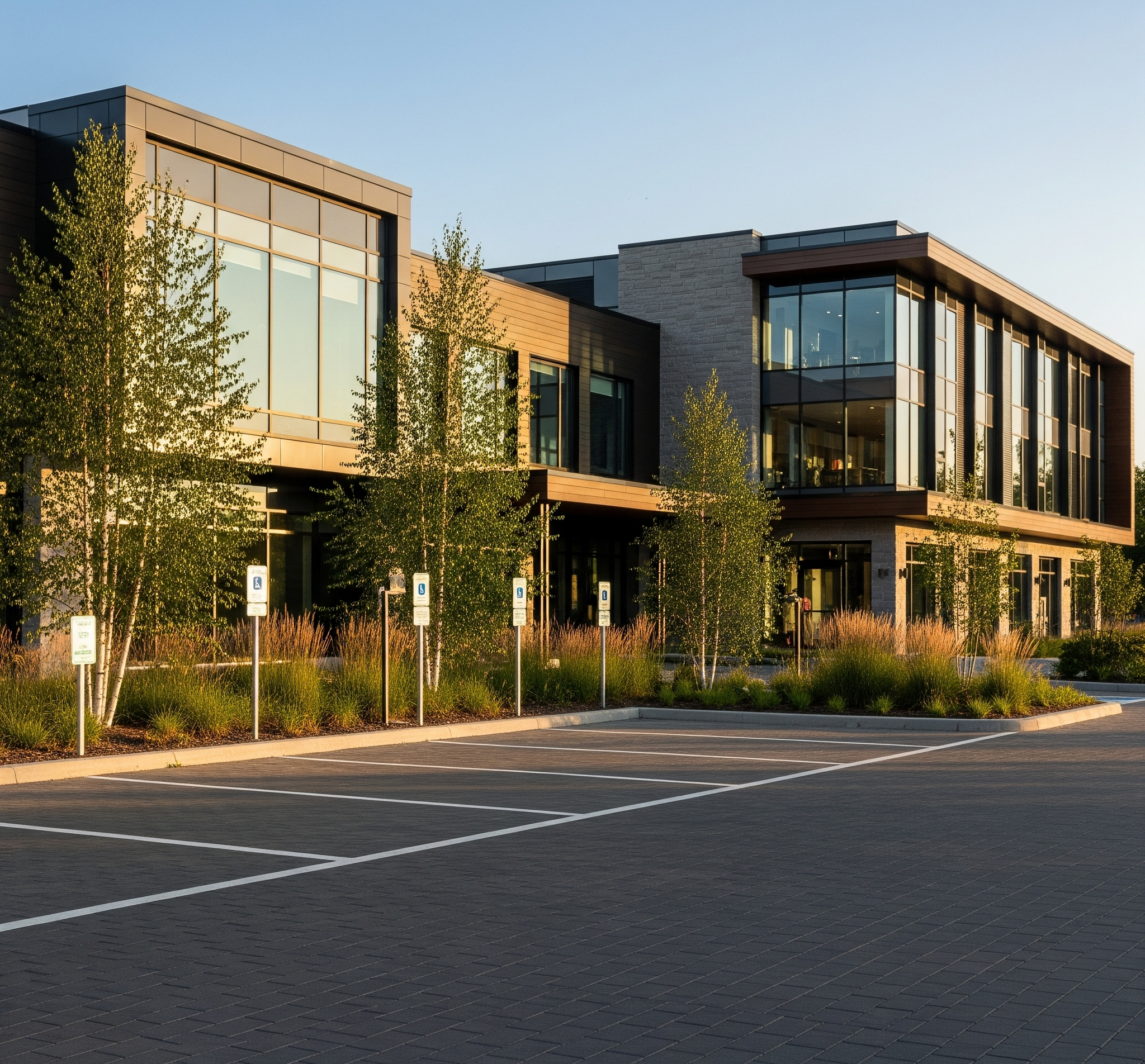
This is value engineering. Not cost-cutting. Not cheapening. Value engineering is the disciplined practice of achieving maximum performance and visual impact per dollar spent—directing your budget toward the elements that generate the highest return (structural integrity, tenant-facing aesthetics, and long-term durability) while applying cost-effective solutions to elements that contribute less to the property's revenue and reputation. It is the difference between a plaza that looks like a million dollars and costs $600,000 and a plaza that costs $900,000 and still looks ordinary, because the money went to the wrong places.
The ROI of First Impressions: Why the Exterior Pays for Itself
Before discussing where to spend and where to save, let's quantify what the exterior is worth to a commercial property.
Commercial real estate data in the GTA consistently shows that properties with professionally finished exteriors—clean hardscaping, modern paver treatments, well-defined pedestrian zones, and visible attention to landscaping—command 8-15% higher lease rates per square foot than comparable properties with dated, deteriorating, or purely utilitarian exteriors. For a 10,000 square foot retail plaza leasing at $30/sqft net, that premium represents $24,000-$45,000 per year in additional gross revenue. Over a 10-year lease cycle, the cumulative revenue premium is $240,000-$450,000.
Set that against a total hardscaping budget of $150,000-$400,000 for the same plaza and the return on investment is stark: a properly designed exterior pays for itself within 2-5 years in rental premiums alone, and continues generating returns for the life of the property. The exterior is not a cost centre. It is the most visible, most impactful capital investment on the property.
But only if the money is directed correctly.
The Zone Strategy: Allocating Budget Where It Matters Most
The single most effective budget management tool in commercial plaza design is material zoning—dividing the property into functional zones based on visibility, traffic type, and structural demand, and assigning a different material specification (and budget allocation) to each zone. Not every square foot of a commercial exterior carries the same value. The entrance court that faces the street is worth ten times more per square foot in visual impact than the service alley behind the building. They should not receive the same material, the same finish, or the same budget.
Zone 1: The Revenue Zone (Highest Budget Priority)
This is every surface that a customer sees and walks on between their car and the storefront entrance: the primary pedestrian walkway, the front entrance court, the plaza's street-facing façade apron, and any outdoor patio or seating area visible from the street or parking lot.
Budget allocation: 40-50% of the total hardscaping budget.
Material specification: This is where the premium materials live. Premium interlocking pavers (60mm or 80mm, Techo-Bloc Blu, Unilock Artline, or equivalent commercial-grade product), decorative stamped concrete with integral colour, or large-format architectural slabs create the visual statement that defines the property's quality. Soldier course borders, contrasting accent bands, and feature medallions at building entrances concentrate the design impact where every visitor experiences it.
In Oakville, where commercial plazas compete aggressively for premium tenants in the Bronte and Kerr Village corridors, we have seen tenant negotiations directly hinge on the quality of the exterior hardscaping. A medical office, a boutique law firm, or a premium dental practice choosing between two plazas at comparable lease rates will choose the property that projects quality from the parking lot to the front door. The revenue zone is where that perception is created or destroyed.
Zone 2: The Functional Zone (Moderate Budget Priority)
This includes the parking lot surface, vehicle access lanes, and secondary pedestrian routes (side walkways connecting overflow parking to the building, paths between separate buildings in a multi-building complex). These surfaces carry heavy traffic but lower visual scrutiny. Customers traverse them, but they do not linger on them. They expect them to be safe, smooth, and clean—but they do not evaluate them aesthetically the way they evaluate the entrance court.
Budget allocation: 35-40% of the total hardscaping budget.
Material specification: This is where value engineering delivers the greatest savings. The material of choice for functional zones is poured concrete—plain, standard grey, broom-finished for slip resistance, reinforced with welded wire mesh or rebar, and saw-cut with properly spaced control joints. Poured concrete costs $8-$14 per square foot installed versus $25-$45+ for premium interlock. On a 5,000 square foot parking area, the savings from concrete over interlock is $85,000-$155,000. That savings can be redirected entirely to the revenue zone, dramatically increasing the visual impact of the areas that actually drive tenant and customer perception.
For parking lots specifically, asphalt remains a viable option at $5-$8 per square foot installed, but its 12-15 year lifespan (versus 25-30+ for concrete) and its ongoing crack-sealing and resurfacing maintenance costs erode the initial savings over time. We address this comparison in detail in the FAQ section below.
Zone 3: The Service Zone (Lowest Budget Priority)
This includes rear service corridors, waste collection pads, mechanical equipment areas, loading docks, and any surface not visible to customers or street traffic. These surfaces must be structurally robust (they often carry the heaviest loads on the property: delivery trucks, waste compactors, snow removal equipment) but they have zero aesthetic obligation.
Budget allocation: 15-20% of the total hardscaping budget.
Material specification: Plain grey poured concrete, 150mm (6-inch) minimum thickness for vehicle traffic, 200mm (8-inch) for loading zones, reinforced with 15M rebar on 12-inch centres. No colour, no texture, no stamp, no sealer. The entire budget for this zone is directed at structural capacity and longevity—because a loading pad that cracks under a delivery truck is a liability event, not a cosmetic issue.
"Budget discipline is not about spending less. It is about spending in the right places—where every dollar produces revenue, safety, or permanence."
Strategic Material Selection: The Cost-Benefit Matrix
Within each zone, the material selection determines both the installed cost and the lifecycle cost. The cheapest material to install is not always the cheapest material to own. The most expensive material to install is not always the best value. Here is how the primary commercial hardscaping materials compare across both dimensions:
Poured Concrete (Broom Finish)
Installed cost: $8-$14/sqft
Lifecycle (before major rehabilitation): 25-30 years
Maintenance: Minimal. Joint sealing every 5-7 years ($0.50-$1.00/
sqft). Occasional section replacement if damaged by heave or settlement.
Best application: Functional zones, secondary walkways, parking
areas, service areas. The workhorse of commercial hardscaping. Durable, clean, and
virtually maintenance-free.
Stamped/Coloured Concrete
Installed cost: $16-$28/sqft
Lifecycle: 25-30 years (structural); sealer requires renewal every
2-3 years at $2-$4/sqft
Maintenance: Moderate. Resealing cycle is mandatory to maintain
colour depth and surface protection. Budget $2-$4/sqft every 2-3 years.
Best application: Revenue-zone walkways, entrance courts, outdoor
dining areas. Provides the visual impact of natural stone at 30-50% of the cost.
The sealer maintenance cycle must be budgeted from day one.
Premium Interlocking Pavers (60-80mm)
Installed cost: $25-$50/sqft
Lifecycle: 25-30+ years (structural); polymeric sand refill every
5-7 years at $1-$2/sqft
Maintenance: Low to moderate. Joint sand refill, occasional unit
replacement, optional resealing. The key advantage is individual unit
repairability: a single damaged paver can be removed and replaced without
affecting the surrounding field. For commercial properties where utility cuts,
signage installation, and periodic surface access are frequent, this repairability
is a significant lifecycle cost advantage.
Best application: High-visibility entrance courts, tenant frontage,
patio areas, pedestrian plazas. The highest aesthetic impact and the most
flexible long-term maintenance profile.
Asphalt
Installed cost: $5-$8/sqft
Lifecycle: 12-15 years before major resurfacing
Maintenance: High. Annual crack sealing ($0.30-$0.50/sqft),
periodic sealcoating ($0.15-$0.25/sqft every 2-3 years), full resurfacing at
12-15 years ($4-$6/sqft).
Best application: Large-format parking areas where the initial
cost saving is substantial and the aesthetic standard is purely functional.
Not appropriate for tenant-facing pedestrian areas.
The Mixing Strategy: How to Get a $50/sqft Look at a $20/sqft Average
The most powerful budget technique in commercial hardscaping is material mixing—using premium materials in the 20-30% of the property that drives perception and cost-effective materials in the 70-80% that drives function.
Example: A 15,000 sqft commercial plaza exterior might allocate:
- 3,000 sqft of premium interlock pavers at the entrance court and primary walkway ($40/sqft = $120,000)
- 5,000 sqft of stamped/coloured concrete at secondary walkways and patio areas ($22/sqft = $110,000)
- 7,000 sqft of plain broom-finish concrete at parking areas and service zones ($10/sqft = $70,000)
Total: $300,000. Average cost: $20/sqft. But the property looks like it was built at $40/sqft, because every surface the customer sees and walks on is premium. The savings are entirely in the zones that customers never evaluate—where premium materials would be wasted.
The Infrastructure Non-Negotiables: Where You Cannot Cut
Value engineering is about redirecting budget, not reducing it. There are components of a commercial hardscaping project where cutting the budget is not a tradeoff —it is a guarantee of failure, liability, and costs that dwarf the initial savings.
Sub-Base Depth and Compaction
The granular sub-base beneath any commercial hardscape surface must be engineered to the anticipated traffic loads, the site's soil conditions, and the Ontario frost depth. For pedestrian zones, this means a minimum of 10-12 inches of compacted Granular A. For vehicle traffic zones (parking lots, access lanes), 14-16 inches minimum. For loading zones and areas receiving heavy truck traffic, 16-20 inches with reinforced concrete above.
Cutting 4 inches from the sub-base specification saves approximately $1.50-$2.50 per square foot in material and labour. On a 15,000 sqft plaza, that is a savings of $22,500-$37,500. Significant on paper. Catastrophic in practice. A shallow commercial sub-base on GTA clay will begin showing settlement and heave damage within 2-3 winters. Repairing or replacing a failed commercial hardscape that is surrounded by active tenant operations, customer traffic, and municipal accessibility requirements costs 2-3x more per square foot than doing it correctly the first time—and it disrupts revenue during the construction period.
Drainage Engineering
Commercial plazas generate massive volumes of stormwater runoff. A 15,000 sqft hardscaped surface receiving 25mm of rainfall generates approximately 9,500 litres of runoff that must be captured, conveyed, and discharged into the municipal storm system within regulatory parameters. This requires engineered surface grades (minimum 1.5-2% slope toward catch basins), strategically placed catch basins connected to the storm sewer, and, in many GTA municipalities, on-site stormwater management features (detention tanks, permeable paver zones, or bioswales) that attenuate peak flow rates.
Inadequate drainage creates three problems simultaneously: standing water that creates slip hazards and liability exposure, accelerated hardscape deterioration from freeze-thaw cycling in pooled zones, and regulatory non-compliance that can result in municipal stop-work orders or mandatory remediation.
Accessibility Compliance
The Accessibility for Ontarians with Disabilities Act (AODA) establishes binding requirements for commercial exterior surfaces: maximum cross-slopes of 2%, maximum running slopes of 5% (or ramp provisions beyond that), tactile attention indicators at pedestrian crossings, minimum clear widths for walkways, and specific surface texture requirements for slip resistance. These are not aesthetic guidelines. They are legal obligations. Non-compliance exposes the property owner to liability claims, regulatory fines, and mandatory remediation at the owner's expense.
Accessibility-compliant design does not add significant cost when incorporated from the beginning of the design phase. It does add significant cost when retrofitted after the hardscape is installed because the slopes, grades, and surface textures were not detailed in the original design.
The Phased Approach: Spreading Cost Without Sacrificing Quality
For property owners whose total budget cannot accommodate the full scope of work in a single construction season, phased construction offers a disciplined alternative to across-the-board quality reduction.
Phase 1 (Year 1): Complete all infrastructure work across the entire property: full excavation, sub-base installation, drainage, and grading. Install the revenue-zone surface materials (entrance courts, primary walkways). Install plain concrete in functional and service zones as the temporary (or permanent) surface.
Phase 2 (Year 2-3): Upgrade functional-zone surfaces from plain concrete to stamped concrete or interlock, if desired. Add decorative elements (landscape beds, bollards, benches, planters) that enhance the aesthetic without requiring structural work.
This approach ensures that the infrastructure is built once, correctly, at full specification—because you cannot phase sub-base work. If the base is shallow in year one, you cannot deepen it in year two without removing everything above it. The infrastructure phase is the one component where there are no second chances and no economical retrofits. Surface materials, on the other hand, can be upgraded at any time: concrete can be overlaid, plain surfaces can be resurfaced, and interlock can be laid over a properly prepared concrete base with a thin bedding layer.
The Cinintiriks Approach: Value-Engineered Commercial Hardscaping
At Cinintiriks, commercial projects follow our Cinintiriks Standard for Commercial Hardscaping—a protocol that integrates value engineering into every design decision from the initial consultation to the final walkthrough.
1. Budget-Priority Design Session: Every commercial project begins with a collaborative design session where we map the property into visibility zones (revenue, functional, service) with the client. We establish the total budget, allocate percentages to each zone, and identify the specific materials that deliver maximum impact within each allocation. The client sees exactly where every dollar goes before a single shovel breaks ground.
2. Material Zoning Specification: We produce a detailed zoning plan that specifies the exact material, finish, thickness, and colour for each zone of the property. Premium interlock at the entrance. Stamped concrete on the primary walkways. Broom-finish concrete in the parking lot. Heavy-duty reinforced concrete at the loading dock. Every material is selected for the specific demands and visibility of its zone. No premium material is wasted on a service alley. No budget material is visible to customers.
3. Non-Negotiable Infrastructure: Regardless of the surface material budget, every zone receives full-specification sub-base engineering: geotextile separation, multi-lift Granular A compaction to 95%+ Standard Proctor, HPB levelling screed, and engineered drainage to municipal requirements. The base never changes. Only the surface responds to the budget.
4. Transparent Commercial Bidding: Our commercial proposals are fully itemised by zone, by phase, and by material. Every line item is defined: excavation depth, granular tonnage, paver product (by manufacturer, product name, and colour), concrete thickness and reinforcement schedule, joint layout, polymeric sand specification, and sealer product. There are no lump sums, no allowances, and no ambiguity. The client can compare our proposal item-by-item against any competitor and evaluate exactly where the differences are.
5. Lifecycle Cost Modelling: For every material option we present, we provide a 10-year and 25-year lifecycle cost projection that includes the installed cost plus all anticipated maintenance (resealing cycles, joint refilling, crack repair, resurfacing). This allows the client to make investment decisions based on total cost of ownership, not just day-one installation cost. In many cases, the material with the higher installed cost proves to be the lower total-cost option over the property's holding period.
Common Budget Traps in Commercial Hardscaping
Beyond sub-base shortcuts, these are the most frequent ways commercial plaza budgets go off the rails:
Over-designing the parking lot. A retail parking lot sees passenger vehicles, not architectural critics. Premium interlock or stamped concrete in a parking lot is an aesthetic investment with virtually zero return —customers do not choose retailers based on the parking lot surface. Plain concrete or asphalt serves the function at 30-60% of the cost. Redirect the savings to the entrance court that customers do evaluate.
Under-specifying catch basins. Commercial drainage is not a place to save $500 per basin by using residential-grade units. Commercial catch basins must handle peak storm flows, resist vehicle traffic loads (if located in drive aisles), and connect to municipal infrastructure at specified sizes and gradients. A single under-capacity basin that floods the tenant entrance after a heavy rain erases every dollar of aesthetic investment on the property.
Ignoring utility locations. Every commercial property has underground utilities: water mains, sanitary sewers, storm sewers, gas lines, electrical conduits, telecommunications conduits. These utilities will eventually require maintenance or emergency repair, and that repair requires cutting through whatever surface is above them. Placing premium interlock or stamped concrete directly over utility corridors guarantees expensive, visible surface damage when the utility is accessed. A smarter approach: map all utility corridors and specify plain concrete (easy to saw-cut and patch) over utility zones while placing premium materials on either side.
Forgetting winter operations. Snow removal on a commercial plaza is aggressive: heavy plows, salt spreaders, ice melt compounds, multiple clearing operations per storm. Stamped concrete and some paver profiles are vulnerable to plow blade damage if the blade catches an uneven joint or a raised paver. The design must account for this: raised paver edges must be chamfered, control joints in concrete must be filled flush, and the snow removal operator must receive a surface map that identifies any areas requiring hand clearing rather than machine plowing.
The Markup Myth: Understanding Commercial Pricing
Commercial hardscaping costs more per square foot than residential hardscaping. This is not contractor markup. It reflects genuine cost differences:
- Thicker slabs and deeper bases. Commercial traffic loads require 150-200mm concrete (vs. 100mm residential) and 14-20 inch granular bases (vs. 10-14 inch residential). More material, more excavation, more compaction passes.
- Engineered drainage. Residential drainage is typically surface grading only. Commercial drainage requires catch basins, storm sewer connections, and often stormwater management features—all designed and certified by a licensed engineer.
- Accessibility compliance. AODA requirements add tactile indicators, controlled slopes, ramp provisions, and surface texture specifications not required in residential work.
- Traffic management. Work on active commercial properties must accommodate ongoing tenant operations, customer access, and delivery schedules. This requires phased construction, temporary access routes, barricading, and coordination that residential projects do not.
- Insurance and bonding. Commercial contractors carry higher liability insurance ($5M+ CGL), WSIB compliance, and often performance bonds —all of which are reflected in the project cost.
When comparing commercial bids, the question is not "Why is this $5/sqft more than residential?" The question is: "Does this bid include the engineering, drainage, accessibility, and structural specifications that a commercial property requires?" If a bid seems suspiciously close to residential pricing, it is almost certainly missing one or more of these components.
Don't let budget overruns derail your commercial project. Contact Cinintiriks for value-engineered, high-ROI commercial hardscaping solutions.
FAQ: Commercial Plaza Design and Budget
Where should I spend the most money on a commercial plaza exterior?
On two things: the sub-base (everywhere) and the surface materials at your building entrances and primary pedestrian corridors. The sub-base determines whether your investment lasts 25 years or 5 years—it is the foundation that protects everything above it, and it is the one component that cannot be upgraded later without full demolition and reconstruction. Never cut the sub-base budget. For surface materials, concentrate your premium budget on the revenue zone—the 20-30% of your property that customers see, walk on, and use to judge the quality of your tenants. Premium interlock or decorative concrete at the entrance court, primary walkway, and any outdoor seating or patio area creates a perception of quality that influences tenant lease rates, customer foot traffic, and property valuation. Everything else—parking lots, service areas, secondary access routes —can be plain concrete or asphalt without any perceptible impact on tenant or customer perception.
Is it cheaper in the long run to use asphalt or concrete for a commercial parking lot?
Over a 25-year ownership period, concrete is typically less expensive
than asphalt despite its higher initial cost. Here is the math for a
5,000 sqft parking area:
Asphalt: Installation: $5-$8/sqft ($25,000-$40,000). Annual
crack sealing: $1,500-$2,500. Sealcoating every 2-3 years: $750-$1,250.
Full resurfacing at year 12-15: $20,000-$30,000. Second resurface at year
24-25: $20,000-$30,000. 25-year total: $95,000-$145,000.
Concrete: Installation: $8-$14/sqft ($40,000-$70,000). Joint
sealing every 5-7 years: $2,500-$5,000. Occasional panel replacement (if
needed): $2,000-$5,000. 25-year total: $45,000-$80,000.
Concrete costs 40-80% more to install and 40-50% less to own over 25 years.
For a property owner planning to hold the asset long-term, concrete is the
clear financial winner. For a developer planning to sell within 3-5 years,
asphalt may make financial sense because the maintenance costs transfer to
the buyer.
How can I make a standard concrete walkway look premium without breaking the budget?
Three techniques that cost relatively little but produce disproportionately
large visual impact:
1. Integral colour ($1-$3/sqft premium): Adding iron oxide
pigment to the concrete mix (integral colour) transforms a plain grey walkway
into a warm sandstone, slate, or charcoal surface that reads as intentional
and designed. The pigment cost is modest, and the colour is permanent—it
doesn't wear off because it's mixed throughout the full slab depth.
2. Exposed aggregate finish ($2-$4/sqft premium): Instead of
a smooth trowel or broom finish, the surface is washed to expose the natural
aggregate (stone) within the concrete. This produces a textured, visually rich
surface with natural colour variation that looks far more expensive than it is.
It is also inherently slip-resistant, reducing liability exposure. The aggregate
blend can be specified to coordinate with the building's stone or brick
palette.
3. Paver border with concrete infill ($3-$5/sqft premium for the
border only): Line the edges of a concrete walkway with a single row
of premium interlocking pavers in a contrasting colour. The border creates a
visual frame that elevates the entire surface from "utility" to "designed."
The concrete infill handles the structural and cost-efficiency role while
the paver border handles the aesthetics. This approach costs a fraction of a
full interlock installation but captures 70-80% of the visual impact.
The Final Word
A commercial plaza that stays on budget is not a plaza that was built cheaply. It is a plaza that was built strategically—where every material decision, every depth specification, and every design element was evaluated against its contribution to revenue, safety, durability, and customer perception. The entrance court gets the interlock. The parking lot gets the concrete. The loading dock gets the heavy-duty reinforcement. And the sub-base gets the same uncompromising engineering everywhere, because the ground doesn't care whether the surface above it is premium or plain.
Budget discipline in commercial hardscaping is not about spending less. It is about spending right. Direct the money where it generates return. Engineer the foundation where failure generates cost. And let every other decision flow from those two principles.