Routine Cleaning: The First Line of Defense
Dirt acts like sandpaper. When abrasive grit sits on your driveway, car tires grind it into the sealer, scratching and dulling the finish. Regular maintenance prevents this.
Sweeping and Rinsing
Weekly sweeping with a stiff push broom is essential. In the fall, wet leaves are the enemy. Decaying organic matter releases tannins—dark brown dyes that can penetrate the sealer and permanently stain the concrete if left to sit for weeks. Treating your driveway like your living room floor pays off.
The Danger of High Pressure
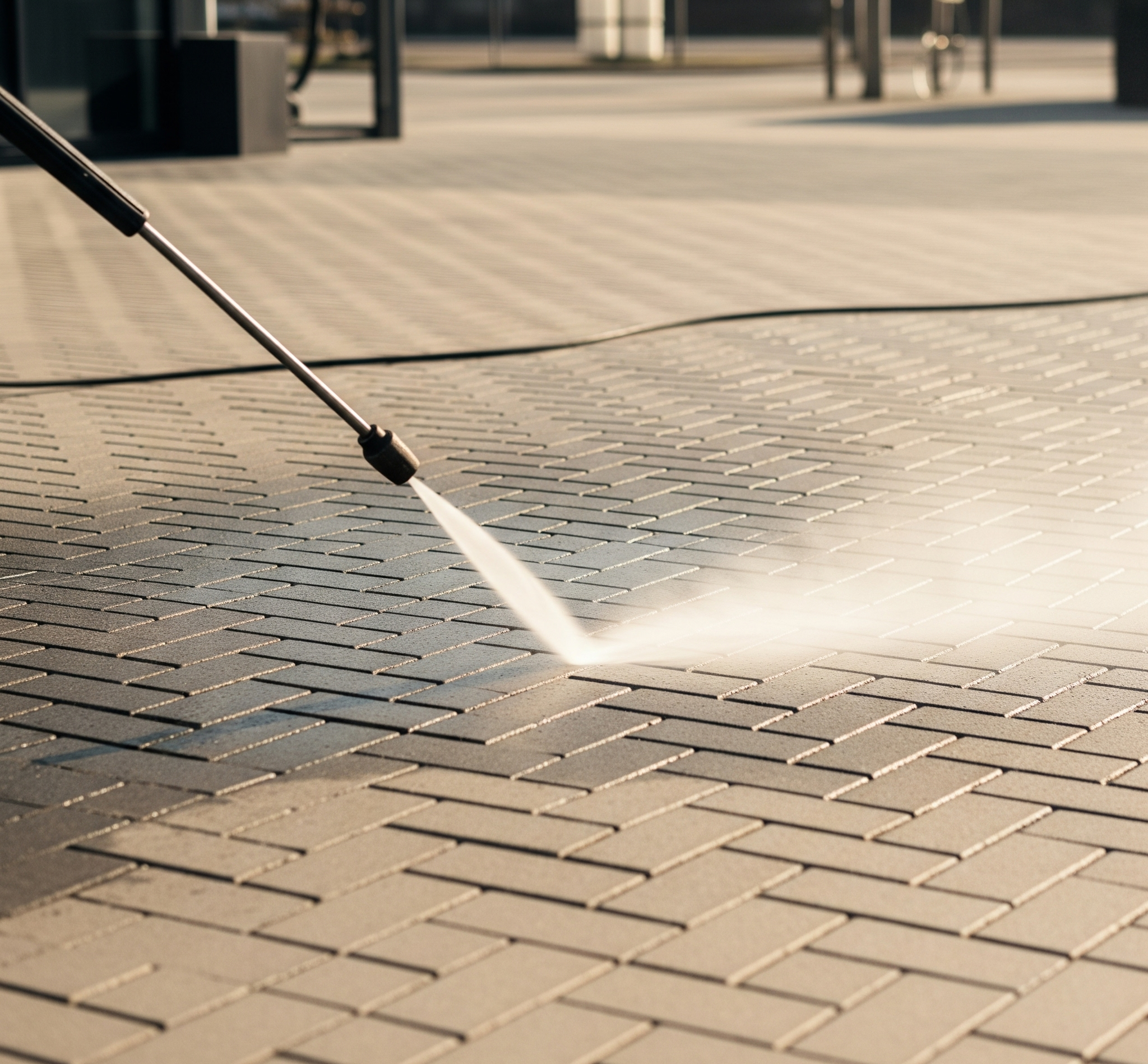
When washing, be careful. A pressure washer is a great tool, but a zero-degree (red tip) nozzle is a knife. Blasting stamped concrete at close range with 4000 PSI can literally strip the Antiquing Release Agent right out of the texture grooves. Always use a wide fan tip (40-degree white tip or green tip) and keep the wand moving 12 inches from the surface. Use mild dish soap or a dedicated concrete cleaner—never harsh degreasers unless necessary.
Winter Warfare: Surviving Ontario's Freeze-Thaw
The single biggest killer of stamped concrete in the GTA is winter maintenance.
The De-Icing Ban: You absolutely CANNOT use rock salt (sodium chloride) or any chemical de-icers (magnesium/calcium chloride) on stamped concrete. Salt lowers the freezing point of water, causing it to melt and refreeze rapidly within the concrete's pores. This hydraulic pressure causes the surface to "spall" or flake off, ruining the expensive finish.
Safe Alternatives: Use clean sand for traction. If you must use a melter, ensure it is 100% Calcium Magnesium Acetate (CMA) based, though even these carry risks. Stick to sand and a plastic shovel. Metal blades will gouge deep white scratches into the acrylic sealer.
The Resealing Schedule: The Golden Rule
Sealer is the sacrificial layer. It takes the UV rays, the rain, and the abrasion so the concrete doesn't have to.
When to Reseal: Typically every 2 to 3 years. The sign is simple: when the concrete is dry, does it look dull, chalky, or faded? When you wet it with a hose, does the rich color suddenly "pop" back to life? If the answer is yes, the color is still there, but the clear coat (sealer) has worn thin. It needs a fresh coat.
The Cinintiriks Approach: Professional Asset Protection
We don't just "paint on" sealer. Our restoration service involves:
1. Deep Cleaning: Removing all oil, grease, and old wax buildup.
2. pH Neutralization: Ensuring the concrete is chemically balanced to accept the new bond.
3. Solvent-Based Sealing: We spray a high-solids, solvent-based acrylic sealer that chemically fuses with the old layer (unlike water-based sealers that just sit on top and peel). We always add micronized anti-slip grit to ensure safety.
"Think of sealer as sunscreen for your driveway. Without it, the color burns and fades. With it, the surface stays vibrant forever."
Don't let your luxury hardscaping fade away. Contact Cinintiriks for professional stamped concrete cleaning, restoration, and commercial-grade sealing.
FAQ: Care & Repair
Can I use bleach or muriatic acid to clean my stamped concrete?
Absolutely NOT. Acid eats cement paste. It will dissolve the very top layer of your concrete, taking the texture and the color with it. Chlorine bleach can also discolor the sealer. Use neutral pH cleaners only.
Why is my stamped concrete peeling and turning white?
This is likely "blushing." It happens when moisture gets trapped under the sealer (often from sealing too soon after washing) or when water-based sealer is applied over oil-based sealer. It requires a solvent wash to re-liquefy the sealer and let the moisture escape.
How do I remove tire marks from my stamped driveway?
Hot tires can leave black rubber marks. Do not scrub with a wire brush! Use a safe, alkaline-based concrete degreaser (like Simple Green) and a stiff nylon bristle brush. Let it dwell for 10 minutes, scrub gently, and rinse thoroughly.
The Final Word
You invested in a driveway that looks like natural stone. Treat it like one. A small amount of care—sweeping, gentle washing, and timely resealing—ensures that your stamped concrete remains the envy of the neighborhood for decades, not just seasons.