The Impermeable Liability: Understanding the Scale
Most people underestimate the volume of water involved in commercial surface drainage. The numbers are staggering once you run them. Mississauga receives an average annual precipitation of approximately 835 millimetres, distributed across rain, snow, and freezing rain events from January through December. During a moderate summer thunderstorm—the kind that rolls through the GTA every week in July and August—rainfall intensity can reach 25 to 40 millimetres per hour. During a severe convective storm, intensity can spike above 60 millimetres per hour.
On a 6,000 square metre commercial parking surface, a moderate 30 mm/hr rainfall generates approximately 3,000 litres of runoff per minute. That is 50 litres per second of water arriving at your drainage collection points. During a severe storm, that number doubles. If your drainage system cannot absorb, convey, and discharge that volume at the rate it arrives, the excess water has nowhere to go but across your surface—pooling against building foundations, flooding pedestrian areas, washing out landscaping, and creating the ice sheets that generate slip-and-fall litigation every winter in Ontario.
This is not a theoretical risk. This is the mathematical reality of commercial impervious surfaces in southern Ontario’s climate. And the Ontario Building Code, the City of Mississauga’s stormwater management policies, and the Region of Peel’s infrastructure standards all exist specifically because this risk is too severe to leave to chance.
Phase 1: The Grading Plan—Where Every Millimetre Matters
Drainage design for a large commercial surface begins not with pipes and basins but with grading—the precise shaping of the surface to control the direction and velocity of water flow across every square metre. On a commercial site in Mississauga, the grading plan is the single most consequential engineering document after the structural drawings. It determines where water goes, how fast it moves, and where it is collected. Every other drainage element—catch basins, trench drains, storm sewers—is subordinate to the grading plan. If the grading is wrong, no amount of drainage infrastructure can compensate.
The Ontario Building Code requires a minimum 2% positive slope (1:50 gradient) on all ground surfaces within 1.8 metres of a building foundation, sloping away from the building. On commercial parking lots and plazas, practical engineering extends this requirement across the entire surface: the paved area is graded with calculated cross-slopes and longitudinal slopes—typically 2% to 3%—that direct sheet flow from the high points (crowns, ridges) to the low points (gutter lines, collection basins) in a controlled, predictable pattern.
On a large commercial surface, the grading plan typically employs a crown-and-valley configuration. The parking lot surface is crowned along its centreline or along defined ridge lines, with the surface sloping downward in both directions from the crown toward the perimeter gutter lines or toward interior valley lines where catch basins are positioned. The slope must be steep enough to move water effectively but gentle enough to be comfortable for pedestrians and to prevent shopping carts, dollies, and mobility devices from rolling uncontrollably.
Laser-Verified Precision
On a Cinintiriks commercial project in Mississauga, we establish the grading plan at the sub-base level—during the excavation and granular placement phase, long before a single paver is laid. The sub-base surface is graded using GPS-guided machine control on larger sites and laser-guided string lines on smaller installations, achieving the calculated slopes to a tolerance of ±3 millimetres over a 3-metre straightedge. This tolerance is verified by our survey team at the sub-base level, again at the aggregate base course level, and a final time at the finished paver surface. Three verification passes. Zero ambiguity.
Why this obsessive precision? Because on a 100-metre-long commercial parking lot with a 2% cross-slope, the total elevation change from crown to gutter is 1 metre. A 6 mm error over a 3-metre section may seem insignificant, but propagated across the full surface it creates localised ponding zones—shallow depressions where water accumulates instead of flowing to the collection point. Each ponding zone becomes an ice hazard in winter and a code-compliance liability year-round. Precision grading eliminates this risk entirely.
Phase 2: Collection Infrastructure—Catch Basins and Trench Drains
Once the grading plan directs water to defined low points, the collection infrastructure takes over. On a commercial surface in Mississauga, the two primary collection systems are catch basins and linear trench drains, and the optimal design typically integrates both.
Catch Basins: Point Collection
Catch basins are precast concrete or HDPE sumps installed at the lowest points of the grading plan. Each basin consists of a vertical sump body (typically 600 to 900 mm diameter), a sediment trap at the base, and a traffic-rated cast iron or ductile iron grate cover at the surface. The grate allows surface water to fall into the sump, where it enters the underground storm sewer piping for conveyance to the municipal system or on-site management facility.
On a commercial parking lot in Mississauga, catch basins are positioned at maximum intervals of 30 to 50 metres along the gutter line or valley line, with supplementary basins at grade changes, building corners, driveway entrances, and any location where the grading plan creates flow convergence. The grate covers are rated to Class D (HS-20 highway loading) for any location subject to vehicular traffic, ensuring they withstand the passage of fully loaded trucks without deflection or damage.
Linear Trench Drains: Continuous Interception
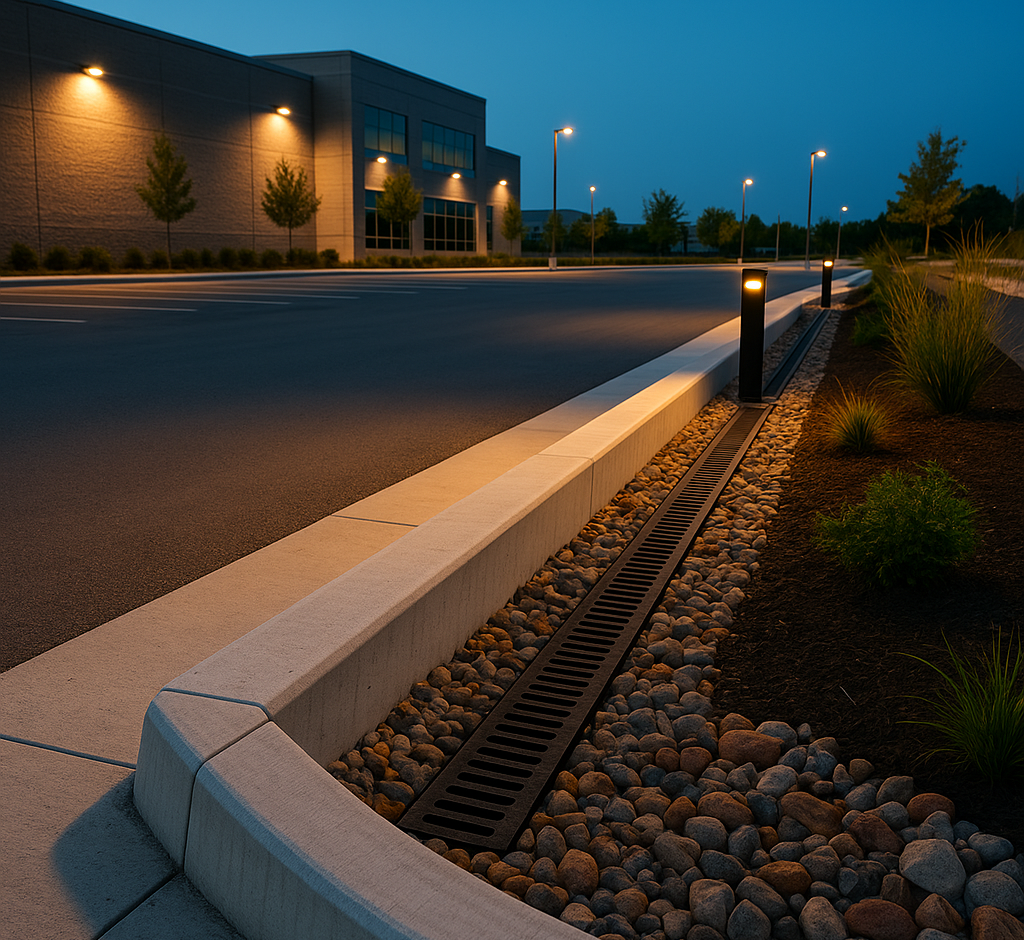
Trench drains are narrow channel systems—typically 100 to 300 mm wide—that intercept sheet flow across their entire length rather than collecting at a single point. They are the superior solution for flat-graded pedestrian plazas, building entrance aprons, loading dock approaches, and any environment where catch basin grates would interrupt the aesthetic continuity of a paver surface.
On a Cinintiriks commercial project, we specify polymer-concrete or fibre-reinforced concrete channel bodies with stainless steel or ductile iron slotted grate covers. The channel body is set on a compacted granular cradle with a continuous internal fall of 0.5% to 1.0% toward the discharge connection, ensuring that captured water moves through the channel without stagnation. The grate cover sits perfectly flush with the adjacent paver surface—no lips, no steps, no trip hazards. On our projects in Mississauga, we align trench drains with Charcoal accent bands in the paver pattern, transforming a utilitarian drainage element into a subtle design feature.
Phase 3: The Underground Network—Storm Sewer Design
Catch basins and trench drains are the visible collection points. Beneath them, an underground network of high-density polyethylene (HDPE) or PVC storm sewer piping conveys collected water to its final destination—either the municipal storm sewer connection at the property line or an on-site stormwater management facility.
The storm sewer piping is sized by a licensed professional engineer using the Rational Method (Q = CiA), where C is the runoff coefficient of the surface, i is the rainfall intensity for the design storm return period, and A is the contributing drainage area. For commercial sites in Mississauga, the design storm is typically the 100-year return period event—approximately 60 to 65 mm/hr for a 1-hour duration, based on current Environment and Climate Change Canada IDF curves for the Pearson Airport climate station.
Pipes are sized to operate at no more than 80% capacity under the design storm, providing margin for sediment accumulation, turbulence losses, and the increasing rainfall intensities being observed across southern Ontario. Pipe diameters on commercial sites typically range from 200 mm to 450 mm, depending on the contributing area and the pipe slope. All connections are sealed with rubber gasket joints for watertight integrity, and the pipe network is bedded on and backfilled with compacted granular material to prevent settlement and joint separation.
Phase 4: The Permeable Revolution
The City of Mississauga, in alignment with the Region of Peel’s stormwater management policies, increasingly requires commercial developments to implement on-site stormwater quantity and quality controls. The era of simply piping everything to the municipal sewer as fast as possible is ending. New developments must demonstrate that post-development runoff rates do not exceed pre-development levels—meaning that your 6,000 square metre parking lot cannot dump more water into the municipal system than the meadow or farm field it replaced.
This is where Permeable Interlocking Concrete Pavers (PICP) have fundamentally changed the engineering calculus for commercial hardscaping in the GTA.
A PICP system converts the pavement structure itself into a stormwater detention and infiltration facility. Rainwater passes through the widened joints between the pavers (filled with clean aggregate chips rather than polymeric sand), percolates through an open-graded aggregate bedding layer, and enters a massive clear stone reservoir beneath the surface. This reservoir—constructed from compacted 50 mm clear crushed stone with an approximate void ratio of 40%—stores the stormwater temporarily, attenuating peak flows and releasing the water gradually through infiltration into the native sub-grade (on permeable soils) or through perforated underdrain piping to the municipal system at a controlled, throttled rate (on impermeable clay soils).
On a Mississauga commercial PICP installation with a 400 mm deep sub-base reservoir, the system provides approximately 160 litres of stormwater storage per square metre of paved surface. A 6,000 square metre PICP parking lot stores nearly one million litres of stormwater within its structure—a volume that satisfies virtually any post-development runoff requirement the municipality imposes.
The benefits extend beyond code compliance. PICP surfaces do not pond water. Rain passes through the surface rather than accumulating on it. This means no puddles, no sheet ice formation on the paver surface, and a dramatic reduction in winter slip-and-fall liability—a benefit that commercial insurers and property managers in Mississauga value enormously.
"On a properly engineered commercial surface, water is not an enemy. It is a managed resource. The system tells it where to go, how fast to move, and where to wait. The surface stays dry. The code stays satisfied."
The Cinintiriks Standard for Commercial Drainage Design
Every large commercial drainage system we engineer in Mississauga follows a disciplined, phased methodology that ensures hydrological compliance, structural integrity, and aesthetic excellence.
1. Hydrological Analysis: We calculate contributing drainage areas, determine design storm intensities from current IDF curves, model runoff volumes using the Rational Method, and size every collection point and pipe run for 100-year storm capacity at 80% pipe flow. No approximation. No shortcuts.
2. Grading Engineering: We establish the complete grading plan at the sub-base level with a minimum 2% positive slope away from all building foundations and calculated cross-slopes directing sheet flow to engineered collection points. Every grade is laser-verified at sub-base, base course, and finished surface levels to ±3 mm tolerance.
3. Collection Infrastructure: Precast concrete catch basins with Class D traffic-rated grates, polymer-concrete linear trench drains with stainless steel slotted covers, and HDPE storm sewer piping—all sized, set, and connected to deliver peak storm flows to the municipal system or on-site management facility without surcharge or surface flooding.
4. Permeable Integration: Where site conditions and municipal requirements dictate, we engineer complete PICP systems with open-graded aggregate reservoirs, geotextile separation fabric, and controlled-release perforated underdrains. The result is a pavement structure that manages stormwater within itself—eliminating surface ponding, satisfying runoff quantity limits, and delivering superior water quality treatment.
5. As-Built Documentation: We deliver complete as-built surveys documenting final grades, pipe invert elevations, basin rim elevations, and system capacity calculations. This documentation serves as your compliance record for municipal inspection, your maintenance reference for ongoing operations, and your legal shield in any future drainage-related dispute.
This is The Cinintiriks Standard for commercial hydrology. We do not treat drainage as an afterthought. We engineer it as the structural and legal backbone of every commercial hardscape we deliver in Mississauga and across the Greater Toronto Area. Every litre of water is accounted for. Every slope is verified. Every pipe is sized with margin. The surface stays dry, the code stays satisfied, and your asset stays protected.
FAQ: Commercial Drainage Design in Mississauga
What is the required slope for a commercial parking lot or plaza to ensure proper water runoff?
The Ontario Building Code mandates a minimum 2% positive slope (1:50 gradient) on all ground surfaces within 1.8 metres of a building foundation, directing water away from the structure. On commercial parking lots and plazas in Mississauga, best engineering practice extends this requirement across the entire paved surface, with typical cross-slopes of 2% to 3% directing sheet flow from crowns or ridge lines toward gutter lines and collection points. Slopes steeper than 5% are generally avoided on pedestrian surfaces for comfort and accessibility reasons. The critical factor is not just the average slope but the consistency of the slope: localised deviations as small as 6 mm over a 3-metre straightedge can create ponding zones that accumulate water, freeze in winter, and generate both slip hazards and code-compliance liabilities. At Cinintiriks, we verify grading at three construction stages—sub-base, base course, and finished surface—to ensure every square metre drains as engineered.
What is the difference between a standard catch basin and a linear trench drain system?
A catch basin is a point-source collection device—a precast sump installed at a single low point in the grading plan, covered by a traffic-rated iron grate. It collects water from a defined area surrounding its location, relying on the grading plan to funnel surface flow toward it. Catch basins are effective on crowned parking lots and conventional guttered road surfaces where water is channelled along a defined gutter line. A linear trench drain is a continuous channel—typically 100 to 300 mm wide and extending several metres or more in length—that intercepts sheet flow across its entire frontage. It is the superior solution for flat-graded environments, pedestrian plazas, building entrance aprons, and any surface where traditional catch basins would either interrupt the paver aesthetic or fail to intercept broadly dispersed sheet flow. On large commercial projects in Mississauga, we typically deploy both systems: catch basins on parking lot gutter lines and loading areas, trench drains at building perimeters, plaza transitions, and pedestrian promenades.
How do permeable interlocking pavers reduce the load on Mississauga’s municipal storm sewers?
Permeable Interlocking Concrete Pavers (PICP) manage stormwater within the pavement structure rather than shedding it immediately to the storm sewer. Rainwater infiltrates through the paver joints into a massive open-graded aggregate reservoir beneath the surface. This reservoir—typically 300 to 450 mm deep with a 40% void ratio—temporarily stores thousands of litres of stormwater per square metre of paved area. On sites with permeable native soils, the stored water infiltrates naturally into the ground over 24 to 72 hours, never reaching the municipal sewer at all. On sites with impermeable clay soils (common across much of Mississauga), perforated underdrain piping at the base of the reservoir releases stored water to the municipal system at a controlled, throttled rate that is a fraction of the peak inflow rate. The result is dramatic peak flow attenuation—the reservoir absorbs the surge from an intense storm and releases it slowly, reducing the instantaneous load on the municipal storm sewer and helping the City of Mississauga manage downstream flooding risk. Additionally, the aggregate layers filter sediment and hydrocarbons from the stormwater, improving water quality before discharge.
The Final Word
Designing a drainage system for a large commercial surface in Ontario is not a task you assign to the paving contractor as a line item at the bottom of the scope. It is a heavy civil engineering discipline that must be integrated into the project from the very first excavation pass. The grading plan, the collection infrastructure, the underground storm sewer network, and—increasingly—the permeable pavement system are all interdependent components of a single hydrological machine. Get any one element wrong and the entire system underperforms, creating ponding, ice hazards, structural damage, and regulatory exposure that will cost far more to remediate than it would have cost to engineer correctly from the start.
Don’t let non-compliant drainage create a structural and legal liability for your property. Contact Cinintiriks for heavily engineered commercial hydrology and luxury hardscaping in Mississauga.