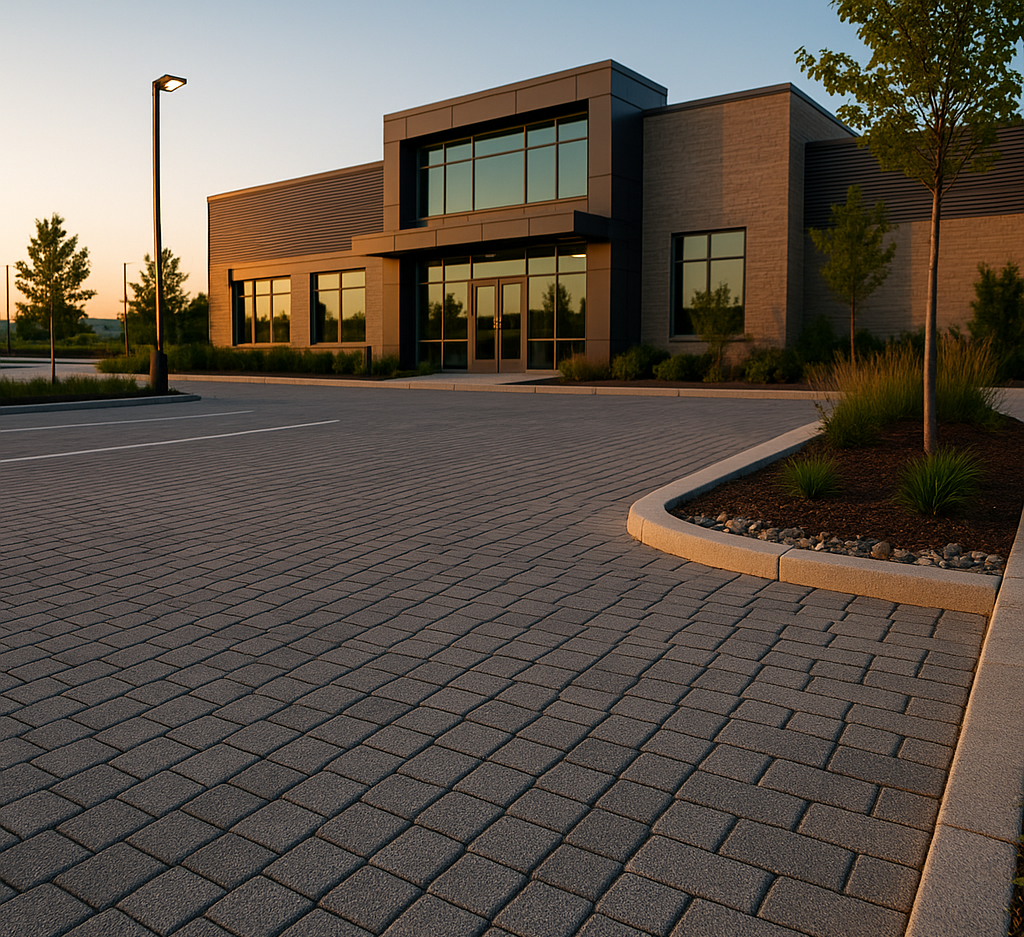
This is the bidding environment that commercial property owners navigate every day in the GTA. And it is the environment that produces the most expensive outcome in the industry: the low-ball bid that wins the contract, begins the work, and then issues a cascade of change orders once the true scope becomes apparent. "We hit rock during excavation." "The drainage needs to be rerouted." "The sub-base needs to be deeper than we anticipated." Every change order is a cost the original bid excluded—deliberately or through incompetence—and every one of them has no competitive pressure, because the contractor already has the job, the site is torn up, and the property owner has no practical alternative but to pay.
We built our commercial quoting process to be the antidote to that experience. It takes longer. It requires more work from our team before we present a number. And the number we present is almost never the lowest in the bid pool. But it is the most accurate, the most transparent, and the most comprehensive—and it is a fixed price that does not change between contract signing and final walkthrough.
Here is exactly how the process works, from first contact to signed proposal.
Phase 1: Initial Contact and Project Scoping
Every commercial project begins with a conversation—not a site visit, not a quote, and certainly not a number. Before we commit our assessment team to a site visit (which represents a significant investment of time and expertise), we need to establish three things:
1. Project Scope and Intent
What is the property? What work is being considered? Is this a new construction hardscape on a freshly graded site, or a tear-out and replacement of an existing failed surface? Is the scope the entire exterior (parking, walkways, entrance courts, loading areas), or a specific zone? Is there an architect or landscape architect involved, and are there existing drawings? What is the intended timeline—are permits already in place, or is this in the planning stage?
These questions are not filters to disqualify projects. They are necessary to determine which team members need to be at the site assessment, what equipment or testing may be required on-site, and what documentation we should request in advance so the site visit is productive rather than preliminary.
2. Budget Range
We ask every commercial client for a budget range. Not to price-match. Not to inflate our quote to the ceiling. To ensure design alignment. A $100,000 budget and a $400,000 budget produce radically different design solutions for the same property. If we design a $350,000 scope without knowing the budget is $150,000, we have wasted the client's time and our own. If the client is unsure of the budget, that is perfectly fine—we will provide tiered options at different price points. But if there is a hard ceiling, knowing it in advance allows us to direct every design decision toward maximising value within that constraint.
3. Decision Timeline and Stakeholders
Commercial decisions involve committees, boards, property management companies, and sometimes multiple ownership groups. Understanding who the decision-makers are, what approvals are required, and what the expected decision timeline looks like allows us to structure our proposal presentation appropriately— providing the level of detail, the format, and the supporting documentation that the specific approval process requires.
Phase 2: The Site Assessment
The site assessment is the most important step in the entire quoting process. It is where every variable that affects cost, schedule, and constructability is identified, measured, and documented. We do not outsource this. Our senior project manager conducts the assessment personally, typically spending 2-4 hours on site for a standard commercial plaza.
What We Evaluate
Existing surface conditions. What is currently on the ground? Asphalt (what thickness? what condition?), concrete (reinforced? scaled? heaving?), interlock (what base depth? are pavers reusable?), or bare grade? The existing surface determines the demolition and removal scope, which is one of the most significant and most frequently underestimated cost components in commercial hardscaping.
Soil conditions. We probe or test-dig at representative locations to determine the native soil type (clay, silt, sand, fill), moisture content, and depth to competent bearing material. In Vaughan, where rapid residential and commercial development has expanded across former agricultural land, the native soil beneath a plaza is often a thick layer of construction fill (imported soil of variable quality placed during site grading) over native clay. Fill over clay requires a different sub-base approach than undisturbed clay alone, and misidentifying the soil profile leads to under-engineered bases that fail under commercial traffic loads.
Drainage infrastructure. Where are the existing catch basins? What size and depth are they? Where do they connect? What is the existing surface grade, and does it drain correctly? Are there standing water or ponding issues that the new design must resolve? Is there a stormwater management plan on file with the municipality, and does it impose flow-rate restrictions on the property's discharge? We document every existing drainage element and assess whether it can be retained, must be modified, or must be replaced entirely.
Site access and logistics. Can a full-size excavator access the work area, or is access restricted to compact equipment? Where will roll-off bins be staged? Is there a hydro pole, gas meter, fire hydrant, or other obstruction that constrains equipment positioning? Will the work require lane closures or traffic control on adjacent municipal roads? Can the project be completed in a single mobilisation, or will it require multiple phases to maintain tenant access?
Underground utilities. We request a utility locate (Ontario One Call) and review the property's site plan for underground services: water mains, sanitary sewers, storm sewers, gas lines, electrical conduits, telecommunications conduits, and any private services (irrigation, landscape lighting, fire suppression). Every underground utility within the work zone affects excavation depth, equipment restrictions, and construction methodology. A utility that is not identified before the quote is a utility that generates a change order during construction. We locate them before we price.
Architectural drawings. If the property has existing architectural or engineering drawings (site plans, grading plans, drainage plans, landscape plans), we request and review them before or during the site visit. These drawings provide critical dimensional, elevation, and infrastructure data that supplements our field measurements and often reveals conditions that are not visible during a surface-level site walk (buried drainage connections, as-built deviations from original design, historical grading changes).
"A quote without a site assessment is a guess. And a guess with six figures attached to it is a liability, not a proposal."
Phase 3: Sub-Base Engineering and Structural Specification
With the site assessment data in hand, our team designs the structural foundation for every zone of the property. This is the phase that separates a professional commercial bid from a surface-level estimate—because the sub-base engineering is where the majority of the project cost lives, and where the majority of budget-bid contractors cut corners.
Zone-by-Zone Structural Design
Not every zone of a commercial property carries the same structural demand. A pedestrian walkway sees foot traffic and hand-pushed carts. A parking lot sees passenger vehicles at low speed. A loading zone sees 20-tonne delivery trucks reversing into a dock. Each of these zones requires a different sub-base depth, a different reinforcement specification, and a different concrete thickness—and each of those specifications drives a different cost per square foot.
Pedestrian zones: Minimum 10-12 inches of compacted Granular A base over geotextile. Concrete thickness: 100mm (4 inches), reinforced with welded wire mesh (WWM 152 x 152 MW 18.7 x MW 18.7) or 10M rebar at 300mm centres. For interlock: 60mm paver on 1-inch HPB bedding over the granular base. This is the lightest specification on the property, and it carries the lowest per-square-foot cost.
Vehicle traffic zones (parking, access lanes): Minimum 14-16 inches of compacted Granular A base over geotextile. Concrete thickness: 150mm (6 inches), reinforced with 10M rebar on 300mm centres both ways, or 15M rebar on 450mm centres. For interlock: 80mm commercial-grade paver on 1-inch HPB bedding over the granular base, with the base compacted to a minimum 98% Standard Proctor to resist rutting under turning vehicles. The increased base depth and reinforcement reflect the repeated axle loads from passenger vehicles, which produce fatigue stress in the slab over time.
Heavy vehicle zones (loading docks, waste collection pads, fire routes): Minimum 16-20 inches of compacted Granular A base over geotextile. Concrete thickness: 200mm (8 inches), reinforced with 15M rebar at 300mm centres both ways, top and bottom mat. This is commercial-industrial specification designed to handle the concentrated axle loads of fully loaded delivery trucks (up to 10,000 kg per axle), waste compactors, and fire apparatus. Interlock is generally not appropriate for heavy vehicle zones due to the risk of paver displacement under braking and turning loads; poured concrete with a broom finish is the standard.
Drainage Design
Every commercial proposal includes an engineered drainage plan: surface grades (minimum 1.5-2% toward catch basins), catch basin locations and sizes, pipe runs to the storm sewer, and any stormwater management features required by the municipality (detention, retention, or permeable surface areas). The drainage plan is not a suggestion or an afterthought. It is a specified, costed component of the proposal, because drainage failure on a commercial property creates liability, regulatory non-compliance, and accelerated surface deterioration simultaneously.
Phase 4: Material Selection and Design
With the structural specification established, the surface material and design phase begins. This is the visible layer—the part the tenants, customers, and street traffic will evaluate.
Material Options by Zone
We present material options for each zone of the property, with installed cost and lifecycle cost for each option:
- Revenue zones (tenant entrances, primary walkways, patio areas): Premium interlock pavers (Unilock, Techo-Bloc 60mm or 80mm), stamped/coloured concrete, or large-format architectural slabs. Multiple colour and pattern options presented with product samples.
- Functional zones (parking, secondary walkways): Plain broom-finish concrete, exposed aggregate concrete, or asphalt. Material selected based on budget allocation and the client's lifecycle cost preference.
- Service zones (loading, waste, mechanical): Plain broom-finish heavy-duty concrete. No decorative options—the entire budget for this zone is directed at structural capacity.
Design Development
For projects with significant decorative scope (multi-paver entrance courts, feature medallions, custom banding, integrated landscape elements), we develop a scaled design drawing that shows the material layout, colour placement, pattern specification, and transition details for every zone. This drawing becomes part of the proposal and part of the construction contract, ensuring that the installed result matches the approved design without ambiguity.
The Cinintiriks Approach: The Anatomy of Our Commercial Proposal
Our completed commercial proposal is not a one-page estimate. It is a comprehensive project document that includes every component required to evaluate, approve, and execute the project without ambiguity. Here is what you receive:
1. Executive Summary: A plain-language overview of the project scope, timeline, and total investment—so decision-makers who do not need the technical detail can understand the project at a glance.
2. Site Assessment Report: A documented record of existing conditions (soil type, drainage infrastructure, existing surface, access constraints, utility locations) with annotated photographs. This report establishes the baseline conditions that informed every specification in the proposal.
3. Zone-by-Zone Specification: For each zone of the
property, the proposal specifies:
• Excavation depth and estimated spoil volume
• Geotextile specification (manufacturer, weight, grade)
• Granular base depth, material type, and compaction standard
• HPB bedding depth (for interlock zones)
• Concrete thickness and reinforcement schedule (for concrete zones)
• Surface material (manufacturer, product name, colour, format)
• Joint specification (control joints for concrete; polymeric sand
product for interlock)
• Edge restraint specification (for interlock zones)
• Sealer specification (product, number of coats)
4. Drainage Plan: Engineered surface grades, catch basin locations, pipe sizes and runs, and stormwater management features, with all municipal compliance requirements identified and addressed.
5. Line-Item Cost Breakdown: Every cost component is
listed individually:
• Demolition and removal (by zone, by material)
• Excavation (by zone, by depth)
• Disposal (estimated tonnage, disposal facility, unit cost)
• Geotextile supply and installation
• Granular base supply, delivery, placement, and compaction
• HPB bedding supply and screeding
• Concrete supply and placement (by zone, by thickness)
• Rebar supply and placement (by zone, by schedule)
• Paver supply (manufacturer, product, quantity, unit cost)
• Paver installation labour (by zone, by pattern)
• Polymeric sand (product, quantity)
• Edge restraint (type, linear footage)
• Catch basins and drainage pipe
• Sealer (product, coverage, number of coats)
• Traffic management and site protection
• Project supervision and quality assurance
There are no lump sums, no "allowances," and no "TBD" items. Every line is
defined, quantified, and priced. The client sees exactly where every dollar
goes and can evaluate every specification independently.
6. Construction Schedule: A phased schedule that identifies start dates, milestone dates, and completion dates for each major activity, with contingency time built in for weather delays. The schedule also identifies any periods where tenant access will be temporarily restricted and specifies the mitigation measures (temporary walkways, signage, alternative access routes) that will maintain business operations during construction.
7. Fixed-Price Guarantee: The total project cost in the proposal is the cost the client will pay. Period. We do not issue change orders for subsurface conditions, disposal overages, or "unforeseen" complications. We assess these variables during the site assessment and build them into the specification. If conditions turn out to be more favourable than anticipated, we absorb the margin. If they turn out to be more challenging, we absorb the cost. The client's approved budget is respected from the first invoice to the final payment.
Phase 5: Proposal Presentation and Revision
We present the completed proposal in person (or via video conference for out-of-region stakeholders), walking the client through every section, answering questions in real time, and noting any revisions or modifications the client requests. Common revisions include:
- Adjusting the material specification for specific zones to align with budget priorities (upgrading the entrance court, downgrading the service alley)
- Phasing the project over two construction seasons to distribute the capital expenditure
- Adding or removing decorative elements (landscape planters, bollards, benches, lighting provisions)
- Modifying the drainage plan to accommodate recently completed or planned building modifications
Revisions are incorporated into an updated proposal, typically within 5-7 business days. There is no charge for revisions during the proposal phase. Our objective is a document that the client is fully confident in before a single shovel breaks ground.
Phase 6: Contract Execution and Pre-Construction
Once the proposal is approved, we execute a formal construction contract that incorporates the proposal (with all specifications and pricing) as the scope of work. The contract includes:
- Payment schedule: Milestone-based payments tied to completion of defined construction phases (typically: contract signing deposit, completion of excavation and base, completion of surface installation, final walkthrough and deficiency clearance). No front-loaded payment structures.
- Warranty: Cinintiriks provides a comprehensive written warranty covering structural integrity (settlement, heave, base failure) and surface integrity (scaling, delamination, paver displacement) for a defined warranty period.
- Insurance: Certificate of insurance ($5M commercial general liability, WSIB compliance) provided prior to mobilisation.
- Permit coordination: If the project requires municipal permits (building permits for structures, road occupancy permits for equipment or material staging on municipal property, stormwater management permits), Cinintiriks coordinates the application process and absorbs the coordination time within the project scope.
Pre-construction activities (utility locates, material ordering, equipment scheduling, tenant notification coordination) typically require 2-4 weeks between contract signing and site mobilisation.
What Makes This Process Different
The Cinintiriks quoting process is not faster than our competitors'. It is not simpler. And the number at the bottom of our proposal is rarely the lowest in the bid pool. What it is is complete.
When a property manager compares our proposal to a competitor's one-page estimate, the difference is immediately apparent. Our proposal specifies the geotextile weight. Theirs says "fabric." Our proposal lists the granular base depth for each zone. Theirs says "gravel base." Our proposal names the paver manufacturer, product, colour, and format. Theirs says "interlock pavers." Our proposal itemises disposal tonnage and unit cost. Theirs says "removal included."
These are not details. They are the substance of the project. A bid that says "gravel base" without specifying the depth is a bid that could mean 4 inches or 16 inches, and the cost difference between those two numbers is $30,000-$60,000 on a commercial plaza. A bid that says "interlock pavers" without identifying the product is a bid that could deliver a $4/sqft builder- grade paver or a $12/sqft commercial-grade slab. The ambiguity is not accidental. It is the mechanism by which low bids become mid-project change orders.
Our proposal eliminates that ambiguity entirely. Every specification is defined. Every cost is visible. Every component is comparable. And the total price is fixed.
Stop wasting time with vague estimates and hidden fees. Contact Cinintiriks for a comprehensive, heavily engineered commercial plaza quote today.
FAQ: The Cinintiriks Commercial Quoting Process
How long does it take to get a full commercial hardscaping proposal?
From initial contact to completed proposal delivery, the typical timeline is 2-4 weeks. This breaks down as follows: initial scoping conversation and document collection (2-3 business days), site assessment scheduling and execution (3-7 business days, depending on site access coordination), structural engineering and material specification (3-5 business days), cost estimation and proposal assembly (3-5 business days), and internal quality review (1-2 business days). For large or complex properties (multiple buildings, phased construction, significant drainage engineering), the timeline may extend to 4-6 weeks. We do not rush the process. An inaccurate proposal delivered quickly is worse than an accurate proposal delivered on a responsible timeline. The proposal is the foundation of the entire project—its accuracy determines whether the project runs smoothly or generates the mid-construction surprises that destroy budgets and timelines.
Do you provide 3D renderings with your commercial quotes?
For projects with significant decorative scope (premium interlock entrance courts, multi-material walkways, patio areas, custom feature zones), we provide scaled design drawings that illustrate the material layout, colour placement, pattern specification, and transition details. For select high-value projects where the design complexity warrants it, we can arrange 3D visualisation renderings through our design partners— however, this is typically a supplemental service rather than a standard inclusion, as the rendering process adds 1-2 weeks and a modest design fee to the proposal timeline. For the majority of commercial projects, our scaled design drawings combined with physical product samples (actual paver and concrete finish samples that the client can hold, compare, and evaluate in the property's natural light) provide a more accurate and tangible representation of the finished result than a digital rendering.
What specific information do I need to provide for the most accurate bid?
The more information you provide upfront, the faster and more accurate the
proposal. The ideal package includes:
1. Site plan or survey—a scaled drawing showing
property boundaries, building footprint, existing hardscape areas,
utilities, and easements. Most commercial properties have this on file
with the original building permit or from a recent survey.
2. Grading and drainage plan—if available, the
original engineered grading plan showing surface elevations, catch basin
locations, and storm sewer connections. If not available, we will survey
the existing grades during the site assessment.
3. Scope description—a written description of
what you want done: which areas are being replaced, which are being built
new, and any specific material preferences or design ideas. Photos of
existing conditions are extremely helpful.
4. Budget range—even a broad range ($100K-$200K
vs. $300K-$500K) allows us to align the design approach with the
financial reality before investing significant design time.
5. Timeline constraints—are there lease dates,
tenant move-in schedules, seasonal deadlines, or municipal permit
timelines that constrain the construction window?
6. Decision-maker information—who approves the
project, what format do they require for proposals (executive summary vs.
full technical detail), and what is their expected decision timeline?
If you don't have all of these items, that is perfectly normal and does
not prevent us from starting the process. We will work with whatever
documentation is available and supplement it with our own field data
during the site assessment.
The Final Word
A commercial hardscaping quote is not a number. It is a commitment—a documented promise of what will be built, how it will be built, what it will cost, and how long it will take. The quality of that promise determines whether the project proceeds smoothly or devolves into the familiar cycle of surprises, change orders, and frustration that defines too much of the commercial construction industry.
Our process takes longer than a phone quote. It is more detailed than a one-page estimate. And it produces a proposal that is not just a price—it is a complete engineering specification, a transparent cost breakdown, a fixed-price guarantee, and a construction schedule that you can hold us to.
That is the difference between a quote and a commitment. And commitments are what we build on.