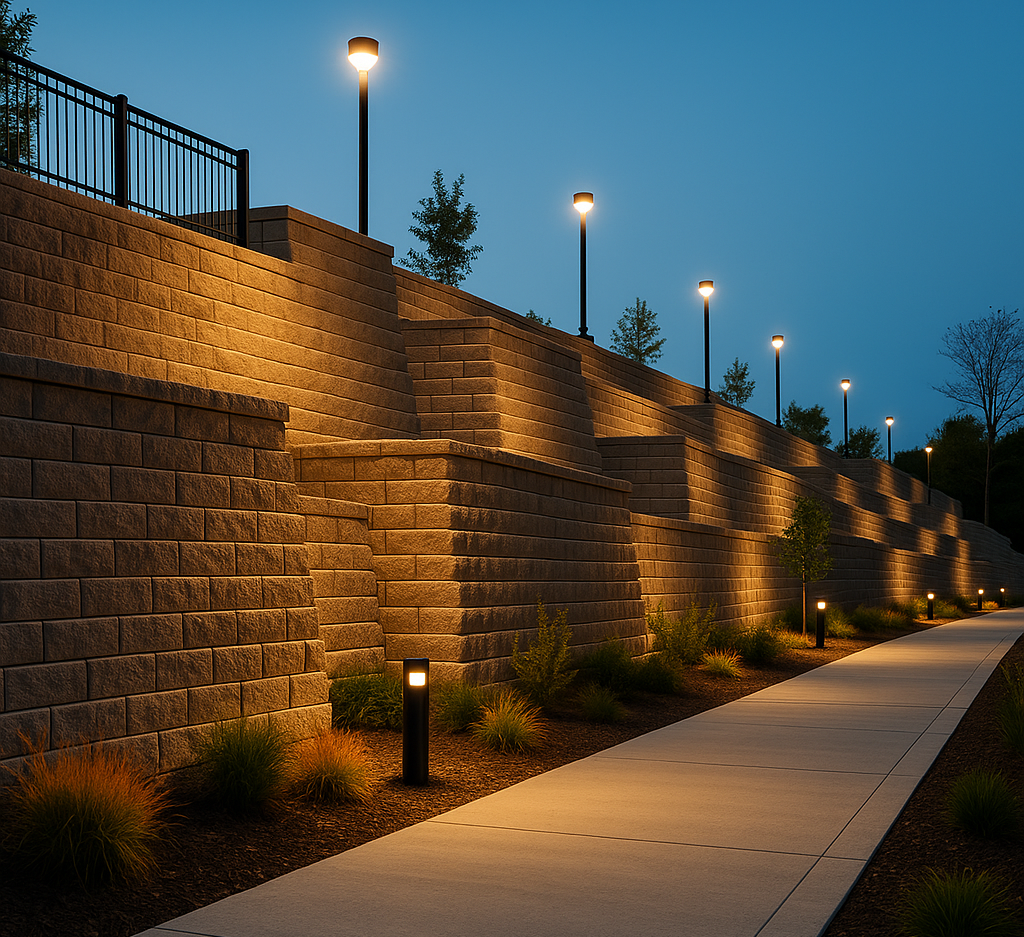
If you are planning a retaining wall project that involves significant grade changes on your property, this guide will walk you through every step of the approval process: when a permit is required, what documents you need, which agencies are involved, what inspections are mandatory, and how long the entire process takes from initial design to final sign-off. It is based on the City of Toronto's current regulatory framework, but the principles apply across most GTA municipalities with minor variations in timelines and application procedures.
The Red Tape Reality: Why the Permit Exists
Before discussing the process, it is worth understanding why the City of Toronto regulates retaining walls as rigorously as it does. The answer is not bureaucratic overreach. It is structural reality.
A retaining wall is a gravity dam. It holds back a mass of earth that would otherwise slide downhill under its own weight. The forces involved are enormous—a 5-foot wall retaining compacted soil generates approximately 4,500-6,000 kg of lateral force per linear metre at its base. A 30-foot-long wall at that height is resisting 135,000-180,000 kg of horizontal thrust. If the wall is under-engineered (too thin, too shallow, too lightly reinforced, inadequately drained), that force eventually overcomes the wall's resistance and the retained earth releases in a sudden, uncontrolled mass movement.
In a dense urban environment like Toronto, that mass movement does not land in an empty field. It lands on a neighbour's property, on a sidewalk, on a parked car, on a pedestrian, or against the foundation of an adjacent house. The permit and inspection system is the municipality's mechanism for verifying that the wall is engineered to resist those forces before it is built, inspected during construction to confirm it matches the engineering, and documented as a permanent record for future owners and for insurance purposes.
Skipping this process is not a shortcut. It is a decision that creates simultaneous exposure to structural failure, municipal enforcement, insurance voidance, and personal liability.
Step 1: The Height Threshold—When a Permit Is Required
Not every retaining wall requires a building permit. The Ontario Building Code (OBC) and the City of Toronto's building bylaw establish a clear threshold:
A building permit is required for any retaining wall with an exposed height exceeding 1.0 metre (3 feet 3 inches) above finished grade.
This is measured as the vertical distance from the finished grade at the base (toe) of the wall to the finished grade at the top of the wall. It is not measured from the top of the footing (which is buried) or from the bottom of the excavation (which is backfilled). It is the visible, exposed height of the wall face after construction is complete.
The Exceptions That Are Not Exceptions
Homeowners sometimes assume they can avoid the permit requirement by building two walls under 1 metre with a terrace in between, effectively achieving a total grade change of 2+ metres without any single wall exceeding the threshold. This does not work. The City of Toronto (and the OBC) considers the total grade change and the proximity of the walls when determining permit requirements. Two walls that are close enough that they function as a single structural system (generally within 1.5x the height of the lower wall) are assessed as a single structure. A building official who observes two 900mm walls with a 1-metre terrace between them will, correctly, treat them as a permit-required structure.
Additionally, a permit is required regardless of height if the wall:
- Supports a surcharge load (a driveway, patio, structure, or any usable surface above the wall)
- Is located within 1.5 metres of a property line
- Alters the surface drainage pattern of the property in a way that directs water onto neighbouring land
- Is located within a TRCA-regulated area (ravine, valley, watercourse setback)
- Requires the removal of a tree with a trunk diameter of 30cm (12 inches) or greater (subject to Toronto's Private Tree Bylaw)
In practice, any retaining wall project involving meaningful grade changes on a Toronto residential property will trigger at least one of these conditions. The safe assumption is that a permit is required.
Step 2: Structural Engineering—The P.Eng. Requirement
The first document required for a retaining wall building permit application is a set of structural engineering drawings prepared and stamped by a Professional Engineer (P.Eng.) licensed in the Province of Ontario.
The structural engineer's scope includes:
Geotechnical assessment. The engineer (or a geotechnical sub-consultant) assesses the native soil conditions at the wall location: soil type (clay, silt, sand, fill), bearing capacity, groundwater level, and frost penetration depth. These parameters directly determine the footing dimensions, drainage requirements, and reinforcement schedule. In Toronto, where the predominant native soils are glacial Lake Iroquois clays with variable fill layers from a century of urban development, the geotechnical conditions are rarely straightforward and almost always require site-specific assessment.
Structural design. Based on the geotechnical data, the engineer designs the wall: footing width and depth (minimum 1.2 metres below grade for frost protection in Toronto), wall stem thickness, reinforcement schedule (rebar size, spacing, and placement), concrete specification (minimum 25-32 MPa, depending on exposure class), and drainage system (clear stone, geotextile, weeping tile). The design must comply with the structural provisions of the OBC (Parts 4 and 9) and the applicable CSA standards for concrete and reinforcement.
Drawing set. The engineer produces a sealed drawing set that includes: a site plan showing the wall location relative to property boundaries, buildings, and existing grades; elevation drawings showing the wall profile and finished grades; cross-section drawings showing the footing, wall stem, reinforcement, backfill, drainage, and waterproofing details; and a structural notes sheet specifying the concrete mix, rebar grade, inspection requirements, and construction procedures. These drawings become the legal specification for the project—the contractor is required to build exactly what the drawings show, and the building inspector will verify compliance against these drawings at each inspection stage.
Timeline and cost: Structural engineering for a residential retaining wall typically takes 3-6 weeks and costs $3,000-$10,000, depending on the wall's complexity, height, and whether a geotechnical investigation is required. This is not an optional expense. The City of Toronto will not accept a building permit application for a structural retaining wall without P.Eng.-stamped drawings.
Step 3: Zoning Compliance
Before the building permit application is submitted, the project must be reviewed for compliance with Toronto's zoning bylaws (primarily Zoning By-law 569-2013). Zoning regulations affect retaining walls in several ways:
Setbacks
Retaining walls are subject to yard setback requirements that dictate how close a structure can be placed to a property line. In most residential zones in Toronto, the required setback is 0.6-1.2 metres from the side and rear property lines, depending on the zone category and the wall height. A retaining wall that encroaches into the required setback zone requires a minor variance from the Committee of Adjustment—a separate application process that adds 2-4 months and $2,000-$5,000 to the project timeline.
Lot Grading and Drainage
Toronto's zoning and site plan requirements mandate that surface drainage on each property is managed so that it does not adversely affect neighbouring properties. A retaining wall that alters the natural grade of the property can redirect stormwater flow patterns, potentially directing water onto a neighbour's lot that did not previously receive it. The building permit application must include a grading and drainage plan demonstrating that the post-construction drainage pattern will not increase runoff to adjacent properties. In some cases, this requires an engineered grading plan prepared by a civil engineer or landscape architect.
Height Restrictions in Certain Zones
Some Toronto zoning categories impose maximum retaining wall heights or maximum total grade changes, particularly in established residential neighbourhoods with heritage designations or in areas adjacent to the public right-of-way. These restrictions are zone-specific and must be confirmed with the zoning department before the engineering design is finalised. Designing and engineering a wall that exceeds the zoning height restriction wastes the engineering investment and delays the project when the permit application is rejected.
"The permit process is not the obstacle. The obstacle is building a wall that fails, that floods your neighbour, or that the city orders you to tear down. The permit is the proof that none of those outcomes will happen."
Step 4: The TRCA—Conservation Authority Approval
This is the approval layer that catches the most homeowners by surprise. If your property is located within a Toronto and Region Conservation Authority (TRCA) regulated area, your retaining wall project requires TRCA approval in addition to the City of Toronto building permit. And a remarkably large portion of Toronto's residential land falls within TRCA jurisdiction.
What Triggers TRCA Involvement
The TRCA regulates development within and adjacent to:
- River and stream valleys (the Don River, Humber River, Rouge River, Highland Creek, Etobicoke Creek, and all tributaries)
- Ravines (Toronto's extensive ravine system, which extends deep into residential neighbourhoods)
- Flood plains (areas identified as being within the Regional Flood Line)
- Valley slopes and associated tableland (the stable top-of-bank area adjacent to valley slopes, typically extending 10-15 metres back from the valley crest)
- Wetlands and their buffers
If your property is within or partially within any of these features, the TRCA must review and approve your retaining wall proposal before the City will issue a building permit. You can check your property's TRCA status through the TRCA's screening map (available online) or by contacting the TRCA's Planning and Development department directly.
What the TRCA Reviews
The TRCA's review focuses on different concerns than the building permit:
- Slope stability: Will the excavation for the wall footing destabilise the valley slope? Is the wall designed to improve or maintain slope stability, or does it introduce new risk?
- Erosion control: Will construction activities (soil disturbance, exposed grading) increase erosion into the watercourse? What erosion and sediment control measures will be implemented during construction?
- Stormwater management: Will the wall alter stormwater runoff patterns in a way that affects the watercourse or flood plain? Is stormwater from the retained area managed to prevent increased flow rates into the ravine?
- Vegetation and habitat: Will the project remove vegetation within the TRCA-regulated area? Are there protected species or sensitive habitats that would be affected?
Timeline: TRCA review typically takes 6-12 weeks from complete application submission. For complex projects (large walls on steep slopes near active watercourses), the review can extend to 16-20 weeks, particularly if the TRCA requires a geotechnical slope stability assessment (which is a separate engineering study from the structural design). TRCA applications require their own engineering drawings (often overlapping with the building permit drawings) and application fees of $1,500-$5,000+.
In Mississauga, where the Credit River valley system creates similar conservation authority oversight through Credit Valley Conservation (CVC), we routinely encounter projects where the homeowner was unaware that their property fell within the regulated area until the permit application was flagged. The CVC review process in Mississauga mirrors the TRCA process in Toronto: separate application, separate timeline, separate fees, and a separate approval that must be obtained before the building permit can be issued. Across the GTA, the conservation authority layer adds a minimum of 2-3 months to the project timeline on every affected property.
Step 5: Urban Forestry—The Tree Protection Layer
Toronto's Private Tree By-law (Chapter 813) protects trees on private property with a trunk diameter of 30cm (approximately 12 inches) or greater, measured at 1.4 metres above ground. If your retaining wall project requires the removal of, or significant excavation within the root zone of, a protected tree, you must obtain an Urban Forestry tree removal or injury permit before commencing work.
What Triggers Urban Forestry Involvement
- Tree removal: Removing a protected tree to accommodate the wall alignment, footing excavation, or grading changes
- Root zone disturbance: Excavating within the critical root zone (CRZ) of a protected tree— defined as a circular area around the trunk with a radius equal to 10x the trunk diameter (DBH). A tree with a 40cm trunk has a CRZ radius of 4 metres. Any excavation within that radius for the wall footing, drainage, or grading changes triggers the requirement for an arborist report and, potentially, a tree protection plan.
The Application
If tree removal is required, the permit application must include:
- An arborist report prepared by an ISA-certified arborist, documenting the species, size, condition, and significance of the affected trees
- A tree protection plan (if the tree is being preserved but the CRZ is being disturbed), specifying protective hoarding, root pruning procedures, and monitoring requirements during construction
- Replacement tree planting plan—Toronto typically requires 2-3 replacement trees for each tree removed, or a cash-in-lieu payment to the City's tree planting fund
Timeline: Urban Forestry review takes 4-8 weeks. Tree removal permits have seasonal restrictions: removal of trees containing active bird nests is prohibited under the federal Migratory Birds Convention Act during the nesting season (approximately April 1 to August 31), which can delay tree removal—and therefore the entire project—by several months if the application is submitted during that window.
Step 6: The Building Permit Application
With the structural engineering drawings completed, zoning compliance confirmed, TRCA approval obtained (if applicable), and Urban Forestry permits secured (if applicable), the building permit application can be submitted to the City of Toronto's Building Division.
Application Package
The complete building permit application includes:
- Completed building permit application form
- P.Eng.-stamped structural drawings (site plan, elevations, cross-sections, structural notes)
- Grading and drainage plan (showing existing and proposed grades, drainage directions, and stormwater management)
- Survey (recent land survey showing property boundaries, building locations, existing grades, and easements)
- TRCA approval letter (if applicable)
- Urban Forestry permit or arborist report (if applicable)
- Application fee (based on the estimated construction value; typically $500-$2,000 for a residential retaining wall)
Review and Approval Timeline
The City of Toronto's target review time for a complete building permit application is 10-15 business days for residential projects. In practice, the actual timeline is often 4-8 weeks, depending on application volume, the complexity of the project, and whether the reviewer requests additional information or revisions to the drawings (which resets the review clock).
Common reasons for review delays:
- Incomplete application: Missing documents, unsigned forms, or drawings that do not include all required information (the most common cause of delay)
- Zoning non-compliance: The proposed wall location or height does not comply with the applicable zoning bylaw, requiring either a design revision or a minor variance application
- Drawing deficiencies: The structural drawings do not include sufficient detail for the reviewer to confirm OBC compliance (missing reinforcement schedules, missing drainage details, missing concrete specifications)
- Waiting for TRCA or Urban Forestry approvals: The building permit cannot be issued until all prerequisite approvals are in place
Step 7: Construction and Mandatory Inspections
Once the building permit is issued, construction can begin. But the permit is not a start-and-forget document. It comes with mandatory inspection stages that must be booked and passed before the next construction phase can proceed:
Inspection 1: Footing excavation. The inspector verifies that the excavation depth reaches competent bearing soil (as identified in the geotechnical assessment), that the footing dimensions match the engineering drawings, and that the excavation is properly supported (shored or sloped to prevent collapse). Construction cannot proceed until this inspection passes.
Inspection 2: Rebar placement (before concrete pour). The inspector verifies that the reinforcement (rebar size, spacing, cover, lap lengths, and placement) matches the P.Eng. drawings exactly. This is the most critical inspection, because the rebar is the structural skeleton of the wall—and once the concrete is poured, the rebar is permanently encased and can never be inspected again. Deficiencies found at this stage (missing bars, incorrect spacing, insufficient cover) must be corrected before the pour is authorised.
Inspection 3: Drainage (before backfill). The inspector verifies that the drainage system (clear stone, geotextile, weeping tile) is installed per the engineering drawings and that the weeping tile has a clear outlet. Like the rebar, the drainage system is permanently buried after backfill and cannot be corrected without demolition. This inspection must pass before backfill begins.
Inspection 4: Final. The inspector verifies the completed wall: finished grades match the approved grading plan, the wall is plumb, the cap is installed, and the overall construction complies with the approved drawings and the OBC. Once the final inspection passes, the building permit is closed—meaning the project is officially complete and compliant in the City's records.
The Cinintiriks Approach: Full-Service Permit Management
At Cinintiriks, the approval process is not the homeowner's problem to manage. It is ours. Our Cinintiriks Standard for Permitted Retaining Walls includes complete management of every regulatory requirement from initial design through final inspection sign-off.
1. Structural Engineering Coordination: We work with our licensed P.Eng. structural engineering partners from the project's inception. The engineer is engaged during the design phase (not after), so the wall design, the landscape design, and the structural engineering are developed simultaneously—eliminating the costly revisions that occur when a landscape plan is designed first and then sent to an engineer who must redesign it to make it structurally feasible.
2. Regulatory Pre-Screening: Before any design or engineering work begins, we screen the property for all applicable regulatory requirements: TRCA/conservation authority jurisdiction, Urban Forestry protected trees, zoning setbacks, heritage designations, easements, and right-of-way restrictions. We identify every approval that will be required before the project enters the design phase, so the design accounts for regulatory constraints from the start rather than discovering them during the permit application.
3. Complete Application Package: We prepare and submit the building permit application with every required document, drawing, approval, and fee included. Incomplete applications are the primary cause of permit delays in Toronto. Our applications are submitted complete, every time, because we have prepared hundreds of them and we know exactly what each municipality requires.
4. TRCA and Urban Forestry Coordination: If conservation authority or forestry approvals are required, we manage those applications in parallel with the building permit preparation, minimising the total timeline rather than processing each approval sequentially.
5. Inspection Scheduling and Compliance: During construction, we schedule each mandatory inspection at the appropriate construction stage, ensure the work is ready for inspection (rebar placed, accessible, and visible; drainage installed and photographed), and resolve any inspection deficiencies immediately. Building inspectors assess the work against the approved drawings. Because we build to those drawings exactly, our inspection pass rate is virtually 100% on first review.
6. Permit Closure: After the final inspection, we confirm that the building permit is formally closed in the City's records and provide the homeowner with a complete permit file (approved drawings, inspection records, P.Eng. certification) for their permanent records. A closed permit is proof of compliance that protects the homeowner if the property is sold, insured, or refinanced.
The Full Timeline: How Long Does All of This Take?
A realistic timeline for a structural retaining wall project in the City of Toronto, from initial consultation to construction completion:
- Design and engineering: 3-6 weeks
- TRCA approval (if required): 6-16 weeks (can run parallel with engineering)
- Urban Forestry permit (if required): 4-8 weeks (can run parallel)
- Building permit review and issuance: 4-8 weeks
- Construction: 2-6 weeks (depending on wall length, height, and complexity)
Best case (no TRCA, no tree issues, clean permit review): 10-16 weeks from design start to construction completion.
Complex case (TRCA + trees + zoning variance): 6-10 months from design start to construction completion.
These timelines are real. They cannot be accelerated by skipping steps, by starting construction before the permit is issued, or by hoping the inspector will not notice. The approval process has a sequence and each step must be completed before the next one begins.
Don't risk a stop-work order or forced demolition. Contact Cinintiriks for fully engineered, permit-approved structural retaining walls.
FAQ: Retaining Wall Permits in Toronto
What happens if I build a retaining wall over 1 metre without a Toronto building permit?
The consequences escalate in severity. First: if the City becomes aware of the unpermitted construction (through a neighbour complaint, a property inspection, a real estate transaction, or a building official driving past), they will issue a stop-work order halting all construction activity on the property immediately. Second: the City will issue an order to comply, requiring the property owner to either obtain a retroactive building permit (which requires the same engineering drawings, the same application, and the same fees as a proactive permit—plus additional fees for the retroactive application) or demolish the unpermitted structure. Third: if the wall does not comply with the OBC (which is virtually certain for a wall built without engineering), the retroactive permit will be denied and demolition will be ordered. Fourth: the Property Standards Office may issue fines of $500-$100,000 per offence under the Building Code Act. Fifth: the unpermitted wall will appear on the property's municipal record, creating complications for future building permits, property sales, mortgage approvals, and insurance claims. The total cost of building without a permit—including demolition, fines, engineering fees for the replacement design, permit fees, and reconstruction—is typically 3-5x the cost of doing it correctly from the start.
How long does it take to get a structural retaining wall approved by the city?
For a straightforward residential retaining wall (not
in a TRCA-regulated area, no tree removal required, no zoning variance
needed), the typical timeline is 10-16 weeks from
initial design to permit issuance: 3-6 weeks for structural engineering
and drawing preparation, plus 4-8 weeks for the City's building permit
review. Construction adds another 2-6 weeks, bringing the total
project timeline to 12-22 weeks.
For a complex project involving TRCA approval (add
6-16 weeks), Urban Forestry permits (add 4-8 weeks), or a zoning
minor variance (add 8-16 weeks), the permit phase alone can take
4-8 months. The single most effective way to
minimise the timeline is to submit a complete application
with all required documents, drawings, and prerequisite approvals
on the first submission. Every resubmission due to missing information
resets the City's review clock by 2-4 weeks. We have seen projects
where incomplete applications added 3-4 months to the approval
timeline entirely due to preventable resubmission cycles.
Does a neighbour have to approve my retaining wall if it's built directly on the property line?
Your neighbour cannot "veto" a retaining wall that complies with
the building code and zoning bylaws. However, there are
important considerations. If the wall is built on the property
line (a party wall), both property owners have legal rights and
obligations under Ontario's Line Fences Act. If the wall is
built within your property but close to the line, it must comply with
the applicable zoning setback (typically 0.6-1.2 metres from the side
property line in residential zones). Building within this setback zone
requires a minor variance from the Committee of
Adjustment, and the variance process includes a public
notification to adjacent property owners, who have the right
to attend the hearing and present objections. The Committee will
consider those objections alongside the planning merits of the
application, but the neighbour does not have a unilateral right to
block the project.
Separately, the drainage impact on the neighbour's
property is a legitimate concern that the City will review regardless
of whether the neighbour objects. If your retaining wall redirects
surface water onto the neighbour's property, the City will require
you to modify the grading plan to eliminate the drainage impact. This
is not subject to neighbour approval—it is a code requirement
that must be satisfied whether or not the neighbour raises the
issue.
The Final Word
The permit process for a structural retaining wall in Toronto is not fast. It is not simple. It is not optional. And it is not an adversary to be outsmarted or avoided.
It is a system that ensures the wall you build will not collapse, will not flood your neighbour, will not destroy protected trees, will not destabilise a ravine slope, and will not create the kind of catastrophic failure that injures people and produces six-figure remediation costs. Every step in the process—the engineering, the zoning review, the TRCA assessment, the tree permit, the building permit, and the inspections—exists because a retaining wall that is built wrong causes serious, expensive, and sometimes irreversible harm.
The permit is not the cost of doing business. It is the proof that the business was done correctly.