The Porous Sponge Liability
Here is what nobody tells you when you pour a light-coloured concrete driveway: concrete is not a solid surface. It is a rigid, porous matrix riddled with microscopic channels called capillary pores—a byproduct of the hydration chemistry that hardens the cement paste. These pores are invisible to the naked eye, but they are open, they are connected, and they are hungry. Every liquid that touches unsealed concrete is drawn into those pores by capillary action—the same physics that pulls water up a paper towel. Oil, tire plasticizer residue, tannin-laden leaf water, iron-rich runoff, calcium chloride brine—all of it wicks into the top 3 to 8 millimetres of the slab within minutes of contact.
On dark concrete, you cannot see the staining. The discoloration blends into the base colour, and the surface looks adequate even when it is chemically saturated with contaminants. On white or light-coloured concrete, every single absorbed molecule is visible. Every tire mark. Every leaf ghost. Every splash of coffee. Every drip of transmission fluid. The light background is an unforgiving canvas that reveals what darker surfaces hide, and once those contaminants have been pulled deep into the capillary network, no amount of garden hose rinsing, dish soap, or weekend scrubbing will extract them. They are inside the concrete. They are bonded to the cement paste at a molecular level. And they are permanent—unless you understand the chemistry required to pull them back out.
This is the fundamental challenge of maintaining any light-coloured hardscape surface in Toronto, where the seasonal cycle delivers a relentless rotation of organic debris (spring and autumn), hot UV exposure (summer), and salt-laden freeze-thaw contamination (winter). A white driveway in this climate is either meticulously engineered for protection or it is a slow-motion staining disaster. There is no middle ground.
Understanding the Stains: What Is Actually in Your Concrete
Before you can clean a light-coloured driveway, you have to understand what you are cleaning. Different stains require different chemistry, and applying the wrong treatment to the wrong contaminant will either do nothing or make the problem worse.
Tire Marks: Hot Plasticizer Transfer
The dark marks your car tires leave on white concrete are not rubber. They are plasticizer residue— a class of chemical compounds (typically phthalates or paraffinic oils) that are mixed into the rubber compound during tire manufacturing to keep the rubber flexible and prevent cracking. When the tire heats up during driving (and tires get hot—surface temperatures can exceed 60°C on a summer day in Toronto), those plasticizer molecules migrate to the surface of the rubber. When the hot tire parks on cool, porous concrete, the plasticizer transfers from the tire to the concrete surface and is immediately drawn into the capillary pores by capillary action and thermal differential (the hot, liquid plasticizer flows easily into the cooler pore structure).
This is why tire marks are almost always worse in summer, why they appear directly under the tire contact patch, and why they darken over time: each parking event deposits another layer of plasticizer on top of the previous one, compounding the discoloration. The marks are not sitting on the surface. They are embedded in the pore structure, which is why scrubbing the surface with soap and water is futile. You are cleaning the top of the sponge while the stain is inside the sponge.
Leaf and Organic Stains: Tannin Acid Penetration
The brown, ghost-like outlines left by fallen leaves are caused by tannins—naturally occurring polyphenolic compounds found in decomposing organic matter. When wet leaves sit on concrete for even 24 to 48 hours, the moisture leaches tannins out of the leaf tissue and carries them directly into the concrete pores. Tannins are acidic, and they chemically bond with the calcium hydroxide in the cement paste, creating a stable, brownish-yellow compound that is remarkably resistant to removal.
Toronto properties with mature maple, oak, or walnut trees are particularly vulnerable. Walnut leaves and husks contain exceptionally high concentrations of tannins (and juglone, a particularly aggressive pigment), and a single autumn weekend of uncollected walnut debris can leave staining that persists for years on unsealed concrete.
Winter Contamination: Salt Film and Efflorescence
The grey, dingy film that accumulates on Toronto driveways over the winter months is a cocktail of sodium chloride (road salt), calcium chloride, sand, automotive fluid drippings, and airborne particulate matter carried in by tire spray and plough residue. The salt itself penetrates the concrete pores as a brine solution, and as it dries, efflorescence forms—white, powdery mineral deposits (calcium carbonate and sodium sulphate) that crystallise on and just below the surface. On dark concrete, efflorescence appears as a whitish haze. On white concrete, it manifests as an uneven, blotchy, chalky texture that dulls the original clean finish and makes the surface look prematurely aged.
The Engineering: Chemical Extraction and Thermal Washing
Maintaining a white concrete driveway is not a weekend chore you solve with a cold-water garden hose, a bottle of household bleach, and optimism. The contaminants you are dealing with are embedded inside a rigid porous matrix, chemically bonded to the cement paste, and layered over months or years of exposure. Extracting them requires targeted chemistry and serious equipment.
Step 1: Targeted Chemical Pre-Treatment
Each stain type requires its own extraction chemistry, applied before any mechanical washing begins.
For tire marks (plasticizer): A commercial-grade alkaline degreaser with a pH between 12 and 13 is applied directly to the stained zones. The alkaline chemistry emulsifies the paraffinic and phthalate compounds, breaking their bond with the cement paste and suspending them in a soapy micelle structure that can be flushed away. The degreaser is applied at full concentration and allowed to dwell for 10 to 15 minutes, agitated with a stiff nylon brush if the staining is severe. Do not use a wire brush; metal bristles will score the concrete surface and create micro-channels that trap future contamination.
For tannin and organic stains: A mild oxalic acid solution (typically 5 to 10% concentration) is applied to the affected areas. Oxalic acid is a chelating agent—it reacts with the iron and calcium compounds that anchor the tannin pigment to the cement paste, breaking the chemical bond and releasing the discoloration from the pore structure. The acid is allowed to dwell for 5 to 10 minutes. This is not muriatic acid. Muriatic (hydrochloric) acid will dissolve the cement paste itself, etching the surface, exposing aggregate, and permanently destroying the finish. Oxalic acid is the precise, surgical tool; muriatic acid is a sledgehammer.
For efflorescence and salt film: A dilute phosphoric acid wash (2 to 5% concentration) dissolves the crystallised mineral deposits without damaging the underlying cement paste. The area is pre-wetted with clean water to prevent the acid from being absorbed too deeply, then the phosphoric acid is applied, agitated, and rinsed within 3 to 5 minutes.
Step 2: Commercial-Grade Hot-Water Pressure Washing
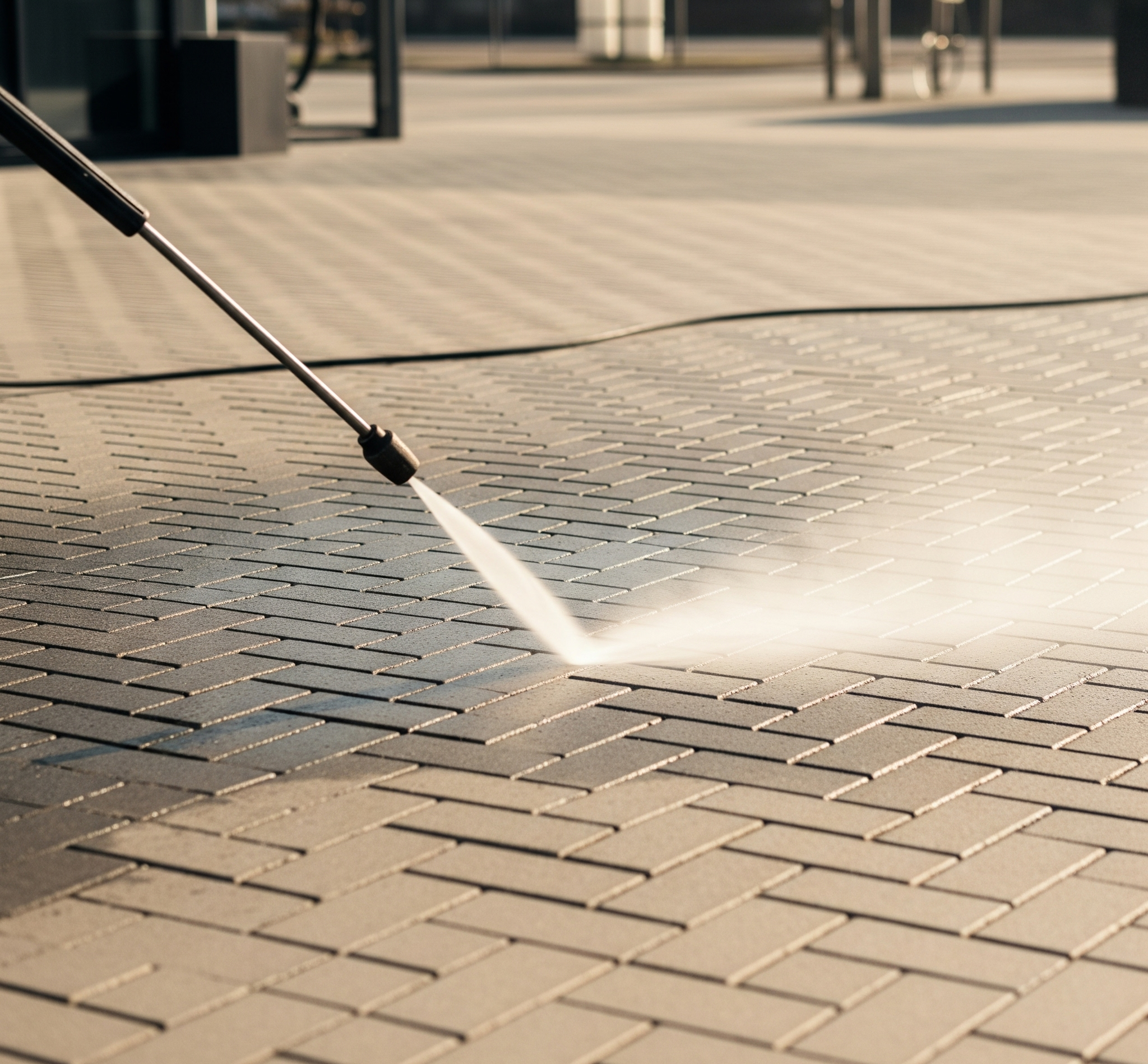
After chemical pre-treatment has broken the molecular bonds anchoring the contaminants, the extraction requires commercial-grade hot-water pressure washing. This is not a consumer-grade electric washer from the hardware store. The equipment we deploy on Toronto projects is a trailer-mounted hot-water unit delivering water at 65 to 85°C at pressures between 3,000 and 4,000 PSI, through a surface cleaner attachment—a rotating, flat disc with dual nozzles that delivers uniform pressure across a 500 mm cleaning path without leaving the visible striping pattern that a single wand tip creates.
The heat is critical. Hot water is dramatically more effective than cold water at dissolving and flushing emulsified contaminants from the pore structure. The thermal energy reduces the viscosity of the suspended plasticizers and tannins, allowing them to flow out of the capillary network rather than simply being pushed deeper by the pressure alone. Cold-water pressure washing (which is what most homeowners and low-cost contractors use) cleans the surface but leaves the deeper pore contamination intact. The stain fades temporarily, then reappears within weeks as the embedded pigment wicks back to the surface through capillary action. It is a frustrating cycle that makes homeowners believe their concrete is permanently ruined, when in reality it has simply never been properly extracted.
The entire driveway is washed systematically, overlapping each pass by 50 to 75 millimetres to ensure uniform cleaning. The runoff is managed with squeegees and directed away from planting beds and catch basins. The result, when done correctly, is a surface that is returned to within 90 to 95% of its original colour—even after years of accumulated contamination.
"A white driveway does not stay white by accident. It stays white because someone engineered the chemistry to keep it that way."
The Permanent Defence: Molecular Encapsulation
Cleaning the concrete is only half the equation. A meticulously extracted surface that is left unsealed will begin re-staining from the very first rainstorm, the very first parking event, the very first leaf fall. The pores are open. The capillary network is intact. The sponge is ready to absorb again. If you do not seal the concrete immediately after cleaning, you have spent significant money on a temporary result that will degrade within weeks.
The Right Sealer: Deep-Penetrating Silane/Siloxane
The sealer you need is a deep-penetrating silane/siloxane molecular sealer—the same class of product we discussed in our guide on preventing concrete spalling, and for good reason: the underlying principle is identical. The silane and siloxane molecules are small enough to enter the capillary pore network of the concrete, where they chemically react with the silica in the cement paste to form a permanent hydrophobic (water-repelling) molecular lining inside the pores themselves.
There is no film on the surface. The concrete looks and feels exactly the same. But at the molecular level, the interior walls of every capillary channel have been rendered water- and oil-repellent. When water hits the surface, it beads and rolls off. When a hot tire parks on the sealed surface, the plasticizer residue cannot wick into the pores—it sits on top, on the surface, where it can be rinsed away with a simple hose or a light pressure wash. When a wet leaf lands on the driveway, the tannin-laden moisture cannot penetrate; it evaporates off the surface and the leaf blows away without leaving a ghost.
This is molecular encapsulation—the pore network is not blocked with a surface film (which would peel, blister, and trap moisture). It is chemically lined with a hydrophobic barrier that is part of the concrete itself. The sealer is breathable: liquid water and contaminants cannot enter from above, but water vapour can escape from below, preventing the entrapment and freeze-thaw damage that film-forming acrylic sealers cause.
Why Film-Forming Sealers Fail on Light Concrete
A quick but critical detour. Many Toronto homeowners and contractors apply film-forming acrylic sealers to light concrete because the glossy finish looks stunning on the day of application. Within one to two winters, the film fails. Here is why.
Film-forming sealers create a thin plastic layer on top of the concrete. Moisture that enters the slab from below (through ground vapour, lateral capillary draw, or trapped construction moisture) is blocked from evaporating upward by the film. The moisture accumulates beneath the film. When it freezes, the ice pushes the film upward, causing peeling, blistering, and a milky-white discoloration called blushing. On dark concrete, blushing is a noticeable but somewhat tolerable aesthetic issue. On white or light-coloured concrete, it is devastating: blotchy, opaque white patches spread across the surface, making the driveway look worse than it did before sealing. The failed film then has to be chemically stripped (using xylene or aggressive solvents), the surface re-cleaned, and a proper penetrating sealer applied—tripling the cost and effort of doing it correctly the first time.
Application Protocol for Light-Coloured Concrete
The sealer is applied to clean, dry, fully extracted concrete. The surface must be completely free of residual chemical agents, contaminant residue, and standing moisture. We typically allow 24 to 48 hours of dry weather after extraction before sealing.
The silane/siloxane product is applied using a low-pressure sprayer, flooding the surface in a single generous coat until the pores stop absorbing. Excess product is back-rolled with a lint-free roller to prevent puddling and ensure even penetration. The sealer disappears into the concrete within 20 to 30 minutes, penetrating to a depth of 3 to 6 millimetres. It cures invisibly over 24 hours. The surface looks unchanged. But the chemistry beneath it has been fundamentally transformed. The pores are lined. The sponge is closed. The driveway is defended.
Reapplication is recommended every 5 to 8 years for residential driveways in Toronto, or every 3 to 5 years for commercial surfaces subject to higher traffic and salt exposure. Each reapplication is a straightforward process: clean, dry, spray, roll, cure. No stripping required, because there is no film to remove.
The Ultimate Alternative: Warm Off-White Interlocking Pavers
For homeowners who want the aesthetic of a pristine, light- coloured driveway without the ongoing chemical maintenance that poured concrete demands, there is a structurally superior alternative: replacing the concrete entirely with high-density Warm Off-White interlocking pavers.
Factory-pressed interlocking pavers are manufactured at hydraulic pressures exceeding 2,000 PSI with a zero-slump concrete mix, producing units with water absorption rates below 5%—compared to 7 to 10% for typical poured concrete. The reduced porosity means dramatically less capillary absorption of tire plasticizers, tannins, salt brine, and contaminants. Stains that would penetrate 5 millimetres into poured concrete sit within the top millimetre of a high-density paver, where they can be extracted with a standard commercial wash without the aggressive chemical pre-treatment that poured concrete requires.
And here is the advantage that makes pavers structurally superior for long-term aesthetics: if a single paver sustains irreversible staining—a deep oil spill, a rust mark from a metal object left on the surface— that individual paver can be lifted and replaced without touching the rest of the driveway. The replacement unit is the same colour, the same profile, the same texture. It drops into the field seamlessly. Try doing that with a monolithic concrete slab. You cannot patch concrete invisibly. You cannot colour-match a new pour to an existing, weathered surface. The repair will always show.
Our signature Warm Off-White pavers with Charcoal soldier course borders deliver a clean, monochromatic, architecturally refined aesthetic that complements the contemporary and transitional home styles throughout Toronto. The colour is integral to the manufacturing process—it is not a surface coating that fades or wears. The paver is the same colour throughout its full depth, meaning even surface abrasion over decades does not reveal a different colour beneath.
The Cinintiriks Standard for Light-Coloured Hardscape Restoration
At Cinintiriks, we do not spray water at your driveway and call it a cleaning. We execute surgical, heavy civil hardscape restoration across Toronto that is engineered to extract years of embedded contamination and then permanently defend the surface against re-staining.
1. Contamination Assessment: We visually and chemically assess the staining profile of the surface: organic tannin deposits, plasticizer transfer zones, salt efflorescence, rust staining, oil or grease penetration. Each contaminant type is mapped and assigned a specific chemical treatment protocol. A stain is not a stain is not a stain. Each one has different chemistry, and each one requires a different extraction agent.
2. Targeted Chemical Pre-Treatment: Commercial-grade alkaline degreasers are applied to plasticizer (tire mark) zones. Oxalic acid solutions are applied to tannin (leaf ghost) zones. Phosphoric acid wash is applied to efflorescence and mineral deposits. Each agent is allowed to dwell for the chemically appropriate duration, and agitated where necessary, before any water touches the surface. The chemistry does the extraction work. The pressure washing is simply the rinse.
3. Commercial-Grade Hot-Water Extraction: Our trailer-mounted hot-water pressure washing unit delivers water at 65 to 85°C at 3,000 to 4,000 PSI through a rotating surface cleaner disc. The entire driveway is systematically washed in overlapping passes, flushing the emulsified contaminants from the pore structure with thermal energy that cold-water systems cannot match. Runoff is managed and directed away from sensitive landscape elements.
4. Drying and Inspection: The surface is allowed to dry completely—typically 24 to 48 hours depending on weather conditions. We return to inspect the result under natural daylight. If isolated areas of deep staining remain (deep oil penetration, iron oxide rust marks), a second targeted treatment is applied to those zones only.
5. Molecular Sealer Application: Once the surface is confirmed clean, dry, and free of residual chemistry, a commercial-grade deep-penetrating silane/siloxane sealer is applied by low-pressure sprayer, saturating the pore network until absorption ceases. Excess product is back-rolled. The sealer penetrates 3 to 6 millimetres into the slab, cures invisibly within 24 hours, and creates a breathable hydrophobic barrier inside the concrete that blocks future stain absorption while allowing vapour transmission.
6. Maintenance Protocol Delivery: We provide every client with a written maintenance guide specific to their surface type and exposure conditions. For light-coloured concrete driveways in Toronto, this includes seasonal leaf management recommendations, salt alternatives (calcium magnesium acetate instead of sodium chloride), and a recommended re-sealing schedule to maintain the hydrophobic barrier at peak performance.
This is The Cinintiriks Standard for light-coloured hardscape maintenance. It is not a garden hose and wishful thinking. It is targeted chemistry, commercial-grade thermal extraction, and molecular-level permanent defence. The result is a driveway that looks the way it did the day it was poured—or, in many cases, better, because the original contractor likely never sealed it properly in the first place.
The Maintenance Calendar: Keeping It White Year-Round
Even a properly sealed driveway in Toronto requires a basic seasonal maintenance rhythm to stay pristine. The sealer prevents stain absorption, but surface dirt, grime, and debris still accumulate and need to be removed regularly. The good news is that on a sealed surface, this maintenance is dramatically easier than on unsealed concrete, because nothing has penetrated the pores. Everything is sitting on top, ready to be rinsed.
Spring: After the final thaw, rinse the entire driveway with a standard pressure washer (1,500 to 2,000 PSI is adequate for sealed surfaces) or even a strong garden hose to remove accumulated winter salt film and sand. Inspect the surface for any new staining that may have occurred during the winter months. On a properly sealed surface, winter contamination should lift easily without chemical treatment.
Summer: Address tire marks promptly. On sealed concrete, fresh tire plasticizer deposits can typically be removed with a mild alkaline cleaner and a nylon brush within 24 to 48 hours of deposition. The longer a tire mark sits, the more the residual plasticizer bonds with the surface, even on sealed concrete. Weekly or bi-weekly rinsing of the parking zones is ideal.
Autumn: This is the most critical season for light concrete. Remove fallen leaves within 24 hours whenever possible. Wet leaves that sit for extended periods can still deposit tannins on the surface layer, and while the sealed pores prevent deep penetration, the surface discoloration can require more aggressive cleaning to remove. A leaf blower is your best friend in October and November.
Winter: Avoid sodium chloride (rock salt) on light concrete whenever possible. Use calcium magnesium acetate (CMA) or sand for traction if needed. CMA is significantly less aggressive to concrete surfaces and does not produce the mineral efflorescence that sodium chloride causes. Shovel or plough snow promptly to minimise the volume of dirty melt-water pooling on the surface.
FAQ: Maintaining Light-Coloured Concrete in the GTA
Why do my car tires leave dark, permanent black marks on my light concrete driveway?
The marks are not rubber deposits. They are plasticizer residue—chemical softening agents (phthalates and paraffinic oils) that are blended into the tire compound during manufacturing to maintain rubber flexibility. When your tires heat up during driving (surface temperatures can exceed 60°C on a Toronto summer day), these plasticizer molecules migrate to the outer surface of the rubber. When the hot tire contacts the cooler, porous concrete, the liquid plasticizer transfers onto the surface and is immediately drawn into the capillary pore network by capillary action and thermal gradient. Each time you park, another layer accumulates. The marks darken progressively because the contamination is inside the pore structure, not just sitting on the surface. This is why scrubbing with soap and water fails: you are cleaning the top of the sponge while the stain is inside the sponge. Extraction requires a commercial alkaline degreaser to emulsify the plasticizer, followed by hot-water pressure washing to flush the emulsified contaminant from the pores. Prevention requires a deep-penetrating silane/siloxane sealer that lines the pores with a hydrophobic barrier, preventing the plasticizer from being absorbed in the first place.
Will household bleach permanently remove brown leaf stains from white concrete?
Household bleach (sodium hypochlorite, typically 3 to 6% concentration) can lighten surface-level tannin stains temporarily, but it will not permanently remove deep tannin penetration, and it introduces problems of its own. Bleach is an oxidising agent—it oxidises the pigment molecules, chemically altering their colour. On a fresh, shallow stain, this can be effective. On a tannin deposit that has penetrated 3 to 5 millimetres into the capillary network over weeks of exposure, the bleach only reaches the top fraction of the stain. The surface lightens, but the underlying pigment remains intact in the deeper pores and slowly wicks back to the surface over the following weeks, causing the stain to "reappear." Additionally, sodium hypochlorite can react with the calcium hydroxide in the cement paste to form calcium hypochlorite, which can cause localised whitening or etching that creates an uneven surface texture visible on light concrete. The correct extraction agent for tannin stains is oxalic acid (a chelating agent that breaks the chemical bond between the tannin and the cement paste) followed by hot-water pressure washing to flush the released pigment from the pore structure entirely.
How often does a light-coloured driveway need to be professionally sealed to prevent stains?
A deep-penetrating silane/siloxane sealer—the only type we recommend for light-coloured concrete— provides effective hydrophobic protection for 5 to 8 years on residential driveways and 3 to 5 years on commercial surfaces subject to higher traffic volumes and salt exposure. The variation depends on UV exposure, traffic intensity, snowplough abrasion, and the volume of de-icing chemicals the surface encounters each winter. The sealer does not wear away visually—there is no film to peel or flake. It degrades gradually at the molecular level as UV radiation slowly breaks down the silane/siloxane bonds over years of exposure. The simplest field test is the water bead test: pour a cup of water onto the driveway surface. If the water beads up and sits on the surface without darkening the concrete, the sealer is still active. If the water absorbs into the concrete within 30 to 60 seconds, darkening the surface colour, the hydrophobic barrier has degraded and reapplication is due. We recommend performing this test annually, ideally in spring after the final thaw, to catch degradation early before the high-staining season of summer and autumn begins.
The Final Word
A white driveway is a statement. It declares precision, cleanliness, and an uncompromising standard of property maintenance. But in a Toronto climate, it is also a commitment—a commitment to understanding the chemistry of stain absorption, the engineering of extraction, and the molecular science of prevention. The homeowners who regret choosing light concrete are the ones who were never told that the surface needed to be sealed. The homeowners who love it are the ones whose driveways were engineered for protection from the beginning.
If your light-coloured driveway has already accumulated years of staining, it is not too late. The contamination is extractable. The surface is restorable. And once restored, it can be permanently defended against re-staining with the right molecular sealer. But it requires the right chemistry, the right equipment, and the right expertise.
Stop fighting a losing battle against driveway stains. Contact Cinintiriks for heavily engineered, deep-extraction cleaning and premium sealing in Toronto.