The Winter Threat: Why Concrete Fails
Concrete appears solid, but at a microscopic level, it is a sponge. It is composed of a network of capillaries and pores. When water sits on the surface, it is drawn deep into the matrix via Capillary Action.
In the GTA, this hydration is fatal. When the temperature drops below zero, that trapped moisture freezes and expands. This internal pressure shatters the pore walls. Repeat this process 50-60 times a winter (our typical freeze-thaw frequency), and the surface begins to scale off. This is Spalling.
Add to this the chemical assault of de-icing salts. Salt is hygroscopic (it attracts water) and acidic to the cement paste. It attacks the chemical bonds holding the aggregate together. An unsealed driveway is essentially defenseless against this dual mechanical and chemical warfare.
Mixing Cities: The GTA Context
The urgency of sealing varies by location, driven by local environmental stressors and usage patterns.
Toronto (The Salt Spray Factor)
In the city, properties are closer to the road. Municipal plows spraying salt-laden slush onto private driveways is a daily winter occurrence. For homeowners in Etobicoke or Scarborough, the lower portion of the driveway (the "apron") is the critical failure point. Without a high-performance hydrophobic sealer, this area will pit and crumble years before the rest of the driveway. Here, sealing is not optional; it is a shield against the city itself.
Vaughan & Richmond Hill (The Estate Factor)
In York Region, we see massive concrete footprints—circular drives, multi-car pads. The sheer surface area increases the risk. If spalling begins on a 3,000 sq. ft. driveway, the repair costs are astronomical. In these areas, sealing is a financial hedge. It protects the asset value of the property. A small investment in professional sealing prevents a six-figure replacement bill.
Oakville & Mississauga (The Decorative Factor)
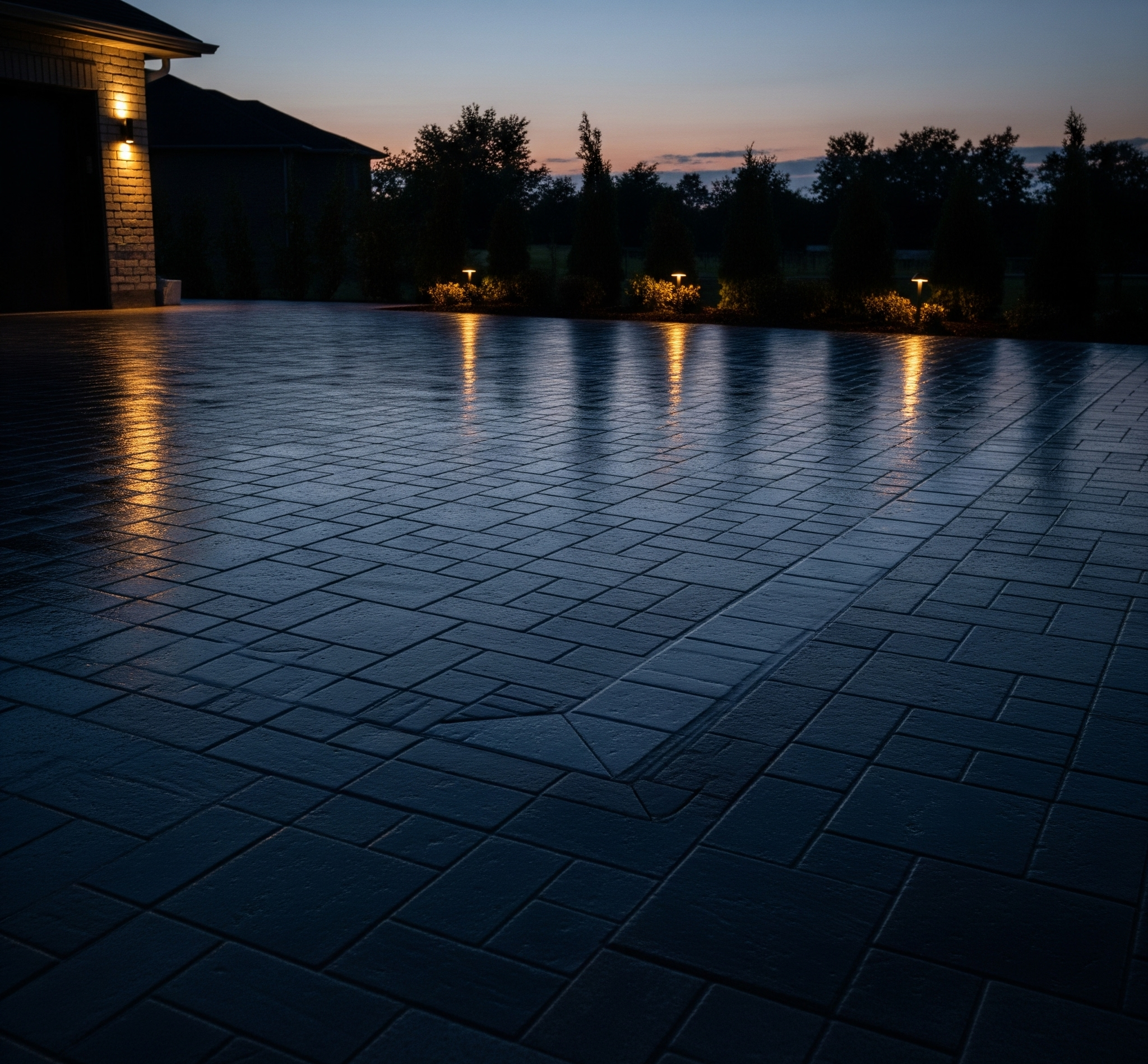
West of the city, we install a high volume of stamped and exposed aggregate concrete. These finishes are premium products. Stamped concrete relies on colour hardeners and release agents for its look. UV radiation and water penetration will fade these colours rapidly, leaving the surface looking washed out and chalky. For these homes, sealing is as much about UV protection and colour enhancement as it is about freeze defenses.
The "Hardware Store Sealer" Myth
There is a pervasive misconception that you can protect your driveway with a $40 bucket of acrylic sealer from a big-box store. You cannot.
Cheap, topical acrylics form a plastic film on top of the concrete. They do not penetrate. In our climate, moisture rising from the ground below the slab gets trapped under this plastic film. When it freezes, it pops the film off. This leads to the ugly peeling and flaking you see on so many DIY driveways. Furthermore, these films yellow under UV light, ruining the aesthetic of your home.
The Cinintiriks Approach: Penetrating Protection
We do not use topical films for protection. We use chemistry. Our standard for winter defense is a Silane-Siloxane Penetrating Sealer.
Unlike a surface coating, this material is a solvent-based liquid with a very small molecular structure. It soaks deep into the concrete's pores—up to 1/2 inch. Once inside, it reacts chemically with the free lime in the concrete to form a hydrophobic (water-repelling) barrier.
The result? Water beads on the surface like mercury. It cannot enter the pores. If water cannot enter, it cannot freeze inside. If it cannot freeze inside, it cannot cause spalling.
The Cinintiriks Application Standard:
- Deep Clean: We pressure wash at 3,500 PSI to remove all dirt, oil, and carbon buildup. The pores must be open.
- Dry Time: We wait 24-48 hours. The concrete must be bone dry. If there is moisture in the pores, the sealer cannot enter.
- Saturation: We apply the sealer to the point of rejection, ensuring maximum penetration depth.
"A topical sealer wears off. A penetrating sealer wears in."
Your hardscaping is too valuable to leave exposed. Contact Cinintiriks for professional-grade concrete cleaning and sealing services.
FAQ: Expert Insights
How often do I need to seal my concrete driveway in Ontario?
For a silane-siloxane penetrating sealer, we recommend re-application every 3-5 years. The protection lasts much longer than topical acrylics. For decorative stamped concrete (which needs the "wet look" gloss), a re-seal every 2-3 years is more common to maintain the aesthetic sheen.
When is the best time of year to apply concrete sealer?
Spring and Fall are ideal. We need temperatures consistently above 10°C (50°F) but below 25°C (77°F). If it is too hot, the solvent evaporates before it can penetrate. If it is too cold, the chemical reaction slows down. We typically stop sealing operations in late October.
Can I seal a brand-new concrete pour immediately?
No. You must wait at least 28 days for the concrete to fully cure and reach its design strength. Sealing too early traps excess moisture inside the slab, which can interfere with the hydration process and actually weaken the concrete.
The Final Word
Sealing is the single most important maintenance task for any concrete surface in Canada. It distinguishes a 40-year driveway from a 10-year driveway. Do not rely on films or coatings. Rely on penetration. Rely on chemistry. Rely on Cinintiriks.