The Danger of Standing Water: "Birdbaths" vs. Failures
When water pools on concrete, it eventually saturates the pores. When the temperature drops below zero in Vaughan or Markham, that trapped water turns to ice, expanding by 9%. This expansion blasts the surface paste off the aggregate (spalling), leaving you with a pitted, ugly slab.
But first, we must diagnose the cause. Is it a "Birdbath" (a shallow depression caused by a finisher who pressed too hard on a wet mix)? Or is it a Structural Failure (where entire sections of the slab have sunken or tilted back toward the house due to sub-base washout)?
The Physics of Drainage: The 2% Grade
The golden rule of hardscaping is Positive Drainage. Gravity must do the work. The industry standard is a minimum slope of 2%—that is roughly 1/4 inch of drop per linear foot.
If you have a 20-foot patio extending from your back door, the far edge should be 5 inches lower than the door threshold. This ensures that even in a torrential downpour, water sheets off immediately toward the lawn or drain.
Why Cheap Contractors Fail: Grading is math. It requires laser levels and transits. Discount contractors often "eyeball" the slope. They might get it right on day one, but if they didn't compact the sub-base, the ground settles, the slope reverses, and suddenly you have a lake forming against your foundation.
Solutions: From Band-Aids to Permanent Fixes
1. Surface Patching (The Trap)
Many homeowners rush to the hardware store for "concrete patch" or "self-leveling resurfacer" to fill a low spot. Do not do this.
Concrete patch applied in a thin layer (feather edge) has very little structural strength. It will not bond permanently to the old, dirty driveway. The first time you drive over it or hit it with a shovel in winter, it will pop off, leaving an even uglier scar.
2. Slab Lifting (Polyurethane Injection)
If your concrete is structurally sound (no cracks) but has simply sunk on one side, Poly-jacking (foam lifting) is a viable option. Professionals drill dime-sized holes and inject high-density expanding foam under the slab, lifting it back to the correct grade. It is cleaner and faster than mud-jacking and allows you to re-establish that crucial 2% slope.
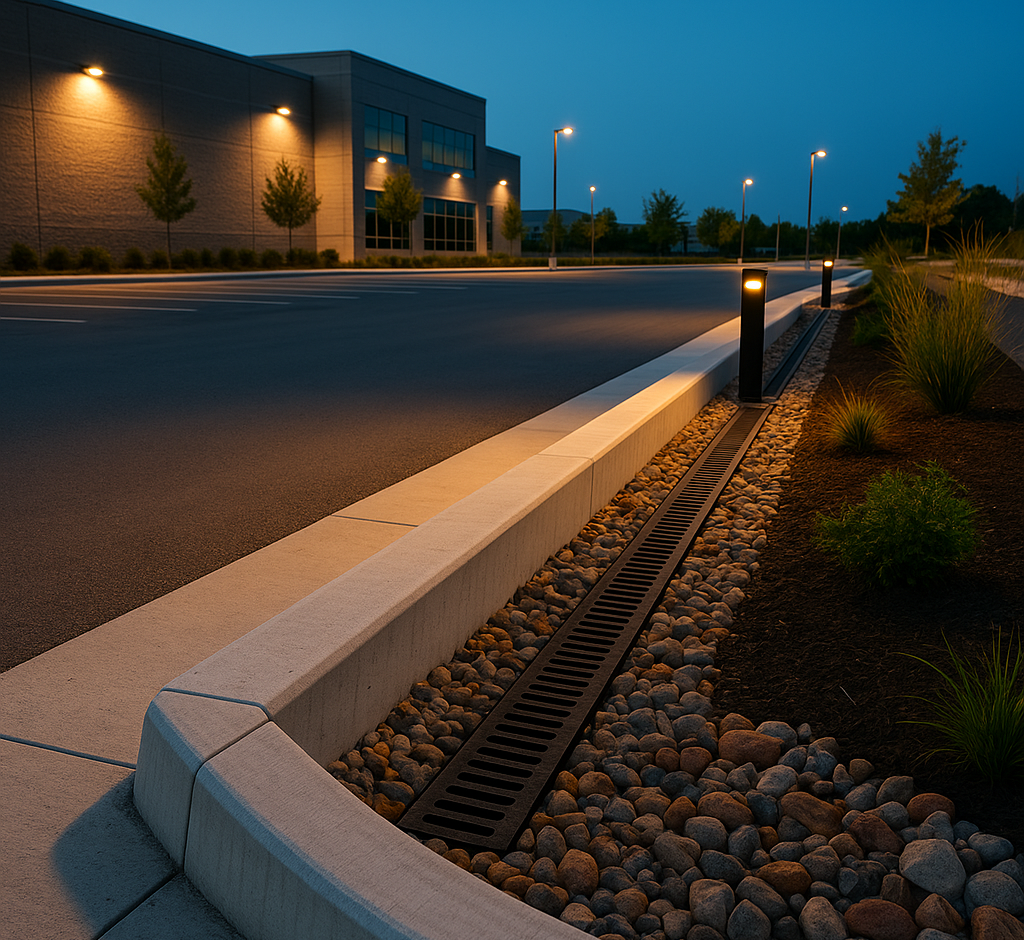
3. Integrated Drainage Systems (Trench Drains)
Sometimes, topography fights you. If your driveway slopes down toward your garage, no amount of grading will help. You need interception.
Installing a Linear Trench Drain (channel drain) across the width of the driveway is the elegant solution. Cut into the concrete and set flush with the surface, it captures the water sheet and pipes it away to a storm sewer or dry well before it can enter your garage.
The Cinintiriks Approach: Engineering the Grade
At Cinintiriks, we don't fix pooling; we prevent it. Our "Cinintiriks Standard" for luxury hardscaping involves:
Laser-Guided Excavation: We don't just grade the concrete; we grade the dirt underneath (the sub-grade). If the earth isn't sloped, the water under the slab has nowhere to go.
HPB Compaction: We use High-Performance Bedding (HPB), a angular stone that is 95% compacted simply by placing it. This eliminates the "settling" that causes future birdbaths.
Master Screeding: Our finishers use rigid screed rails set to laser-verified heights, ensuring the wet concrete is perfectly flat and positively sloped before it even starts to cure.
"Water always wins. If you don't give it a path to leave, it will find a way to stay and destroy your investment."
Don't let standing water destroy your foundation. Contact Cinintiriks for a laser-precise structural assessment and drainage solution.
FAQ: Water Management
Will water pooling ruin my concrete over the winter?
Yes. The freeze-thaw cycle is the primary killer of concrete in Ontario. A puddle acts as a reservoir of destruction. As it freezes, it pries the pores open, leading to severe scaling and eventually cracking through the entire slab.
Can I just fill a low spot with more concrete?
Technically yes, but practically no. New concrete does not like to stick to old concrete without expensive bonding agents and surface preparation. Even then, a thin "feathered" edge is prone to chipping. It is a temporary cosmetic band-aid, not a fix.
How much slope does a concrete patio actually need?
A minimum of 1/8 to 1/4 inch per foot. On a textured or stamped surface, we aim for the steeper 1/4 inch (2%) to ensure water doesn't get trapped in the texture valleys.
The Final Word
Pooling water is a sign of failure—either in the sub-base, the grading, or the finishing. It is not normal. Whether you need a simple drain install or a complete removal and replacement with proper engineering, the solution starts with understanding the physics of flow.