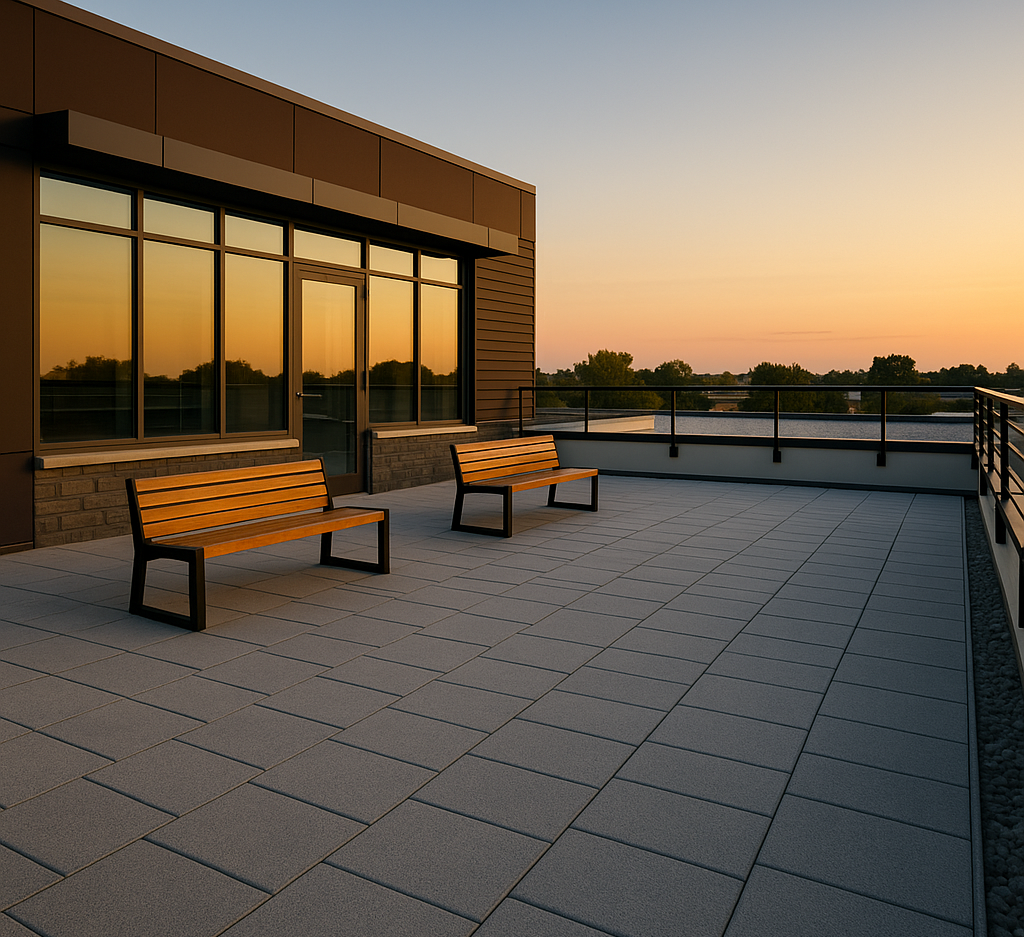
The Wasted Real Estate: A Financial Liability Hiding in Plain Sight
The commercial real estate market across the Greater Toronto Area has fundamentally shifted. Corporate tenants are no longer selecting office space based solely on price per square foot, parking ratios, and proximity to transit. The post-pandemic workplace has redefined what tenants demand. Outdoor amenity space—usable, beautiful, furnished outdoor environments where employees can work, decompress, hold informal meetings, and host corporate events—has moved from a luxury perk to a baseline expectation for Class A and Class B commercial space.
The numbers are unambiguous. Industry research from CBRE and Cushman & Wakefield consistently demonstrates that commercial properties with dedicated rooftop amenity spaces command lease premiums of 10% to 20% over comparable properties without outdoor amenities. On a 50,000 square foot office building in Scarborough leasing at $22 per square foot net, a 15% premium translates to an additional $165,000 in annual rental income. Over a 10-year lease term, that single amenity generates $1.65 million in incremental revenue—a return that dwarfs the capital cost of the terrace installation.
But the financial impact extends beyond lease rates. Rooftop amenity spaces directly affect tenant retention. In a market where tenant improvement allowances, leasing commissions, and vacancy carrying costs can exceed $50 per square foot for each turnover event, keeping an existing tenant for an additional 5-year term is worth hundreds of thousands of dollars in avoided transaction costs. The rooftop terrace is not a cost. It is an investment with a measurable, auditable return—and the commercial real estate market in Scarborough is increasingly rewarding landlords who understand this.
The Engineering: You Cannot Simply Pile Pavers on a Roof
Here is where the conversation turns from finance to physics, and it is the part that separates a professional rooftop installation from a catastrophic structural failure.
A commercial flat roof is not a ground-level patio slab. It is a complex, multi-layer assembly designed for one purpose: to keep water out of the building. The typical commercial flat roof in Scarborough consists of a structural steel or concrete deck, a vapour barrier, rigid insulation board (typically polyisocyanurate or extruded polystyrene), and a waterproof membrane—either a multi-ply modified bitumen system or a single-ply thermoplastic (TPO or PVC) membrane. This assembly is engineered to support its own dead weight, the weight of snow (the Ontario Building Code specifies a ground snow load of approximately 1.1 kPa for the Scarborough area), and modest maintenance traffic. It is not engineered to support the concentrated dead load of a heavy paver terrace installed directly on its surface.
A 20 mm thick porcelain paver weighs approximately 45 kg per square metre. A 50 mm thick concrete paver weighs closer to 120 kg per square metre. Add pedestals, planters filled with growing media, seating furniture, occupant live load, and snow load, and the total applied load on the roof deck can easily reach 3 to 5 kPa—three to five times the design load that many existing roof structures were built to carry.
If you simply spread pavers directly onto the membrane, several things happen, all of them bad. The concentrated weight compresses the insulation beneath the membrane, creating permanent deformation and reducing the insulation’s thermal performance. The pavers trap moisture against the membrane surface, accelerating degradation. Any movement—thermal expansion, wind vibration, foot traffic—grinds the paver surface against the membrane, abrading through the waterproof layer. And when the membrane fails—not if, when—you have a catastrophic roof leak in a commercial building with thousands of square feet of pavers sitting on top of the failure point, making diagnosis and repair extraordinarily expensive.
The Pedestal Paver System: Engineering the Solution
The pedestal paver system solves every one of these problems through a single, elegant engineering concept: decouple the paver surface from the membrane surface.
Instead of resting directly on the membrane, each paver is supported by adjustable-height engineered pedestals—typically injection-moulded polypropylene units with a threaded stem that allows precise height adjustment from approximately 20 mm to 300 mm (or more, with extension columns). The pedestals sit on rubber isolation pads that rest on the membrane surface, distributing the load across a wide bearing area and cushioning the membrane from point loads and abrasion.
The system creates an elevated deck—a paver surface that floats above the roof membrane on a field of adjustable support points. The gap between the paver underside and the membrane creates a continuous drainage plenum: a ventilated air space that allows rainwater to flow freely beneath the pavers to the existing roof drains, allows the membrane to dry after rainfall, and permits air circulation that prevents moisture entrapment and mould growth.
Each pedestal is individually adjusted to achieve a perfectly level finished surface, regardless of the underlying roof slope (which is typically 2% to 4% toward the roof drains, per OBC requirements). This means the paver deck is flat and level even though the roof beneath it is intentionally sloped—a feat that is impossible with a direct-lay installation. The result is a terrace surface that feels like a ground-level patio: flat, stable, and architecturally precise.
Structural Load Analysis
Before any pedestal is placed on any Scarborough rooftop, we commission a structural load analysis by a licensed professional engineer (P.Eng.). The engineer reviews the building’s original structural drawings, calculates the existing dead and live load capacity of the roof deck, and determines the allowable additional load for the proposed terrace installation. This analysis dictates the paver type (20 mm porcelain for weight-sensitive structures, thicker concrete pavers where capacity permits), the pedestal spacing, the maximum planter size and soil depth, and the occupancy load limit for the finished terrace.
On most commercial buildings in Scarborough constructed after 1990, the structural deck has sufficient reserve capacity for a porcelain pedestal paver terrace with moderate planter loads. On older structures or buildings with lightweight steel-joist roof systems, the engineer may specify reinforcement of specific structural members or restrict the terrace to lower-density paver materials. The point is this: the structural analysis happens first, before any design work, before any material selection, and before any promise is made to the building owner. There is no guessing. There is no approximation.
The ROI: Premium Tenant Acquisition and Asset Appreciation
Let us return to the financial case, because the numbers are where the decision lives for most commercial property owners in the GTA.
Lease Premium
As noted, properties with rooftop amenities consistently command 10% to 20% lease premiums in the Toronto commercial market. In Scarborough’s evolving commercial corridor—where new mixed-use developments along Eglinton East and the Scarborough Centre area are redefining the neighbourhood’s commercial identity—the amenity premium is particularly potent because relatively few existing buildings offer rooftop space. The landlord who moves first captures a disproportionate competitive advantage.
Tenant Retention
The cost of tenant turnover in commercial real estate is brutal. Leasing commissions (typically 3% to 5% of total lease value), tenant improvement allowances ($30 to $60+ per square foot for office space), legal and administrative costs, and vacancy carrying costs during the re-leasing period combine to make each turnover event a six-figure expense. A rooftop amenity that increases tenant satisfaction and extends the average lease term by even one renewal cycle generates a return that massively exceeds the cost of the terrace installation.
Appraised Value
Commercial properties are valued using income capitalisation. Increased net operating income (NOI)—driven by higher lease rates and lower vacancy—translates directly to higher appraised value. At a capitalisation rate of 6%, the $165,000 annual lease premium generated by a rooftop amenity increases the appraised value of the property by approximately $2.75 million. That is the financial mathematics of converting dead rooftop space into a productive amenity asset.
The Aesthetic Statement
On every Cinintiriks rooftop terrace, we deploy our signature material palette to create a space that projects unmistakable luxury. Expansive fields of Warm Off-White porcelain pavers—large-format, rectified-edge units with a natural stone aesthetic—create a bright, open, resort-like atmosphere. Deep Charcoal accent bands define seating zones, circulation paths, and perimeter borders with bold geometric precision. The contrast is monochromatic, sophisticated, and photographed endlessly by the tenants who use the space—generating organic social media marketing for the building that no advertising budget can replicate.
"Your roof is not overhead. It is underperforming. Every month it sits empty is revenue you are leaving on the table."
The Cinintiriks Standard for Rooftop Terrace Engineering
We are not ground-level landscapers who occasionally venture onto a roof. We execute complex, high-elevation heavy civil installations across Scarborough and the Greater Toronto Area, integrating precision-engineered pedestal systems with premium finish materials to transform barren commercial rooftops into lucrative tenant amenity assets.
1. Structural Assessment: Every project begins with a P.Eng.-certified structural load analysis of the existing roof deck. We determine the allowable additional dead and live loads, identify any structural reinforcement requirements, and establish the design parameters that govern every subsequent decision—paver type, pedestal spacing, planter capacity, and maximum occupancy.
2. Membrane Inspection & Protection: Before a single pedestal is placed, we conduct a comprehensive inspection of the existing roof membrane in coordination with the building’s roofing warranty provider. Any repairs or reinforcements to the membrane are completed prior to terrace installation. We install protective separation layers—heavy-duty EPDM rubber pads beneath every pedestal, and drainage mats across the membrane surface where specified—to ensure the terrace system never compromises the waterproof integrity of the roof.
3. Pedestal Installation & Levelling: Adjustable polypropylene pedestals are positioned on a calculated grid aligned with the paver layout, then individually adjusted to achieve a perfectly level finished surface regardless of the underlying roof slope. Height adjustments are verified with precision bubble levels across the full terrace area. Every pedestal is fitted with rubber isolation pads and slope-compensating shims as required.
4. Paver Installation: Large-format porcelain or concrete pavers are placed on the pedestal grid in the specified pattern—our signature Warm Off-White field with Charcoal accent borders. Each paver rests on the pedestal heads without adhesive, creating a demountable system that allows individual pavers or sections to be lifted for membrane inspection or repair at any time during the life of the building.
5. Perimeter & Safety Systems: Wind-load rated glass or cable railings, code-compliant guard heights (minimum 1,070 mm per OBC), and integrated LED lighting systems are installed at all exposed perimeters and elevation changes. All railing systems are engineered for the wind loads specified in the Ontario Building Code for the building height and exposure category of the specific Scarborough location.
6. Furniture & Planting Integration: Lightweight fibreglass or aluminium planters with engineered drainage and irrigation, modular lounge furniture, and shade structures are positioned on independent pedestal-supported platforms that distribute their weight across the roof deck without exceeding the P.Eng.-approved load limits.
This is The Cinintiriks Standard for rooftop terrace construction. Every pedestal, every paver, every railing post, and every planter is engineered, documented, and installed with the same precision we bring to our heaviest ground-level civil projects. The roof is not a simpler environment than the ground. It is a harder one—elevated, exposed, structurally constrained, and absolutely unforgiving of engineering shortcuts. We treat it with the respect it demands.
FAQ: Rooftop Amenity Spaces in the GTA
How do pedestal paver systems protect the underlying commercial roof membrane from damage?
The pedestal system decouples the paver surface from the membrane surface, eliminating the two primary failure modes of direct-lay rooftop installations: abrasion and moisture entrapment. Each pedestal sits on a heavy-duty EPDM rubber isolation pad that distributes load across a wide bearing area and cushions the membrane from point loads. The pavers float above the membrane on the pedestal heads, never contacting the membrane surface directly. The resulting air gap—typically 20 to 300 mm—creates a continuous drainage plenum that allows rainwater to flow freely to the existing roof drains, allows the membrane to dry completely after rain events, and permits air circulation that prevents the moisture entrapment, mould growth, and accelerated degradation that destroy membranes beneath direct-lay installations. Critically, the entire paver system is demountable: individual pavers and pedestals can be lifted at any time to expose the membrane for inspection, repair, or eventual re-roofing, without disturbing the rest of the terrace. This preserves the roofing warranty and dramatically reduces the cost of future membrane maintenance.
What are the wind-uplift requirements for installing interlocking pavers on a high-rise rooftop?
Wind uplift is a critical design consideration for any rooftop terrace, and it becomes more severe with building height and exposure. The Ontario Building Code requires that rooftop installations resist negative wind pressures (suction forces) calculated using the building’s height, location, and exposure category. At roof edges and corners—where wind acceleration creates the highest uplift forces—pressures can exceed 2.0 to 3.0 kPa on tall buildings. For pedestal paver systems, wind uplift resistance is achieved through paver self-weight (heavier pavers resist greater uplift), perimeter edge restraints (aluminium or steel profiles that lock the perimeter pavers against lateral and vertical displacement), and in extreme exposure zones, mechanical anchoring clips that connect individual pavers to the pedestal heads. On every Cinintiriks rooftop project in Scarborough, we perform a wind-load analysis specific to the building and specify the appropriate combination of paver thickness, edge restraint, and mechanical anchoring to ensure the system remains stable under the maximum design wind speed for the location.
How does rainwater drain off a flat roof once a pedestal paver terrace has been installed over it?
This is one of the most elegant aspects of the pedestal system. Rainwater falling on the paver surface passes through the open joints between pavers (typically 3 to 5 mm wide) and drops into the drainage plenum beneath the deck. From there, it flows across the membrane surface—which is already sloped toward the existing roof drains at 2% to 4%—and exits through the original roof drain infrastructure. The pedestal system does not modify, obstruct, or replace the building’s existing drainage. It works with it. The pavers are elevated above the drains on adjustable pedestals, and drain locations are accommodated with custom paver cuts or removable access panels that allow maintenance access to the drain body without disturbing the surrounding terrace. In heavy rainfall, the drainage plenum handles enormous volumes of water because the entire area beneath the paver deck functions as an unrestricted flow path. There is no ponding on the paver surface, no ponding on the membrane, and no modification to the building’s existing storm drainage system.
The Final Word
Your roof is real estate. Every square foot of it. And in a commercial leasing market that increasingly rewards outdoor amenity, every month that roof sits empty is revenue you are choosing not to collect. The engineering is not simple—it demands structural analysis, membrane protection, wind-load calculation, and the kind of precision installation that most contractors cannot deliver at elevation. But when it is done right, the return is extraordinary: premium lease rates, extended tenant retention, elevated property appraisal, and a visual asset that transforms the identity of your building from forgettable to iconic.
Ready to monetize your unused roof space and attract premium corporate tenants? Contact Cinintiriks for heavily engineered luxury rooftop terrace installation in Scarborough.