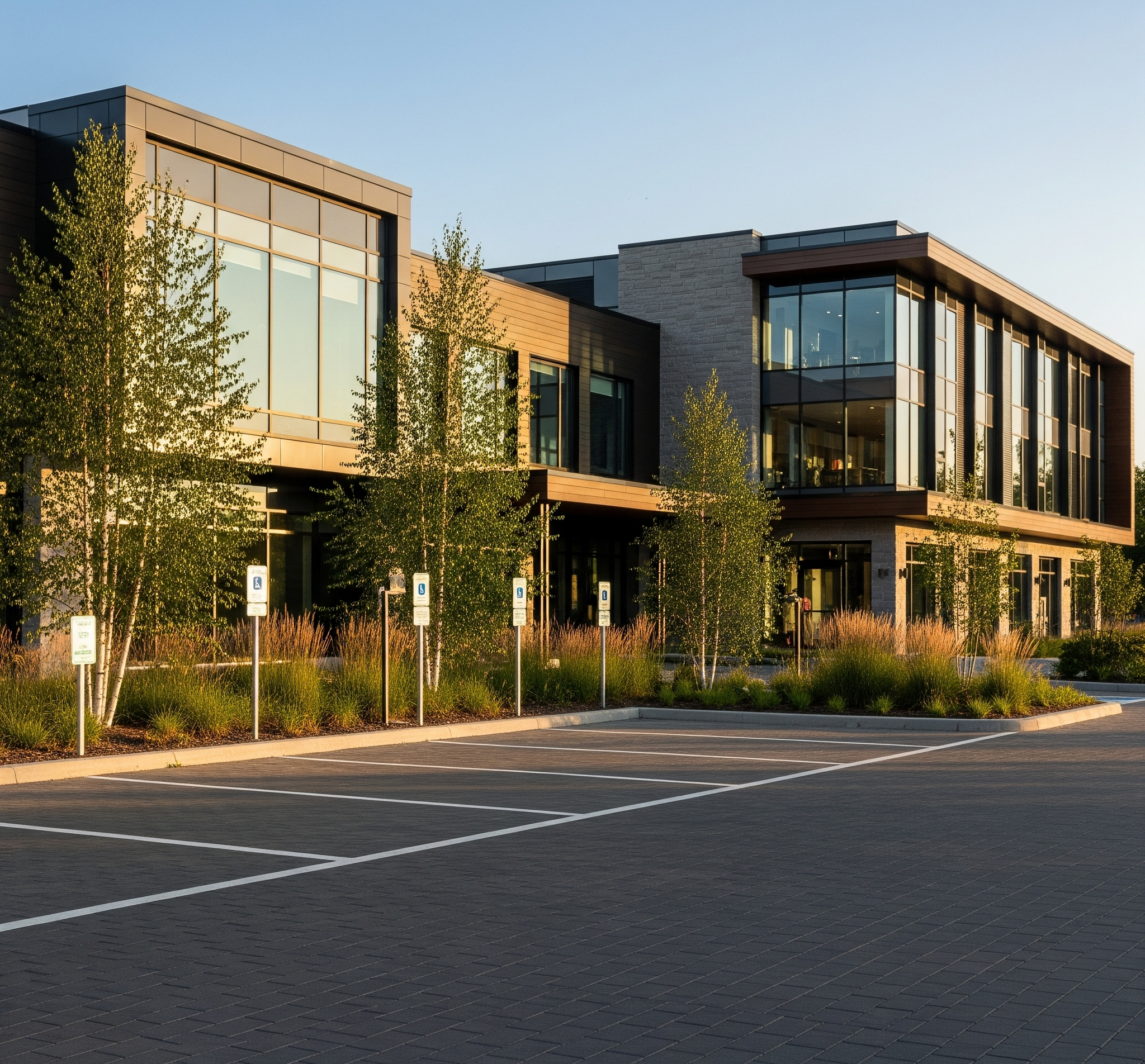
A smooth, freshly sealed surface with crisp white lines communicates: this business cares about details. This business invests in its property. This business respects the people who visit it. A surface riddled with potholes, faded lines, crumbling curbs, and standing water communicates the exact opposite: this business is cutting corners. This business is in decline. If they cannot maintain the parking lot, what are they cutting corners on inside?
That subconscious assessment happens in under seven seconds. It happens before your customer parks, before they step out of the vehicle, before they see your signage, your merchandise, your staff, or your pricing. The parking lot has already framed their expectation of the entire experience ahead. And if that frame is negative, your business spends the rest of the visit trying to overcome a first impression it never needed to create.
For commercial property owners across Toronto and the GTA, this is not a cosmetic conversation. This is a conversation about customer retention, liability exposure, brand perception, and the measurable financial return on surface infrastructure.
The Physical Handshake: Psychology of First Contact
Behavioural psychologists have studied the phenomenon of environmental priming—the way physical surroundings shape a person’s emotional state, expectations, and decision-making before they are consciously aware it is happening. The research is unambiguous: people form lasting judgements about the quality of a business, the trustworthiness of its operators, and the value of its products or services based on the condition of its physical environment.
In a retail or commercial context, the parking lot is the largest and most publicly visible component of that physical environment. A typical Toronto retail plaza may have 3,000–10,000 square metres of paved parking surface. That is an enormous canvas of first-impression real estate, and it is the one surface that every single visitor interacts with, every single time they visit. Not every customer enters every store. Not every customer uses the washroom or speaks to an employee. But every customer walks across the parking lot.
The condition of that surface is processing through your customer’s brain at a primal, non-verbal level. Here is what specific conditions communicate:
- Potholes and surface failures: Neglect. Financial distress. A property owner who is not investing in the infrastructure. The customer unconsciously wonders: if the landlord won’t fix the parking lot, how well are they maintaining the building systems? The HVAC? The fire suppression? Should I trust the food safety in the restaurant, or the product quality in the retail store, or the professionalism of the office, in a building where the parking lot has been allowed to deteriorate?
- Standing water and puddles: Drainage failure. Incompetence. The customer steps out of their vehicle into a 50 mm-deep puddle and their shoes are soaked before they reach the entrance. The emotional response is not abstract—it is physical irritation and immediate resentment toward the property where it happened. Research on retail environments consistently shows that customers in a negative emotional state spend less, stay shorter, and are significantly less likely to return
- Faded or missing line striping: Confusion and conflict. Cars park at inconsistent angles. The stall widths become ambiguous. Door-ding frequency increases. Traffic flow becomes unpredictable because drivers cannot distinguish driving lanes from parking zones, fire routes from general access roads, or pedestrian crossings from vehicle areas. On a property where the lines are crisp, the entire choreography of arrival, parking, walking, shopping, and departure is smooth, intuitive, and conflict-free. On a property where the lines are faded, every customer has to figure out where to go. That cognitive load is a cost your business pays in reduced satisfaction
- Crumbling curbs and spalling surfaces: Physical hazard and visual decay. A customer who trips on a heaved concrete curb or catches a heel in a spalled surface patch is not thinking about how much they love your tenant’s products. They are thinking about the bruise on their knee and whether they should call their lawyer
“The parking lot is the largest billboard a commercial property owns. It is seen by every visitor, every day, from every angle. And unlike a billboard, customers physically walk across it. Every crack tells a story.”
The Engineering of Customer Experience
The conditions that destroy customer satisfaction in a parking lot are not aesthetic problems. They are engineering failures. And they have engineering solutions that, when implemented by a contractor who understands heavy civil infrastructure, permanently resolve the root cause rather than masking the symptoms.
Drainage: The Invisible Infrastructure
Standing water in a commercial parking lot is not a cosmetic annoyance. It is a grading and drainage failure that signals one or more of the following systemic problems:
- Negative or flat grading: The paved surface was not graded at the minimum 1.5–2% slope required to direct surface water toward catch basins. On a 5,000 m² parking lot, a 1.5% slope means a 75 mm elevation change over 5 metres of travel. This sounds minuscule. It is minuscule. But it is the difference between water sheeting efficiently toward the drains and water ponding in the middle of the lot in a permanent, expanding puddle
- Collapsed or blocked catch basins: The cast-iron grates and concrete structures that collect surface water and channel it into the stormwater system settle, crack, and block over time. A catch basin that has settled 50 mm below the surrounding pavement creates a permanent low-point puddle in an area that should be draining freely. A basin that is blocked with debris, sediment, or failed pipe connections backs up during rain events and floods the surrounding pavement
- Surface deterioration: As asphalt ages and the binder oxidises, the surface becomes progressively more permeable and develops micro-depressions where the aggregate has loosened and washed away. Each depression holds a small amount of water. Individually, these are trivial. Collectively, across a large lot, they produce the appearance of a surface that is “always wet” after rain—dozens or hundreds of small puddles that take hours longer to evaporate than a properly sealed, non-porous surface
In Toronto, where the annual precipitation exceeds 830 mm distributed across approximately 130 rain days, plus the additional volume of snowmelt runoff across roughly 100 days of snow cover, a commercial parking lot’s drainage system is under constant hydraulic loading for two-thirds of the year. A drainage deficiency that might be unnoticeable in a drier climate produces visible, customer-impacting ponding in this market on a near-weekly basis during spring and fall.
And during winter, those ponding zones become something far worse than an inconvenience. They become sheet ice. A puddle that forms during a daytime thaw and refreezes overnight produces a plane of black ice that is nearly invisible to pedestrians and vehicles. The liability implications are severe and immediate. The customer-experience implications are worse: a customer who slips on black ice in your parking lot does not file a complaint. They file a claim. And they never come back.
Line Striping: The Choreography of Movement
Line striping is the most undervalued element of commercial parking lot management. Property owners spend thousands on surface repair and seal coating and then skip the restriping because it “still shows.” What they do not realise is that degraded striping does not just look old. It functionally degrades the parking experience in ways that directly impact customer satisfaction, safety, and operational efficiency.
Crisp, high-contrast line striping accomplishes five things simultaneously:
- Maximises stall count. Properly dimensioned parking stalls (2,600 mm × 5,500 mm minimum per the Ontario Building Code, wider for accessible stalls) painted at precise intervals ensure that every square metre of the lot is utilised at maximum efficiency. When lines fade, drivers self-position their vehicles at inconsistent widths and angles. A lot that is engineered for 200 vehicles begins functioning as a 170-vehicle lot because of wasted space from inconsistent parking. That is a 15% capacity loss that directly translates to 15% fewer customers during peak hours —customers who circle the lot, fail to find a stall, and drive to a competitor
- Reduces door-ding frequency. Door dings are the number-one source of vehicle damage in commercial parking lots. They are caused by drivers parking too close together because the stall boundaries are unclear. A freshly striped lot with visible, centred stall lines results in vehicles being parked with consistent lateral clearance. A faded lot results in vehicles clustered unevenly, with some stalls effectively double-occupied and others left with half a metre of wasted space on one side and zero clearance on the other
- Directs traffic flow. Directional arrows, stop bars, crosswalk markings, and lane dividers painted in the asphalt create a visual traffic system that drivers follow instinctively. On a properly striped lot, vehicles move in orderly, predictable patterns. On a lot with faded flow markings, drivers make ad-hoc decisions about direction, creating head-on confrontations in narrow aisles, wrong-way travel through one-way lanes, and confusion at intersection points
- Marks safety-critical zones. Fire routes, accessible parking stalls, loading zones, pedestrian crossings, and no-parking curbs are delineated by specific paint colours and patterns mandated by the Ontario Fire Code and AODA regulations. Faded fire route markings put the property in violation of fire code compliance and can result in fines, fire department orders, and insurance complications. Faded accessible parking markings violate AODA and create genuine access barriers for persons with mobility limitations
- Signals maintenance investment. Bright, clean lines on a dark, sealed surface communicate investment, professionalism, and operational competence. It is the visual equivalent of a pressed shirt and polished shoes. The customer may not consciously think “the lines are fresh,” but they feel that the property is cared for, and that feeling colours their perception of every business on the property
The Liability Equation
Beyond customer psychology and operational efficiency, there is a hard, legal dimension to parking lot maintenance that every commercial property owner in Toronto must understand: occupiers’ liability.
Under Ontario’s Occupiers’ Liability Act, the occupier of a commercial premises (which includes the owner, the property manager, and in some cases the tenant) has a statutory duty to ensure that persons entering the premises are reasonably safe. The parking lot is part of the premises. A customer who trips over a heaved concrete curb, twists an ankle in a pothole, slips on black ice formed in a ponding zone, or sustains vehicle damage from a severe surface failure has standing to bring a negligence claim against the property.
The legal standard is not perfection. The standard is reasonable care. But “reasonable care” includes proactive inspection, timely repair of known hazards, and a documented maintenance program that demonstrates the property owner is actively managing the condition of the surface. A property owner who can produce records showing regular inspections, scheduled maintenance, and prompt repair of identified deficiencies is in a vastly stronger legal position than one who cannot produce any maintenance records at all.
The financial exposure is not trivial. A single slip-and-fall claim on a commercial property in Ontario typically settles in the range of $25,000 to $150,000 for soft-tissue injuries, and can reach $500,000+ for fractures, head injuries, or permanent disability. Defence costs alone (legal fees, expert witnesses, engineering reports) routinely exceed $15,000–$30,000 even if the claim is ultimately defeated.
Compare those figures to the cost of the maintenance that would have prevented the hazard. A pothole repair: $200– $800. A curb replacement: $1,000–$3,000. A catch basin rebuild to eliminate ponding: $2,000–$5,000. Full-lot seal coating and restriping: $8,000–$25,000 depending on lot size. Every one of these maintenance costs is a fraction of a single liability claim. The arithmetic is not close.
The Aesthetic Premium: Perception Is Revenue
There is a reason luxury retail developments invest heavily in their parking infrastructure. The brands that lease space in premium Toronto plazas—Yorkdale, Bayview Village, Shops at Don Mills—understand that the customer’s brand experience begins at the property boundary, not the store threshold. The parking surface is not separate from the retail environment. It is the retail environment.
The aesthetic hierarchy of commercial parking surfaces, from lowest to highest perceived value:
- Uncoated, weathered asphalt: Grey, oxidised, showing aggregate. Communicates end-of-life infrastructure. Appropriate for industrial back-lots and aging strip malls that have not been refreshed in over a decade
- Seal-coated asphalt with fresh striping: Rich, uniform black with brilliant white lines. Clean, professional, well-maintained. The baseline standard for any commercial property that values its brand perception. Seal coating restores the deep black appearance of new asphalt, unifies the colour of patched and repaired areas, and provides a smooth, non-porous surface that resists staining from automotive fluids and makes the property look maintained without looking extravagant
- Premium interlocking concrete pavers: Deep Charcoal through-mix pavers with Off-White pedestrian accents and Walnut banding at transitions. This is the architectural language of high-end commercial developments where the parking surface is designed as part of the architectural composition— not just a functional slab but a design element that communicates luxury, permanence, and deliberate investment. The initial cost is higher. The service life is dramatically longer. And the customer perception is in a different category entirely
For many commercial properties in Toronto, the optimal approach is a hybrid: high-quality seal-coated asphalt in the vehicle zones (where the surface is subjected to the heaviest wear and where the dark, uniform colour hides tire marks and fluid stains), with interlocking pavers in the high-visibility pedestrian zones—building entrances, outdoor seating areas, crosswalks, and boulevard frontages. This hybrid approach delivers the visual premium of pavers where customers walk and linger, while maintaining the cost efficiency of asphalt where vehicles dominate.
“A freshly sealed, crisply striped parking lot does not just look maintained. It looks like the property owner respects every person who parks there. That respect is felt before a word is exchanged.”
The Hidden ROI: Numbers That Justify the Investment
Commercial property owners often view parking lot maintenance as a pure cost centre—money spent on a surface that generates no direct revenue. This framing is incorrect. The parking lot generates revenue indirectly through every mechanism that drives commercial property performance:
- Tenant retention. Tenants on multi-tenant commercial properties are acutely aware of parking lot condition. A deteriorating lot signals a landlord who is deferring maintenance, which raises tenant concerns about other building systems (HVAC, roofing, fire safety) and makes them more likely to relocate at lease renewal. The cost of tenant turnover (vacancy loss, tenant improvement allowances for new tenants, leasing commissions, marketing) typically ranges from 6 to 18 months of gross rent per unit. A $20,000 annual parking lot maintenance program is trivial compared to losing even a single tenant
- Lease rates. Properties with well-maintained common areas (of which the parking lot is the most visible) command higher net rental rates than comparable properties with deferred maintenance. Prospective tenants evaluating two otherwise similar plazas will pay a premium for the one that demonstrates visible, ongoing property investment. The parking lot is the most immediate, visceral indicator of that investment
- Customer traffic volume. Retail tenants live and die on foot traffic. A parking lot that is easy to navigate, well-lit, well-drained, and well-striped produces a smoother, faster, more pleasant arrival experience that encourages repeat visits. A lot that is confusing, potholed, and frequently flooded produces an arrival experience that customers subconsciously avoid—they may not articulate why they stopped visiting, but the deteriorated arrival experience is a contributing factor in their decision to go elsewhere
- Insurance premiums. Commercial general liability insurance premiums are influenced by the property’s claims history. A property with a documented, proactive maintenance program and zero slip-and-fall claims benefits from lower premiums and more favourable renewal terms than a property with a history of claims arising from deferred surface maintenance. Over a five-year insurance cycle, the premium differential can exceed the total cost of the maintenance program
- Property valuation. Commercial properties are valued on capitalised net operating income (NOI). Every dollar of avoided maintenance cost reduces apparent NOI. But every dollar of maintenance that prevents a larger capital expense (a $200 pothole repair that prevents a $15,000 sub-base failure) preserves NOI. And the condition of the parking lot is one of the first things an appraiser or prospective buyer evaluates during due diligence. A well- maintained lot supports the property’s assessed value. A deteriorated lot triggers capital reserve concerns that directly reduce the appraised value and the achievable sale price
The Cinintiriks Approach: Comprehensive Commercial Surface Management
At Cinintiriks, we do not patch holes and call it maintenance. We execute comprehensive commercial surface management—a systematic, engineering-driven approach that treats the parking lot as critical commercial infrastructure rather than a maintenance afterthought. The Cinintiriks Standard for commercial parking lot management in Toronto encompasses every layer of the system, from the sub-base to the surface finish.
1. Stormwater Grading Audit & Correction: Before any surface work begins, we perform a laser-level drainage audit of the entire lot surface, identifying every ponding zone, every negative- grade area, and every failed drainage path. We map the catch basin locations, inspect their structural condition and pipe connections, and determine whether the ponding is caused by surface grade failure, basin settlement, pipe blockage, or a combination. The correction is engineered to the root cause: milling and re-grading the surface in areas of negative grade, rebuilding settled catch basins to match the surrounding surface elevation, and jetting and root-cutting blocked drainage pipes to restore full flow capacity. The goal is a lot that drains completely within 60 minutes of a moderate rain event, leaving zero standing water in any customer-accessible area.
2. Structural Surface Repair: Every pothole, every alligator-cracked section, every spalling curb, and every heaved panel is repaired at the structural level— not surface-patched with cold-mix asphalt that crumbles within one freeze-thaw cycle. Our full-depth repairs involve saw-cutting the failed section, excavating to the sub-base, re-compacting the Granular A foundation, and installing fresh hot-mix asphalt at the specified thickness (minimum 75 mm for standard vehicle areas, 100 mm+ for heavy-vehicle zones). Concrete curbs are replaced with reinforced curb-and-gutter sections that restore both the structural edge restraint and the drainage channel function. Every repair is designed to match the service life of the surrounding lot—not to survive until next spring.
3. Premium Seal Coating: After all structural repairs are complete, the entire lot surface receives a commercial-grade coal-tar or asphalt-emulsion seal coat (product selection depends on environmental regulations and surface condition), applied in two coats at the manufacturer’s specified coverage rate. The seal coat serves three functions: it waterproofs the asphalt surface (preventing water infiltration into the binder that causes freeze-thaw cracking), it UV-protects the binder (preventing the oxidation that turns asphalt grey and brittle), and it restores the uniform black appearance that makes the lot look new. Seal coating extends asphalt surface life by 5–8 years per application and is the single most cost-effective maintenance intervention available for commercial asphalt.
4. High-Contrast Line Striping & Safety Markings: Every stall, every directional arrow, every fire route, every accessible parking symbol, every crosswalk, and every stop bar is re-striped with commercial-grade traffic paint (minimum 15-mil wet-film thickness, glass-bead reflective additive for nighttime visibility). We lay out the striping plan using string lines and measurement templates— not freehand spray from a walking striper—ensuring every stall is dimensioned to code, every line is straight, and every accessible stall meets AODA dimensional and signage requirements. The result is a lot where every vehicle and every pedestrian knows exactly where to go, without hesitation or confusion.
5. Documented Maintenance Program: For Toronto commercial clients who retain Cinintiriks for ongoing lot management, we provide a written annual maintenance schedule that includes spring inspection (post- winter damage assessment), summer repairs and seal coating, fall drain clearing, and winter-readiness checks. Every inspection is documented with photographs, measurements, and priority-ranked repair recommendations. This documentation protects the property owner legally (demonstrating reasonable care under the Occupiers’ Liability Act) and financially (providing evidence of proactive maintenance for insurance and appraisal purposes).
Don’t let a crumbling, dangerous parking lot drive your customers to the competition. Contact Cinintiriks for heavily engineered commercial surface restoration and maintenance in Toronto and across the GTA.
FAQ: Commercial Parking Lot Maintenance
How often should a commercial parking lot in Ontario be resealed and restriped?
The industry-standard interval for seal coating a commercial asphalt parking lot in Ontario is every 3–5 years, depending on traffic volume and environmental exposure. High-traffic retail plazas (grocery- anchored centres, big-box retail) that see 2,000–5,000+ vehicle movements per day should be on a 3-year cycle. Lower-traffic professional office parks and medical centres may extend to 4–5 years. The determining factor is the condition of the existing seal coat: when the surface begins showing visible aggregate exposure (grey speckles appearing through the black seal coat) and oxidation cracking (fine hairline cracks across the surface), it is time to reseal. Delaying beyond this point allows water to infiltrate the binder, which initiates the freeze-thaw cracking cycle that leads to potholes and structural failure. Line striping should be refreshed every 1–2 years, regardless of seal coat timing. Commercial traffic paint has a functional life of approximately 12–24 months under regular vehicle traffic before it fades to the point where contrast is significantly reduced. On high-traffic Toronto retail properties where the lines are the primary traffic-management tool, annual restriping is not an extravagance —it is a operational necessity. Many property managers combine the annual spring restriping with a post-winter damage inspection, addressing both the visual refresh and the safety assessment in a single mobilisation.
Can poor parking lot drainage actually cause damage to a customer’s vehicle?
Yes, and more frequently than most property owners realise. There are three primary mechanisms: (1) Pothole damage. A water-filled pothole is invisible to a driver. The standing water conceals the depth and shape of the hole. A driver who hits a concealed pothole at even moderate parking-lot speed (15–20 km/h) can sustain tire sidewall damage, bent wheel rims, damaged suspension components, and misaligned steering. Repair costs range from $200 for a single tire to $2,000+ for suspension and alignment damage. (2) Splash damage and soiling. Standing water adjacent to pedestrian walkways is splashed onto vehicles and pedestrians by passing traffic. This is not just water—it is water laden with road salt, oil residue, and particulate that stains vehicle paint, deposits salt residue on lower body panels (accelerating corrosion), and ruins customers’ clothing and footwear. (3) Black ice. Standing water that freezes overnight during Ontario’s extended freeze-thaw season (November through April) produces sheet ice that can cause vehicle slides at low speed, resulting in collisions with parked vehicles, curbs, bollards, and building elements. A vehicle slide at 10 km/h into a concrete bollard produces $3,000–$10,000 in body damage. The property owner who failed to address the drainage deficiency that created the ponding zone may face a claim for that damage. All three mechanisms are preventable with proper drainage engineering. A lot that drains completely within 60 minutes of a rain event has no standing water to conceal potholes, no puddles to splash, and no ponding zones to freeze into ice sheets.
Does fixing potholes and trip hazards proactively reduce my commercial property insurance liability?
Significantly. Ontario’s Occupiers’ Liability Act establishes a duty of reasonable care for property occupiers. The legal standard is not “no hazards ever exist”—it is “the occupier takes reasonable steps to identify and address hazards in a timely manner.” A proactive maintenance program provides three specific forms of legal and insurance protection: (1) Evidence of reasonable care. Documented inspection reports, repair orders, and maintenance records demonstrate that the property owner is actively monitoring the lot condition and addressing deficiencies as they are identified. In a negligence claim, this documentation is the most powerful defence available. (2) Reduced claims frequency. Properties with proactive maintenance programs have fewer incidents because the hazards are corrected before they cause injuries. Fewer incidents means fewer claims, which directly improves the property’s claims experience rating—the metric that commercial general liability insurers use to set premiums. (3) Favourable policy terms. Insurers underwriting commercial general liability look at the property’s maintenance posture as a risk factor. A property with a documented, contractor-performed maintenance program is a demonstrably lower risk than one with no maintenance records. This can translate into lower premiums, lower deductibles, and broader coverage terms at renewal. The savings over a five-year insurance cycle can partially or fully offset the cost of the maintenance program itself. Multiple Toronto commercial property managers we work with have specifically cited their Cinintiriks maintenance documentation as a contributing factor in favourable insurance renewals.
The Final Word
Your parking lot is not a cost centre. It is the largest customer-facing surface your commercial property owns. Every crack, every puddle, every faded line, and every crumbling curb is a message to every customer who visits. The message is either “we invest in your experience” or “we don’t.” There is no neutral ground.
The engineering required to maintain that surface at a level that enhances customer satisfaction, reduces liability exposure, supports tenant retention, and preserves property value is not exotic. It is not experimental. It is the systematic application of drainage grading, structural repair, surface protection, and visual marking—executed on a documented schedule, by a contractor who understands heavy commercial infrastructure.
The return on that investment is not abstract. It is measurable in tenant retention, lease rates, insurance premiums, property valuations, and—most fundamentally—in the seven-second first impression that determines whether a customer walks into your tenant’s business with confidence or with doubt.
One impression. Every visit. Every customer. Every day.
Engineer it accordingly.