That said, you deserve a framework. You deserve to understand what you are paying for, where the money goes, and why one contractor's $12,000 quote and another's $28,000 quote for the same driveway might both be accurate reflections of what they intend to deliver—just radically different standards of delivery. This guide provides that framework in complete detail.
The Realistic Price Range for Premium Interlock in the GTA
Let's establish the range first, and then decompose it.
For a professionally installed, fully engineered custom interlock driveway in the Greater Toronto Area, using premium paver products (Unilock, Techo-Bloc, Oaks, or Permacon), a deep granular sub-base, geotextile fabric, polymeric sand, and proper edge restraint, the installed price in 2026 typically falls into the following ranges:
- Standard premium installation (Holland, Plaza Stone, or equivalent standard-format paver on deep base): $22-$30 per square foot, installed
- Mid-range luxury installation (Techo-Bloc Blu 60mm, Unilock Artline, or similar contemporary paver with soldier course border): $30-$42 per square foot, installed
- High-end custom installation (Techo-Bloc Industria, Unilock Town Hall, large-format slabs with inlaid feature bands, multi-paver blends, custom patterns): $42-$60+ per square foot, installed
For a typical two-car driveway of 500-650 square feet in the GTA, this translates to a total project cost ranging from approximately $14,000 to $39,000+ depending on product selection, design complexity, site conditions, and sub-base requirements. Larger driveways, circular designs, multi-level transitions, and integrated walkway-and-stoop packages push the total higher.
These numbers are not padded. They are not inflated. They reflect the actual cost of materials, skilled labour, equipment, disposal, engineering, and overhead required to deliver an installation that will remain level, stable, and beautiful for 25+ years in an Ontario climate.
The Cost Breakdown: What You're Actually Paying For
The total project cost is the sum of multiple discrete components! each of which varies independently based on site conditions, design choices, and material quality. Here is what those components are and why each one matters.
1. Demolition and Removal ($3-$6 per square foot)
Before anything new can be installed, what currently occupies the driveway must be removed—completely. This is not a trivial operation, and its cost varies dramatically based on what is being removed.
Asphalt removal: Old asphalt must be broken up with a skid-steer-mounted breaker or hydraulic saw, loaded into bins, and hauled to a certified disposal facility. Asphalt is heavy—approximately 100-110 kg per square metre at 2 inches thick —and disposal is charged by weight. A typical 500 sq ft driveway generates 5-6 tonnes of asphalt waste, at disposal costs of $80-$120 per tonne plus bin rental and trucking. Total: $800-$1,500.
Concrete removal: Old concrete is significantly harder and heavier to remove than asphalt. A 4-inch reinforced concrete driveway generates 8-10 tonnes of waste from the same 500 sq ft footprint. Breaking is slower, the equipment wear is higher, and disposal fees are comparable. If rebar is present, the concrete must be broken into manageable pieces around the steel. Total: $1,200-$2,500.
Interlock-over-existing removal: Some budget contractors will lay new pavers over an existing asphalt or concrete surface rather than removing it. This saves the demolition cost entirely—and it is one of the most common corners cut in the industry, because it produces an installation that looks fine on day one but reflects every crack, settlement, and imperfection of the old surface within one to two winters. We never install over existing surfaces. Always full removal.
2. Excavation ($3-$5 per square foot)
With the old surface removed, the native soil must be excavated to the engineered design depth. In the GTA, where native clay soils are frost-susceptible and drainage-poor, a premium interlock installation requires a total excavation depth of 14-18 inches below the finished grade (12-14 inches of granular base + 1 inch of bedding sand + 2.5-3 inches of paver thickness).
Excavation cost is driven by three factors:
- Volume of material removed: A 500 sq ft driveway at 16 inches depth generates approximately 19 cubic yards of excavated soil. This requires a mini excavator or skid steer, an operator, and sufficient bin capacity to receive the spoils.
- Soil conditions: Clean, dry clay excavates smoothly. Wet clay (common in spring pours) is heavier, stickier, and dramatically slower to dig. Rocky soil or buried construction debris (old foundations, rubble) can double the excavation time.
- Site access: If the excavator must access the driveway through a narrow side yard, over a septic bed, or past a mature tree with protected roots, the logistics are significantly more complex and time-consuming than a straightforward front-yard driveway with open street access.
3. Disposal and Haulage ($1,500-$3,500)
The excavated material and demolished surface must leave the property. This requires roll-off bins (typically 14-20 cubic yard capacity), bin delivery and pickup fees, and disposal tipping fees at the receiving facility. Clean soil is less expensive to dispose of than contaminated or mixed fill (soil containing concrete, asphalt, or organic material), which may need to be sorted or sent to a specialised facility. In the GTA, disposal costs have risen steadily over the past five years as landfill capacity tightens. This is a cost component that budget quotes frequently underestimate or omit entirely—leaving the homeowner with a surprise bill when the bins arrive.
4. Sub-Base Materials and Installation ($4-$7 per square foot)
The granular sub-base is the single most important component of the installation. It determines whether the driveway stays level for 25 years or sinks and ruts within two. The cost includes:
Geotextile fabric: A non-woven separation fabric (200+ g/m²) laid over the entire excavation floor to prevent native clay from contaminating the granular base over time. Material cost: approximately $0.50-$1.00 per square foot.
Granular A base: Clean, properly graded crushed limestone installed in lifts and compacted. For a 12-inch base on a 500 sq ft driveway, this requires approximately 18-20 tonnes of material at $30-$40 per tonne delivered, plus the labour and equipment to place, grade, and compact it in separate lifts. Material cost: $600-$800. Labour and equipment: $1,000-$2,000.
HPB bedding layer: A 1-inch levelling screed of High Performance Bedding (fine, angular limestone screenings) provides the flat, uniform surface on which the pavers sit. Material cost: approximately $150-$250 for a standard driveway. Screeding labour: $300-$500 (this is precision work that requires patience and skill).
Total sub-base cost for a typical driveway: $2,500-$4,500.
5. Paver Material ($4-$14 per square foot, materials only)
This is where the aesthetic decisions directly drive cost. The paver itself—its format, thickness, colour, texture, and brand—is the single most variable cost component in the project.
Standard-format pavers (Holland, Plaza Stone, basic tumbled rectangle): $4-$6 per square foot for the materials. These are the workhorse pavers of the industry—reliable, attractive in a classic way, and available in every yard in Ontario. They produce a traditional, clean look that works well on smaller driveways and walkways.
Mid-range contemporary pavers (Techo-Bloc Blu 60mm, Unilock Artline, Oaks Villanova): $7-$10 per square foot. These pavers offer sleeker profiles, sharper edges, larger format options, and more refined colour palettes. They read as modern and intentional, and they are the sweet spot for homeowners who want a premium look without entering bespoke territory.
Premium large-format pavers and slabs (Techo-Bloc Industria, Unilock Town Hall, Blu Grande 80mm, Borealis): $10-$14+ per square foot. These are the flagships—oversized, thick, textured to simulate natural stone or polished concrete, and available in sophisticated colourways. They create a visual presence that approaches natural stone at a fraction of the weight and cost. The installation is also more demanding: large-format pavers require more precise bedding, more careful handling (they are heavy and brittle compared to standard units), and more skilled cutting.
A 5% paver overage (waste factor) should be included in every material order to account for cutting losses, breakage, and future repairs. Some complex patterns (herringbone 45°, random ashlar) generate higher cutting waste—up to 8-10%.
6. Edge Restraint ($2-$4 per linear foot)
Every interlock installation requires a rigid edge restraint along every exposed edge of the paver field—driveway sides, apron, and any border where pavers meet landscape or lawn. Without edge restraint, the pavers at the perimeter will migrate outward under traffic and weather, opening joints, allowing polymeric sand to wash out, and initiating a progressive loosening of the entire field.
Professional edge restraint is a heavy-duty plastic or aluminum channel (Snap-Edge or equivalent) spiked into the compacted base with 10-inch galvanised steel spikes at 12-inch intervals. On driveways with concrete curbs or house foundations at the border, the restraint is often a concrete haunch (a formed concrete edge pour) that provides even more robust lateral support. Material and installation cost: approximately $500-$1,200 for a standard driveway, depending on the perimeter length and method.
7. Paver Installation Labour ($5-$10 per square foot)
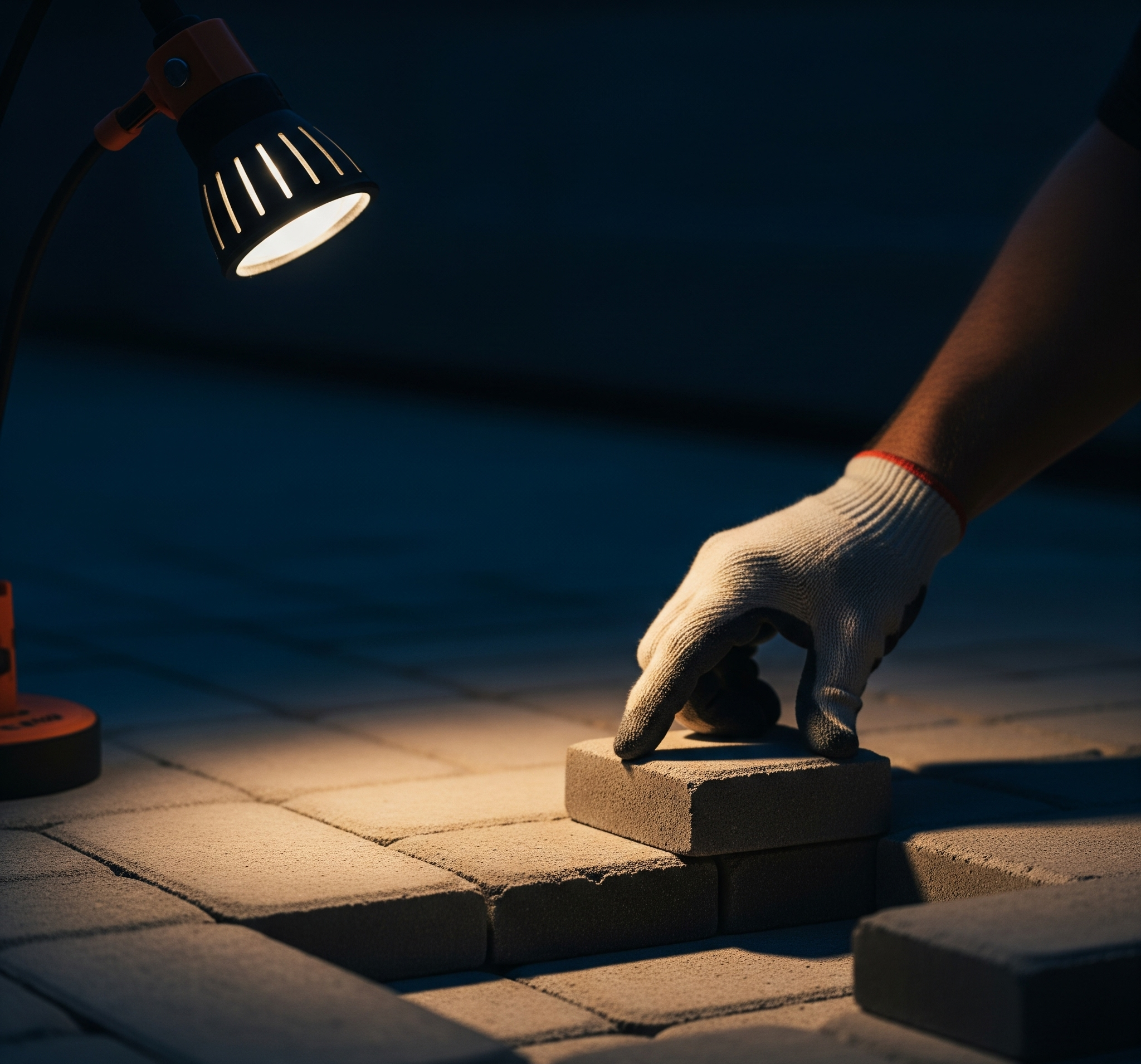
This is the human element—the hardest to quantify and the most impactful on quality. Laying interlock is not pouring concrete. It is not spreading asphalt. It is placing individual stones, one at a time, by hand, in a precise pattern, with consistent joint spacing, across a surface that must be flat to within 1/8 inch over 10 feet. It is skilled manual labour performed on hands and knees, in full sun or freezing rain, for 8-10 hours a day.
The labour cost is driven by:
- Pattern complexity: A running bond (stacked brick pattern) is the fastest to lay. A 45° herringbone is 15-20% slower due to the angular alignment. A random ashlar (multiple stone sizes in a non-repeating pattern) is the slowest and requires the most skilled crew.
- Cutting: Every border, curve, and edge requires custom cutting with a gas-powered wet saw or guillotine splitter. A simple rectangular driveway with straight borders requires minimal cutting. A driveway with radiused curves, a tapered flare at the street, and a circular feature medallion may require 300+ individual cuts. Cutting is time-intensive, produces waste, and requires precision—a poor cut ruins the aesthetic of the entire edge.
- Soldier course borders: A contrasting border course (pavers in a different colour or format running around the perimeter of the driveway) adds a striking visual frame, but it is laid separately from the main field and requires precise alignment at every corner and transition.
In Vaughan, where custom homes often feature sweeping circular driveways, stepped entrance courts, and multi-paver-blend designs, the installation labour component frequently exceeds the material cost. The complexity of the design drives the labour hours, and the skill of the crew determines whether that complexity produces beauty or chaos.
8. Polymeric Sand ($1.50-$2.50 per square foot)
Polymeric sand is a specially engineered joint-filling sand that contains polymer binders which activate when wetted, curing the sand into a semi-rigid, weed-inhibiting, ant-resistant, water-stable joint fill. It is the modern standard for interlock joints and it is overwhelmingly superior to conventional kiln-dried sand, which washes out, allows weed growth, and provides zero pest resistance.
Application requires sweeping the polymeric sand into every joint, using a vibrating plate compactor to consolidate the pavers and settle the sand, refilling any depleted joints, and then a controlled water activation (misting, not flooding) that triggers the polymer cure. The process takes 2-3 hours for a standard driveway and must be executed in dry weather with no rain forecast for 24 hours. Premium products (such as Techniseal HP Nextgel or Alliance Gator Maxx G2) cost $30-$45 per bag and a standard driveway consumes 10-20 bags depending on joint width and paver format.
9. Sealing (Optional but Recommended: $2-$4 per square foot)
Sealing an interlock driveway is not mandatory for structural performance, but it provides significant aesthetic and maintenance benefits. A solvent-based wet- look paver sealer deepens the paver colour, enhances surface texture, provides a subtle sheen, and stabilises the polymeric sand in the joints by creating a surface film that prevents moisture intrusion and UV degradation. On coloured pavers, sealing is particularly impactful—it transforms a matte, somewhat muted surface into a rich, vibrant palette that photographs beautifully and makes the entire driveway appear freshly installed.
Sealing is typically performed 60-90 days after installation (to allow any initial efflorescence to emerge and be cleaned) and renewed every 3-5 years. The initial application cost for a standard driveway is $1,000-$2,500, depending on product and surface area.
"The price of interlock is not what it costs to lay the pavers. It is what it costs to build the foundation that keeps them from moving."
The Hidden Costs: What Budget Quotes Leave Out
When a contractor quotes $12-$15 per square foot for an interlock driveway—fully installed—something has to give. The pavers alone cost $5-$10 per square foot at retail. At $12/sqft all-in, there is virtually no budget remaining for proper excavation, deep granular, geotextile, quality polymeric sand, or skilled labour. The installation will happen. The driveway will look fine on the day the crew leaves. And the homeowner will wonder, six months or two winters later, why the pavers are sinking, the joints are empty, weeds are growing through the surface, and the once-level driveway now tilts toward the garage.
Here are the components most commonly cut from budget quotes:
- Full excavation depth. Budget: 4-6 inches. Professional: 14-18 inches. The difference is $2,000-$4,000 in material and labour that the budget contractor never includes.
- Geotextile fabric. Omitted entirely. Cost saved: $300-$500. Consequence: clay migrates into the base within 3-5 years, restoring the frost-susceptible conditions that cause heave and settlement.
- Multi-lift compaction. Budget: dump and spread in one pass, compact once. Professional: install in 3-4 separate lifts, compact each independently. The difference is 3-4 hours of labour and equipment time.
- Premium polymeric sand. Substituted with kiln-dried sand or the cheapest polymeric available. Cost saved: $300-$600. Consequence: joint failure within 1-2 years, weed growth, ant colonisation.
- Proper edge restraint. Omitted or installed with house-framing nails instead of 10-inch landscape spikes. Cost saved: $300-$500. Consequence: perimeter pavers migrate within the first season.
- Disposal fees. Underquoted or passed through as a change order after the work begins. "We didn't realise how much material there was" is the most common surprise bill in the industry.
Every one of these cuts saves money on day one. Every one of them costs money— often far more money—within 2-5 years when the installation fails.
The Cinintiriks Approach: Transparent, Site-Specific, Comprehensive
At Cinintiriks, every interlock project is quoted under our Cinintiriks Standard for Interlock Installation—a fully itemised, site-specific proposal that covers every component of the project with zero hidden costs.
1. Mandatory Site Visit: We do not quote over the phone. Every project begins with a physical site assessment where we evaluate existing conditions (current surface, soil type, drainage patterns, access), take precise measurements, discuss the client's design vision, and identify any site-specific challenges (utilities, tree roots, elevation changes, municipal requirements) that will affect the scope and cost.
2. Fully Itemised Proposal: Our written proposal breaks down every cost component individually: demolition and removal, excavation depth, disposal (with estimated tonnage), geotextile, granular base (depth and material), HPB bedding, paver product (identified by manufacturer, product name, colour, and format), edge restraint, polymeric sand (product name), installation labour, and sealing (if selected). There are no "allowances" or "TBD" line items. Every cost is defined before the contract is signed.
3. Deep Engineered Sub-Base (Minimum 12 Inches): Every driveway receives a minimum 12-inch compacted Granular A base over geotextile, installed in 3-4 lifts and individually compacted to 95%+ Standard Proctor. This is our minimum. On sites with known clay issues, high water tables, or poor drainage, we increase to 14-16 inches with subsurface drainage.
4. Premium Materials Only: We specify Unilock, Techo-Bloc, or Oaks pavers exclusively. We use Techniseal HP Nextgel or equivalent tier-one polymeric sand. We apply hot-dipped galvanised spikes for edge restraint. There are no substitutions, no "equivalent" downgrades, and no material changes after the contract is executed without the client's written approval.
5. Fixed-Price Contract: Our quoted price is the price you pay. We do not issue change orders for disposal overages, unexpected soil conditions, or additional labour. We assess these variables during the site visit and build them into the proposal. If conditions turn out to be better than expected, we absorb the difference. The client's budget is respected from first quote to final bill.
Design Complexity: The Multiplier You Control
The one cost variable entirely within the homeowner's control is design complexity. The same 500 sq ft driveway, on the same site, with the same sub-base, can cost $16,000 or $35,000 depending purely on what is laid on top.
Simplest (lowest cost): Single paver type, single colour, running bond pattern, straight edges, no border, no feature elements. This is functional and clean but visually restrained.
Moderate (mid-range cost): Primary paver in running bond or herringbone with a contrasting soldier course border, tapered flare at the street apron, and a simple colour accent at the walkway transition. This is the most popular configuration and provides a strong visual impact at a reasonable cost premium.
Complex (highest cost): Multi-paver blend (two or three different stone formats in an ashlar or random layout), contrasting border, radiused curves, a circular or diamond feature medallion, integrated walkway and stoop, and custom-cut edges around landscape beds and trees. This is bespoke craftsmanship that transforms a driveway into an architectural feature. The material cost is higher (more waste from cutting), and the labour hours can double compared to a simple layout.
The Investment Perspective: Interlock as Property Value
A custom interlock driveway is not a maintenance expense. It is a capital improvement that increases the assessed and perceived value of the property. Real estate data in the GTA consistently shows that professionally installed hardscape improvements —particularly front-yard driveways and walkways—return 60-80% of their installation cost in added property value, and often more in competitive markets where curb appeal directly influences sale price.
Beyond the financial return, interlock offers a practical longevity that amortises the cost over decades. A properly installed interlock driveway in the GTA has an expected service life of 25-30+ years before major rehabilitation is required. Amortised over 25 years, even a $30,000 premium installation costs $1,200 per year, or $100 per month—less than the monthly cost of a parking spot in downtown Toronto, for a feature that transforms the property every single day.
Don't gamble your property value on a cheap estimate. Contact Cinintiriks for a transparent, site-specific pricing consultation and luxury interlock design.
FAQ: Custom Interlock Driveway Costs
Why do two contractors have such different prices for the exact same size interlock driveway?
Because they are not quoting the same project. They are quoting the same surface area with dramatically different engineering beneath it. A quote at $12/sqft and a quote at $30/sqft differ in excavation depth (4 inches vs. 14+ inches), granular base quality and compaction (single dump-and-spread vs. multi-lift engineered platform), geotextile (absent vs. present), polymeric sand quality (cheap vs. premium), edge restraint (nails vs. 10-inch galvanised spikes), and crew skill level. The cheaper quote delivers a surface that looks identical on day one. But within 2-3 Ontario winters, the shallow base heaves, the surface sinks, the joints fail, and the homeowner pays again—this time for removal and replacement. The more expensive quote delivers a surface that looks identical on day one and on year twenty. The cost difference is not margin. It is engineering.
Is interlock more expensive than poured or stamped concrete?
Generally, yes—by approximately 30-50% for equivalent quality levels. A properly installed stamped concrete driveway in the GTA typically costs $18-$28 per square foot installed. A properly installed interlock driveway in comparable aesthetics costs $25-$42 per square foot. The premium reflects the higher material cost per square foot (individual manufactured pavers vs. bulk concrete), and the significantly higher labour intensity (hand-placing individual stones vs. pouring and stamping). However, interlock offers one major advantage that concrete does not: individual unit repairability. If a section of an interlock driveway is damaged by a utility cut, a tree root, or a vehicle fluid stain, the affected pavers can be individually removed and replaced without disturbing the surrounding field. With concrete, the same repair requires saw-cutting and removing an entire panel and re-pouring—a far more disruptive and expensive operation. Over a 25-year lifespan, this repairability can offset the higher initial cost.
Does the quote include the polymeric sand and final sealing?
It should, but you must ask—and read the fine print. At Cinintiriks, polymeric sand is included in every interlock installation quote as a standard, non-optional component. Sealing is listed as a separate, optional line item with a defined cost so the client can make an informed decision. Many budget contractors do not include polymeric sand in the base quote—they use conventional kiln-dried sand and charge extra for the polymeric upgrade, or they omit it entirely. Some include polymeric but use an entry-level product that fails within one season. And very few include sealing in the installation quote; it is almost always a separate charge applied 60-90 days after installation. The key questions to ask any contractor: What specific brand and product of polymeric sand is included? Is sealing included or separate? If separate, what product will be used and what is the cost? If the contractor cannot name the specific products, they are not specifying—they are improvising.
The Final Word
A custom interlock driveway in Toronto costs what it costs because it is not a simple product—it is a site-specific, multi-phase engineering project executed by skilled tradespeople using premium materials, heavy equipment, and a deep understanding of Ontario's demanding climate. The price you pay reflects the excavation depth, the granular integrity, the paver quality, the installation precision, and the polymeric sand that holds everything together.
Any quote that seems too good to be true is telling you exactly what will be left out. The money you save on a shallow base, cheap sand, and a fast crew is money you will spend again—with interest—when the surface fails and the job must be done a second time. The smartest investment is the one that only needs to be made once.