This is the urban lot dilemma, and it is felt most acutely in neighbourhoods like Etobicoke, where residential lots are generous enough to accommodate a real backyard but not so large that you can banish the play equipment to a far corner and forget about it. Every feature in the yard is visible from every other feature. The play zone is part of the composition, whether you planned it that way or not. And if it is not engineered with the same precision as the rest of the hardscape, it will undermine everything around it.
The good news: a backyard play area does not have to be the aesthetic compromise you think it is. With the right engineering underneath, the right surface materials on top, and the right spatial design to integrate it into the larger property, a play zone can be a beautiful, structurally permanent feature that adds function and value to your yard rather than subtracting from its appearance. But getting there requires treating the play area like what it actually is—a heavy civil hardscaping project, not a trip to the toy store.
The Urban Space Dilemma: Why Every Square Foot Matters
A typical residential lot in Etobicoke—whether you are in a mature neighbourhood south of Bloor near the Humber or in the newer developments off The Westway—gives you somewhere between 800 and 2,000 square feet of usable backyard space after you subtract the house footprint, the garage, the side setbacks, and the property line margins. That is not nothing, but it is also not expansive. Every feature competes for the same limited real estate.
The patio takes 150 to 300 square feet. The lawn takes 200 to 600 square feet. The garden beds and perimeter plantings take another 100 to 200 square feet. A walkway, a fire pit area, a BBQ station—each one eats into the remaining footprint. Now add a play area. A swing set alone needs a minimum safety zone of 6 feet in all directions beyond the arc of the swing —that is 12 feet by 16 feet at minimum, or roughly 200 square feet, before you even count the structure itself. A small climbing structure with a slide needs a 6-foot clearance zone around the entire perimeter —another 200 to 300 square feet.
On an urban Etobicoke lot, dedicating 200 to 400 square feet to a play area means you are giving up 15% to 30% of your total usable yard. That allocation must earn its space. It must drain properly, support safe play surfaces, look architecturally intentional, and eventually transition gracefully to a different use when the kids outgrow it.
The Plastic Wasteland Problem
The default approach—and the approach we are asked to undo on roughly half of our Etobicoke renovation projects—is this: the homeowner buys a plastic or cedar playset online, assembles it on the existing lawn, and throws down a few bags of rubber mulch around the base. Total planning time: one weekend.
Within six months, the lawn under the play structure is dead. Foot traffic from children running the same paths every day compacts the topsoil, kills the grass, and creates bare dirt patches that turn to mud every time it rains. The rubber mulch migrates across the yard, ending up in the garden beds, the patio joints, and the neighbour's property. The play structure sinks unevenly into the soft, uncompacted ground because it was never anchored to a proper foundation. The drainage pattern of the yard is disrupted because the structure and the compacted soil beneath it create a dam that pools water against the fence line or, worse, back toward the foundation.
And the aesthetic? The brightly coloured plastic structure dominates every sightline in the yard, clashing violently with the carefully chosen hardscaping materials that surround it. The backyard you designed to feel like a private urban retreat now looks like a daycare that shares a property line with a luxury patio.
The Engineering: Safety Starts Underground
A properly engineered play area is, from a construction perspective, nearly identical to a properly engineered patio or walkway. The sub-base must drain. The surface must be stable. The grades must be correct. The only difference is that the surface material is chosen for impact absorption rather than traffic load—and the engineering standards come from CSA Z614 (Children's Playspaces and Equipment) rather than interlocking paver installation guides.
The Sub-Base: Drainage First, Everything Else Second
The single most important engineering element of an outdoor play area is drainage. Children play in all weather. Play surfaces get wet. If the water has nowhere to go, the play area becomes a swamp. A swamp breeds mosquitoes, grows mould on play equipment, creates a slip hazard on any hard surface, and makes the entire feature unusable for days after every rain.
The drainage solution is the same one we use on every hardscape project in Etobicoke: a deep, heavily compacted clear stone sub-base that moves water out of the surface zone and into the native sub-grade below.
Excavation depth: A minimum of 8 to 12 inches below finished grade for a play area on a typical urban lot with clay-heavy soil. The excavation removes the existing topsoil and any soft, organic material down to the native clay sub-grade.
Geotextile fabric: A non-woven geotextile is placed over the excavated sub-grade to prevent clay migration into the granular drainage layer. Without this fabric, clay fines will gradually clog the stone voids over years, killing the drainage performance you are paying to install.
Clear stone (19mm washed aggregate): Clear stone is the preferred sub-base material under play surfaces because it is 100% free-draining—there are no fines to retain water. Rainfall passes through the surface material, drops through the clear stone voids, and disperses into the native sub-grade below. The play surface is dry and usable within minutes of a rainstorm ending, rather than staying soggy for days like a play area built directly on clay soil.
Compaction: The clear stone is placed in lifts of 4 to 6 inches, each compacted with a vibratory plate compactor. The finished sub-base is graded with a minimum 1% to 2% cross-slope falling away from the house and toward a perimeter drain or the lawn edge, ensuring water that does not percolate downward is still directed away from the foundation and the play surface.
The Surface: Impact Absorption Is Not Optional
CSA Z614—the Canadian safety standard for children's playspaces— specifies that the surface beneath and around any play equipment from which a child could fall must provide adequate impact attenuation. This is not a suggestion. It is a standard. And it effectively rules out every hard surface material—concrete, interlocking pavers, natural stone, bare compacted gravel—from the zone directly beneath play structures.
The two premium surface options for residential play areas on engineered sub-bases are:
Option 1: Premium Playground-Grade Artificial Turf
This is the surface we install most frequently on Etobicoke urban lots, and for good reason. Playground-grade synthetic turf is engineered specifically for impact absorption, providing a uniform, consistent fall surface that meets CSA Z614 requirements at the correct infill depth. It is visually the closest alternative to natural lawn—from even a few feet away, a quality playground turf is virtually indistinguishable from premium natural grass—and it eliminates every maintenance issue that plagues natural grass play areas: no mowing, no bare patches, no mud, no dormancy in winter, no irrigation required.
Playground artificial turf differs from standard landscaping turf in two critical ways. First, the pile height is taller—typically 50mm to 65mm compared to 30mm to 40mm for landscaping turf—providing more cushion depth. Second, the infill material is specifically engineered for impact absorption: either TPE (thermoplastic elastomer) granules or rounded silica sand with a shock-absorbing foam pad installed beneath the turf. The combination of tall fibres, deep infill, and shock pad produces a surface with a Critical Fall Height (CFH) rating that meets or exceeds the requirements for equipment up to 1.5 to 2.0 metres in height—sufficient for residential swing sets, climbing structures, and slides.
Option 2: Engineered Wood Fibre (EWF) Playground Mulch
Engineered wood fibre is a processed, kiln-dried, precision-cut hardwood product specifically manufactured for playground use. It is not bark mulch, not wood chips, and not shredded pallet wood. EWF is a CPSC-certified (Consumer Product Safety Commission) and ASTM F1292-compliant fall-attenuation material that provides excellent impact absorption at a depth of 9 to 12 inches.
EWF is the more traditional and lower-cost play surface option. It provides a natural, organic appearance that blends well with garden beds and landscaping. However, it requires annual replenishment (the material decomposes and compacts over time, losing cushion depth), it can be tracked out of the play zone by foot traffic, and it retains moisture longer than artificial turf—meaning the play area takes longer to dry after rain. For these reasons, EWF is typically recommended for larger play zones where a generous material depth can be maintained, rather than compact urban installations where tidiness and fast drainage are priorities.
Structural Zoning: Separating Chaos from Calm
Now we arrive at the design challenge that most homeowners struggle with and most contractors ignore entirely: how do you make a play area look like it belongs in a luxury backyard?
The answer is structural zoning—using hardscape elements to physically define the play area as a distinct architectural zone within the yard, rather than letting it bleed into the surrounding lawn and patio like an afterthought. When the play zone is structurally separated from the entertaining zone, both spaces become stronger. The play area reads as intentional and designed. The patio reads as protected and curated. The transition between them reads as an architectural decision, not an accident.
The Low Retaining Wall as Zone Separator
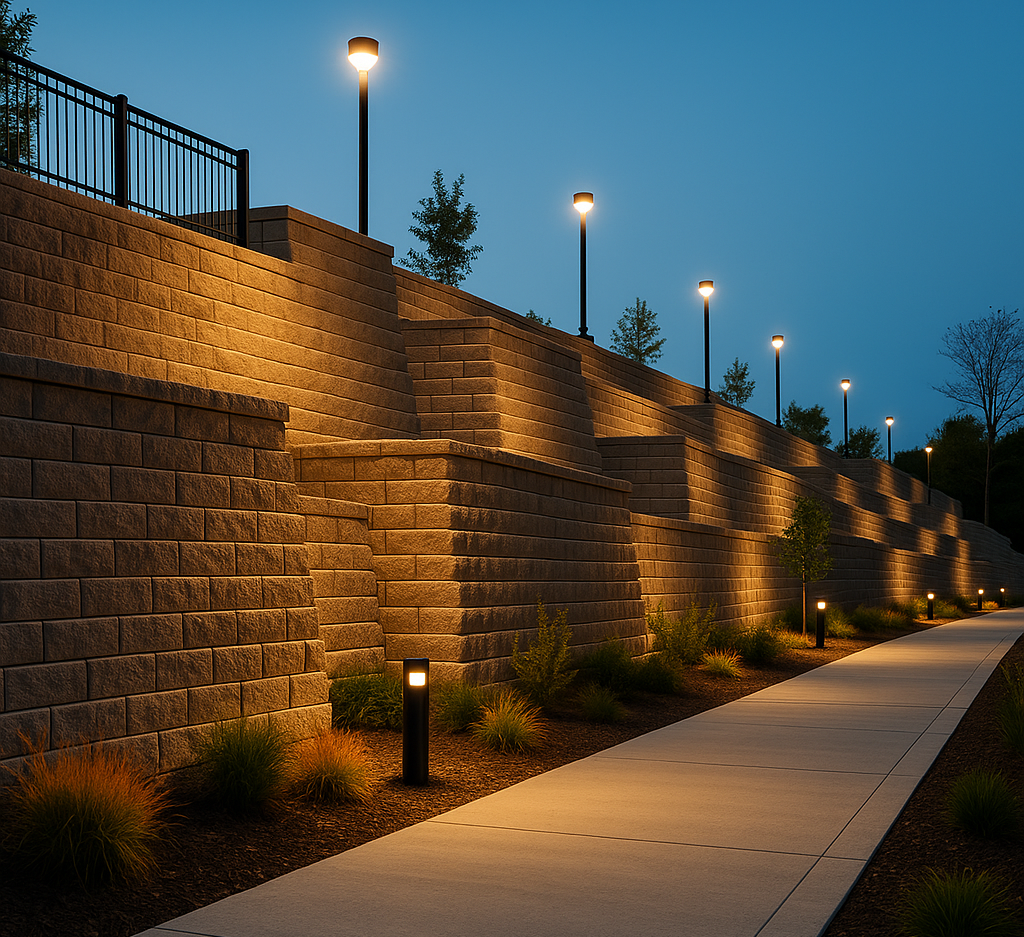
The most effective structural zoning element for play areas on urban Etobicoke lots is a low segmental retaining wall —typically 12 to 18 inches high—built with deep Charcoal segmental blocks that match or complement the existing hardscape palette. This wall performs three functions simultaneously:
1. Material containment. Whether the play surface is artificial turf or EWF mulch, a physical border prevents the material from migrating into the adjacent paver patio or lawn. Without containment, rubber infill from artificial turf ends up in patio joints, EWF mulch creeps across the lawn, and the clean separation between zones disappears within a season.
2. Visual definition. The wall creates an unmistakable line between the play zone and the entertaining zone. From the patio, you look across a defined edge—not a gradual, sloppy transition from pavers to grass to mulch to plastic. The Charcoal wall provides a bold, architectural frame that communicates design intent, the same way a picture frame defines the boundary of a painting.
3. Informal seating. A 12 to 18 inch wall is the perfect sitting height for adults supervising children at play. Instead of standing awkwardly at the edge of the play zone or dragging a patio chair across the lawn, parents sit on the wall itself—feet on the patio side, eyes on the play side. The wall becomes a social boundary that is comfortable and functional, not just structural.
The Patio Integration
On urban Etobicoke lots where space is limited, the play zone and the patio are often directly adjacent. This is actually an advantage, not a problem, if the transition is designed correctly.
The optimal layout positions an expansive Warm Off-White interlocking paver patio—the adult entertaining and dining zone— immediately adjacent to the play area, separated by the low Charcoal retaining wall. The adults are on the patio. The children are on the play surface. The wall between them is low enough for conversation and supervision but tall enough to contain materials and define the zones. The colour contrast between the Warm Off-White patio field and the deep Charcoal wall creates a clean, modern aesthetic that reads as a unified design rather than two competing installations.
The play surface itself—whether it is vibrant green artificial turf or warm wood-toned EWF—provides a natural texture contrast with the precisely laid paver surface of the patio. The yard has three distinct textures (pavers, stone wall, turf/mulch), three distinct tones (off-white, charcoal, green/wood), and three distinct functions (entertaining, separation, play)—all working together as a single composition.
"A play area that looks like it was designed by the same architect who designed the patio is a feature. A play area that looks like it landed from space is a problem. The difference is not the play equipment. It is the engineering and the materials around it."
The Lifecycle Advantage: Designing for Transition
Here is the conversation most play area builders never have with the homeowner: your children will outgrow this space. The swing set that is the center of their universe at age five will be gathering cobwebs by age twelve. What happens to the 300 square feet of play zone when the play stops?
If the play area was built on a properly engineered sub-base with structural zoning, the transition is simple and cost-effective. The play equipment is removed. The artificial turf remains as a low-maintenance lawn substitute (or is replaced with sod if natural grass is preferred—the drainage sub-base supports both). The retaining wall stays as a permanent architectural feature that now defines a garden zone, a fire pit area, a hot tub pad, or an additional patio extension.
The heavy civil foundation that was installed for the play area supports any future use. The drainage works for any surface. The wall defines any zone. The homeowner spent money on infrastructure that will serve the property for its entire lifecycle, not on a single-purpose installation that gets torn out and replaced ten years later.
Compare this to the plastic-slide-on-dead-grass approach: when the kids outgrow it, you remove the slide and you are left with a patch of bare, compacted clay where the lawn used to be. Rehabilitating that soil requires excavation, topsoil import, grading, and sodding—essentially building from scratch what should have been built properly the first time.
Play Structure Selection: Form Follows Function
The play equipment itself is the last consideration, not the first. The sub-base, the surface, the zoning, and the grading are all designed and installed before a single piece of play equipment is placed. This ensures the equipment is installed on a level, stable, properly drained surface with the correct safety clearances in all directions.
For urban Etobicoke lots, we recommend play structures that meet three criteria:
Scale-appropriate. The structure must fit within the play zone with full CSA Z614 clearances (minimum 1.8 metres from the structure to any hard surface, fence, wall, or obstruction). On a compact lot, this usually means a single multi-function structure (climbing wall, platform, slide) rather than separate freestanding pieces spread across the zone.
Material quality. Cedar, composite lumber, or powder-coated commercial-grade steel are the appropriate materials for structures that will be anchored to an engineered base in a premium landscape. Moulded plastic degrades under UV exposure within 3 to 5 Ontario summers, becoming brittle, faded, and structurally suspect. The play structure should be a permanent fixture that ages with dignity, not a disposable product that needs replacing every few years.
Colour restraint. This is controversial, but it matters. A play structure in natural cedar, dark brown, dark green, or matte black integrates visually with a Charcoal-and-Off-White hardscape palette. A structure in primary red, blue, and yellow dominates the visual field and overpowers everything around it. The children do not care what colour the slide is. The property's resale value does.
The Cinintiriks Approach: Engineered Environments, Not Assembled Playsets
At Cinintiriks, we do not assemble playsets on dead lawns. We engineer complete family environments. Our Cinintiriks Standard for Integrated Play Zones treats the play area as a fully engineered hardscaping project that is designed, built, and guaranteed with the same rigour as every patio, walkway, and retaining wall on the property:
1. Spatial Design: We begin with a scaled site plan that maps the play zone within the context of the entire yard—patio, lawn, garden beds, walkways, drainage, and utility corridors. The play area is sized and positioned to meet CSA Z614 clearance requirements while maximising the remaining usable space for entertaining and landscaping. On compact Etobicoke lots, spatial efficiency is not optional—it is the design driver.
2. Heavy Civil Sub-Base: We excavate the play zone footprint to a minimum of 10 inches below finished grade, install non-woven geotextile over the native clay, and build a compacted clear stone sub-base that provides unlimited drainage capacity. The sub-base is graded with 2% slope to direct water away from the house, the patio, and the play surface. No standing water. No mud. No mosquitoes.
3. Structural Zone Separation: A low Charcoal segmental retaining wall—12 to 18 inches in height, built on a compacted granular footing with geogrid reinforcement where needed—separates the play zone from the adjacent patio and lawn. The wall contains play surface materials, defines the visual boundary, and provides comfortable seating height for supervising adults.
4. Premium Play Surface: Playground-grade artificial turf with TPE infill and a shock-absorbing foam pad is installed over the compacted sub-base, meeting CSA Z614 Critical Fall Height requirements for the specified play equipment. The turf edge is tucked against the retaining wall and secured with landscape spikes for a clean, permanent perimeter.
5. Hardscape Integration: The play zone wall, the patio, the walkways, and all surrounding hardscape are built from the same Warm Off-White and deep Charcoal material palette, creating a unified composition that reads as a single, cohesive design. The play area is a feature of the property, not a concession.
Don't ruin your luxury backyard with a muddy, unengineered play zone. Contact Cinintiriks to design and build a seamlessly integrated, heavily engineered family space in Etobicoke.
FAQ: Backyard Play Areas on Urban Lots
What is the safest, lowest-maintenance surface for a backyard play area in Ontario?
Playground-grade artificial turf with a shock-absorbing foam underlayment is the best combination of safety, durability, drainage, and low maintenance for residential play areas in Ontario's climate. The turf provides a uniform, consistent surface that does not develop bare patches, ruts, or mud under heavy foot traffic. The foam underlayment (typically 10mm to 25mm thick closed-cell polyethylene or rubber) provides additional impact absorption beyond what the turf and infill alone deliver, allowing the system to meet CSA Z614 Critical Fall Height requirements for equipment up to 2.0 metres. The artificial turf surface is permeable— water drains through the backing and through the clear stone sub-base below, so the surface is dry and playable within minutes of a rainstorm. It does not retain water, does not grow mould, and does not freeze into a solid ice sheet in winter the way rubber mats or poured-in-place rubber surfaces can. Maintenance is minimal: periodic brushing to redistribute infill, debris removal with a leaf blower, and an annual rinse with a garden hose. There is no mowing, no fertilising, no irrigation, no reseeding, and no seasonal overhaul. The turf looks the same in November as it does in June. Compared to natural grass (which dies under play structures), rubber mulch (which migrates and retains moisture), pea gravel (which provides poor impact absorption and is a choking hazard for small children), and poured rubber (which cracks in Ontario's freeze-thaw cycles), playground artificial turf offers the most comprehensive performance across all relevant criteria for urban Etobicoke and GTA properties.
How deep does the sub-base drainage need to be under artificial playground turf?
A minimum of 8 inches (200mm) of compacted clear stone (19mm washed aggregate) for standard residential play areas on clay-heavy soils. This depth provides sufficient drainage volume to handle intense rainstorms without water rising above the stone layer and saturating the turf infill. On sites with particularly poor natural drainage—heavy clay, high water table, or low-lying areas that collect water from surrounding properties—the sub-base depth should be increased to 10 to 12 inches (250mm to 300mm) to provide additional storage volume and drainage capacity. The clear stone is placed over non-woven geotextile fabric that separates the granular layer from the native clay sub-grade. Without this fabric, clay fines migrate upward into the stone voids over time, gradually clogging the drainage capacity and turning the free-draining sub-base into a water-retaining clay-contaminated mass. The geotextile is inexpensive and its omission is inexcusable. The stone is compacted in lifts of 4 to 6 inches, each receiving multiple passes with a vibratory plate compactor to prevent future settlement. The finished sub-base is graded with a minimum 1% to 2% cross-slope to direct any water that does not percolate downward away from the play area—typically toward the lawn edge or a concealed perimeter drain. This sub-base is identical in specification to what we install under interlocking paver patios and walkways. The investment in the drainage infrastructure serves the play area now and any future use of the space decades from now.
Can I use structural concrete retaining walls to level a sloped urban lot for a play structure?
Absolutely, and for sloped lots in Etobicoke it is often the only practical solution. Many Etobicoke properties— particularly those along the Humber River valley, on the escarpment south of Dundas, or on the ridge lines through central Etobicoke—have significant rear-yard slopes that make direct ground-level play area installation impractical. A play structure requires a level surface with consistent safety clearances in all directions. Placing equipment on a slope creates uneven fall heights, uneven safety zones, and drainage problems where water sheets downhill through the play surface. Structural retaining walls solve this by creating a level terrace within the slope. A segmental or poured concrete retaining wall is built at the base of the slope (or at mid-slope, depending on the design), and the area behind the wall is backfilled with engineered aggregate and topsoil (for sod) or clear stone and turf (for a play surface) to create a flat platform. The retaining wall must be engineered for the specific soil conditions and retained height —walls over 24 inches in height require geogrid reinforcement, and walls over 48 inches typically require a professional engineer's design stamp per Ontario Building Code requirements. Drainage behind the wall is critical: a perforated drain pipe (wrapped in filter fabric) is installed at the base of the wall, behind the first course, to collect water that percolates through the backfill and direct it to a positive outlet. Without this drain, hydrostatic pressure builds behind the wall, eventually destabilising it. The result is a perfectly level play platform with full clearance zones, proper drainage, and a structural retaining wall that doubles as a permanent architectural feature of the yard—useful long after the children outgrow the play equipment.
The Final Word
A backyard play area on an urban lot is not a toy installation. It is a heavy civil hardscaping project that requires excavation, drainage engineering, structural zoning, and premium surface materials to do correctly. The sub-base must drain. The surface must absorb impact. The zone must be defined. And the entire feature must integrate visually and structurally with the rest of the property.
Build it right, and the play area is a beautiful, functional feature that serves the family now and transitions seamlessly to a new use later. Build it cheap, and it is a muddy, fading, liability-laden eyesore that drags down everything around it.
The kids deserve better. And so does the yard.