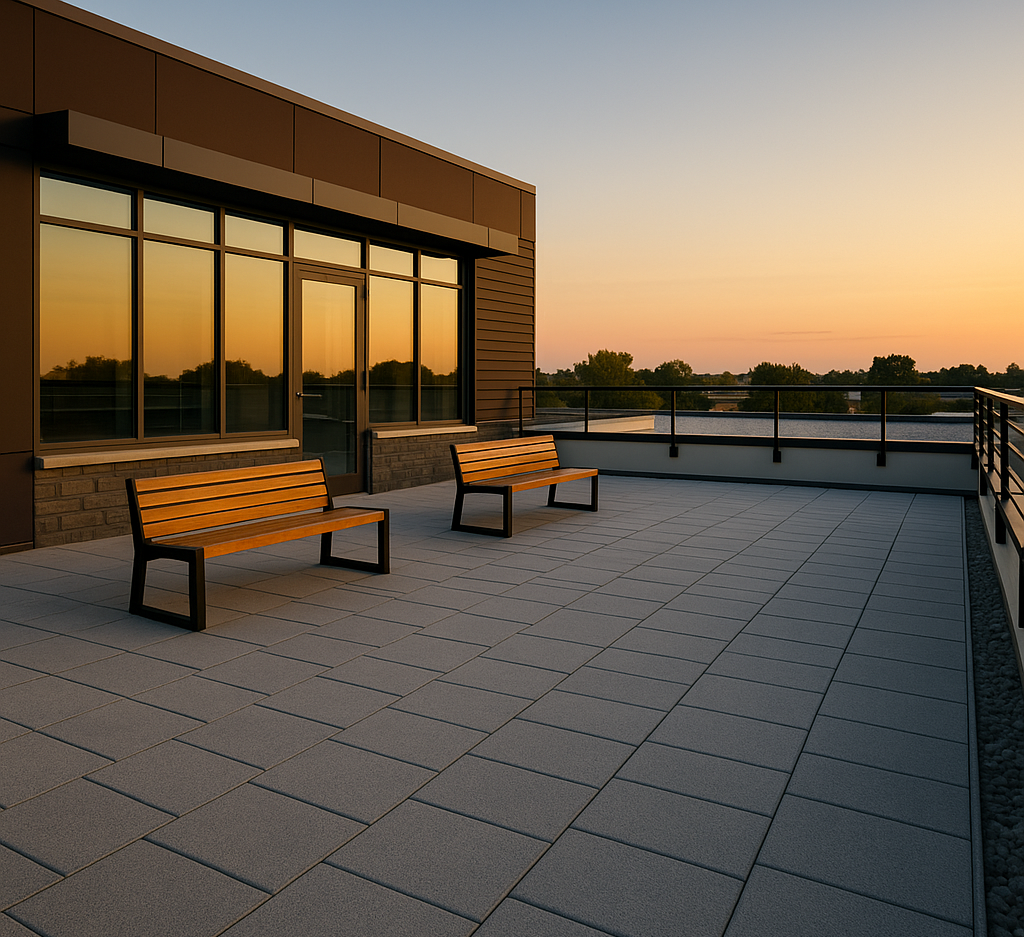
The Skyward Aesthetic: Scarborough’s Evolving Roofscape
The rooftop of an urban building was, for decades, the space nobody thought about. It existed to keep water out and house mechanical equipment. The idea of placing luxury finishes on a surface that was never designed for habitation would have seemed absurd to the engineers who built the commercial towers along the Scarborough Town Centre corridor or the mid-rise office complexes flanking Highway 401. The roof was infrastructure. It was hidden. It was irrelevant to the tenant experience.
That era is over. The convergence of three powerful market forces has made the rooftop the most strategically valuable piece of real estate in a commercial building. First, the post-pandemic demand for outdoor corporate amenity space has made rooftop terraces a decisive factor in tenant acquisition and retention. Second, increasingly restrictive municipal density requirements across Scarborough and the broader GTA mean that ground-level outdoor space is scarce and expensive—the roof is often the only place to create meaningful outdoor amenity. Third, the materials science and engineering systems have matured to the point where rooftop hardscaping is no longer experimental; it is a proven, warrantied, code-compliant building system with a decades-long track record across European and North American commercial markets.
But here is the part that architects and property managers must understand before they start selecting colours and patterns: rooftop paver design is not interior design with weather exposure. Every aesthetic decision on a rooftop is constrained by, enabled by, and ultimately dependent on the heavy civil pedestal system that supports it. You cannot design the surface without understanding the structure beneath it.
The Engineering Foundation: Design Dictated by Physics
Every luxury rooftop paver installation—regardless of style, pattern, or material—sits on the same foundational system: an adjustable pedestal matrix that creates an elevated, level deck above the sloped roof membrane. Understanding this system is essential because it directly determines which paver formats, thicknesses, and layouts are structurally viable at elevation.
The pedestal system consists of injection-moulded polypropylene supports, each with a threaded stem that allows precise height adjustment from approximately 20 mm to 300 mm (extendable with column adapters for greater heights). Each pedestal is topped with a cross-shaped head that supports the corners of four adjacent pavers, and each head includes integrated spacer tabs that maintain consistent 3 to 5 mm open joints between pavers for drainage.
The pedestals rest on rubber isolation pads placed directly on the roof membrane, distributing load and protecting the waterproof surface from point contact and abrasion. The entire assembly creates a drainage plenum—a continuous air gap between the paver underside and the membrane that allows rainwater to flow freely to the existing roof drains, permits the membrane to dry after rainfall, and prevents the moisture entrapment that destroys membranes beneath ballasted or direct-lay systems.
This engineering foundation does three things that shape every design decision. It provides a perfectly level canvas regardless of the roof’s drainage slope. It imposes dimensional constraints—pavers must be compatible with the pedestal grid spacing. And it determines the weight budget—the structural engineer’s approved maximum dead load per square metre, which dictates whether you can use 20 mm porcelain (approximately 45 kg/m²) or thicker concrete units (up to 120 kg/m²).
With that foundation understood, let us explore the designs that are dominating the luxury rooftop market across Scarborough and the Greater Toronto Area in 2026.
Design 1: Large-Format Monochromatic Fields
The single most requested rooftop paver design in our portfolio is the large-format monochromatic field—and the reasons are both aesthetic and psychological.
Large-format pavers—typically 600 × 600 mm or 600 × 900 mm rectified-edge porcelain units in a single colour—create an expansive, uninterrupted surface plane that reads as a seamless floor rather than a collection of individual tiles. The minimal joint lines, combined with the precise rectified edges that allow those 3 mm joints to virtually disappear from standing height, produce what designers call the “floating floor” effect: the surface appears to hover in space, detached from the building below, creating a sensation of openness and luxury that smaller-format pavers simply cannot achieve.
Our signature Warm Off-White porcelain—a soft, natural stone-inspired tone with subtle veining and a matte anti-slip finish—is the dominant colour choice for Scarborough rooftop projects. The light colour reflects solar radiation rather than absorbing it, keeping the surface noticeably cooler underfoot during summer months compared to darker alternatives. It also creates a visual connection with the sky, amplifying the sense of altitude and openness that makes a rooftop terrace feel fundamentally different from a ground-level patio.
From an engineering perspective, large-format porcelain pavers are ideal for pedestal systems because their dimensional precision and uniform thickness allow them to sit on the pedestal heads with absolute stability. The 20 mm thickness keeps the dead load within the structural budget of most existing commercial roofs in Scarborough, and the fired porcelain body is virtually non-porous (water absorption below 0.5%), making it immune to freeze-thaw damage, salt staining, and UV degradation—the three environmental forces that destroy lesser materials at elevation.
Design 2: High-Contrast Geometric Bordering
A vast monochromatic field is beautiful. A vast monochromatic field with bold geometric borders is architectural.
This is the design philosophy that transforms a rooftop from a pleasant outdoor surface into a spatial experience—and it is the technique we deploy most frequently on commercial amenity terraces across the GTA. The concept is deceptively simple: use contrasting paver colours to define functional zones within the open rooftop without erecting physical walls, screens, or barriers that would block sightlines, obstruct wind flow, and diminish the panoramic openness that makes the rooftop valuable in the first place.
In practice, we lay the primary terrace surface in Warm Off-White porcelain, then introduce deep Charcoal porcelain pavers as accent bands—typically 600 mm to 900 mm wide—that create striking geometric borders around designated zones. A lounge area is framed by a double-width Charcoal border. A dining zone is delineated by a single Charcoal band running perpendicular to the building face. A circulation path is defined by parallel Charcoal runners that guide movement across the terrace. The result is a rooftop that reads as an elegantly zoned environment—living room, dining room, and hallway—without a single partition.
The high contrast between the two tones is critical. Subtle colour variations (light grey against medium grey, for instance) do not create sufficient visual separation at the distances involved on a large rooftop. The Warm Off-White against deep Charcoal provides the maximum achromatic contrast available—a clean, monochromatic palette that is inherently sophisticated, never dates, and photographs beautifully in every lighting condition from harsh midday sun to warm evening golden hour.
Engineering note: the Charcoal pavers are the same format, thickness, and material specification as the Warm Off-White units. They sit on the same pedestal grid, at the same height, with the same joint width. The design is entirely a surface-level pattern change—it adds zero structural complexity to the installation. This is pure aesthetic impact achieved with zero engineering compromise.
Design 3: Mixed-Texture Biophilic Integration
The most forward-thinking rooftop designs in the GTA are moving beyond hard surfaces entirely, incorporating living and natural elements directly into the paver grid to create environments that feel organic, layered, and connected to nature despite being elevated dozens of metres above the ground.
The most popular mixed-texture integration is modular synthetic turf panels inserted into the pedestal paver grid. These are not the cheap plastic grass of a decade ago. Modern premium synthetic turf—multi-tonal, UV-stabilised, drainage-integrated, and virtually indistinguishable from natural grass at conversational distance—is manufactured in panel formats that are dimensionally compatible with standard pedestal paver grids. We integrate turf panels into specific zones of the terrace design—a soft, green relaxation area within the hard paver field, a children’s play zone on a family-oriented residential rooftop, or a verdant border between the dining zone and the perimeter railing—creating a biophilic contrast that softens the architecture and creates an instinctive emotional warmth.
Another rising technique is the integration of smooth river-rock drainage channels within the paver pattern. Narrow channels (200 to 400 mm wide) are framed by the paver grid and filled with polished white or grey river stones, creating visual “streams” that flow across the terrace surface. These channels serve a dual purpose: they are aesthetically stunning as design elements, and they function as surface drainage features, allowing water to pass through the loose stone fill and into the drainage plenum below. The effect is distinctly Japanese-inspired—a zen garden quality that is extraordinarily effective on corporate wellness terraces and hospitality rooftops in Scarborough.
A third integration gaining momentum is modular planting systems—shallow-profile fibreglass or aluminium planter troughs that sit within the pedestal grid at the same height as the pavers, creating flush planting beds that appear to grow directly from the terrace surface. Filled with drought-tolerant ornamental grasses, evergreen shrubs, or seasonal colour, these integrated planters bring vertical texture and living colour into the hardscape without the weight penalty of deep soil volumes. Each planter includes its own drainage and irrigation connections, engineered to operate independently of the paver system.
"The best rooftop designs do not look engineered. They look inevitable—as if the building was always meant to have this space, and nobody noticed until now."
The Cinintiriks Standard for Rooftop Paver Design
We are heavy civil hardscape architects. We design and execute flawless, wind-load-compliant luxury rooftop environments across Scarborough and the Greater Toronto Area, ensuring your building’s amenity space is not only visually breathtaking but structurally bulletproof.
1. Structural & Wind-Load Engineering: Every design begins with a P.Eng.-certified structural analysis and a wind-uplift calculation specific to the building height, location, and exposure category. We determine the paver type, thickness, and perimeter restraint system required to resist the maximum design wind loads at the specific Scarborough location—before a single colour is selected.
2. Design Development: We produce detailed paver layout drawings showing the exact position of every field paver, every accent border, every mixed-texture integration zone, every planter, and every furniture pad. The layout is dimensioned to the pedestal grid spacing, verified for structural load compliance, and reviewed with the client before fabrication and procurement.
3. Pedestal Installation & Levelling: Adjustable pedestals are placed on the membrane surface on protective rubber isolation pads, positioned on the calculated grid, and individually adjusted to achieve a perfectly level finished surface. Every pedestal height is verified across the full terrace to eliminate rocking, lippage, and drainage inconsistencies.
4. Paver & Feature Installation: Large-format porcelain pavers are placed on the pedestal heads in the designed pattern. Charcoal accent bands, turf panel zones, river-rock channels, and planter troughs are integrated precisely according to the approved layout. Perimeter edge restraints and mechanical wind-uplift clips are installed at all exposed edges and corners.
5. Lighting, Railing & Furniture: LED strip lighting is integrated into railing bases and planter edges for ambient evening illumination. Code-compliant glass or cable railings are installed at all perimeter exposures. Modular furniture is positioned and, where required by wind-load analysis, anchored to independent pedestal-supported platforms.
This is The Cinintiriks Standard for rooftop design. We do not hand you a material sample and wish you luck. We engineer the complete system—from the structural assessment that determines what the roof can carry, through the pedestal matrix that creates the level canvas, to the bespoke paver pattern that makes the space unforgettable. Every layer serves a purpose. Every decision is backed by calculation. The result is a rooftop terrace in Scarborough that looks effortless and performs flawlessly.
FAQ: Rooftop Paver Design in the GTA
Can you use standard interlocking driveway pavers on a commercial flat roof?
Technically possible, but almost never advisable. Standard interlocking concrete pavers—the 60 mm or 80 mm thick units designed for ground-level driveways and patios—weigh between 100 and 140 kg per square metre. That dead load, combined with live load, snow load, and furniture, often exceeds the structural capacity of existing commercial roof decks. Additionally, concrete pavers are dimensionally less precise than rectified porcelain, making them more difficult to lay flat on pedestal heads without rocking or lippage. They are also more porous than porcelain, which means they are more susceptible to freeze-thaw damage, efflorescence, and staining at elevation where exposure to weather is constant and unshielded. For these reasons, the rooftop market has overwhelmingly moved toward 20 mm porcelain pavers—units specifically manufactured for pedestal installation, with precise dimensional tolerances, near-zero porosity, superior freeze-thaw resistance, and a dead load of approximately 45 kg/m² that fits within the structural budget of most existing commercial buildings in Scarborough.
How do large-format porcelain pavers handle extreme wind loads on Scarborough high-rises?
Wind uplift is the primary structural concern for any rooftop paver installation, and it becomes more severe with building height and at roof edges and corners where wind acceleration creates the highest negative pressures. Large-format porcelain pavers resist wind uplift through three mechanisms. First, self-weight: even at 20 mm thick, a 600 × 600 mm porcelain paver weighs approximately 16 kg, providing meaningful gravitational resistance. Second, perimeter edge restraints: continuous aluminium or stainless steel profiles are installed around the full perimeter of the terrace, physically locking the edge and corner pavers against vertical and lateral displacement. Third, mechanical wind-uplift clips: in high-exposure zones (typically within 2 metres of the roof edge on buildings above 6 storeys), stainless steel clips are attached to the pedestal heads, engaging the underside of the pavers and mechanically restraining them against uplift forces. The combination of these three systems is engineered to resist the specific wind pressures calculated for the building height, location, and exposure category per the Ontario Building Code. On every Cinintiriks rooftop project in Scarborough, the wind-load analysis is performed by a licensed professional engineer and the restraint system is specified accordingly.
Is it possible to integrate outdoor lighting directly into a rooftop pedestal paver design?
Absolutely, and it transforms the space. The drainage plenum beneath the pedestal paver system creates a natural wiring channel that is invisible from the surface. Low-voltage LED strip lighting and individual LED puck lights can be routed through this plenum and integrated at multiple points in the terrace design. The most popular integrations include: perimeter glow strips installed along railing bases or planter edges, creating a soft ambient border of light around the terrace perimeter; in-paver uplights—small LED fixtures set flush into specially cut paver openings, illuminating seating areas or circulation paths from the surface itself; and under-bench lighting concealed beneath floating seating platforms, creating a dramatic “hovering furniture” effect at night. All wiring is low-voltage (12V or 24V DC), transformer-fed from a building electrical connection, and rated for outdoor wet-location use. The pedestal plenum keeps all wiring protected from weather, foot traffic, and UV exposure while allowing easy access for maintenance or future modification by simply lifting the pavers above the wire runs.
The Final Word
The rooftop of a Scarborough building is not a ceiling. It is a canvas. And the paver design you place on that canvas defines whether the space is merely functional or genuinely extraordinary. Large-format monochromatic fields create serene, expansive luxury. High-contrast geometric bordering transforms open space into architectural experience. Mixed-texture biophilic integration brings nature to the sky. All of it sits on the same engineering foundation—an invisible pedestal matrix that makes the impossible look effortless.
Ready to elevate your building’s aesthetic and property value? Contact Cinintiriks for heavily engineered, luxury rooftop paver design in Scarborough.