The Hydrological Liability: What Is at Stake
Let us be direct about the consequences of getting commercial drainage wrong. This is not a hypothetical risk. These are outcomes that play out on Toronto commercial properties every year.
Foundation undermining. Water that is not graded away from a commercial building perimeter pools against the foundation wall, saturates the backfill, and generates hydrostatic pressure against the below-grade structure. Over time—and in Toronto’s freeze-thaw climate, “over time” can mean a single winter—that pressure cracks foundation walls, compromises waterproofing membranes, and allows water infiltration into below-grade spaces. The repair cost for a compromised commercial foundation in the GTA routinely exceeds $150,000 to $500,000, not including business interruption, tenant displacement, and insurance premium escalation.
Ice liability. Ponding water on a commercial parking lot or pedestrian plaza freezes overnight in October, November, and every month through April. A single slip-and-fall injury on a commercial property in Ontario can generate a personal injury claim exceeding $1 million. If the property owner cannot demonstrate that the site was engineered to prevent ponding—that the grading meets OBC requirements and the drainage infrastructure is properly maintained—the liability exposure is severe. Insurance adjusters and plaintiff’s attorneys examine site grading and drainage compliance as a matter of routine in commercial slip-and-fall litigation.
Municipal enforcement. The City of Toronto’s Engineering and Construction Services division actively enforces stormwater management compliance on commercial properties. Non-compliant drainage systems—those that discharge unmanaged runoff onto municipal rights-of-way, overwhelm storm sewer capacity, or fail to meet post-development runoff quantity and quality targets—trigger enforcement actions that range from mandatory remediation orders to daily fines under the City of Toronto Municipal Code until compliance is achieved.
This is the landscape. Commercial drainage in Toronto is not a construction detail. It is a legal, structural, and financial imperative. And the Ontario Building Code is the regulatory framework that defines the minimum standard.
The OBC Framework: What the Code Actually Requires
The Ontario Building Code (O. Reg. 332/12, as amended) addresses commercial drainage across several interconnected provisions. The requirements are not consolidated in a single convenient section—they are distributed across Division B, Parts 5 and 6, and supplemented by the City of Toronto’s own municipal standards and the Toronto Green Standard. Here is what they mandate in practical terms.
Minimum Grading and Surface Slope
The OBC requires that all ground surfaces within 1.8 metres of a building foundation be graded to slope away from the building at a minimum gradient of 1 unit vertical per 50 units horizontal—which translates to a 2% positive slope. This is the absolute minimum. On commercial projects in Toronto, best practice and municipal site plan approval frequently mandate steeper slopes—2% to 5%—depending on the surface material, the contributing drainage area, and the intensity-duration-frequency (IDF) curve used in the stormwater calculation.
That 2% minimum sounds modest. It is not. On a 50-metre-wide commercial parking lot, a 2% cross-slope means the surface drops 1 metre from crown to gutter. That slope must be established at the sub-base level during excavation, carried through the aggregate base course, and maintained at the finished paver or asphalt surface with tolerances tight enough to prevent the formation of ponding zones. A deviation of as little as 6 millimetres over a 3-metre straightedge can create a low spot where water accumulates rather than flowing to the collection point. In winter, that low spot becomes an ice patch. In litigation, that ice patch becomes evidence of non-compliant grading.
Stormwater Collection Infrastructure
The OBC and the City of Toronto’s Wet Weather Flow Management Policy require that commercial sites include engineered stormwater collection systems sized to handle design storm events without overwhelming the municipal storm sewer network. In practice, this means a network of catch basins, trench drains, and area drains connected by underground storm sewer piping to the municipal system (or, where on-site management is required, to detention or retention facilities).
Catch basins are the primary collection points on conventional commercial sites. These are precast concrete or high-density polyethylene (HDPE) sumps installed at calculated low points in the grading plan, with cast iron grate covers rated for the anticipated traffic loading. On a commercial parking lot in Toronto, catch basins are typically spaced at intervals of 30 to 50 metres along the gutter line, with additional basins at grade changes, building corners, and any location where the grading plan creates a convergence of surface flow.
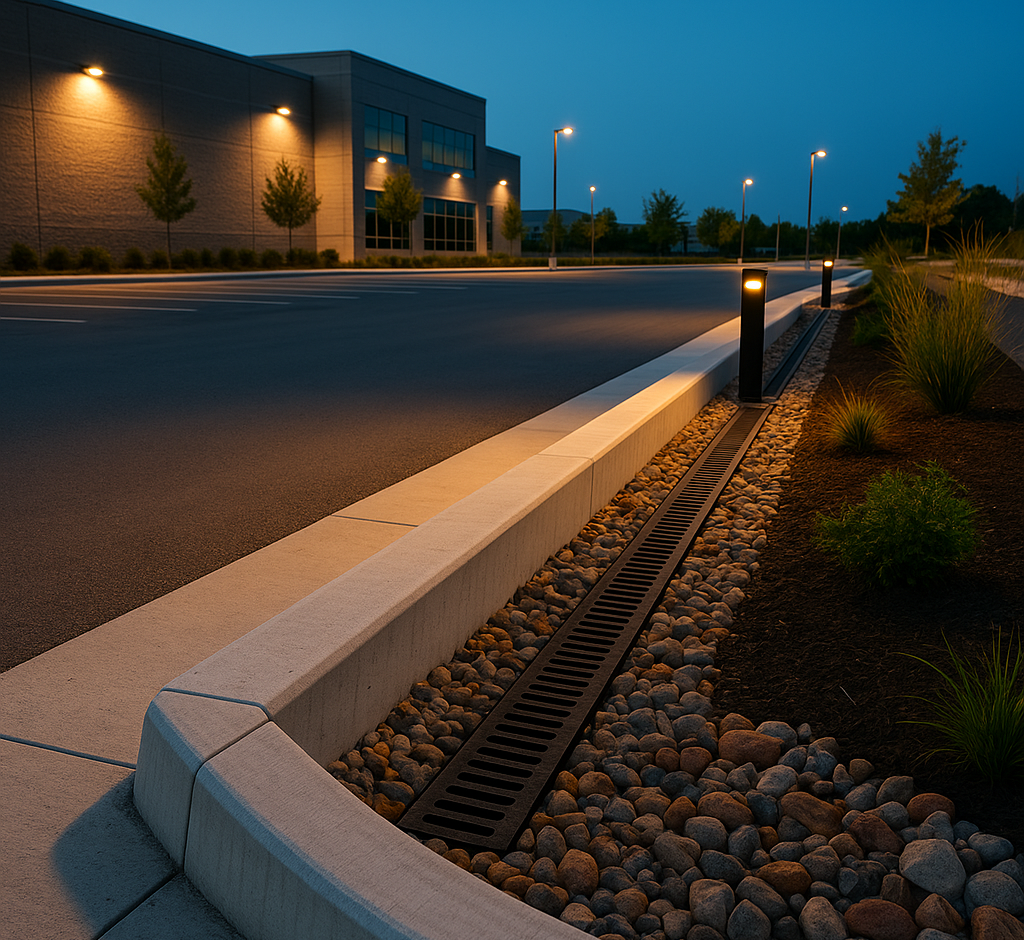
Linear trench drains are increasingly specified on modern commercial sites, particularly in pedestrian plazas, building entrance aprons, and flush curb environments where traditional catch basins would interrupt the paver surface. These are narrow channel drains—typically 100 to 300 millimetres wide—with slotted stainless steel or ductile iron grate covers rated to the appropriate load class (Class C or Class D for vehicular traffic zones, per CSA B79). Trench drains intercept sheet flow across a wide frontage and convey it to the storm system with far greater efficiency than point-source catch basins in flat-graded environments.
Storm Sewer Sizing and the 100-Year Event
The underground storm sewer piping connecting catch basins and trench drains to the municipal system must be sized by a licensed professional engineer using the Rational Method or an approved equivalent hydrological model. The design storm for commercial sites in Toronto is typically the 100-year return period storm event—a rainfall intensity that has a 1% probability of occurring in any given year. For Toronto, the 100-year, 1-hour rainfall intensity is approximately 60 to 65 millimetres per hour, based on the current IDF curves published by Environment and Climate Change Canada.
The pipes must be sized so that, under this design storm, the system operates at no more than 80% capacity—providing a safety margin for debris accumulation, flow turbulence, and the increasing rainfall intensities that climate change is delivering across southern Ontario. Undersized storm sewers back up during intense storms, flooding catch basins, surcharging manholes, and sending water across the property surface in uncontrolled sheet flow. The resulting damage, and the resulting liability, can be catastrophic.
"Water does not care about your budget, your schedule, or your aesthetic vision. It goes where physics sends it. Your job is to make sure physics sends it exactly where you engineered it to go."
The Permeable Revolution: Managing Water On-Site
Here is where the conversation in Toronto commercial development has shifted dramatically in the past decade. The City of Toronto’s Wet Weather Flow Management Policy and the Toronto Green Standard now require that new commercial developments implement stormwater quality and quantity controls that go far beyond simply piping runoff to the municipal sewer. The mandate is clear: reduce the volume of stormwater leaving your site, improve its quality before it enters the municipal system, and manage peak flows so that your development does not worsen downstream flooding.
The traditional approach—impervious asphalt or concrete surfaces draining to catch basins and straight to the sewer—is no longer sufficient on most new commercial sites in Toronto. The municipal approval process increasingly requires on-site detention, retention, or infiltration systems that manage a specified volume of stormwater before any excess is released to the public system.
This is where Permeable Interlocking Concrete Pavers (PICP) have become a transformative technology for commercial hardscape projects in the GTA.
How PICP Systems Work
A permeable paver system is not simply a paver with wider joints. It is a complete, engineered hydrological system that manages stormwater within the pavement structure itself. The system has four layers, each performing a specific engineering function.
Surface layer: High-density interlocking concrete pavers with widened joints (typically 6 to 13 millimetres) filled with small, clean aggregate chips rather than polymeric sand. The joint aggregate allows rainwater to pass through the paver surface and enter the structure below.
Bedding layer: A 50 millimetre layer of clean, uniformly graded aggregate (typically ASTM No. 8 stone, 2.36 to 9.5 mm) that provides the levelling surface for the pavers while maintaining open void space for water passage.
Base reservoir: A 100 to 150 millimetre layer of open-graded aggregate (ASTM No. 57 stone, 4.75 to 25 mm) that provides structural support while functioning as the primary stormwater detention reservoir. The void ratio of this layer is approximately 40%, meaning that 40% of its volume is available for water storage.
Sub-base reservoir: A 150 to 450 millimetre layer of large, open-graded clear stone (typically 50 mm clear crushed stone) that provides the deep structural foundation and the bulk of the stormwater storage volume. On a commercial PICP installation in Toronto with a 400 mm sub-base, this layer alone provides approximately 160 litres of stormwater storage per square metre of paved surface.
The entire system sits on a geotextile-wrapped sub-grade. On sites with permeable native soils (sand, gravel), the stored water infiltrates naturally into the ground over 24 to 72 hours. On sites with impermeable clay sub-grades—which are common across much of Toronto’s urban core—the system includes perforated underdrain piping at the base of the sub-base reservoir, which slowly releases stored water to the municipal storm sewer at a controlled rate that satisfies the site’s post-development runoff limits.
Why PICP Satisfies the OBC and Toronto Standards
A properly engineered PICP system addresses virtually every stormwater management requirement that commercial developers face in Toronto. It reduces peak runoff rates by detaining stormwater within the pavement structure. It improves water quality by filtering suspended solids and hydrocarbons through the aggregate layers. It reduces total runoff volume by allowing infiltration where soil conditions permit. And it eliminates surface ponding by design—water passes through the surface rather than accumulating on it, which means no puddles, no ice formation on the paver surface, and no ponding-related slip-and-fall liability.
For Toronto Green Standard compliance, a PICP parking lot or plaza can earn credits toward Tier 1 and Tier 2 performance levels, which in turn can unlock development charge rebates and other municipal incentives. The system is not just code-compliant; it is code-advantageous.
The Cinintiriks Standard for OBC-Compliant Commercial Drainage
At Cinintiriks, we do not treat drainage as an afterthought tacked onto the end of a paving project. We engineer the hydrology first—before a single paver is selected, before a single colour palette is discussed. The water management system is the structural and legal foundation of every commercial hardscape we build in Toronto.
1. Hydrological Engineering: Every commercial project begins with a comprehensive stormwater management analysis, performed in coordination with the project’s civil engineer of record. We calculate contributing drainage areas, determine design storm intensities from current Toronto IDF curves, size catch basins and trench drains for 100-year storm capacity, and verify that the complete system operates within the City of Toronto’s post-development runoff limits.
2. Precision Grading: We establish the grading plan at the sub-base level—a minimum 2% positive slope away from all building foundations, with calculated cross-slopes directing sheet flow toward collection points. Every grade is laser-verified at the sub-base, base course, and finished surface levels. Tolerances are held to ±3 mm over a 3-metre straightedge. No ponding zones. No ambiguity.
3. Collection Infrastructure: Precast concrete catch basins with traffic-rated cast iron grates, stainless steel linear trench drains with Class D load-rated covers, and HDPE storm sewer piping sized to 80% capacity under the 100-year design storm. Every connection is watertight. Every basin is set to the precise elevation dictated by the grading plan.
4. Permeable Paver Integration: Where the project scope and soil conditions permit, we engineer full PICP systems with open-graded aggregate reservoirs, geotextile separation, and controlled-release underdrains. The permeable system reduces peak runoff, improves water quality, eliminates surface ponding, and positions the development for Toronto Green Standard compliance and associated municipal incentives.
5. Documentation & Compliance Verification: We provide complete as-built documentation of the drainage system, including final grading surveys, pipe invert elevations, basin rim elevations, and system capacity calculations. This documentation is essential for municipal inspection sign-off, for the property owner’s ongoing maintenance program, and—critically—as a legal record demonstrating code-compliant design in the event of any future drainage-related claim.
This is The Cinintiriks Standard for commercial hydrology. We engineer drainage systems in Toronto that do not merely meet the Ontario Building Code—they exceed it, because the code defines the minimum acceptable performance, and minimum is not a word that belongs in the same sentence as a Cinintiriks project. Every catch basin, every trench drain, every millimetre of calculated slope is engineered to protect your commercial asset from water damage, ice liability, and regulatory enforcement—permanently.
FAQ: OBC Commercial Drainage in Toronto
What is the minimum slope required by the OBC to safely drain surface water away from a commercial building?
The Ontario Building Code requires a minimum gradient of 1:50 (2%) for all ground surfaces within 1.8 metres of a building foundation, sloping away from the building. This applies to both hard surfaces (pavers, concrete, asphalt) and soft landscaping (graded soil, sod). On commercial sites in Toronto, best engineering practice and municipal site plan approval frequently require steeper slopes—2% to 5%—particularly on large contributing drainage areas where the volume of sheet flow is substantial. The slope must be established at the sub-base level during construction and maintained through every subsequent layer to the finished surface. We laser-verify grading at multiple stages of construction to ensure that the as-built slope matches the engineered design within ±3 mm tolerance over a 3-metre straightedge. Even minor deviations can create ponding zones that become ice hazards in winter and code-compliance liabilities year-round.
Do I need an oil-grit separator installed in my commercial parking lot drainage system?
In most cases in Toronto, yes. The City of Toronto’s Wet Weather Flow Management Policy and the Toronto Green Standard require stormwater quality treatment for commercial site runoff before it enters the municipal storm sewer system. An oil-grit separator (OGS) is one of the most common quality treatment devices specified for commercial parking lots. It is an underground hydrodynamic separation chamber that removes suspended sediment, hydrocarbons (oil, gasoline, diesel), and floatable debris from stormwater before discharge. The OGS is sized based on the contributing drainage area and the design flow rate, and it must be maintained on a regular inspection and cleanout schedule—typically annually or semi-annually—to ensure continued performance. On sites where we install Permeable Interlocking Concrete Pavers (PICP), the aggregate sub-base layers themselves provide significant filtration of suspended solids and hydrocarbons, which can reduce or eliminate the need for a separate OGS device depending on the site-specific stormwater management plan approved by the City.
How do permeable interlocking pavers help commercial properties meet strict Toronto stormwater runoff limits?
Permeable Interlocking Concrete Pavers (PICP) manage stormwater within the pavement structure itself, which fundamentally changes the hydrology of a commercial site. Instead of shedding rainwater off an impervious surface and piping it directly to the municipal storm sewer—which increases peak flow rates and overwhelms downstream infrastructure during intense storms—a PICP system allows water to infiltrate through the paver joints into a massive open-graded aggregate reservoir beneath the surface. This reservoir detains stormwater temporarily (providing peak flow attenuation) and, where soil conditions allow, infiltrates it into the native sub-grade (reducing total runoff volume). On Toronto sites with impermeable clay soils, perforated underdrains release stored water to the municipal system at a controlled, throttled rate that complies with the City’s post-development runoff quantity limits. Additionally, the aggregate layers filter suspended solids and hydrocarbons from the stormwater as it percolates through the system, improving water quality and satisfying the stormwater quality treatment requirements of the Toronto Green Standard. The system also eliminates surface ponding entirely—water passes through the surface rather than sitting on it—which eliminates ice formation on the paver surface and dramatically reduces winter slip-and-fall liability.
The Final Word
Commercial drainage in Toronto is not a secondary consideration. It is the hydrological spine of your entire development—the invisible system that protects your building foundations, keeps your tenants safe from ice, keeps your property compliant with the Ontario Building Code and Toronto municipal standards, and shields your investment from the kind of water damage litigation that destroys commercial balance sheets. Engineering it correctly is not expensive. Engineering it incorrectly—or not engineering it at all—is catastrophically expensive.
Don’t let non-compliant drainage create a structural and legal liability. Contact Cinintiriks for heavily engineered, OBC-compliant commercial hydrology in Toronto.