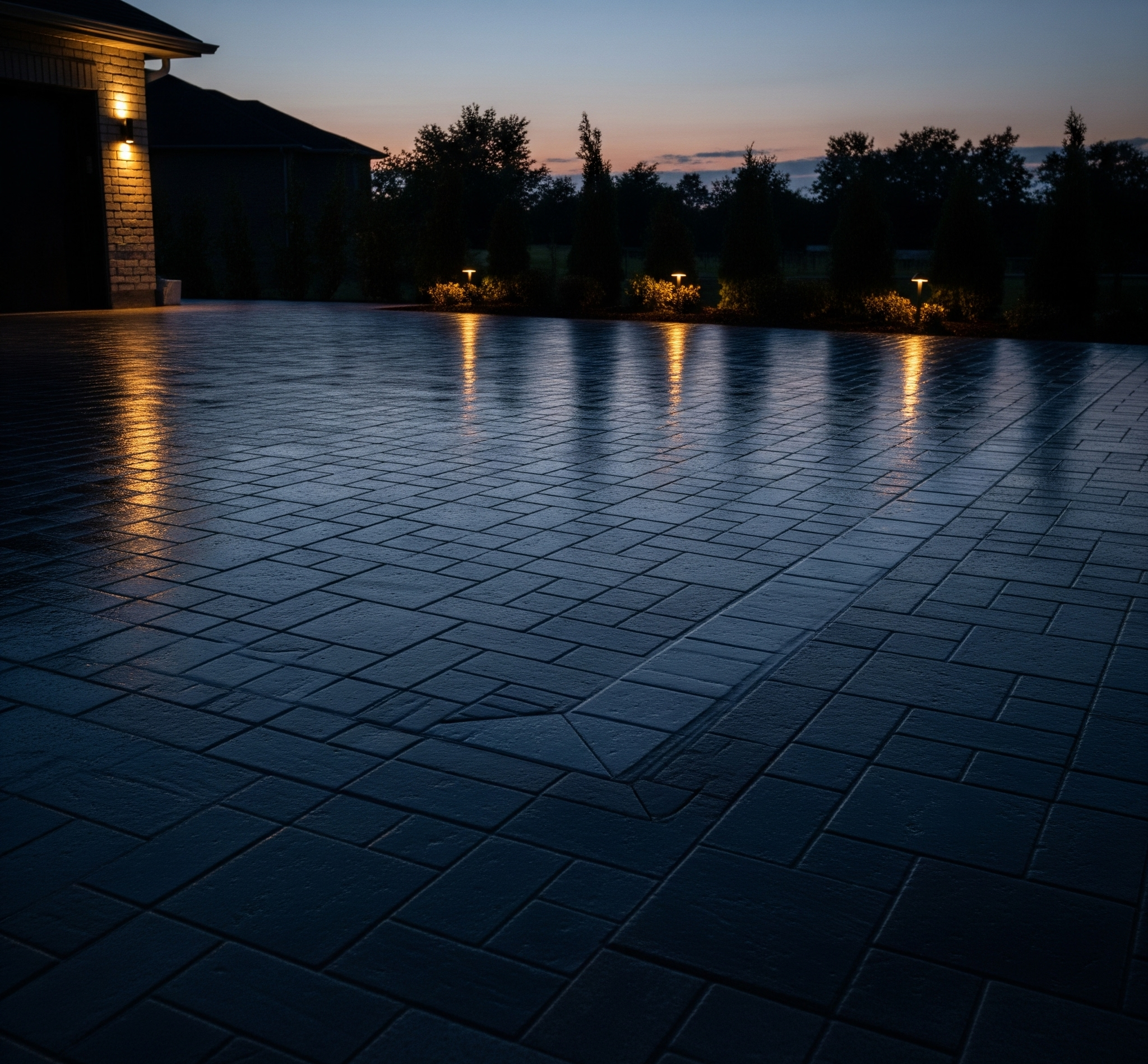
The End of the Grey Era: What Coloured Concrete Actually Is
Before we discuss pros and cons, let's clarify what "coloured concrete" means in a professional context, because there are several methods, and they produce drastically different results.
Integral Colour (The Gold Standard)
Integral colour is the method we specify for every coloured concrete project at Cinintiriks, and it is the only method that produces a genuinely permanent, through-body colour. Iron oxide pigments—the same mineral compounds that give natural stone, brick, and clay their colour—are added directly to the concrete mix at the batch plant, blended into the wet concrete along with the cement, water, and aggregates before the truck even leaves the facility.
The result is concrete in which the colour is not on the surface. It is the surface. And the interior. And the edges. If you were to cut the slab in half, the colour would be uniform throughout the entire cross-section. This means that surface wear, minor chipping, or even shallow scaling does not expose a different-coloured substrate beneath. The surface that is revealed is the same colour as the surface that was lost. This is the fundamental advantage of integral colour over every other colouration method.
Surface-Applied Colour Hardener
Colour hardener is a dry pigmented powder broadcast (hand-tossed) onto the surface of freshly placed concrete and then floated into the top 1/8 to 1/4 inch of the slab. It produces richer, more vibrant colours than integral colour alone and simultaneously densifies and hardens the surface layer, improving abrasion resistance. In the stamped concrete world, colour hardener is the primary colouration method and is often combined with a darker release agent to create the two-tone effect that gives stamped surfaces their depth and dimension.
The trade-off is that the colour is concentrated at the surface rather than distributed through the full slab depth. If the surface wears through the hardener layer— uncommon during normal use but possible in heavy traffic zones or under snowplow scraping—the lighter base concrete beneath is exposed. For driveways specifically, where the plow blade is a recurring reality, integral colour is the safer long-term investment.
Topical Stains and Dyes
Concrete stains (acid-based reactive stains or water-based penetrating stains) and dyes are applied to the surface of cured, existing concrete. They produce beautiful, often variegated colour effects, and they are the go-to option when colour needs to be added to an existing slab without removal and replacement. However, stains and dyes are the most maintenance-intensive option. They penetrate only the top fraction of a millimetre, they are susceptible to UV degradation, they wear unevenly under traffic, and they require sealer protection to maintain colour depth. For a new driveway installation, we do not recommend stains or dyes as the primary colouration method; integral colour provides superior durability, consistency, and longevity.
The Pros: The Aesthetic Edge
1. Curb Appeal and Property Value
The visual impact of a coloured concrete driveway is immediate and substantial. A warm sandstone-toned driveway beneath a red-brick Colonial home doesn't just "look nice" —it creates a cohesive architectural composition where the horizontal plane of the driveway relates harmoniously to the vertical planes of the façade. A charcoal or slate-grey driveway against a contemporary white-rendered home projects a sleek, gallery-like precision. A deep walnut or terra cotta tone beneath a stone-clad estate evokes the timeless warmth of a European villa.
This is not trivial. The driveway is the single largest visible surface on most residential properties. It occupies more visual real estate than the front yard, the walkway, and often the house façade itself. When that surface is plain grey, it reads as infrastructure—something necessary and unremarkable. When it is intentionally coloured to complement the home, it reads as design. It tells every visitor that the homeowner has considered the entire property as a unified aesthetic statement.
From a property value perspective, real estate agents in the GTA consistently report that homes with professionally finished, coloured or stamped driveways photograph better, generate more listing interest, and convey a higher perceived standard of overall property maintenance. The driveway is the first thing a visitor or buyer sees. First impressions in real estate are not metaphorical; they are literal appraisals that influence everything that follows.
2. Integral Colour Is Permanent
Unlike paint, unlike stain, unlike any surface-applied coating, integral colour cannot peel, chip, flake, delaminate, or wear off the surface. The iron oxide pigments used in integral colour are chemically inert, UV-stable mineral compounds. They are the same oxides responsible for the red of natural sandstone, the brown of clay brick, and the ochre of limestone—materials that have maintained their colour for centuries of sun exposure. Iron oxide does not photograde. It does not bleach. It does not react with water, salt, or de-icing chemicals. The colour you see on the day of the pour is the colour the concrete will carry for its entire service life.
This permanence is the single most compelling advantage of integral colour, and it is the reason we recommend it over every other method for driveways, where the surface endures vehicle traffic, snowplow contact, salt exposure, and decades of UV radiation.
3. Design Versatility
The range of colours available in integral concrete pigment is expansive: warm earth tones (buff, sandstone, terra cotta, sienna, walnut), cool neutrals (charcoal, slate, pewter, dove grey), and deep accent tones (black, deep brown, adobe red). Colours can be combined with stamped textures, exposed aggregate surfaces, or broom finishes. Borders and feature bands can be poured in contrasting colours to delineate the driveway from walkways, create visual interest, and direct the eye toward the front entrance.
In the custom residential work we do across Vaughan—where home styles range from classic Georgian brick to ultra-modern glass and stone—the ability to precisely match the driveway colour to the architectural palette is the difference between a driveway that exists beside the home and a driveway that belongs to it. That distinction is everything.
The Cons: The Maintenance Reality
Coloured concrete is genuinely superior to plain grey in aesthetic impact and design flexibility. But it is not without trade-offs, and any contractor who presents it as maintenance-free is either misinformed or dishonest. Let us be transparent about the realities.
1. The "Fading" Perception: Sealer Degradation and Efflorescence
This is the number one complaint we hear from homeowners who had coloured concrete installed by other contractors: "The colour is fading." In nearly every case we investigate, the colour has not faded at all. What has happened is one of two things—or both simultaneously.
Sealer degradation. A freshly sealed coloured concrete driveway looks extraordinary—the sealer deepens the colour like wetting a stone, producing a rich, saturated finish that makes the pigment pop. Over 2-3 years of UV exposure, the acrylic sealer film degrades. It whitens, clouds, and loses its transparency. The colour beneath hasn't changed, but the protective film above it has turned into a translucent veil that mutes the vibrancy. The homeowner looks at their driveway and says, "It's fading." It's not. The sealer is failing. The remedy is to strip or dissolve the degraded sealer and reapply fresh sealer, and the colour returns to its original intensity immediately. This is a maintenance task, not a material failure.
Efflorescence. Efflorescence is a white, powdery mineral deposit that forms on the surface of cured concrete. It occurs when moisture migrates through the concrete matrix, dissolves soluble calcium hydroxide compounds within the cement paste, and carries them to the surface, where the water evaporates and leaves behind a white crystalline residue. On plain grey concrete, efflorescence is barely noticeable. On dark-coloured concrete, it is devastatingly conspicuous. A charcoal driveway with a bloom of white efflorescence looks like it has been dusted with chalk. It transforms a premium surface into something that appears neglected.
Efflorescence is a cosmetic issue, not a structural one. It does not harm the concrete. It is most aggressive during the first 12-18 months after placement (while the concrete is still curing and moisture is migrating freely), and it typically diminishes as the curing process completes and the soluble compounds are exhausted. In the interim, it can be removed with dilute acid washing or commercial efflorescence cleaners. A properly applied sealer also significantly retards efflorescence by restricting moisture migration to the surface.
The "Fading" Verdict
Integral colour does not fade. Not in 5 years, not in 50 years. What fades is the sealer above it and the confidence of the homeowner who wasn't told that the sealer is a consumable component with a 2-3 year service life. The single most important thing you can do to preserve the appearance of a coloured concrete driveway is reseal it on schedule. This is the maintenance reality of coloured concrete. It is not onerous, but it is non-negotiable.
2. Colour Inconsistency Across Multiple Loads
A standard residential driveway requires 15-25 cubic metres of concrete—that is typically 2-4 ready-mix truck loads. Each load is batched independently at the plant. If the pigment dosing varies by even a small percentage between loads, or if the water content differs (because someone added a few litres of water at the site to make one load easier to spread), the finished colour will vary visibly from one section to the next.
This is called batch variation, and it is the most common quality defect on coloured concrete projects. The homeowner sees a driveway that is slightly darker on one side and lighter on the other, or that has visible "tide lines" where successive truck loads met. The colour is permanent in each zone—but the zones don't match.
The cause is almost always one of three factors: inconsistent pigment dosing at the batch plant (a quality control failure), inconsistent water addition at the job site (a crew discipline failure), or different slump/workability between loads that changes how the pigment distributes at the surface during finishing (a specification failure). All three are preventable. None are acceptable.
3. Higher Initial Cost
Integral colour adds a material cost premium of approximately $8-$15 per cubic metre of concrete, depending on the pigment type and colour intensity (darker colours require more pigment and cost more). For a typical 50-60 square metre residential driveway, the total material premium is in the range of $150-$400 for the pigment itself. When you factor in the additional labour cost for the more demanding finishing process (coloured concrete is less forgiving of finishing errors than plain grey), the all-in premium is typically 10-20% above the cost of equivalent plain grey concrete.
This premium is modest relative to the total project cost and the long-term aesthetic return. But it is a real cost, and homeowners should expect it rather than be surprised by it.
4. Repair Visibility
If a section of a coloured concrete driveway is damaged (by a utility cut, a tree root heave, or a vehicle fluid spill) and needs to be removed and replaced, matching the replacement section to the original colour is extremely difficult. The original concrete has been curing, weathering, and developing a patina for years. A freshly poured replacement section, even batched with the identical pigment formula, will look noticeably different—brighter, more saturated, and lacking the softened appearance of the aged surface. Over time, the difference diminishes as the new section weathers. But in the short term, a patch repair on a coloured driveway is more conspicuous than the same repair on a plain grey surface.
This is not a reason to avoid coloured concrete. It is a reason to ensure the driveway is built correctly the first time, with adequate reinforcement and sub-base engineering to prevent the kind of structural failures that necessitate section replacement.
"Coloured concrete doesn't ask for much. It asks for the right sealer, on the right schedule, applied by someone who understands the material. Give it that, and it gives you a lifetime of beauty."
The Colour Selection Process: What Actually Works on a Driveway
Not all colours perform equally on a driveway surface. Some look spectacular on the sample chip and mediocre on a 60-square-metre expanse. Some photograph beautifully on day one and look tired within a year. Here is what we have learned from hundreds of coloured driveway projects across the GTA:
Mid-tone earth tones perform best. Sandstone, buff, mocha, warm grey, and desert tan sit in the "sweet spot" where the colour is visible and impactful but not so dark that every imperfection, sealer scuff, and efflorescence bloom is magnified. They also complement the broadest range of home exteriors.
Dark colours are dramatic but demanding. Charcoal, dark walnut, and black create a striking visual statement, but they show every speck of efflorescence, every sealer degradation zone, every tire scuff, and every salt stain. They require more frequent maintenance to maintain their appearance. If you choose dark, you must commit to a rigorous resealing schedule.
Very light colours lack impact. Buff-white and light cream integral colours, while technically available, produce a surface that is barely distinguishable from lightly weathered plain grey concrete. The pigment cost is the same, but the visual return is minimal. If the goal is a light, clean look, a plain grey concrete with a high-quality clear sealer often achieves a better result for less investment.
Always evaluate colour wet. The colour of the sample chip in your hand is the unsealed colour. When the sealer is applied, the colour deepens dramatically—typically by 2-3 shades. A medium sandstone chip will look like a rich amber tone once sealed. A light grey chip will look like a true medium grey. Always ask your contractor to show you both sealed and unsealed samples, or pour a small test slab and seal it, before committing to a full driveway.
The Sealer: The Single Most Important Maintenance Decision
If coloured concrete has a weakness, it is not the colour itself. It is the sealer that protects it. And the sealer is not a permanent installation—it is a consumable component that degrades over time and must be renewed.
What the Sealer Does
A solvent-based acrylic sealer applied to coloured concrete serves three functions:
- Colour enhancement: The sealer wets the surface, deepening and enriching the integral colour the way water darkens a dry stone. This is the "wet look" that makes freshly sealed concrete look so vivid.
- Moisture barrier: The sealer forms a continuous film that blocks water, salt solutions, and de-icing chemicals from penetrating the pore structure, preventing the freeze-thaw damage that causes scaling and spalling.
- Efflorescence control: By blocking moisture migration to the surface, the sealer prevents the dissolved minerals from reaching the exterior where they would crystallise as efflorescence.
When the sealer fails (and it will, after 2-3 years of UV exposure and traffic wear), all three of these functions are lost simultaneously. The colour appears muted. Water begins penetrating the surface. Efflorescence returns. This is why the resealing cycle is so critical for coloured concrete: you are not just refreshing the appearance; you are restoring the protective envelope that keeps the concrete structurally sound and chemically defended.
The Cinintiriks Approach: Batch-Controlled, Sealed-for-Life Colour
At Cinintiriks, every coloured concrete installation follows our Cinintiriks Standard for Integral Colour—a protocol that eliminates the common failure modes of coloured concrete from the very first phone call to the batch plant.
1. Batch Plant Coordination: We do not leave the pigment dosing to the batch plant operator's discretion. We specify the exact pigment product, the exact dosage rate (in kilograms per cubic metre of concrete), and the exact mixing time on the purchase order. We require a batch ticket on every truck confirming that the pigment was added at the specified quantity. If a truck arrives without a confirming batch ticket, or if the batch ticket shows a dosage deviation, that truck does not pour.
2. On-Site Water Discipline: We never add water to coloured concrete at the job site. Never. Additional water dilutes the pigment concentration, lightens the colour, and creates inconsistency between loads. If the mix is too stiff to place, we contact the plant and have the next load dispatched with a mid-range water reducer admixture instead. The water-to-cement ratio is sacrosanct in coloured concrete; changing it at the site is the most common and most preventable cause of colour inconsistency.
3. Consistent Finishing Protocol: The finishing process affects how pigment distributes at the surface. Over-trowelling concentrates pigment and darkens the surface; under-trowelling leaves it lighter and more mottled. Our finishing crews follow a standardised pass count (bull float, fresno, final trowel) that produces a uniform surface density and colour saturation across the entire driveway, regardless of how many truck loads are placed.
4. Two-Coat UV-Resistant High-Solids Sealer: We apply two coats of a 25-30% solids, UV-stabilised solvent-based acrylic sealer (not a 15-18% solids economy sealer that will cloud within one year). The first coat is applied at the manufacturer's full coverage rate to penetrate and seal the pore structure. The second coat is applied at half-coverage to build the surface film that provides colour depth, wet-look enhancement, and chemical resistance. This two-coat system provides a denser, more durable protective film that maintains its clarity and colour enhancement for a full 3+ year cycle before resealing is required.
5. Post-Cure Efflorescence Management: We schedule a follow-up inspection at 60-90 days after placement to assess any early efflorescence that may have developed during the initial curing period. If efflorescence is present, we treat it with a dilute acid wash, neutralise, rinse, and reapply a maintenance coat of sealer to restore the colour to its full sealed depth. This proactive step is included in every coloured concrete project. It is not an extra. It is part of the Cinintiriks Standard.
Coloured Concrete vs. The Alternatives
How does a coloured concrete driveway compare to other premium driveway materials in the GTA market?
vs. Interlocking Pavers: Pavers offer colour through the manufacturing process (pigmented throughout, similar to integral colour) and provide the added benefit of individual unit replaceability if one section is damaged. However, pavers require polymeric sand maintenance, are susceptible to settling and shifting, allow weed and ant intrusion at the joints, and cost 30-50% more per square foot than coloured concrete for equivalent aesthetics. Coloured concrete delivers a seamless, monolithic surface with no joints to maintain.
vs. Asphalt: Asphalt is less expensive than coloured concrete but offers zero aesthetic flexibility (it is black, and only black), softens in extreme heat, and requires regular crack sealing and resurfacing. Coloured concrete is permanent, rigid, and configurable in dozens of tones. For a homeowner investing in curb appeal, there is no comparison.
vs. Natural Stone: A natural stone driveway (flagstone, granite pavers) is the ultimate luxury option and carries a corresponding price tag—often 3-5x the cost of coloured concrete. Coloured and stamped concrete can closely replicate the appearance of natural stone at a fraction of the cost, with the added structural advantages of a monolithic slab (no joints, no shifting, no settling).
Don't gamble on a patchy, dull driveway. Contact Cinintiriks for expertly batched, permanently coloured luxury concrete installations.
FAQ: Coloured Concrete Driveways
Can you colour an existing plain grey concrete driveway?
Yes, but with important caveats. An existing grey driveway can be coloured using either an acid-based reactive stain (which chemically reacts with the minerals in the cement paste to produce earthy, variegated colour tones) or a water-based penetrating concrete stain (which deposits pigment into the top pores of the surface). Both methods produce attractive results, but neither penetrates more than a fraction of a millimetre. The colour is a surface treatment, not a through-body pigmentation. It will show wear in high-traffic zones (under tires, at the apron) faster than integral colour, and it requires more frequent sealer maintenance to preserve its appearance. It is also not possible to achieve vibrant, saturated colours on an existing grey surface; the underlying grey concrete acts as a base tone that mutes the applied colour. The best results come from earth tones (amber, walnut, dark brown) that work with the grey substrate rather than trying to overpower it. If you want truly vivid, uniform colour, the only reliable method is to remove the existing driveway and pour a new one with integral colour.
Does coloured concrete cost significantly more than standard grey concrete?
The material cost premium for integral colour is approximately $8-$15 per cubic metre of concrete for standard colours, and up to $20/m³ for deep/dark colours that require higher pigment dosages. For a typical residential driveway of 50-60 square metres, this translates to a raw material premium of roughly $150-$400. When you include the additional finishing time (coloured concrete requires more careful, consistent finishing), the mandatory sealer application, and any colour testing (sample pours), the all-in project premium is typically 10-20% above the cost of equivalent plain grey concrete. For a driveway project in the $8,000-$15,000 range, the colour upgrade represents an additional $1,000-$2,500. In our experience, this is one of the highest-return investments in a driveway project—a modest cost premium that produces a disproportionately large impact on curb appeal and property perception.
How often do I need to reseal a coloured concrete driveway to keep it looking new?
The standard resealing interval for a coloured concrete driveway in the GTA is every 2-3 years, depending on UV exposure, traffic volume, and de-icing chemical application. South-facing driveways with maximum sun exposure and heavy salt application degrade faster and are typically on a 2-year cycle. Shaded or north-facing driveways with moderate traffic may extend to 3 years comfortably. The resealing process itself is straightforward: the surface is cleaned, any efflorescence is removed, and a fresh coat of solvent-based acrylic sealer is applied. On a standard two-car driveway, the process takes 3-4 hours and the surface is walkable within 4 hours, drivable within 24 hours. The cost for professional resealing is typically $2-$4 per square foot—a modest investment compared to the cost of the original installation, and one that immediately restores the colour depth, wet-look enhancement, and protective barrier that keep the driveway looking like the day it was poured.
The Final Word
Coloured concrete is not a gimmick. It is not a trend. It is a mature, proven material technology that, when properly batched, placed, finished, and maintained, delivers a driveway surface of striking beauty and exceptional longevity. The colour is permanent. The sealer is not. And the homeowner who understands that distinction—who commits to the modest, predictable maintenance cycle that keeps the sealer intact—will enjoy a driveway that makes their home stand out on the street, that ages with grace and richness, and that consistently outperforms every alternative material in the balance of aesthetics, durability, and value.
Grey is functional. Colour is intentional. The difference between the two is the difference between a driveway that exists and a driveway that belongs.