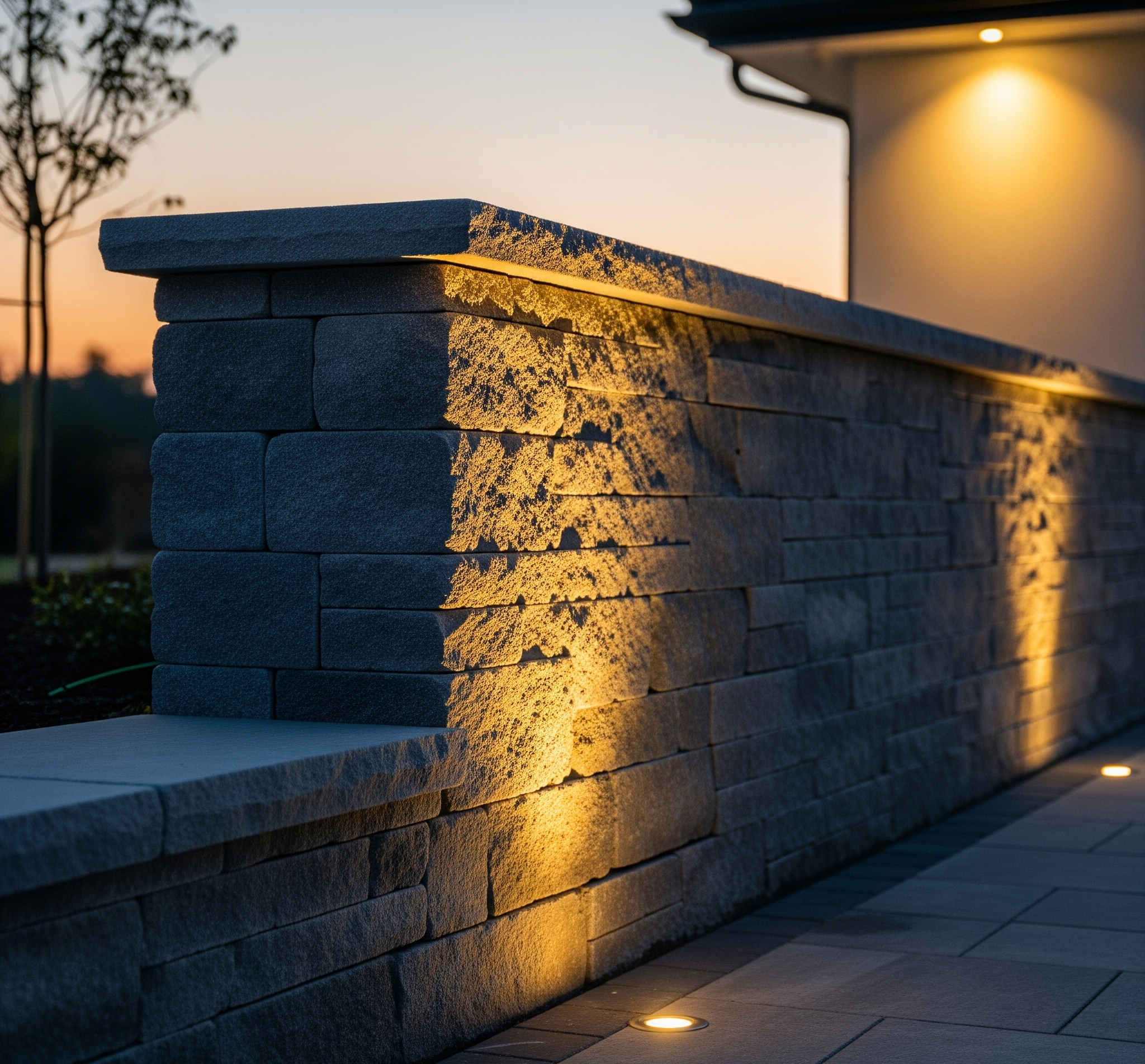
These standards exist for a specific reason. A retaining wall that fails does not merely look poor. It releases a mass of earth that can bury people, crush fences, undermine foundations, redirect stormwater onto neighbouring properties, and expose the property owner to civil liability, municipal fines, and forced demolition orders simultaneously. The Ontario Building Code's retaining wall standards are the province's mechanism for ensuring that these structures are engineered to prevent failure, inspected during construction to confirm compliance, and documented as permanent records that follow the property through every future sale, insurance claim, and renovation.
This guide breaks down every standard that applies to structural retaining walls in Ontario: the height threshold that triggers the code, the engineering requirements, the structural specifications for footings, reinforcement, concrete, drainage, and guardrails, and the inspection process that verifies it all. Whether you are a homeowner planning a backyard grade change or a commercial property manager engineering a multi-metre grade separation, these are the rules.
The Code of Stability: The Regulatory Framework
Retaining walls in Ontario are governed by three overlapping layers of regulation:
1. The Ontario Building Code (OBC), O. Reg. 332/12. The provincial code establishes the structural design standards, material specifications, and performance requirements for all structures in Ontario, including retaining walls. Parts 4 (Structural Design) and 9 (Housing and Small Buildings) contain the provisions that apply directly to retaining wall design, and the referenced CSA standards (A23.3 for concrete design, A23.1/A23.2 for concrete materials and test methods, S16 for steel) provide the detailed engineering specifications.
2. Municipal bylaws. Each municipality in the GTA (Toronto, Vaughan, Markham, Richmond Hill, Mississauga, Oakville, and others) enacts local building bylaws that supplement the OBC with municipality-specific requirements for permit applications, inspection procedures, zoning setbacks, and fees. The OBC sets the minimum standard. Municipal bylaws may impose additional requirements but cannot allow less than the OBC requires.
3. Professional Engineers Act, R.S.O. 1990. The Ontario legislation that governs the practice of professional engineering, including the requirement that structural designs for designated structures must be prepared by, or under the supervision of, a Professional Engineer (P.Eng.) licensed in Ontario and must bear the engineer's seal and signature.
The Height Threshold: When the Code Applies
The OBC and virtually all GTA municipal building bylaws establish a clear threshold for when a retaining wall transitions from an unregulated landscape element to a regulated structure:
A building permit and engineered design are required for any retaining wall with an exposed height exceeding 1.0 metre (3 feet 3 inches).
How Height Is Measured
The exposed height is measured as the vertical distance from the finished grade at the toe (base) of the wall to the finished grade at the top of the wall. It is not measured from the bottom of the footing (which is buried) or from the bottom of the excavation (which is backfilled). The measurement reflects the height of the earth that the wall is visibly retaining.
This measurement methodology has a critical implication: a wall that retains 1.2 metres of soil on the uphill side but has 0.3 metres of soil banked against the downhill face has an exposed height of only 0.9 metres and may not require a permit under the height threshold alone. Conversely, a wall with a shallow footing on the low side that exposes 1.1 metres of wall face requires a permit regardless of how much soil is present on the high side.
Beyond Height: Other Permit Triggers
The 1.0-metre threshold is the most commonly cited trigger, but it is not the only one. The OBC and municipal bylaws also require a building permit for retaining walls that:
- Support a surcharge load: Any wall that supports a driveway, patio, terrace, structure, or usable surface above it, regardless of height
- Are attached to a building: Any wall that connects to or supports a building foundation, basement, or garage
- Are located within a minimum setback: Walls within 1.2-1.5 metres of a property line (municipality-dependent)
- Alter drainage patterns: Walls that redirect surface water flow onto adjacent properties
- Are located in regulated areas: Conservation authority jurisdictions (TRCA, CVC, LSRCA), flood plains, ravines, or areas subject to slope stability concerns
In practice, any retaining wall project that involves a grade change significant enough to warrant a wall (rather than a gentle slope) will trigger at least one of these conditions. The prudent assumption is that a permit is required.
"The 1-metre threshold is the line where the province says: this is no longer landscaping. This is engineering. Treat it accordingly."
Standard 1: Structural Engineering (P.Eng. Design)
The most fundamental standard for a retaining wall exceeding the permit threshold is that the wall must be designed by a Professional Engineer (P.Eng.) licensed in Ontario. This is not a recommendation, a best practice, or a quality upgrade. It is a legal requirement under both the OBC and the Professional Engineers Act.
What the Engineer Designs
The structural engineer's design addresses every force acting on the wall and specifies the structural response to each:
Active earth pressure. The lateral force exerted by the retained soil. The engineer calculates this based on the soil type (determined through geotechnical investigation), the wall height, the slope of the retained soil surface, and any groundwater conditions. Coulomb's or Rankine's earth pressure theories are applied depending on the wall-soil interface conditions.
Surcharge loads. Any additional vertical load applied to the surface behind the wall (vehicles, structures, stored materials, snow, future construction). The engineer calculates the additional lateral pressure generated by each surcharge and adds it to the active earth pressure.
Hydrostatic pressure. The lateral pressure generated by water accumulated behind the wall. The engineer specifies the drainage system to prevent hydrostatic buildup and designs the wall to resist residual water pressure as a safety factor.
Seismic forces. Ontario is classified as a moderate seismic zone. The OBC (referencing the National Building Code of Canada) requires retaining walls to be designed for the site-specific seismic acceleration, which adds a dynamic lateral force component to the earth pressure calculation.
The engineer's design output is a sealed drawing set that includes: site plan with wall location, elevation drawings, cross-section details showing footing dimensions, wall stem thickness, reinforcement schedule, concrete specification, drainage details, and structural notes. These drawings become the legal specification that the contractor must build to and the inspector will verify against.
Standard 2: Footings Below Frost Depth
The OBC requires that the footing of any structural retaining wall extend below the depth of frost penetration for the geographic location, or be designed as a frost-protected shallow foundation (FPSF) with insulation to prevent frost heave.
Frost Depth in the GTA
The frost penetration depth for the Greater Toronto Area is approximately 1.2 metres (4 feet) below finished grade. This is the depth to which the ground freezes during a typical Ontario winter. Any footing placed above this depth is subject to frost heave—the upward displacement caused by ice lens formation in the soil beneath the footing.
Frost heave does not lift a wall uniformly. It lifts it differentially— some sections heave more than others, depending on soil moisture, exposure, and microclimate variations along the wall's length. A wall that heaves differentially develops cracks, joint separations, and rotational tilting that are permanent. When the frost releases in spring, the wall settles back, but not to its original position—it settles into a slightly different configuration, creating cumulative displacement over successive freeze-thaw seasons. Within 3-5 winters, a wall with an inadequate footing depth can shift 25-50mm (1-2 inches) from its original alignment, enough to compromise its structural capacity and its visual appearance.
Footing Specification
The OBC-compliant footing for a structural retaining wall in the GTA must meet the following minimum standards:
- Depth: Bottom of footing at minimum 1.2 metres (4 feet) below finished grade at the toe of the wall
- Width: Minimum 50-100% of the total wall height (including buried portion), as calculated by the structural engineer. A 1.5-metre exposed wall with a 1.2-metre footing depth may require a footing width of 1.0-1.5 metres or more
- Thickness: Minimum 200-300mm (8-12 inches) of reinforced concrete, as specified by the engineer
- Bearing surface: Footing must bear on undisturbed native soil or on engineered compacted fill. Bearing on uncompacted fill, organic soil, or disturbed ground is prohibited without geotechnical remediation
- Toe and heel: The footing typically extends both forward (toe) and backward (heel) from the wall stem. The heel extension engages the weight of the retained soil above it to resist overturning, while the toe extension distributes the bearing pressure across a wider area
In Richmond Hill, where many of the newer residential developments along the Yonge Street corridor and the Oak Ridges Moraine foothills sit on variable glacial till deposits with high clay content, the geotechnical conditions frequently dictate wider footings than the structural minimum because the native soil bearing capacity is lower than the standard assumption. A structural engineer working from a desktop assumption of 150 kPa bearing capacity may design a 1.0-metre footing, while the geotechnical investigation reveals the actual bearing capacity is 75-100 kPa, requiring a 1.3-1.5-metre footing to distribute the load without exceeding the soil's capacity. This is why the geotechnical assessment is not optional—it is the data that makes the structural design accurate rather than assumed.
Standard 3: Reinforcement and Concrete
The OBC references CSA A23.3 (Design of Concrete Structures) for the design of reinforced concrete retaining walls and CSA A23.1/A23.2 (Concrete Materials and Methods of Concrete Construction / Test Methods and Standard Practices for Concrete) for the material specifications.
Reinforcement (Rebar)
The reinforcement in a concrete retaining wall serves a single critical function: it resists the tensile forces that the concrete itself cannot. Concrete is strong in compression (it can resist being squeezed) but weak in tension (it cracks and fails when pulled apart). The lateral earth pressure behind a retaining wall creates bending in the wall stem, which produces tension on the soil-facing side of the wall. Without reinforcement, the concrete cracks at the tension face and the wall fails.
Typical specifications for residential retaining walls (1.0-2.0m exposed height):
- Vertical reinforcement (stem): 15M rebar at 200-400mm centres (depending on wall height and surcharge), positioned on the tension face (soil side) of the wall stem, with a minimum cover of 50mm from the concrete surface
- Horizontal reinforcement (stem): 10M rebar at 400-600mm centres for crack control and temperature/shrinkage resistance
- Footing reinforcement: 15M rebar top and bottom, at 200-300mm centres, running in both directions. The bottom steel resists bending from the bearing pressure, and the top steel resists bending from the wall stem overturning moment
- Development and lap lengths: All rebar must be developed (anchored) into the concrete per CSA A23.3 requirements. Vertical stem rebar must extend into the footing with proper hooks or development length. Lap splices must be a minimum of 40-50 bar diameters (600-750mm for 15M rebar)
For walls exceeding 2.0 metres or carrying significant surcharge loads, the reinforcement increases substantially: 20M or 25M rebar at closer spacing, with shear reinforcement (stirrups or ties) at the base where shear forces are highest.
Concrete Specification
The OBC and CSA A23.1 classify retaining walls under Exposure Class C-1 (structurally reinforced concrete exposed to chlorides and freezing/thawing), which dictates the following minimum specifications:
- Compressive strength: Minimum 32 MPa at 28 days
- Air entrainment: 5-8% entrained air content (achieved through air-entraining admixture) for freeze-thaw resistance. The microscopic air bubbles provide expansion space for freezing water within the concrete pore structure, preventing the internal hydraulic pressure that causes scaling and pop-outs
- Water-to-cement ratio: Maximum 0.45 (lower is better for durability and impermeability)
- Cement content: Minimum 335 kg/m³
- Cover: Minimum 50mm (2 inches) of concrete between the outermost rebar and the concrete surface exposed to soil and weather. This cover protects the rebar from moisture, chlorides, and carbonation that cause corrosion
These are not arbitrary numbers. Each specification addresses a specific deterioration mechanism that acts on retaining walls in Ontario's climate: the air entrainment resists freeze-thaw damage, the low w/c ratio reduces permeability (slowing moisture and chloride ingress), the high cement content provides alkalinity that protects the rebar from corrosion, and the cover depth provides a physical barrier between the environment and the steel.
Standard 4: Segmental Retaining Walls (Landscape Block Systems)
Not all retaining walls are poured concrete. Segmental retaining wall (SRW) systems—interlocking concrete block products manufactured by companies like Allan Block, Versa-Lok, Risi Stone, and others—are widely used for retaining walls up to 3-4 metres in height. The OBC recognises SRW systems as a valid structural method, but with specific requirements that differ from poured concrete walls.
Geogrid Reinforcement
SRW blocks resist earth pressure through a combination of mass (the weight of the blocks themselves) and soil reinforcement using geogrid. Geogrid is a high-strength polymer mesh that is laid horizontally into the backfill behind the blocks at specified vertical intervals, extending back into the retained soil mass. Each layer of geogrid engages a volume of soil through friction, effectively turning the soil mass into part of the wall's structure—a reinforced earth system that resists sliding and overturning through the combined weight and friction of the block-geogrid-soil composite.
OBC-compliant geogrid specifications:
- Material: High-density polyethylene (HDPE) or polyester geogrid, manufactured to ASTM D6637 / D6916 standards
- Tensile strength: Minimum ultimate tensile strength of 30-200 kN/m, depending on the wall height and surcharge (specified by the engineer)
- Layer spacing: Typically every 2-3 block courses (400-600mm vertical spacing), as specified by the engineer
- Embedment length: Minimum 60-70% of the total wall height or 1.0 metre, whichever is greater. A 2.0-metre wall requires geogrid extending a minimum of 1.2-1.4 metres behind the block face
- Backfill over geogrid: Compacted granular fill (Granular A or equivalent) placed in maximum 200mm lifts and compacted to 95%+ Standard Proctor Density
A segmental wall built without geogrid reinforcement relies solely on the mass of the blocks for stability. For walls under 600-800mm, block mass alone may be sufficient. For walls above 1.0 metre, block mass cannot resist the lateral forces without supplemental reinforcement, and a wall built without geogrid above this height will progressively tilt, separate, and collapse as the earth pressure exceeds the block friction.
Standard 5: Drainage
The OBC does not prescribe a specific drainage system detail for retaining walls (this falls within the engineer's design scope), but it does require that the wall design account for hydrostatic pressure and that the design either prevents hydrostatic buildup (through drainage) or resists it (through additional structural capacity). In practice, every structural engineer designs for drainage rather than resistance, because designing a wall to resist full hydrostatic pressure roughly doubles the required structural capacity—and therefore doubles the cost.
The Standard Drainage Assembly
The drainage system behind a code-compliant retaining wall consists of three components working together:
1. Clear stone drainage zone. A minimum 300mm (12-inch) wide zone of washed 19mm (3/4-inch) clear stone directly behind the wall face, extending from the footing level to within 300mm of the top of the wall. The clear stone provides a high-permeability pathway for water to move vertically downward to the collection pipe without building lateral pressure against the wall.
2. Non-woven geotextile filter fabric. A non-woven, needle-punched geotextile fabric encapsulating the clear stone zone, separating it from the native soil behind and the topsoil above. The geotextile allows water to pass through while preventing fine soil particles from migrating into the clear stone and clogging the void spaces. Without the geotextile, the drainage zone has a finite functional lifespan—typically 5-15 years before soil migration reduces its permeability to the point where it no longer functions as a drain.
3. Perforated collection pipe (weeping tile). A 100mm (4-inch) perforated pipe installed at the base of the wall, within the clear stone zone, along the full length of the wall. The pipe collects the water that descends through the clear stone and conveys it to a daylight outlet (a point where the pipe discharges to open air at grade level) or to a connection to the municipal storm sewer. The pipe must be installed with a minimum 1% gradient toward the outlet and with perforations facing downward (to collect rising water rather than trapping falling sediment).
This three-component system is the minimum standard. Depending on the wall height, soil conditions, and water table level, the engineer may specify additional drainage measures: a secondary drainage pipe at a mid-height level for tall walls, a drainage mat (dimpled HDPE sheet) against the wall face for poured concrete walls, or weep holes through the wall face for gravity walls where an outlet pipe cannot be routed.
Standard 6: Guards and Railings
The OBC requires a guard (railing, fence, or barrier) at the top of any retaining wall where the difference in elevation between the top of the wall and the grade at the base of the wall exceeds 600mm (2 feet) and where people have access to the top of the wall or the area behind it.
Guard Specification
- Height: Minimum 1,070mm (42 inches) above the finished surface at the top of the wall
- Load resistance: The guard must resist a minimum horizontal load of 0.75 kN/m (approximately 75 kg per linear metre) applied at the top of the guard, plus a minimum concentrated load of 1.0 kN applied at any point
- Opening size: If the guard includes openings (such as balusters or pickets), no opening shall be large enough to allow a 100mm (4-inch) sphere to pass through (to prevent a child's head from passing through)
- Non-climbable: The guard design should not include horizontal elements that create a climbing ladder for children (horizontal rails spaced 100-300mm apart are specifically discouraged)
This requirement catches many homeowners by surprise. A retaining wall that is only 750mm (2.5 feet) high still requires a guard—and that guard must be 1,070mm tall, making the total height of the wall-plus-guard approximately 1.82 metres (6 feet). The guard requirement is a safety standard, not a structural one: it exists to prevent falls, not to stabilise the wall.
The guard can be a separate railing system (metal, glass, cable) attached to the wall cap, or it can be integrated into the landscape design as a fence or hedge, provided the fence or hedge meets the height and load resistance requirements. In residential applications, many homeowners opt to extend the wall with a seat-height cap (450mm above grade) and install a shorter railing above the cap to reach the required 1,070mm total height from the walking surface, creating a more aesthetically integrated solution than a standalone railing.
The Cinintiriks Approach: OBC-Compliant and Beyond
At Cinintiriks, OBC compliance is our baseline, not our target. Our Cinintiriks Standard for Structural Retaining Walls meets every OBC requirement and exceeds several of them, because the code defines the minimum acceptable standard—and minimum is not where we build.
1. Geotechnical-Informed Design: Every project begins with a site-specific geotechnical assessment. We do not design from assumed soil conditions. The structural engineer works from measured bearing capacity, measured groundwater data, and measured soil classification to produce a design that is accurate for this property, not a generic property. The geotechnical data frequently reveals conditions that a code-minimum design would not account for: perched water tables, fill layers from previous construction, expansive clay lenses, or abandoned utilities that require footing adjustments.
2. Conservative Concrete Specification: While the OBC minimum for Class C-1 exposure is 32 MPa, we routinely specify 35 MPa concrete with a maximum w/c ratio of 0.40 (versus the code-permitted 0.45). The incremental cost of the higher- performance concrete is approximately $5-$8 per cubic metre—trivial on a residential wall. The durability benefit is measurable: lower permeability, higher resistance to chloride penetration, and a longer service life before carbonation reaches the reinforcement.
3. Oversized Drainage Systems: Our drainage zones are a minimum of 450mm (18 inches) wide—50% wider than the code-minimum 300mm. The additional clear stone volume provides greater water handling capacity and a larger buffer against long-term permeability reduction from any fine particle migration that the geotextile does not fully prevent.
4. Full Geotextile Encapsulation: We wrap the entire clear stone zone in non-woven geotextile—bottom, back, top, and front—with 300mm seam overlaps. Many contractors install geotextile only on the back face of the drainage zone. Our full encapsulation prevents soil migration from any direction, including from the topsoil and planting beds that are placed above the drainage zone after construction.
5. Footing Depth Margin: While the OBC frost depth for the GTA is 1.2 metres, we excavate footings to a minimum of 1.5 metres (5 feet). The additional 300mm of depth provides a safety margin against unusually deep frost penetration during extreme winters and places the footing into soil that has never experienced seasonal moisture fluctuation—a more stable, consistent bearing surface.
6. 100% First-Inspection Pass Rate: We build to the approved drawings exactly. Every rebar position, every concrete cover measurement, every drainage pipe grade, and every footing dimension matches the P.Eng.-stamped design. Our mandatory inspections pass on the first review because there are no deviations to explain, justify, or correct.
What Non-Compliance Looks Like
The consequences of building a retaining wall that does not meet OBC standards are severe and cascading:
Municipal enforcement. Building without a permit, or building contrary to the approved permit, triggers a stop-work order, an order to comply (obtain a retroactive permit or demolish the structure), and potential fines of $500-$100,000 under the Building Code Act. The non-compliant structure is flagged on the property's municipal record permanently.
Insurance voidance. Homeowner's insurance policies universally exclude damage caused by unpermitted construction. If a non- compliant retaining wall collapses and damages a neighbouring property, the homeowner's insurance will deny the claim, leaving the homeowner personally liable for the full cost of damage, remediation, and any injuries.
Real estate complications. An unpermitted retaining wall is a material deficiency that must be disclosed on a property sale. Buyers' lawyers, inspectors, and mortgage lenders routinely flag unpermitted structures, leading to sale price renegotiations, conditions requiring retroactive permitting (which may require demolition if the wall cannot be brought to code), or collapsed transactions.
Personal liability. Under Ontario law, the property owner is liable for damage caused by structures on their property, whether or not those structures were permitted. A collapsed wall that injures a person, damages a neighbouring property, or causes environmental harm (erosion, sedimentation into a watercourse) exposes the owner to civil claims that insurance will not cover if the structure was non-compliant.
Don't gamble with building codes or structural liability. Contact Cinintiriks for fully engineered, OBC-compliant retaining wall installations.
FAQ: Ontario Retaining Wall Standards
What is the maximum height for a retaining wall without an engineer in Ontario?
1.0 metre (3 feet 3 inches) of exposed height. Below this threshold, the OBC does not require a building permit or engineered design, provided the wall does not support a surcharge load, is not attached to a building, and does not fall within a conservation authority regulated area or municipal setback zone. However, "not requiring an engineer" does not mean "no standards apply." A wall under 1.0 metre must still be built competently: on a stable base, with appropriate drainage, and with materials suitable for the load and the climate. A 900mm wall that collapses because it was built on organic soil with no drainage is still the property owner's liability, even though no permit was required. The 1.0-metre threshold is the point where the province mandates professional design and permitting. It is not a guarantee that walls below the threshold are risk-free. For walls in the 600mm-1,000mm range, we still recommend professional design to ensure adequate drainage and structural stability, particularly on clay soils prevalent across the GTA where seasonal heave is a significant concern.
Does the Ontario Building Code require a railing or guard fence on top of a retaining wall?
Yes, when the drop from the top of the wall to the grade at the base exceeds 600mm (24 inches). The OBC Section 9.8.8 requires a guard with a minimum height of 1,070mm (42 inches) above the walking surface or finished grade at the top of the wall. The guard must resist a horizontal load of 0.75 kN/m at the top rail and must not have openings large enough to pass a 100mm sphere. This requirement applies to all accessible elevation changes, including retaining walls adjacent to walkways, patios, driveways, and yard areas. Common compliance solutions include: metal or aluminum railings bolted to the wall cap stone, glass panel systems with stainless steel standoffs, cable rail systems with vertical posts at maximum 1,200mm centres, or solid fencing that meets the height and loading requirements. A dense hedge may satisfy the intent of the guard requirement in some jurisdictions, but this interpretation varies by municipality and inspector, and relying on a hedge creates a gap in protection during winter dormancy. We recommend a physical guard that complies unambiguously.
Who is liable if a non-compliant retaining wall collapses onto a neighbouring property?
The property owner is personally liable. Under Ontario common law (the tort of nuisance and negligence), the owner of the property on which the wall is constructed is liable for damage caused to adjacent properties by the failure of that wall. If the wall was built without a building permit, without engineered design, or contrary to the OBC, the property owner cannot argue that the contractor was responsible—the contractor may share liability, but the property owner's liability is direct and primary. The neighbour can sue the property owner for the cost of all damage (property repair, landscaping replacement, temporary accommodation if the home is rendered uninhabitable, personal injury), and the property owner's homeowner's insurance will almost certainly deny coverage because the damage arose from an unpermitted, non-compliant structure —a standard policy exclusion. Additionally, the municipality will issue orders requiring the property owner to remediate the collapsed wall, restore the affected grade, and manage any environmental impacts (erosion, sediment discharge). The total financial exposure from a single non-compliant wall collapse can easily reach $100,000-$500,000 when combining property damage claims, remediation costs, municipal fines, and legal fees. The cost of engineering, permitting, and building the wall correctly is a fraction of this exposure.
The Final Word
The standards for structural retaining walls in Ontario are precise, comprehensive, and non-negotiable. They specify how deep the footing must go, what the concrete must be made of, how much steel must be inside it, how the water behind it must be managed, and when a guard must be placed on top of it. They require a licensed engineer to design it, a municipal permit to authorise it, and a building inspector to verify it at every concealed stage before it is buried and inaccessible.
These standards are not obstacles to your project. They are the specifications that make your project safe, durable, insurable, and legally defensible for the life of the property. Every dollar invested in compliance —in the engineering, the permit, the inspections, and the materials that meet the code—is a dollar that prevents the catastrophic cost of non-compliance: the structural failure, the municipal order, the voided insurance claim, and the lawsuit.
Build it to the standard. Build it once.