It is also, at this precise moment, dying.
Every roll of sod that left the farm this morning was sliced off its root system by a mechanical harvester. The roots that held it in the ground—the roots that pulled water and nutrients from the soil, the roots that kept the grass alive— are still at the farm. What is lying on your property is a living organism with no root connection to the soil beneath it. It is sitting on top of the topsoil, not in it. It cannot extract water from the ground. It cannot regulate its own temperature. It is surviving entirely on the moisture trapped in its cut sod layer, and in a Toronto July afternoon with 32°C air temperature and full sun exposure, that trapped moisture will evaporate in hours.
If that sod does not receive precise, engineered, frequent irrigation within the first 48 hours of installation—and continuously for the next 14 days—the edges will curl. The seams will separate. The grass will turn brown from the edges inward. And within two weeks, your $80,000 investment will be a patchwork of dead, shrunken, unsalvageable turf that must be ripped up and replaced at full cost.
This is not a theoretical risk. It is the default outcome when commercial sod is installed without a fully automated, properly engineered irrigation system in place and running on installation day.
The Burnout Liability: Why Hand-Watering Cannot Save Commercial Sod
On a residential property with 200 square metres of new sod, a homeowner with a garden hose and determination can provide adequate establishment watering. It is tedious, it is inefficient, and it requires daily commitment, but the area is manageable.
On a commercial property with 2,000–10,000 square metres of new sod, hand-watering is not just inefficient. It is physically impossible. The mathematics are unforgiving:
- Establishment watering requires approximately 25 mm of water per application across the entire sodded area
- A standard commercial hose delivers approximately 30–40 litres per minute
- Applying 25 mm of water to 5,000 m² requires 125,000 litres
- At 35 litres per minute, that single watering application takes 59 hours of continuous hose operation
- During the establishment phase, the sod requires 2–3 applications per day
You would need to run a hose 24 hours a day, seven days a week, and you would still not cover the area fast enough to prevent the sections you watered first from drying out before you reach them again. The sod at the end of your watering route is dead before you finish the first pass.
A properly designed automated irrigation system applies 25 mm of water to 5,000 m² in 45–90 minutes across multiple simultaneous zones, then repeats the cycle on a programmable schedule without human intervention. It is not a convenience. It is the only delivery mechanism that can provide the frequency, uniformity, and volume of water that commercial-scale sod establishment demands.
“A commercial irrigation system is not a luxury upgrade. It is the life-support system that determines whether your sod investment survives the first two weeks.”
The Critical First 14 Days: The Establishment Phase
The science of sod establishment is straightforward, but the execution margin is razor-thin. Fresh sod must regenerate its root system by growing new roots from the cut stolons and rhizomes downward into the prepared topsoil. This process requires continuous moisture at the sod-soil interface—the contact plane where the bottom of the sod roll meets the top of the topsoil bed. If this interface dries out, root growth stops. If it stays dry for more than a few hours in hot weather, the developing root tips desiccate and die, and the establishment process must start over from zero.
Days 1–7: High-Frequency Shallow Watering
During the first week after installation, the irrigation priority is keeping the sod-soil interface continuously moist without saturating the topsoil beneath it.
- Frequency: 2–3 cycles per day during hot weather (above 25°C). In moderate conditions (18–25°C), 1–2 cycles per day may be adequate. In cool, overcast conditions, a single daily cycle may suffice
- Duration per zone: Each irrigation zone runs for 8–15 minutes per cycle, delivering approximately 6–12 mm of water per application. The goal is to wet the top 25–50 mm of soil beneath the sod. Deeper watering is wasted during this phase because the roots have not yet grown deep enough to access it
- Timing: The first cycle runs in the early morning (5:00–7:00 AM) before evaporative demand increases. The second cycle runs at midday (11:00 AM–1:00 PM) to replace moisture lost to morning evaporation. If a third cycle is required, it runs in late afternoon (3:00–5:00 PM). Evening watering (after 7:00 PM) is generally avoided because it leaves the grass surface wet overnight, promoting fungal disease—particularly brown patch (Rhizoctonia solani), which thrives in warm, humid conditions on newly established sod
- Verification: The establishment irrigation schedule is verified daily by physically lifting a corner of the sod at multiple locations across the property and checking the soil beneath. The soil should be uniformly moist (dark colour, cool to the touch) but not saturated (no standing water, no mud, no squishing underfoot). Dry spots indicate missed coverage or insufficient run time. Saturated areas indicate over-application or poor drainage that must be addressed immediately
Days 7–14: Transition to Deep Watering
By the end of the first week, the sod’s root system has begun regenerating. New roots are pushing 10–25 mm into the topsoil. The sod is beginning to anchor itself. You can verify this by gently tugging on the sod: if it resists lifting, roots are establishing.
During week two, the irrigation strategy transitions from frequent and shallow to less frequent and deeper:
- Frequency: Reduce to 1–2 cycles per day
- Duration per zone: Increase to 15–25 minutes per cycle, delivering 12–20 mm of water per application. The deeper water application encourages the developing roots to grow downward, chasing the moisture deeper into the soil profile. Roots that are trained to grow deep establish a stronger, more drought-resilient turf
- Verification: By day 14, you should not be able to lift the sod at any point on the property. The root system should be firmly anchored into the topsoil. If sections are still loose, those areas require continued establishment-phase watering and investigation into why root growth is lagging (compacted soil, poor sod-soil contact, shade, or drainage issues)
Week 3 Onward: Established Turf Schedule
Once the sod is fully rooted (typically by day 14–21), the irrigation transitions to a mature turf watering schedule:
- Frequency: 2–3 times per week, depending on rainfall and temperature. Toronto’s summer rainfall is erratic—heavy storms interspersed with dry stretches of 7–14 days—so an automated system with a rain sensor or weather- based smart controller is essential to prevent both under- and over-watering
- Duration per zone: 20–40 minutes per cycle, delivering 25–30 mm of water per application. Deep, infrequent watering drives roots down into the 100–150 mm soil zone, producing dense, resilient turf that can tolerate short drought periods and recover from summer heat stress
- Weekly total: Established Kentucky Bluegrass in Toronto’s summer climate requires approximately 25–40 mm of total weekly water (from irrigation plus rainfall combined). A smart controller adjusts the irrigation schedule automatically based on actual rainfall, ensuring the turf receives its required total without waste
Heavy Civil Irrigation: The System Behind the Schedule
The watering schedule described above is only possible if the hardware beneath the turf surface can deliver it. A commercial irrigation system is not a garden-hose timer connected to a sprinkler head. It is an underground pressurised piping network with electrically controlled zone valves, commercial-grade rotary heads, a central controller, and environmental sensors— all of it installed before the sod is rolled out so the system is operational on installation day.
The Pipe Network: Mainlines and Laterals
The pipe network is installed by vibratory plowing or open trenching, depending on site conditions and access constraints.
- Mainline: The primary supply pipe running from the water source (typically a dedicated irrigation meter or a connection to the building’s domestic water supply with a backflow prevention assembly) to the zone valve manifold. On commercial properties, the mainline is typically 50–75 mm Schedule 40 PVC or HDPE (high-density polyethylene), sized to deliver the full flow demand of the largest irrigation zone without exceeding a 1.5 m/s velocity limit in the pipe (above which friction losses and water hammer become problematic). On large commercial properties in Toronto with multiple buildings or large turf areas, the mainline may be 100 mm to accommodate the aggregate flow demand
- Lateral lines: Smaller-diameter pipes (typically 25–40 mm PVC or poly pipe) branching from each zone valve to the individual sprinkler heads within that zone. Lateral sizing is determined by the number of heads on the zone and their combined flow rate, with the same velocity limit applied to prevent pressure loss at the end-of-line heads
- Installation depth: All pipes are installed at a minimum depth of 300–400 mm below finished grade to protect against damage from aeration, de-thatching, and other turf maintenance operations. In areas subject to vehicle traffic (along driveways and service roads), pipe depth increases to 450–600 mm and the pipe is sleeved in a larger-diameter conduit for protection. Mainline connections and zone valve manifolds are installed in valve boxes set flush with the turf surface for access without excavation
Hydro-Zoning: Why One Zone Does Not Fit All
Hydro-zoning is the practice of grouping irrigation heads into separate zones based on the water requirements and topographical characteristics of each area. It is the single most important design principle in commercial irrigation, and it is the principle most frequently violated by contractors who design systems based on pipe convenience rather than turf science.
On a typical commercial property in Toronto, the following zones are required as a minimum:
- Flat turf zones: Open, level turf areas away from buildings and slopes. These zones receive standard application rates and run times. They are the baseline zones against which all other zones are calibrated
- Sloped turf zones: Turf areas on grades steeper than approximately 3–4%. On slopes, water runs off the surface before it can infiltrate the soil. These zones require shorter run times with multiple repeat cycles (the “cycle-and-soak” method) to prevent runoff: each cycle applies a small amount of water that soaks in before the next cycle applies more. Without cycle-and-soak programming, irrigation water on slopes flows downhill, saturating the bottom of the slope while the top—where the sod is most vulnerable to drying—receives almost nothing
- Foundation zones: Narrow turf strips adjacent to building foundations. These zones require controlled, precise application with heads selected and positioned to keep water off the building wall and away from foundation drainage systems. Over-watering foundation zones can contribute to basement moisture infiltration and foundation settlement issues. Under-watering leaves the highest-visibility turf on the entire property (the entrance frontage) dry and brown
- Shaded zones: Turf areas under dense tree canopy or in the shadow of buildings. Shaded turf receives less direct evaporation but also competes with tree roots for soil moisture. These zones typically require less frequent watering but longer run times to deliver water deep enough to reach below the tree root competition zone
- High-traffic zones: Turf areas adjacent to parking lots, walkways, and entrances that experience heavy foot traffic. Compacted soil in these areas has reduced infiltration capacity, requiring cycle-and-soak programming similar to slope zones to prevent surface runoff and puddling
Each zone is controlled by its own electric zone valve and runs on its own schedule. A properly designed commercial system on a mid-size Toronto property may have 8–20 zones, each calibrated to the specific needs of its area. This granularity is what separates a professional commercial irrigation system from a residential system scaled up: it does not apply the same water everywhere. It applies the right water, at the right rate, to the right area.
Commercial-Grade Sprinkler Heads
The sprinkler heads on a commercial system are not the pop-up spray heads used on residential lawns. Commercial turf areas require gear-driven rotary heads that deliver water in a slow, rotating stream across a large radius (typically 8–15 metres), applying water at a low precipitation rate (approximately 10–15 mm per hour) that allows infiltration without surface runoff.
On Toronto commercial properties, head selection must also account for mechanical survival:
- Snowplow resistance: Heads installed in turf areas adjacent to parking lots and roadways must be heavy-duty commercial bodies with stainless steel retract springs and rubber wiper seals designed to survive being struck by a snowplow blade that drifts off the pavement edge. Standard residential pop-up heads shatter on first contact. A commercial rotary head with a reinforced 100 mm pop-up body absorbs the impact, retracts into its housing, and continues operating
- Mower resistance: Commercial ride-on mowers (zero-turn units weighing 400–700 kg) frequently run over head locations. Heads must be installed flush with grade in heavy-duty rubber flex-joint swing assemblies that absorb lateral impact without fracturing the riser pipe or the lateral connection beneath the surface. A rigid connection (head screwed directly into a hard PVC fitting) transmits mower impact directly into the underground pipe, cracking the fitting and creating a below-grade leak that wastes water and erodes the soil around the pipe
- Check valves: Every head in a commercial system should be equipped with a built-in check valve (also called a Seal-A-Matic or SAM valve) that prevents low-head drainage—the gravity- driven draining of water from higher heads through lower heads after the zone shuts off. Without check valves, the lowest heads in each zone weep water continuously after every cycle, creating perpetually soggy areas and wasting significant water volume over the course of a season
The Smart Controller
The controller is the brain of the system. On a commercial property, the controller must be capable of:
- Multiple programs and start times: The establishment phase requires 2–3 start times per day across all zones. The mature-turf phase requires different schedules for different zone groups. A commercial controller supports 4–8 independent programs, each with its own start times, run days, and zone assignments
- Cycle-and-soak programming: The ability to split a zone’s run time into multiple short cycles with soak intervals between them. Essential for slope zones and compacted-soil zones
- Rain sensor integration: A wired or wireless rain sensor mounted on the building shuts down the irrigation system automatically when rainfall exceeds a preset threshold (typically 6–12 mm). This prevents the system from irrigating during or immediately after rain, eliminating waste and preventing over-saturation. Advanced weather-based smart controllers (ET controllers) go further: they connect to local weather station data (or on-site weather sensors measuring temperature, humidity, solar radiation, and wind speed) and calculate evapotranspiration (ET)— the actual rate at which the turf is losing moisture— then adjust the irrigation schedule in real time to replace only the water the turf has actually lost. A weather-based smart controller on a Toronto commercial property typically reduces total seasonal water consumption by 20–40% compared to a fixed-schedule timer, while delivering equal or better turf health
- Remote access: Commercial smart controllers offer Wi-Fi or cellular connectivity that allows the property manager or irrigation contractor to monitor system status, adjust schedules, and receive fault alerts (flow anomalies indicating broken heads or pipe leaks, valve failures, sensor malfunctions) from a phone or computer. On a commercial property where no one is monitoring the irrigation system in person daily, remote fault alerting is the only way to catch a broken head that is wasting 50 litres per minute on a Tuesday afternoon before it runs for three full cycles and floods a section of entry landscaping
The Cinintiriks Approach: Engineering Survival, Then Thriving
At Cinintiriks, irrigation is not an afterthought bolted on after the sod is down. It is the first infrastructure we design when a commercial sod installation is specified, and the first system we install in the field. Our methodology for Toronto commercial irrigation systems is engineered from the water source to the sprinkler head, with every component sized, zoned, and programmed for the specific conditions of your property.
1. Site Survey & Hydraulic Design: Before any pipe is cut, we conduct a full site survey that documents the water source location and available pressure (verified by static and dynamic pressure testing at the point of connection), the property topography (slopes, flat zones, elevation changes), building and hardscape locations, tree canopy coverage, soil type, and all existing underground utilities (located by Ontario One Call). From this data, we produce a hydraulic design that specifies: mainline and lateral sizing, zone boundaries, head type and spacing, flow rate per zone, run time per zone during establishment and mature phases, and the controller programming schedule. The design is a detailed CAD drawing delivered to the client before installation begins.
2. Pre-Sod Installation: The entire irrigation system—mainlines, laterals, zone valves, sprinkler heads, controller, and rain sensor—is installed before the topsoil is graded and the sod is rolled out. This sequence is critical. Installing irrigation after sod is laid requires cutting through the new sod to trench for pipes, destroying the very turf you are trying to protect, and leaving visible trench scars that take months to heal. Installing before sod means the pipes are trenched into the sub-grade, the topsoil is graded over them, and the sod is rolled out on a surface with a complete, operational irrigation system hidden beneath it. On day one, when the last roll of sod is in place, the controller starts the establishment watering cycle. Zero delay. Zero gaps.
3. Commercial-Grade Components: We specify and install commercial-rated components exclusively: gear-driven rotary heads with stainless steel retract springs and check valves, Schedule 40 PVC mainline with solvent-welded fittings, heavy-duty brass or glass-filled nylon zone valves with manual bleed capability, swing-joint riser assemblies on every head for mower impact absorption, and a weather-based smart controller with remote access and flow monitoring. These components are designed for a 15–20 year service life under commercial operating conditions. They cost more than residential-grade equivalents. They last three to four times longer. The math is obvious.
4. Establishment Programming & Monitoring: We program the controller for the establishment phase schedule (high-frequency shallow watering) and personally monitor the system through the first 14 days of sod establishment, adjusting run times and cycle frequency based on daily weather conditions, soil moisture checks, and root development progress. At the end of the establishment period, we transition the controller to the mature-turf schedule (deep, infrequent watering) and provide the property manager with a written seasonal watering guide that specifies spring startup procedures, summer peak schedule, fall wind-down, and winter blow-out (compressed-air winterisation to evacuate all water from the pipe system before freeze-up).
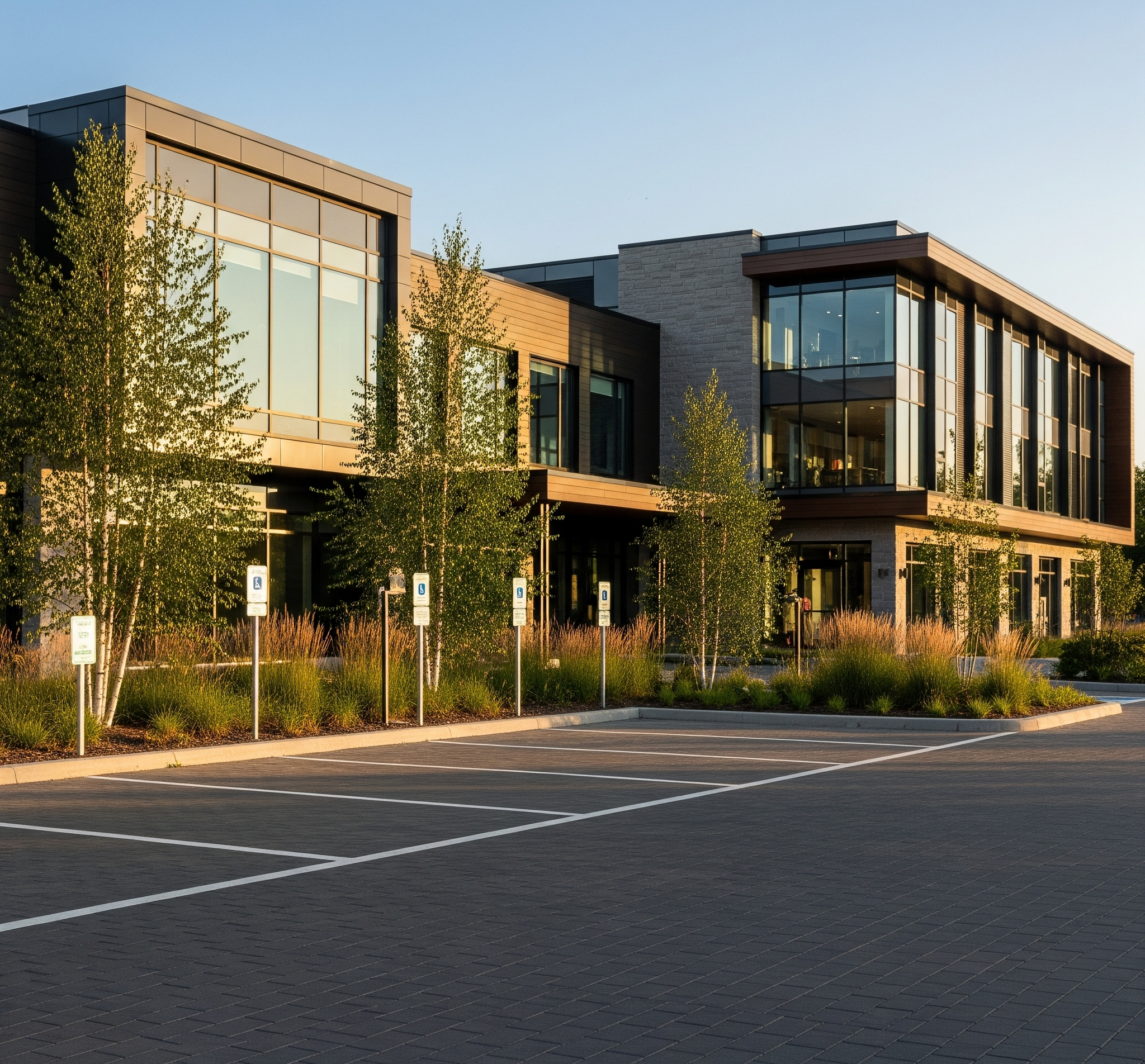
5. Aesthetic Integration: On properties where the irrigated turf borders our signature Warm Off-White and deep Charcoal commercial hardscapes, the irrigation system is designed to produce a crisp, clean turf edge against the paver surface—no overspray onto walkways, no wet staining on porcelain, no puddling at turf-to-paver transitions. The contrast of deep green, perfectly hydrated turf against clean Off-White interlock is the visual signature of a Cinintiriks commercial landscape. It does not happen by accident. It happens because the irrigation was designed to make it happen.
Don’t let a massive commercial sod investment burn out in the sun. Contact Cinintiriks for heavily engineered, fully automated commercial irrigation systems in Toronto and across the GTA.
FAQ: Commercial Sod Irrigation
How long should I run my commercial irrigation zones for newly installed sod?
During the establishment phase (days 1–7), each zone should run for 8–15 minutes per cycle, 2–3 times per day, delivering approximately 6–12 mm of water per application. The target is to wet the top 25–50 mm of soil beneath the sod without saturating it. During the transition phase (days 7–14), reduce to 1–2 cycles per day at 15–25 minutes per cycle to encourage deeper root growth. After full establishment (day 14+), transition to a mature schedule of 2–3 waterings per week at 20–40 minutes per cycle, delivering 25–30 mm per application. These are baseline guidelines; actual run times must be calibrated to the specific precipitation rate of the heads installed (measured in mm per hour) and adjusted based on soil type, slope, temperature, wind, and rainfall. On Toronto commercial properties, we calibrate each zone individually during system commissioning by running catch-cup tests —plastic measurement cups placed at regular intervals across the zone to verify that the actual precipitation rate matches the design specification and that coverage is uniform. Any zone that shows more than a 15% variation in precipitation rate across its coverage area is adjusted (head arc, radius, nozzle size, or spacing) until uniformity meets the commercial standard. A system that applies 30 mm in one area and 8 mm in another is worse than no system at all, because it creates the false confidence that the irrigation is working while specific areas are silently starving.
Can I cleanly install an automated irrigation system after the new sod is already laid?
Yes, but with significant trade-offs. Retrof itting irrigation into an existing sod installation requires one of two methods. (1) Vibratory plow: A vibratory plow can pull pipe through the soil beneath existing sod with minimal surface disturbance. The plow blade creates a narrow slit approximately 25 mm wide and 250–400 mm deep, through which the pipe is pulled simultaneously. The sod above the plow line is lifted slightly and then settles back into place. The visual disturbance is a narrow line across the turf that heals within 2–4 weeks with proper watering. This is the preferred retrofit method for lateral lines and short mainline runs. (2) Open trenching: For mainline installations, valve manifolds, and head locations, open trenching is required. This involves cutting the sod, rolling it back, excavating the trench, installing the pipe and components, backfilling, replacing the sod, and watering it back to establishment. The trench scar is visible for 4–8 weeks and requires the same establishment-phase watering as newly installed sod. The fundamental trade-off is this: installing irrigation after sod is 30–50% more expensive than installing before sod, because the retrofit process is slower, more labour-intensive, requires sod repair, and risks damage to the new turf. More critically, the sod has been without automated irrigation for however long it took to arrange the retrofit—days or weeks during which establishment watering was either inadequate (hand-watered) or absent. Every day without proper irrigation during the establishment phase is a day of root-growth delay and potential turf loss. The correct sequence, always, is: design the irrigation, install the irrigation, grade the topsoil, roll the sod, start the controller. This is the Cinintiriks standard, and we do not deviate from it.
How do smart irrigation controllers prevent overwatering during a Toronto rainstorm?
Smart controllers prevent overwatering through one or both of two mechanisms. (1) Rain sensor interrupt: A wired or wireless rain sensor is mounted in an exposed location on the building (typically on the roof edge or a fence post). The sensor contains hygroscopic discs that expand when wet and contract when dry. When rainfall exceeds a preset threshold (adjustable, typically set to 6–12 mm), the expanded discs trigger a switch that sends an interrupt signal to the controller, suspending all programmed irrigation cycles until the discs dry out (which corresponds to the soil drying to the point where irrigation is again needed). This is a simple, reliable, and inexpensive system (sensor cost: approximately $50–$150) that prevents the most obvious form of waste: irrigating during active rain. (2) Weather-based ET adjustment: Advanced smart controllers (ET-based or “smart ET” controllers) go significantly further. These controllers receive real-time weather data from local weather stations (via Wi-Fi or cellular connection) or from on-site sensors measuring temperature, humidity, solar radiation, and wind speed. From this data, the controller calculates the daily evapotranspiration (ET) rate— the actual volume of water the turf lost through evaporation from the soil and transpiration through the grass blades. The controller then adjusts the next irrigation cycle to replace only the water that was actually lost, accounting for any rainfall that occurred in the interim. On a cool, cloudy day after 10 mm of rain, the controller may skip irrigation entirely. On a hot, windy day with no rain, it may increase run times by 20–30%. The adjustment is automatic, daily, and continuous—no manual intervention required. On Toronto commercial properties where water costs are metered and increasingly expensive, ET-based controllers typically pay for themselves in water savings within 2–3 seasons while producing healthier turf than a fixed-schedule timer, because the turf receives precisely what it needs rather than a rigid, weather-blind volume.
The Final Word
Commercial sod installation is not a landscaping project. It is a living infrastructure investment with a 14-day survival window that is completely determined by the irrigation system beneath it. Without engineered, automated, multi-zone irrigation, commercial-scale sod will fail. It will not partially fail. It will not slowly decline. It will burn, shrink, separate, and die within two weeks of a hot summer installation—and the cost of replacement equals the cost of the original installation.
The irrigation system costs a fraction of the sod investment it protects. It is the most defensible line item in the entire project budget. And the time to install it is before the first roll of sod arrives on site—not after the brown patches start appearing.
Build the system. Program the schedule. Protect the investment. Green turf against Warm Off-White interlock is the signature of a Cinintiriks property—and it stays green because the engineering beneath it was done right.