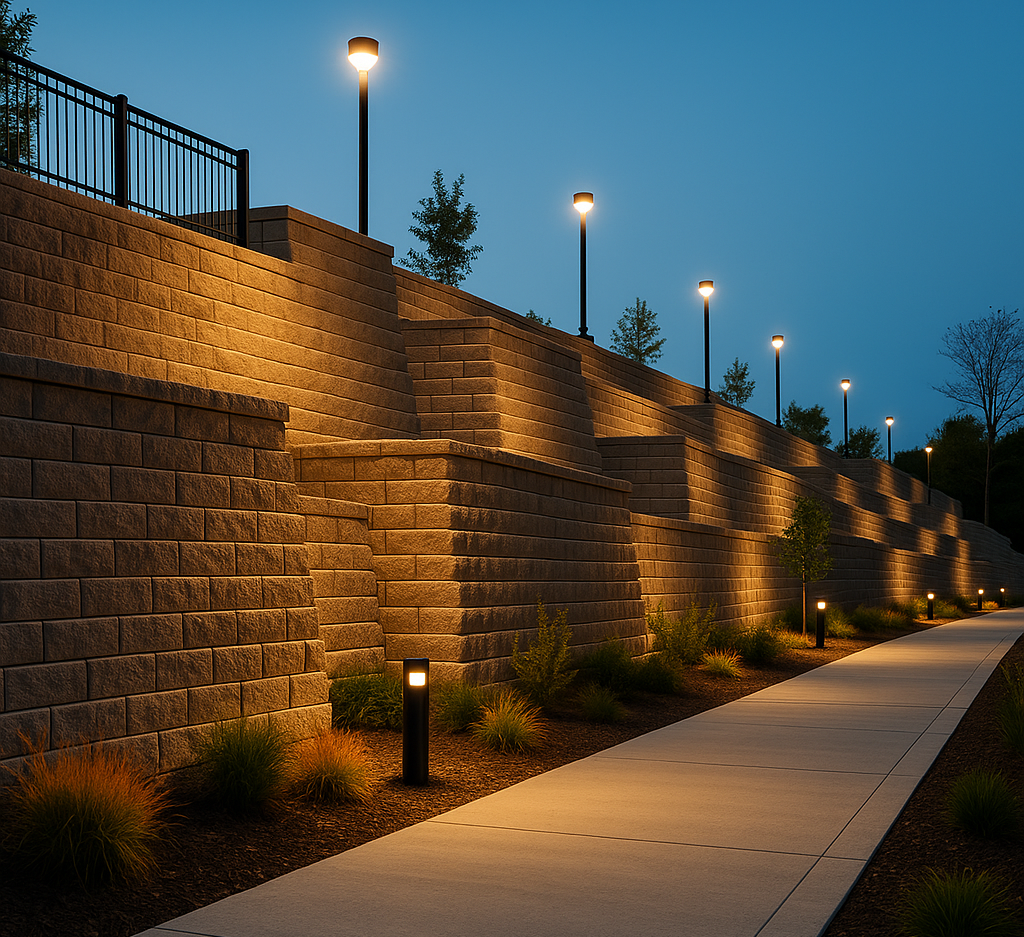
Whether you are a commercial developer planning a logistics facility on uneven terrain or a luxury estate owner dealing with a failing ravine slope, retaining massive volumes of earth is one of the highest-stakes challenges in civil engineering. When millions of pounds of soil, perched high above your property, decide they want to move, they do not ask for permission. This is not a landscaping problem; it is a heavy civil structural mandate. If you attempt to hold back a severe grade change in Brampton using amateur methods or standard residential block walls, you are actively engineering a catastrophic failure. When true stability is non-negotiable—when lives, infrastructure, and millions of dollars are on the line—the only acceptable architectural solution is a Mechanically Stabilized Earth (MSE) wall.
The Gravity Limit: Why Standard Retaining Walls Blow Out
To understand why an MSE wall is so revolutionary, you must first confront the brutal physics of holding back a hillside and the inherent limitations of standard construction methods. Historically, when builders needed to retain soil, they constructed a "gravity wall." A gravity retaining wall relies entirely on its own physical mass—its sheer dead weight—to resist the immense lateral earth pressure pushing against it from behind.
For small garden beds or decorative knee-walls under two feet tall, gravity walls function perfectly. However, the physics scale violently as the height increases. Earth is incredibly heavy. A single cubic yard of wet soil can easily weigh over 3,000 pounds. As you build a wall taller, the volume of soil trapped behind it grows exponentially, and the lateral force (the pressure pushing the wall outward) multiplies geometrically.
Now, add a "surcharge" load to the equation. A surcharge is any external weight resting on the earth directly behind the wall. In Brampton, this could be a sprawling luxury interlock driveway holding multiple heavy vehicles, an infinity edge pool filled with thousands of gallons of water, or the foundation of a commercial building. When dealing with an immense soil surcharge, the lateral earth pressure becomes astronomical.
A standard gravity wall—even one built from massive concrete blocks—cannot simply be stacked high enough or wide enough to resist this force. Without deep structural reinforcement tying the wall back into the hillside, a standard gravity wall will inevitably bow outward. As the pressure mounts, the blocks will begin to shear. Eventually, the wall will snap at its weakest flexural point and violently blow out, dumping hundreds of tons of earth, stone, and whatever structure was sitting on top of it, directly into your yard or the street below.
Anatomy of an MSE System: The Geogrid-Soil Matrix
This is where the heavy civil breakthrough of the Mechanically Stabilized Earth (MSE) wall completely changes the paradigm of slope retention. To demystify the engineering: in an MSE wall, the concrete face blocks you see from the outside are largely cosmetic. They are not actually doing the heavy lifting; they are not holding the hill back. The true engineering genius is buried deep underground.
An MSE wall construction GTA project transforms the unstable soil itself into a massive, immovable composite structure. This is achieved through the surgical insertion of high-tensile synthetic geogrids deep into the excavated hillside. A geogrid is an incredibly strong, grid-like polymer mesh designed specifically for heavy civil soil retention.
During construction, the hillside is excavated far back—often a distance equal to or greater than the intended height of the wall itself. As the wall is built upward, the geogrid is rolled out horizontally, extending from the back of the concrete face blocks deep into the excavated cavity. We then backfill over the geogrid using heavily compacted lifts of clear, angular stone and engineered soil. We run heavy vibratory compactors over the lifts, physically locking the aggregate tightly into the apertures (the holes) of the geogrid mesh.
This process is repeated every few courses of block, creating multiple horizontal layers of geogrid stabilization stacked deep into the hillside. The friction generated between the compacted stone and the high-tensile geogrid physically binds the earth together. It creates a reinforced, monolithic "block" of stabilized soil that is so massive and internally strong that it easily supports its own immense weight and completely resists the lateral pressure of the unreinforced earth behind it. The concrete blocks on the face simply act as a rigid skin, preventing localized erosion at the very front of the stabilized matrix. You are no longer relying on the weight of a block to hold back the hill; you have engineered the hill to hold back itself.
Hydrostatic Pressure Mitigation: Engineering the Hidden Dam
While lateral earth pressure is immense, the most dangerous and insidious enemy of any retaining wall—whether a gravity wall or an MSE system—is water. In the field of heavy civil engineering, we consider water to be a destructive physical force.
If a torrential Brampton rainstorm saturates the soil behind a retaining wall, the physics of the structure change instantly. Water adds extraordinary dead weight to the soil, effectively doubling the lateral pressure. More critically, if that water cannot escape, it begins to pool against the back of the wall. Your retaining wall is no longer just holding back earth; it has unintentionally become a dam holding back a subterranean lake. This phenomenon is known as hydrostatic pressure. It is the number one cause of retaining wall blowouts globally.
Therefore, a structurally sound mechanically stabilized earth wall Brampton is just as much a feat of hydrology as it is a feat of structural engineering. To aggressively combat hydrostatic pressure, we must engineer a massive, free-draining environment directly behind the wall face. This is not achieved by simply throwing some gravel behind the blocks.
We mandate the installation of a continuous, vertical clear stone backfill column that extends from the very bottom of the excavation all the way to the top of the wall. This angular clear stone contains zero fines (sand or dust), meaning it is essentially empty space that water can plummet through instantly. When rain saturates the hillside, the water hits this clear stone column and immediately drops straight down to the base of the wall.
At the base of the excavation, we install a commercial-grade, rigid perforated weeping tile pipe, fully encased in a protective geotextile filter fabric to prevent silt clogging. The water drops through the clear stone, enters the weeping tile, and is aggressively evacuated away from the wall structure and safely discharged into a designated storm management system. By engineering this hidden drainage matrix, we ensure that hydrostatic pressure can never build, keeping the reinforced soil mass dry, stable, and immune to catastrophic hydraulic failure.
The Cinintiriks Heavy Civil Execution: Securing Brampton’s Slopes
Constructing a geogrid retaining wall Ontario is an incredibly complex undertaking that requires surgical precision, advanced geotechnical knowledge, and massive heavy machinery. It is not a project for a standard residential landscaping crew. It requires genuine heavy civil execution.
Detailing "The Cinintiriks Standard" means operating with zero compromises. We do not guess at soil bearing capacities. We do not eyeball geogrid lengths. We execute surgical, heavy civil hillside retention engineered to the millimeter. Whether we are securing a luxury infinity pool perched precariously on a ravine edge, or building a massive commercial loading ramp capable of supporting fully loaded transport trucks, we engineer bulletproof MSE systems in Brampton.
We manage the deep, complex excavations. We perfectly integrate the high-tensile geogrid stabilization layers. We execute flawless, multi-lift mechanical compaction, and we meticulously install the advanced hydrostatic drainage infrastructure required to guarantee the wall will survive the most brutal Ontario storms. Finally, we finish the monolithic structure with luxury architectural facing blocks, ensuring that your heavy civil engineering marvel is as breathtakingly beautiful as it is structurally indestructible.
FAQ: Understanding MSE Retaining Walls
What is the core difference between a traditional gravity retaining wall and an MSE wall?
The core difference lies entirely in the physics of how the wall resists lateral earth pressure. A traditional gravity retaining wall relies strictly on its own immense physical mass—the sheer weight and thickness of the concrete or stone blocks—to hold back the soil. If the earth pressure exceeds the weight of the blocks, the wall fails. A Mechanically Stabilized Earth (MSE) wall completely changes this dynamic. Instead of relying on the weight of the face blocks, an MSE wall utilizes layers of high-tensile synthetic geogrid buried deep into the hillside. This geogrid binds with the compacted soil and clear stone backfill, transforming the loose earth itself into a massive, structurally unified block that holds itself back. The face blocks on an MSE wall are merely cosmetic fascia; the true strength is the reinforced earth matrix hidden behind them.
How far back into the hillside do geogrid layers need to extend to be structurally effective?
The embedment length of the geogrid is a highly precise engineering calculation that depends heavily on the soil type, the height of the wall, and the severity of the surcharge load (what is sitting on top of the wall). However, as a strict general rule in heavy civil engineering, the geogrid layers must extend back into the hillside a distance equal to at least 70% to 100% of the wall's total height. For example, if you are building a 10-foot-tall MSE wall to support a commercial driveway, the geogrid layers must physically extend 7 to 10 feet horizontally back into the excavated earth. Attempting to save money by cutting geogrids short fundamentally compromises the reinforced soil mass, guaranteeing an eventual structural blowout.
Why do retaining walls sometimes lean forward or 'bow' after a few years?
When a retaining wall begins to lean forward, bow, or bulge in the center, it is almost always due to a catastrophic failure to mitigate hydrostatic pressure. If the wall was built without an adequate clear stone backfill column and a functional, commercial-grade weeping tile system at the base, water from rain or melting snow has nowhere to drain. It pools directly behind the wall blocks, saturating the soil and adding immense hydraulic dead weight. This trapped water creates hydrostatic pressure that pushes violently outward. Because the wall was likely not engineered as a proper MSE system with deep geogrid tie-backs, it cannot resist this doubled lateral pressure, causing the blocks to shear outward and the wall to slowly topple forward.
The Final Word
Don't let a failing slope threaten your property or your life. Contact Cinintiriks for heavily engineered, code-compliant MSE retaining walls in Brampton.