The Structural Boundary: Why Curbing Exists
Before we compare the two systems, it is worth understanding what a curb actually does—because most property owners think of curbing as a decorative border when it is, in fact, a critical piece of heavy civil infrastructure.
A curb performs three essential functions simultaneously. First, edge restraint. Every paved surface—whether asphalt, poured concrete, or interlocking pavers—exerts lateral pressure outward under traffic loading. Vehicles brake, accelerate, and turn, generating horizontal forces that push the paving material toward its edges. Without a rigid perimeter restraint, the edge units migrate outward over time, the joints open, interlock is lost, and the entire paver field begins to unravel from the outside in. The curb stops this. It is the structural frame that holds the picture together.
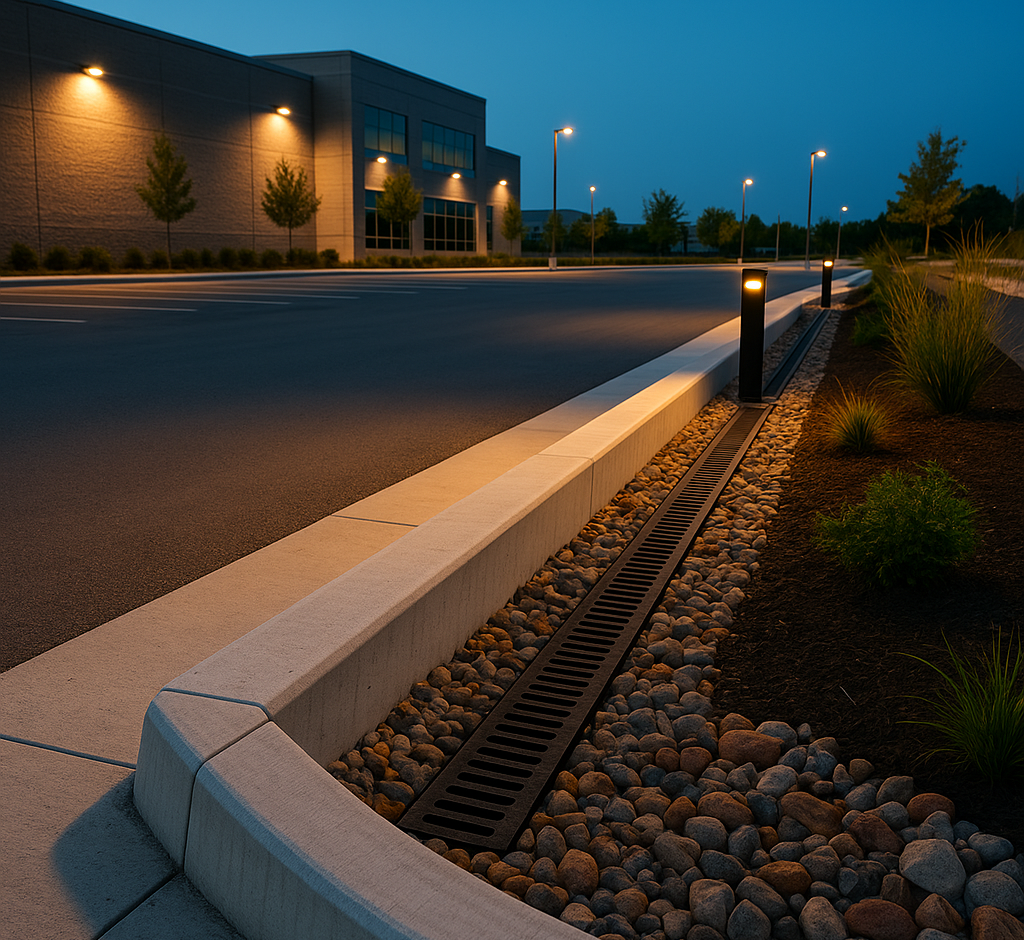
Second, hydrology. A curb defines where water goes. On a conventional road or parking lot in Toronto, the raised curb acts as a dam along the pavement edge, channelling stormwater along a defined gutter line toward catch basins at calculated intervals. Without that vertical barrier, water would sheet off the paved surface in every direction—into landscaping, into building foundations, into adjacent properties—creating erosion, flooding, and liability issues that no amount of grading can reliably prevent.
Third, spatial definition. A curb physically and visually separates zones of different use. The raised curb between a commercial parking lot and a pedestrian sidewalk is not just channelling water; it is telling a 2,000-kilogram SUV that the pedestrian zone is off-limits. It is a physical barrier that prevents vehicular encroachment—a function that matters enormously in commercial and municipal contexts where public safety is non-negotiable.
These three functions—edge restraint, hydrology, and spatial definition—are the engineering imperatives that every curbing solution must satisfy. The raised curb and the flush curb accomplish them through radically different means. Understanding those differences is the key to selecting the right system for your Toronto project.
The Raised Concrete Curb: The Traditional Workhorse
The raised concrete curb is the backbone of conventional North American road and site infrastructure. Drive along any arterial road in Toronto—Finch Avenue, Steeles, the Queensway—and the raised curb-and-gutter profile is the universal constant. It is a monolithic concrete extrusion, typically 150 millimetres wide and projecting 150 to 180 millimetres above the adjacent pavement surface, with an integrated gutter pan that slopes inward to collect and convey stormwater.
On commercial sites, raised curbs are installed using one of two methods. Slip-form machine extrusion is the dominant method for large-scale linear runs—parking lot perimeters, roadway edges, median islands. A self-propelled slip-form curbing machine moves along a pre-set string line, extruding a continuous ribbon of low-slump concrete in the specified profile (barrier, mountable, or straight-back) at rates of 300 to 600 linear metres per day. The concrete is typically a 30 to 35 MPa air-entrained mix—the same class of concrete used in Ontario bridge decks and highway infrastructure—with 5% to 7% entrained air for freeze-thaw resistance.
For tighter radii, custom profiles, and complex intersections, curbs are form-poured—cast in place using rigid steel or composite forms, reinforced where necessary, and finished by hand. Form-poured curbs allow for tighter geometric control but are slower and more labour-intensive than slip-forming.
Hydrology: The Dam and Channel System
The raised curb’s hydrological function is brute-force effective. The vertical face acts as a physical dam, preventing stormwater from escaping the road or parking surface laterally. Water flows along the gutter pan—the depressed channel at the base of the curb face—under gravity, following the longitudinal slope of the curb to the nearest catch basin. The catch basin connects to the underground storm sewer, and the water is conveyed to the municipal system.
This system is simple, reliable, and well-understood by every municipal engineering department in the GTA. It handles enormous volumes of water: a properly designed curb-and-gutter system on a Toronto commercial parking lot can manage peak storm flows from a 100-year return period rainfall event—the kind of intense, 25-millimetres-per-hour downpour that has become increasingly frequent in Ontario’s shifting climate.
The limitation is aesthetic and functional. A raised curb is, by definition, a vertical step. It creates a physical separation between surfaces that cannot be crossed by a wheelchair, a stroller, or a mobility scooter without a dedicated curb ramp. It interrupts the visual plane of the hardscape. It is brutalist infrastructure: effective, essential in many contexts, but inherently incompatible with the seamless, pedestrian-first design philosophy that defines contemporary luxury urban development.
The Flush Curb: The Modern Alternative
A flush curb eliminates the vertical step entirely. The paved surface transitions to the adjacent surface—whether it is another paving material, a planting bed, or a drainage element—at the same elevation. There is no raised barrier. No gutter pan. No visible concrete extrusion. The edge is invisible, the surface is continuous, and the entire environment reads as a single unified plane.
This is the curbing philosophy behind shared streets (woonerven), luxury commercial plazas, AODA-compliant public spaces, and high-end residential hardscape designs. It is the system that allows a wheelchair user to move from a vehicular travel lane to a cafe seating area without encountering a single grade change. It is what makes a commercial courtyard in Toronto look and feel like a European piazza rather than a parking lot with fancy pavers.
But here is the critical distinction that separates competent engineering from decorative wishful thinking: a flush curb does not eliminate the need for edge restraint or stormwater management. It simply hides them.
Hidden Edge Restraint
When the curb is flush, the edge restraint system moves underground. We install heavy-duty extruded aluminium or galvanized steel edge restraints—continuous L-shaped or T-shaped profiles that are spiked into the compacted sub-base with hardened steel nails at 300 millimetre centres. The restraint sits at the exact elevation of the paver bedding layer, gripping the bottom edge of the perimeter pavers and preventing any lateral migration under traffic loads.
On vehicular-rated flush curb installations across Toronto, we specify commercial-grade restraints rated for axle loads exceeding 10,000 kilograms. The stakes are driven through the restraint flange and into the compacted clear stone sub-base to a depth of 250 to 300 millimetres, anchoring the system against the horizontal shear forces generated by braking and turning vehicles. The restraint is completely invisible once the pavers are installed—buried beneath the surface, doing its work in silence.
Hidden Hydrology: Micro-Grading and Trench Drains
Without a raised curb to channel water, the flush curb system relies entirely on precision surface grading and integrated linear drainage. This is where the engineering complexity escalates dramatically, and it is where most underqualified contractors fail.
The entire paver surface must be micro-graded to calculated cross-slopes and longitudinal slopes—typically 1.5% to 2.5%—that direct sheet flow toward predetermined collection lines without creating perceptible tilting in the walking surface. These slopes are established at the sub-base level and carried with surgical precision through the aggregate base, the bedding layer, and the finished paver surface. Deviations of more than 3 millimetres over a 3-metre straightedge can create ponding zones that accumulate water, freeze in winter, and create both slip hazards and freeze-thaw damage.
At the collection lines, stainless steel or polymer-concrete linear trench drains are installed flush with the paver surface, their slotted grate covers sitting at the exact same elevation as the surrounding pavers. These drains are typically 100 to 200 millimetres wide, and on a well-designed Cinintiriks project, they are aligned with a Charcoal accent band in the paver pattern so that the drain reads as a design element rather than utilitarian plumbing.
The trench drains connect through underground piping to the municipal storm sewer system, maintaining full compliance with the City of Toronto’s stormwater management requirements. On sites where on-site retention is mandated, the clear stone sub-base itself functions as a temporary stormwater reservoir—an engineered void space that attenuates peak flows and releases them gradually, reducing the load on the municipal system during intense rainfall events.
"A raised curb tells water where to go by force. A flush curb tells water where to go by intelligence. Both work. One is invisible."
When to Deploy Each System
The choice between a raised curb and a flush curb is not a matter of one being “better” than the other. It is a matter of context, function, and design intent. Here is how we evaluate the decision on every Cinintiriks project in the Greater Toronto Area.
Raised curbs are essential where physical vehicle containment is required. Commercial parking lots with defined traffic lanes, municipal roadways, loading dock approaches, and any application where vehicles must be physically prevented from entering a pedestrian zone or landscape area. The raised curb is not a suggestion to drivers; it is a physical barrier. In high-speed, high-volume traffic environments, there is no substitute for that vertical face.
Flush curbs are superior in pedestrian-priority commercial environments, shared streets, AODA-compliant public plazas, hotel and hospitality entrances, luxury residential estates, and any context where the design vision demands a seamless, continuous surface. In these environments, traffic calming is achieved through visual hardscape architecture—contrasting paver colours, strategic planter placement, bollard positioning—rather than physical concrete barriers. Vehicles are not physically stopped; they are psychologically slowed by an environment that signals pedestrian dominance.
On many large-scale commercial projects in Toronto, we deploy both systems on the same site. The parking lot perimeter receives slip-formed raised concrete curbing for maximum vehicle containment and efficient stormwater channelling. The pedestrian courtyard, the building entrance plaza, and the internal shared-use laneways receive flush curb construction with hidden edge restraints and integrated trench drains. The transition between the two systems is engineered with a tapered curb ramp or a gradual grade change that maintains AODA compliance while clearly delineating the shift from vehicular to pedestrian priority.
The Cinintiriks Standard for Curb Engineering
Whether your project requires traditional raised concrete curbing or precision flush curb construction, we execute every linear metre to the same uncompromising standard.
For Raised Curbs: We place 30–35 MPa air-entrained concrete with 5–7% entrained air content, slip-formed or form-poured on a compacted granular base with a minimum depth of 300 mm below the base of the curb. Expansion joints are saw-cut at calculated intervals to control thermal cracking. Every curb run is laser-verified for alignment, grade, and profile consistency. The result is a curb that resists Toronto’s freeze-thaw cycles, withstands snowplough impact, and maintains its structural integrity for decades.
For Flush Curbs: We engineer the complete invisible infrastructure—commercial-grade aluminium or steel edge restraints anchored into the compacted clear stone sub-base, precision micro-grading verified to ±3 mm tolerance, and stainless steel linear trench drains integrated seamlessly into the paver pattern. The paver field uses our signature Warm Off-White and Charcoal palette, with 80 mm commercial-grade units installed in 45-degree herringbone pattern across all vehicular zones. The edge restraints, the drainage, and the grading are invisible. The beauty is all that remains.
For Hybrid Sites: We execute the transition between raised and flush curb systems with engineered taper ramps and integrated drainage connections, ensuring zero-step AODA compliance at every pedestrian crossing point and seamless hydrological continuity across the entire site. No water ponds. No edge fails. No joint opens.
This is The Cinintiriks Standard for edge engineering. Whether the project calls for 2,000 linear metres of slip-formed barrier curb around a commercial parking facility or 50 linear metres of surgically precise flush curb transition at a luxury hotel entrance, we deliver the same engineering discipline, the same material specifications, and the same obsessive attention to tolerance and finish. In Toronto’s demanding climate and regulatory environment, there is no margin for approximation.
FAQ: Curb Engineering in Toronto
Why do raised concrete curbs often crack and spall during the Canadian winter?
The same freeze-thaw mechanics that destroy concrete driveways attack concrete curbs with equal ferocity—and in some ways, curbs are more vulnerable. A curb has a high surface-area-to-volume ratio: it is a narrow, exposed extrusion with three faces open to the weather. Water penetrates the capillary pore structure of the concrete from multiple directions simultaneously. When that water freezes—expanding approximately 9% by volume—the resulting hydraulic pressure fractures the cement paste from the inside out. Curbs also take direct impact from snowplough blades, which chip the exposed face and open fresh pathways for water entry. The solution is proper air-entrainment (5–7% entrained air in the concrete mix creates microscopic relief chambers that absorb ice expansion pressure), adequate curing time before the first winter exposure, and avoidance of de-icing salt contact during the first season. At Cinintiriks, we specify air-entrained mixes exclusively and we time our pours to ensure a full 28-day cure before freeze exposure whenever the construction schedule permits.
How do you stop interlocking pavers from shifting outward when using a flush curb design?
With engineered mechanical edge restraint. The flush curb aesthetic means there is no visible curb, but there is absolutely a restraint system working beneath the surface. We install continuous heavy-duty aluminium or galvanized steel L-profile edge restraints around the full perimeter of the paver field. These restraints are anchored into the compacted clear stone sub-base with hardened steel spikes driven at 300 mm centres to a depth of 250 to 300 mm. The restraint grips the bottom edge of the perimeter pavers and resists the lateral forces generated by vehicular braking, turning, and acceleration. On commercial installations with heavy traffic, we use a double-staked restraint system with alternating spike positions for maximum pull-out resistance. The polymeric sand in the paver joints provides additional lateral resistance by locking adjacent units together. The result is a paver field that shows zero lateral migration over decades of use—even under the daily passage of delivery trucks and emergency vehicles. The restraint is invisible. Its performance is not.
Are flush curbs completely wheelchair accessible and AODA compliant?
Yes—and this is one of the primary reasons the flush curb has become the standard for progressive commercial and institutional developments in Ontario. The Accessibility for Ontarians with Disabilities Act (AODA) and the Ontario Building Code require barrier-free pedestrian access on all new commercial and public developments. A raised curb, by definition, creates a vertical barrier that requires a dedicated curb ramp to achieve compliance. A flush curb eliminates the barrier entirely. The transition between surfaces is at-grade—zero step, zero lip, zero obstruction. A wheelchair user, a person with a walker, a parent with a stroller, and a delivery dolly operator all move across the transition without encountering any change in elevation. We further enhance accessibility by integrating tactile warning indicator strips—rows of truncated dome pavers in a contrasting Charcoal colour—at the boundary between vehicular and pedestrian zones. These strips provide underfoot and visual warning of the zone change without creating a physical barrier, meeting the AODA Integrated Accessibility Standards in both letter and spirit.
The Final Word
The curb is the most overlooked element in hardscape design, and it is one of the most consequential. It governs water flow, structural integrity, accessibility, and the visual identity of your entire project. A raised concrete curb delivers brute physical containment and reliable stormwater channelling for traditional vehicular environments. A flush curb delivers seamless modern aesthetics and universal accessibility for pedestrian-priority spaces. Both demand precision engineering, quality materials, and a contractor who understands that the edge of your hardscape is not an afterthought—it is the structural frame that holds everything together.
Don’t let amateur grading and weak edge restraints ruin your commercial hardscape. Contact Cinintiriks for heavily engineered curbing and paving solutions in Toronto.