The Band-Aid Liability: What Resurfacing Actually Is
Concrete resurfacing is the process of applying a thin layer of polymer-modified cement-based compound over an existing concrete surface. The products go by various trade names and are marketed as miracle cures: concrete resurfacers, overlay systems, micro-toppings, skim coats. The formulation varies, but the fundamental concept is the same: mix the product (Portland cement, fine aggregate, polymer emulsion, and sometimes fibres), trowel or squeegee it over the existing slab at a thickness of 2 to 6 millimetres, let it cure, and walk away with what appears to be a fresh, new concrete surface.
On paper, it sounds reasonable. In controlled laboratory conditions—a climate-controlled room at 20°C with no moisture variation, no traffic loading, and no freeze-thaw cycling—these products perform adequately. The polymer additive improves the flexural strength and adhesion of the overlay beyond what plain cement would achieve, and bond strength test results on laboratory specimens look credible.
But your driveway is not a laboratory specimen. Your driveway is a slab of concrete that has been exposed to 10, 20, or 30 years of Toronto winters. It has been saturated by rain and snowmelt. It has absorbed de-icing salt brine into its capillary pore network. It has been heaved by frost. It has cracked under thermal contraction. The cement paste in the upper zone has been progressively destroyed by freeze-thaw cycling, creating a weak, fractured, contaminated substrate that has about as much in common with a clean laboratory surface as a gravel road has with a polished marble floor. And when you trowel a thin layer of new material over that compromised, contaminated, structurally degraded substrate, you are not fixing anything. You are hiding the problem behind a thin veneer and hoping that physics takes a season off.
Physics does not take a season off.
The Engineering: Why Resurfacing Delaminates
To understand why concrete resurfacing fails in the Ontario climate, you have to understand three things: bond mechanics, moisture dynamics, and the relentless mathematics of the freeze-thaw cycle.
Bond Mechanics: The Adhesion Problem
For a resurfacing layer to survive, it must achieve a tensile bond with the existing concrete substrate that is strong enough to resist every force attempting to separate them: thermal expansion, mechanical loading, frost heave, and—most critically— the hydraulic pressure generated by freezing water at the bond line.
Achieving an adequate bond requires two conditions that are rarely met on a residential resurfacing project:
1. A mechanically profiled substrate. The existing concrete surface must be shot-blasted, scarified, or grinder-profiled to an International Concrete Repair Institute (ICRI) surface profile of CSP-3 to CSP-5—a rough, open-pored texture that provides mechanical keying for the overlay. Simply pressure washing the surface (which is what most residential resurfacing contractors do) achieves a CSP-1 at best: essentially smooth, with no meaningful mechanical profile. The overlay sits on the surface rather than in it. The bond is adhesive only, with no mechanical interlock, and adhesive bonds on contaminated, carbonated, salt- saturated concrete are inherently weak.
2. A clean, sound, structurally intact substrate. The existing concrete must be free of oil, grease, curing compounds, salt contamination, laitance (the weak, chalky layer on the surface of poorly finished concrete), and loose or delaminated material. Every square millimetre of the substrate must be structurally sound—meaning the cement paste is intact, the aggregate is firmly bonded, and there are no sub-surface voids, cracks, or zones of freeze-thaw degradation.
On a concrete driveway in Toronto that is already showing spalling, cracking, or surface degradation, neither condition is met. The surface is carbonated, contaminated with salt and oil, and the upper zone of the cement paste has been progressively fractured by years of freeze-thaw cycling. The substrate is, in engineering terms, structurally compromised. And applying a resurfacing overlay to a structurally compromised substrate is like gluing wallpaper over a crumbling plaster wall: it looks good until the wall continues to crumble, and then it falls off.
Moisture Dynamics: The War at the Bond Line
Even if the bond were initially adequate (which, on a typical residential project without proper profiling, it is not), the bond line between the overlay and the substrate becomes the primary point of failure because of moisture.
The existing concrete slab absorbs moisture from below (through ground vapour transmission, lateral capillary draw from surrounding soil, and snowmelt infiltration through cracks and joints) and from above (through rain, puddles, and de-icing brine). This moisture migrates through the slab and accumulates at the bond line—the interface between the old concrete and the new overlay—because the overlay itself has a different porosity than the substrate. The bond line becomes a moisture trap: a thin zone of elevated saturation sandwiched between two layers of concrete with different absorption rates and different vapour transmission characteristics.
In a climate where freezing never occurs, this moisture might eventually migrate harmlessly upward or downward. In Toronto, where temperatures oscillate above and below 0°C dozens of times per winter, the trapped moisture at the bond line freezes. And when water freezes, it expands by 9% by volume, generating hydraulic pressure that pushes outward in every direction. At the bond line, that outward pressure pushes the overlay away from the substrate. The bond—already weak from inadequate profiling and substrate contamination—cannot resist the lateral shear force. Micro-delaminations form: tiny pockets where the overlay has separated from the substrate but the separation is not yet visible on the surface.
Each subsequent freeze-thaw cycle enlarges these pockets. Water flows into the newly opened voids during the next thaw (because water always flows into empty space), and on the next freeze, the voids expand further. Within 10 to 30 freeze-thaw cycles—which can occur within a single Toronto winter—the micro-delaminations connect. The overlay lifts. It cracks along the delamination boundary. Chunks begin to detach. And by the following spring, your "resurfaced" driveway looks like a peeling sunburn: sheets of thin, curling, crumbling overlay material separating from a substrate that is now in worse condition than before the resurfacing, because the delamination process has opened new moisture pathways into the slab that did not exist previously.
"Resurfacing does not fix a failing driveway. It adds a thinner, weaker layer on top of the failure and delays the truth by one winter."
The Thickness Problem
There is a reason that structural concrete toppings in commercial and industrial applications are poured at a minimum thickness of 40 to 75 millimetres with reinforcing mesh, bonded with epoxy primers, and applied to shot-blasted substrates profiled to CSP-5. At that thickness and with that preparation, the overlay has enough mass, enough structural rigidity, and enough bond surface area to resist freeze-thaw hydraulic forces and traffic loading for a reasonable service life.
A residential resurfacing product applied at 2 to 6 millimetres has none of those attributes. It is too thin to resist the lateral shear forces of freeze-thaw delamination. It is too thin to bridge or absorb the movement of existing cracks in the substrate (which will telegraph through the overlay within months— a phenomenon called reflective cracking). It is too thin to withstand the point-loading of a snowplough blade scraping across the surface in January. And it is applied to a substrate that has not received the aggressive mechanical profiling that a genuine structural bond requires.
The product is designed for controlled environments: interior floors, covered patios, surfaces in temperate climates that never experience freezing. Applying it to an exterior driveway in Toronto is like installing interior-grade drywall on the outside of a building and expecting it to survive a rainstorm. The product is not designed for the application. The failure is not a defect; it is an inevitability.
When Resurfacing Can Work—In Theory
In fairness, concrete resurfacing is not a complete fraud in every application. There are narrow, specific conditions under which a properly applied resurfacing compound can deliver an acceptable result:
The substrate must be structurally sound. No spalling. No delamination. No deep cracks. No zones of freeze-thaw degradation. The existing concrete must be solid, intact, and capable of supporting a bonded overlay without continuing to deteriorate underneath it.
The surface must be properly profiled. Shot-blasting or mechanical scarification to an ICRI CSP of 3 to 5. Not pressure washing. Not acid etching (which creates a chemically weakened surface, not a mechanically profiled one). Genuine mechanical profiling that opens the pore structure and provides keying for adhesion.
The overlay must be applied at adequate thickness. A minimum of 10 to 15 millimetres for any exterior application subject to freeze-thaw cycling. Not 2 to 3 millimetres. Not 6 millimetres. Thicknesses below 10 millimetres do not have sufficient mass to resist hydraulic shear at the bond line.
The substrate must be uncontaminated. No oil saturation, no de-icing salt within the capillary pore network, no carbonated surface layer. If the concrete has been exposed to salt for years, the chloride ions have migrated deep into the cement paste, and no amount of surface cleaning will remove them.
How many residential driveways in Toronto meet all four conditions? Almost none. The driveways that need resurfacing are, by definition, the ones that have been damaged by the climate. And the damage that makes them ugly is the same damage that makes them structurally unsuitable as a substrate for a bonded overlay. It is a cruel paradox: if your concrete is in good enough condition for resurfacing to work, you probably do not need resurfacing in the first place.
The Permanent Upgrade: Tear It Out, Replace It Right
If the concrete is dead—if it is spalled, cracked, heaved, delaminating, or structurally compromised by decades of freeze-thaw abuse—the only honest, permanent, engineering-sound solution is a full tear-out and replacement.
And when you are investing in a complete removal and replacement, the question becomes: do you replace the failing concrete with more concrete— the same rigid, monolithic, porous, freeze-thaw- vulnerable material that just failed—or do you upgrade to a structurally superior system that is engineered to survive the exact climate that destroyed the original slab?
Why Interlocking Pavers Are the Structural Answer
High-density segmental interlocking pavers solve every failure mechanism that destroys poured concrete and resurfacing overlays in the Ontario climate.
No delamination. There is no bond line. Pavers are individual units that sit on a compacted sand bedding layer. There is nothing to delaminate, because there is no bond between layers. The failure mechanism that destroys every resurfacing job in Toronto does not exist in a paver system.
No reflective cracking. Poured concrete cracks because a monolithic slab is rigid. Thermal contraction, frost heave, and sub-grade settlement create tensile stresses that exceed the tensile strength of concrete (which is, frankly, poor—approximately 2.5 to 4.0 MPa), and the slab fractures. A paver field is composed of hundreds of individual units separated by polymeric sand joints. Each joint is a built-in stress-relief gap. Thermal contraction is absorbed across hundreds of joints rather than concentrated at a single crack tip. The system articulates instead of fracturing.
No spalling. Factory-pressed pavers achieve compressive strengths exceeding 50 MPa and water absorption rates below 5% (compared to 25–35 MPa and 7–10% absorption for poured concrete). The reduced porosity means dramatically less water absorption, less ice crystal formation within the pore structure, and no surface spalling over the service life of the installation. These units are manufactured to CSA A231.2 standards and tested to survive 300+ freeze-thaw cycles—several times the annual freeze-thaw load of a Toronto winter.
Structural flexibility. When frost heave pushes the sub-grade upward (and it will, in the clay soils that underlie most of Toronto), the paver field flexes as a unified but articulating surface. The pavers rise with the heave and settle back when the frost releases. There is no cracking, no shattering, no permanent deformation. This is a system that is designed for ground movement—not one that fights it and eventually loses.
Individual unit replacement. If a single paver is damaged by a snowplough blade, a dropped tool, or localised oil saturation, that one unit is lifted out and a replacement unit dropped in. Same colour. Same profile. Same texture. The repair is invisible. With poured concrete, there is no invisible repair. Every patch shows. Every cold joint is visible. Every colour mis-match between old and new concrete screams "repair" from the street.
The Cinintiriks Standard for Driveway Tear-Out and Replacement
At Cinintiriks, we refuse to sell temporary resurfacing overlays. We do not trowel thin cement over a dying slab, collect payment, and wait for the inevitable call-back when it peels off the following winter. That business model is built on repeat failure, and we will not participate in it. When a Toronto homeowner calls us about a failing concrete driveway, we tell them the truth: the concrete is done. The foundation is done. And the smartest investment is to remove it completely and replace it with a system that will never fail the same way again.
1. Heavy Civil Demolition: The existing concrete slab is saw-cut at clean boundaries using a diamond-blade walk-behind saw. The slab is then broken into manageable sections using pneumatic breakers and loaded into disposal bins by mini-excavator. All demolition debris is hauled to a licensed concrete recycling facility. The exposed sub-grade is inspected for the root causes of the original failure: inadequate compaction, organic material in the fill, poor drainage, frost- susceptible silty clay soils, or buried construction debris that was never removed during the original pour.
2. Over-Excavation and Sub-Grade Improvement: We excavate to the full calculated depth—typically 350 to 450 millimetres below finish grade for vehicular driveways in Toronto. If the native sub-grade is frost-susceptible clay (which is overwhelmingly common across the city), we over-excavate an additional 100 to 150 millimetres and install a non-woven geotextile fabric over the native soil to prevent fine particle migration into the aggregate base. The geotextile acts as a permanent separation layer that maintains the drainage performance of the sub-base for the entire service life of the installation.
3. Compacted Clear Stone Sub-Base: A massive clear stone sub-base (19 mm or 50 mm crushed clear limestone) is installed in lifts of 100 to 150 millimetres, with each lift mechanically compacted using a reversible plate compactor to 98% Standard Proctor density. The clear stone serves a dual purpose: it provides a structurally rigid, frost-stable foundation that does not heave (because clear stone does not retain moisture the way clay and silt do), and it functions as an open-graded drainage reservoir that allows water to percolate downward and away from the surface rather than being trapped where it can freeze and heave. This drainage function is the single most critical engineering element that most cheap concrete pours omit—and it is the reason those pours fail within a decade.
4. Bedding Layer: A uniform 25 mm bedding layer of high-performance modified limestone screenings is screeded to a precise, flat plane on top of the compacted sub-base. The bedding layer provides the fine adjustment surface on which the pavers rest and allows for the micro-settlement that occurs during initial traffic loading and compaction.
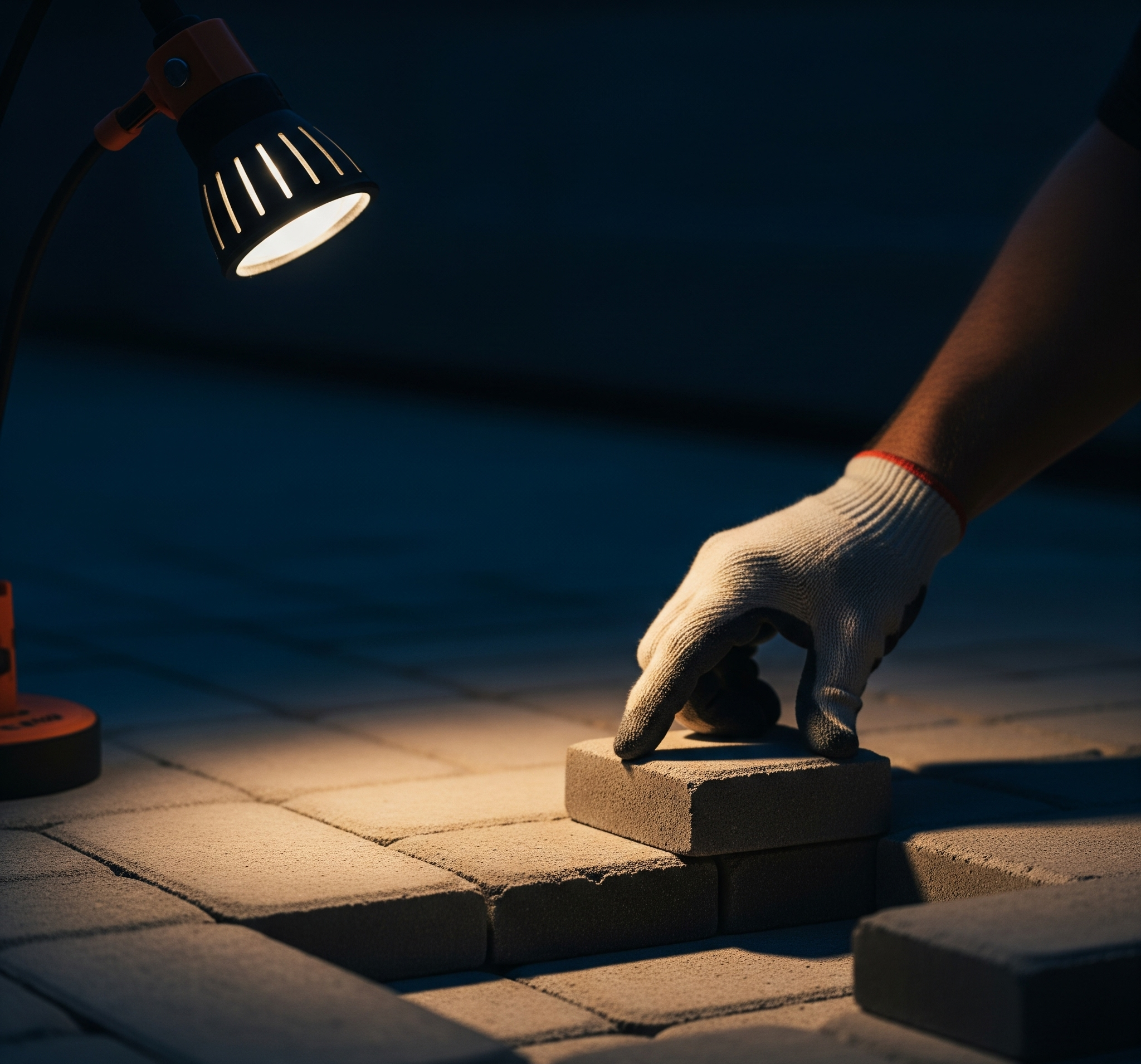
5. Paver Installation (Herringbone Pattern): High-density interlocking pavers—our signature Warm Off-White field with deep Charcoal soldier course borders—are installed in a 45-degree herringbone pattern. Herringbone is the only laying pattern that provides full multi-directional interlock under vehicular traffic: the angled geometry of each unit transfers vertical wheel loads horizontally into the surrounding units, distributing the force across a wide area rather than concentrating it on a single paver. Every unit is placed by hand. Cuts at borders, curves, and obstructions are executed with a diamond- blade wet saw for surgical precision. The entire field is mechanically compacted with a rubber-pad plate compactor to seat the pavers into the bedding layer and activate the initial interlock.
6. Joint Stabilisation: Commercial- grade polymeric sand is swept into every joint, vibrated into the full depth of the joint profile with a plate compactor, and activated with controlled misting. The polymer binder cures within 24 hours, locking the sand matrix in place. The stabilised joints prevent weed germination, ant colonisation, and paver migration while remaining flexible enough to articulate with seasonal frost movement. The joints are permeable, allowing surface water to infiltrate into the clear stone drainage reservoir below rather than pooling on the surface.
7. Continuous Edge Restraint: Heavy-duty aluminium or composite edge restraints are spiked into the compacted sub-base around the full perimeter of the driveway, locking the border pavers in position and preventing lateral creep under the horizontal forces of vehicle braking, turning, and thermal expansion.
This is The Cinintiriks Standard. Every layer, every specification, every compaction pass is engineered with one objective: to permanently replace a failing concrete driveway with a luxury interlocking paver system that does not crack, does not spall, does not delaminate, does not heave, and does not require the cyclical patching and resurfacing that poured concrete demands in this climate. The system is designed to survive not by resisting the freeze-thaw cycle but by accommodating it—draining water before it freezes, flexing with ground movement, and presenting a surface density that simply does not absorb enough moisture to be vulnerable.
The Economics: Resurface vs. Replace
The appeal of resurfacing is the price. A typical residential resurfacing quote in the Toronto market ranges from $3 to $6 per square foot—roughly $1,500 to $3,000 for an average driveway. A full tear-out and interlock replacement ranges from $15 to $30+ per square foot, depending on complexity, access, and design specifications. The resurfacing quote is cheaper by a factor of five.
But the economics shift dramatically when you factor in service life. The resurfacing overlay in a Toronto climate will delaminate within 1 to 3 years. Generously, perhaps 3 to 5 years if the stars align: the substrate was unusually sound, the profiling was better than average, and de-icing salt was avoided (unlikely in Toronto). At that point, you have two choices: resurface again (another $1,500 to $3,000) or finally commit to the tear-out you should have done in the first place. If you resurface three times over a decade, you have spent $4,500 to $9,000—and you still have a failing concrete slab underneath that is in worse condition now than it was before the first resurfacing, because the repeated delamination cycles have opened additional moisture pathways into the substrate.
The interlocking paver installation costs more upfront. But it has a functional lifespan of 25 to 40 years or more, with maintenance limited to occasional re-sanding of joints and an optional cosmetic power wash and re-seal every 3 to 5 years. No re-surfacing. No re-pouring. No cyclical failure. Over a 30-year horizon, the total cost of ownership is lower, the aesthetic is incomparably superior, and the property value contribution is significant. Real estate appraisers do not assign value to a resurfaced concrete driveway. They assign value to luxury hardscaping that is visibly permanent and structurally sound.
FAQ: Concrete Resurfacing in the GTA
How long does a standard concrete resurfacing layer actually last in the Ontario climate?
Under ideal conditions—a structurally sound substrate, proper mechanical profiling to ICRI CSP-3 or higher, a quality polymer-modified product applied at 10+ millimetres thickness, and minimal salt exposure—a resurfacing overlay can survive 5 to 8 years in southern Ontario before freeze-thaw delamination begins. Under typical residential conditions in Toronto—which invariably means a degraded substrate, pressure-washed (not profiled) surface, a product applied at 2 to 6 millimetres, and regular de-icing salt use—the realistic lifespan is 1 to 3 years before visible delamination, peeling, and cracking appear. Many homeowners see failure within the first winter. The failure is not a product defect; it is a predictable consequence of applying a thin overlay to a compromised substrate in a freeze-thaw climate. The product is performing exactly as the physics dictate. The problem is that the physics were never honestly explained at the point of sale.
Can you apply a resurfacing compound over a concrete slab that has deep structural cracks?
You can physically apply it, but the result is guaranteed to fail. Deep structural cracks in a concrete slab are active movement joints—they open and close with thermal contraction, frost heave, and sub-grade settlement. A thin resurfacing overlay cannot bridge an active crack. The crack movement will telegraph directly through the overlay (a phenomenon called reflective cracking ), typically within the first freeze-thaw season. The overlay cracks along the exact same line as the substrate crack beneath it, because the overlay is too thin and too rigidly bonded to absorb the differential movement. Worse, the crack in the overlay now provides a new pathway for water to reach the bond line, where it accelerates the delamination process in the surrounding area. The result is a resurfaced driveway that cracks in the same places as the original, with the added liability of delaminating overlay material between the cracks. A slab with deep structural cracks is telling you that the sub- base has failed. No surface treatment—no matter how advanced—can fix a sub-base failure. The slab must be removed, the sub-base must be re-engineered, and the replacement surface must be structurally independent of the compromised foundation that caused the original failure.
Why is tearing out concrete and installing interlocking pavers considered a better long-term investment?
Because the tear-out addresses the root cause of the failure, rather than masking its symptoms. Concrete driveways fail in Ontario because of three interconnected mechanisms: freeze-thaw spalling of the porous surface, frost heave cracking due to inadequate sub-base drainage, and thermal contraction fracturing of a rigid monolithic slab. Resurfacing addresses none of these. It applies a thin cosmetic layer over all three active failure mechanisms. A full tear-out removes the failed slab, exposes and corrects the sub-base deficiencies (drainage, compaction, organic contamination), and installs a replacement system—high-density interlocking pavers— that is immune to all three mechanisms. The pavers do not spall (factory-pressed density, below 5% absorption). They do not crack from frost heave (individual units flex independently on a compacted bedding layer). They do not suffer thermal contraction fractures (polymeric sand joints absorb expansion and contraction across hundreds of stress- relief points). And the clear stone sub-base provides the drainage performance that the original concrete pour almost certainly lacked. The result is a surface with a functional lifespan 3 to 5 times longer than the original concrete, requiring dramatically less ongoing maintenance, and contributing measurably to property value. The upfront cost is higher. The lifetime cost is lower. And you never have to watch your driveway peel apart again.
The Final Word
Concrete resurfacing is not a repair. It is a postponement. It delays the inevitable tear-out by one winter, maybe two, while consuming thousands of dollars that could have been applied toward the permanent solution. The contractor who sells you resurfacing knows this. The product manufacturer knows this (read the fine print: most residential resurfacing products are warranted for 1 to 2 years only, and the warranty explicitly excludes delamination caused by "substrate conditions" or "freeze-thaw cycling"—which is, of course, the only thing that will ever cause the failure).
If your concrete driveway in Toronto is cracking, spalling, heaving, or showing any sign of freeze-thaw degradation, do not spend money resurfacing it. That money is gone the moment the first winter frost reaches the bond line. Invest in the permanent solution: a heavy civil tear-out, a properly engineered clear stone sub-base, and a luxury interlocking paver system that will outlast the next three decades of Canadian winters without cracking, without spalling, and without delaminating.
Stop throwing money at peeling concrete band-aids. Contact Cinintiriks for a heavily engineered, permanent hardscape tear-out and luxury upgrade in Toronto.