The Chemistry of the Joint
Let's start with something that almost nobody thinks about. When a professional interlock installation is completed—whether that's a 600-square-foot patio behind your Etobicoke home or a 4,000-square-foot commercial courtyard entrance—every single paver is set into a precisely graded sand bedding layer, separated from its neighbours by a deliberate gap of approximately 2 to 4 millimetres. Those gaps are not incidental. They are not the result of imprecise placement. They are a fundamental engineering requirement. Without them, the pavers cannot function as a flexible, interlocking system. They need room to transfer load laterally, to accommodate micro-movements caused by vehicular traffic and Ontario's brutal freeze-thaw cycles, and to allow the surface to breathe.
The material that fills those joints is what turns a collection of loose concrete or natural stone units into a cohesive, monolithic pavement. For decades, the standard was plain kiln-dried sand—fine, inexpensive, and poured in bulk between the joints with a broom. It worked. Barely. The sand sat loosely in the gaps, relying on nothing more than gravity and compression to stay in place. Every rainstorm displaced it. Every ant colony excavated it. Every pressure wash blew it clear across the driveway. And every spring, homeowners across the GTA found themselves re-sweeping sand into joints that had hollowed out over the winter, creating the perfect environment for weed germination.
Polymeric sand changed this equation entirely. At its core, polymeric sand is a calibrated blend of fine quartz aggregates and chemical polymer binders—typically a proprietary mix of polyvinyl acetate (PVA), silicone-based water repellents, and sometimes Portland cement modifiers. The aggregates are graded to specific particle size distributions designed to achieve maximum density when compacted into a joint. The polymer binders are dormant in their dry state. But when you activate them with water—a controlled, deliberate misting process—those binders undergo a chemical cross-linking reaction, bonding the aggregate particles together into a semi-rigid matrix that hardens to a consistency approaching lean concrete.
The result is a joint that is effectively locked. It resists water penetration, prevents weed germination by eliminating the loose substrate that seeds need to anchor into, and denies insects the soft, excavatable material they exploit. It holds the pavers firmly in place, transferring shear loads across the surface as a unified system rather than as individual, floating units. And critically, it retains just enough flexibility to accommodate the thermal expansion and contraction that every hardscape surface in Ontario endures through the seasonal cycle.
This is not grout. This is not cement. This is a purpose-engineered, chemically activated binding system designed specifically for the hostile, dynamic environment of an exterior paver joint. And understanding this chemistry is the foundation of everything that follows.
The Golden Sequence: Sand Before Sealer
Now we arrive at the single most important piece of knowledge in this entire guide. If you are planning to reseal your interlocking paver driveway or patio—and if you are reading this, you likely are—you need to understand the golden sequence. Get this right, and your hardscape looks pristine for years. Get it backwards, and you will create a problem that is significantly worse than what you started with.
The sequence is absolute: Clean. Sand. Cure. Seal. In that order. No deviations. No shortcuts. No "we'll do the sand later." Let us walk through why each step must happen exactly where it falls in this chain.
Step 1: The Deep Clean
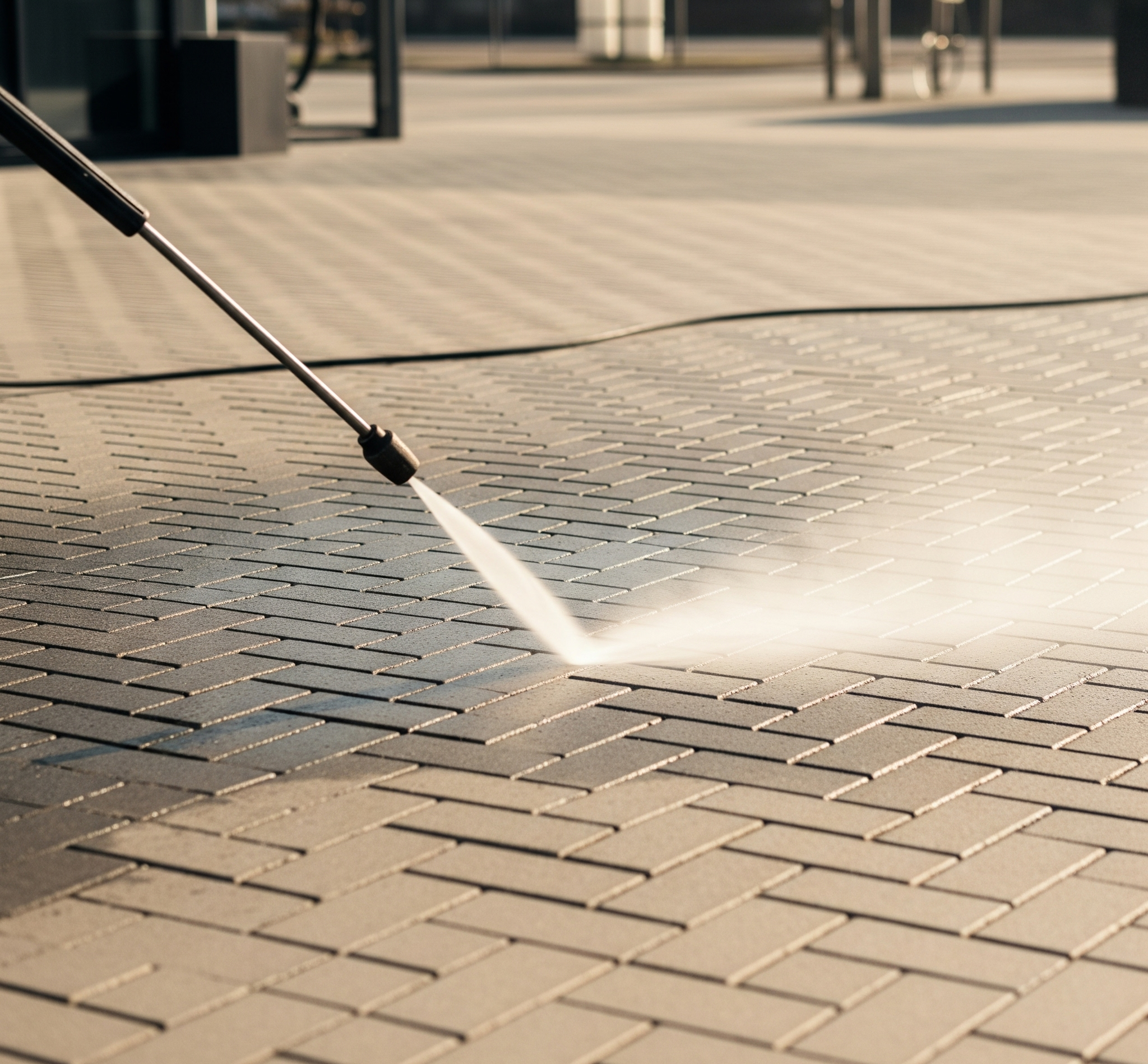
Before anything else touches your pavers, the entire surface must be power washed with a commercial-grade machine operating at 3,000 to 3,500 PSI, fitted with a surface cleaner attachment for uniform coverage. The purpose of this wash is not cosmetic, though it certainly transforms the appearance. The purpose is full-depth joint extraction. We are blowing out the old, failed sand. We are dislodging the compacted organic matter—the decomposed leaf debris, the moss colonies, the root networks of weeds that have threaded their way deep into the joint profile. We are removing the efflorescence, the calcium carbonate deposits, the tire marks, the embedded grime. Everything must go. The joints must be opened to their full depth, clean and ready to accept new material.
This is not a garden hose rinse. On a typical Etobicoke driveway that hasn't been properly maintained in three to five years, this extraction process alone can take a full day. The difference between a surface that has been thoroughly cleaned and one that has been superficially sprayed is the difference between a successful restoration and an expensive failure.
Step 2: Install Fresh Polymeric Sand
With the joints thoroughly cleaned and the surface dried sufficiently to prevent premature activation, fresh polymeric sand is swept into every joint. This is not as simple as it sounds. The sand must be distributed evenly, worked into the joints with a stiff-bristled push broom, and then mechanically compacted—typically with a plate compactor fitted with a rubber pad to protect the paver faces. The compaction drives the sand deep into the joint profile, eliminating air voids and ensuring the material is seated firmly from the bottom of the joint to the surface. You want full joint contact, not a thin layer of sand perched on top of an air pocket.
The excess material is then meticulously blown off the paver faces with a leaf blower. This step is critical: any polymeric sand left on the paver surface will activate when you mist it, bonding permanently to the face of the stone and leaving a hazy, gritty film that is extraordinarily difficult to remove once cured. Precision here is non-negotiable.
Once the joints are filled and the faces are clean, a controlled water mist is applied to activate the polymer binders. Not a flood. Not a pressure wash. A gentle, even mist that saturates the sand without displacing it from the joints. The water triggers the cross-linking reaction, and the curing process begins.
Step 3: Allow Full Cure
This is where patience separates the professionals from the amateurs. The polymeric sand requires a minimum of 24 to 48 hours of dry weather to achieve its initial cure. During this window, rain is the enemy. If a significant rainfall hits fresh polymeric sand before it has set, the water can wash the uncured binders out of the joints, creating a white, hazy residue across the paver surface and leaving the joints partially bound—weak, porous, and vulnerable to exactly the kind of washout you were trying to prevent. We monitor weather forecasts obsessively before scheduling sand installation. If the forecast shows rain within 48 hours, we defer. No exceptions.
Step 4: Seal Over the Top
Only after the polymeric sand has fully cured do we apply the paver sealer. The sealer goes over the sand, not under it, not instead of it. The sealer serves as the final encapsulation layer: it bonds to the paver face and the cured sand joints simultaneously, creating a unified, protective membrane that enhances color, deepens the wet-look aesthetic, and provides an additional barrier against moisture penetration, UV degradation, and organic staining.
And this is precisely where the massive liability lives if you do it backwards.
The Catastrophe of Doing It Backwards
We need to be very direct about this, because we see it happen across Etobicoke and the broader GTA with alarming regularity. A homeowner calls a contractor—or worse, attempts it themselves—and the contractor, in a rush to finish the job in a single day, skips the sand step entirely. They pressure wash the surface (sometimes), and then immediately spray sealer over the top. The driveway looks great for about 72 hours. The sealer gives it a gorgeous, glossy finish. The homeowner writes a cheque and feels like the project was a success.
But here is what actually happened beneath that glossy surface. The old, failing joint sand—compacted with years of organic debris, weed roots, insect tunnels, and decomposed matter—was never removed. The sealer simply laminated all of that contamination permanently into the joint. The weed roots are now chemically sealed in place, preserved under a transparent, impervious film. The ant channels are still there, but now they are impossible to access for remediation without stripping the sealer entirely. The mud and organic silt are locked in place, giving the joints a dark, streaky, permanently dirty appearance that no amount of surface cleaning will ever address.
Within weeks, the weeds push through anyway. They always do. Because the sealer film across the top of a joint is microscopically thin—far too thin to resist the hydraulic pressure of a germinating root system. The weeds crack through the sealer film at the joint, the sealer peels back from the disrupted area, and now you have a surface that looks worse than it did before the project started: sealed pavers with visibly cracking, peeling joint lines and weeds growing through the failures.
The corrective work to fix this—stripping the sealer, extracting the contaminated joints, reinstalling polymeric sand, and resealing properly—costs significantly more than doing it right the first time. This is not a hypothetical scenario. This is a correction we perform routinely.
"Don't seal the disease under a glossy finish. Extract it, replace it, cure it, and then seal the cure."
Structural Necessity and the Luxury Aesthetic
Beyond the chemical and procedural realities, there is a structural and aesthetic dimension to polymeric sand that elevates it from a functional necessity to a genuine design element.
Structural Performance in Ontario Weather
Consider what happens to a paver driveway in Etobicoke during a heavy spring rainstorm. We are talking about the kind of downpour that turns Mimico Creek into a torrent and overwhelms storm drains across the neighbourhood. On a driveway filled with conventional sweep-in sand, that water sheets across the surface, enters every joint, and erodes the loose material like a river cutting through sandstone. The sand migrates out of the joints, collects in low spots, washes down the apron and into the street. Within a single season of heavy rainfall, the joints are visibly hollow. The pavers begin to shift under vehicle loads because the lateral restraint that the sand was providing has been removed. Ants discover the empty joints almost immediately. Weed seeds follow within days. The entire system begins to degrade.
Polymeric sand resists this. The cured polymer matrix repels water rather than absorbing it. Rainfall sheets across the cured joint surface and drains off the edge of the pavement or into the bedding layer through controlled drainage channels. The sand stays put. The joints remain filled and stable. And crucially, the polymer matrix retains enough flexibility to accommodate the frost heave and thaw settlement cycles that Ontario's climate imposes on every exterior surface from November through April. It flexes without cracking. It holds without being brittle.
The Aesthetic Accent: Joints as Architecture
Here is where polymeric sand transcends pure function and enters the realm of design. Most homeowners treat the joints between their pavers as an afterthought—a necessary gap that gets filled with whatever beige or grey material the installer happened to have on the truck. But at Cinintiriks, we treat the joint as an architectural accent line.
Consider this: a large-format Warm Off-White or Ivory Cream paver, laid in a clean linear pattern across a generous backyard patio. The pavers themselves are beautiful. But it is the deep Charcoal polymeric sand in the joints that provides the visual definition. That dark joint line frames each individual unit, creates depth and shadow, and gives the installation a sense of precision and intentionality that simply does not exist when the joint sand matches the paver color. It is the difference between a floor that looks like a single, featureless plane and a floor that looks like a carefully composed mosaic of individual stone elements.
Conversely, on a darker paver—a deep Onyx or Charcoal Holland unit—a lighter Granite Grey polymeric sand in the joints creates a striking contrast that emphasises the geometric pattern and adds a contemporary, high-design sensibility to the installation. We have specified this approach on numerous projects across Etobicoke's residential streetscapes, and the response from homeowners is consistently the same: "I never thought the joints could make that much of a difference."
They can. They absolutely can. And the sealer, when applied over the top, locks that aesthetic contrast permanently in place while deepening the color of both the paver face and the sand, creating a unified, rich, wet-look finish that reads as unmistakably premium.
The Cinintiriks Approach: Engineering the Solution
The Cinintiriks Standard for Paver Restoration
At Cinintiriks, we do not spray chemicals on dirty driveways. We do not offer "quick seal" packages that skip the joint work. We execute heavy civil restoration—a full, sequenced engineering process that addresses the structural integrity of the pavement before we even think about the cosmetic finish. Here is precisely how we approach every paver restoration project in Etobicoke and across the Greater Toronto Area.
1. Comprehensive Surface Assessment: Before any equipment arrives on site, we walk the entire installation and assess the condition of every component: paver face integrity, joint depth and stability, bedding layer settlement, edge restraint condition, and drainage performance. We identify areas of subsidence, heave, and lateral shift. We photograph the existing condition as part of our project documentation. If structural repairs are needed—if individual pavers have cracked, if sections have sunk significantly, if the edge restraint has failed—those issues are addressed before the restoration sequence begins. You cannot seal your way out of a structural problem.
2. Full-Depth Joint Extraction (3,500+ PSI): We power wash the entire surface with commercial-grade hot-water equipment, operating at pressures sufficient to blast the old, contaminated joint material completely out of the profile. Every joint is opened to its full depth. All organic matter—root systems, moss, algae, decomposed debris—is physically expelled. The paver faces are cleaned simultaneously, removing efflorescence, tire marks, oil stains, and surface grime. For heavily stained areas, we pre-treat with targeted chemical applications: degreasers for petroleum contamination, oxidisers for biological growth, and acid-based cleaners for mineral deposits. The result is a surface that is forensically clean, with joints that are ready to accept fresh material.
3. Precise Chemical Polymeric Sand Installation: Once the surface is adequately dried, we install premium-grade polymeric sand into every joint. The sand is swept in with professional brooms, mechanically compacted with a rubber-padded plate compactor to eliminate air voids and achieve maximum joint density, and then meticulously blown clean from the paver faces. We then apply a controlled water mist to activate the polymer binders, carefully managing saturation levels to ensure full activation without displacement. We select the sand color deliberately—Charcoal, Granite Grey, or Natural Beige—based on the paver color and the client's design intent, treating the joint as an architectural element rather than an afterthought.
4. Monitored Cure Period (24–72 Hours): The polymeric sand is left to fully cure before any sealer is applied. We monitor weather conditions throughout this window and will reschedule the sealing phase if precipitation threatens. We do not rush this step. The integrity of the entire restoration depends on allowing the polymer cross-linking reaction to complete undisturbed.
5. Premium Sealant Application: Only after the joints are fully cured do we apply a professional-grade paver sealer. We use high-solids, solvent-based or advanced water-based formulations (depending on the surface material and client preference) applied via the spray-and-back-roll method for uniform, bubble-free coverage. Two thin coats with proper flash-off time between them. The sealer encapsulates the entire system—paver faces and cured polymeric joints together—creating a unified, water-repellent, UV-resistant, stain-resistant finish that enhances color depth and delivers the wet-look aesthetic that defines a luxury hardscape installation.
6. Final Inspection & Client Walkthrough: On completion, we walk the entire installation with the homeowner, verifying joint fill levels, sealer uniformity, and overall appearance. We provide detailed maintenance instructions—including guidance on de-icing product selection, seasonal cleaning protocols, and expected reseal intervals—to ensure the investment is protected for years to come.
This is what we mean by The Cinintiriks Standard. It is not a marketing phrase. It is a rigid, sequential engineering protocol that we follow on every project, without exception. It is more labor-intensive than what most contractors deliver. It takes more time. It costs more upfront. And it produces results that are structurally sound, visually stunning, and built to survive Ontario's winters. That is the trade-off, and it is one that our clients in Etobicoke and across the GTA have come to expect.
Understanding Product Quality: Not All Polymeric Sand Is Equal
A brief but important digression on product selection, because this is an area where a well-meaning homeowner or an under-qualified contractor can undermine the entire project before it even begins.
The polymeric sand market has exploded over the past decade, and the quality range is enormous. At the top end, you have professional-grade formulations from manufacturers like Techniseal, Alliance, and Unilock—products that use high-purity quartz aggregates with precise particle size distributions, advanced polymer binder systems engineered for Ontario's freeze-thaw environment, and integrated insect deterrents. These products cost more per bag. They also perform for five to eight years in a properly sealed joint system.
At the bottom end, you have hardware-store sand products that are marketed as "polymeric" but contain minimal binder content, poorly graded aggregates, and no insect or weed treatment additives. They are inexpensive. They are also functionally equivalent to slightly sticky regular sand. They wash out within a year. They crack under frost pressure. They leave a hazy residue on the paver face that is nearly impossible to remove without chemical stripping. The four-dollar-per-bag saving translates directly into a multi-hundred-dollar correction within 12 months.
We specify professional-grade polymeric sand exclusively. The cost difference per square foot of joint is measured in pennies. The performance difference is measured in years.
Common Misconceptions We Encounter
"I sealed my pavers last year without redoing the sand, and they look fine."
They may look fine now. The sealer is masking the deterioration happening beneath it. Within two to three seasons, the weed roots sealed into the joints will either push through the sealer film or decompose into voids that cause the sealer to sag and crack along the joint lines. We see this progression consistently. The longer you wait to address it, the more costly the correction becomes, because now you have to strip the sealer before you can even begin the proper restoration sequence.
"My joints still have sand in them. I don't need new polymeric sand."
The fact that there is material in the joints does not mean the joints are functioning. Old polymeric sand degrades. The polymer binders break down under UV exposure and moisture cycling. What was once a bonded matrix becomes powder again—loose, friable, and offering no structural benefit. You can test this yourself: push the tip of a flathead screwdriver into a joint. If it penetrates easily and the material crumbles, the sand has failed. If it resists penetration and feels solid, the sand is still performing. Most joints we assess on properties that haven't been maintained in three or more years fail this test decisively.
"Polymeric sand is just for aesthetics. Regular sand is fine structurally."
This is flatly incorrect. Regular sand provides zero resistance to water erosion, insect excavation, or weed penetration. It offers only compression-based lateral restraint, which is immediately compromised the moment any sand migrates out of the joint. Polymeric sand provides bonded lateral restraint, water resistance, insect deterrence, and weed prevention simultaneously. Calling it "cosmetic" is like calling rebar in a concrete slab "decorative." It is a structural component.
FAQ: Polymeric Sand and Resealing
Can I apply new polymeric sand directly on top of old, failing sand in the joints?
No. This is one of the most common mistakes we encounter, and it produces predictably poor results. Old, degraded polymeric sand—or worse, old conventional sand that has become contaminated with organic debris—creates an unstable substrate. If you pour fresh polymeric sand on top of it, the new material bonds to the old, failing layer rather than to the clean walls of the paver joint itself. When the old layer continues to degrade (and it will), it takes the new layer with it. You end up with double the material volume crumbling out of the joint. The correct procedure is always full-depth extraction of the old material, through high-pressure washing, followed by installation of fresh polymeric sand into clean, open joints. There is no shortcut to this. Layering new over old is throwing money into a failing system.
How long does fresh polymeric sand need to dry before I can safely apply a paver sealer?
The minimum cure time is 24 hours of continuous dry weather after the water activation step, though 48 to 72 hours is strongly recommended for a complete, deep cure—particularly in cooler spring or fall temperatures where the polymer cross-linking reaction proceeds more slowly. The critical factor is not just time but weather conditions during that window. If it rains within the first 24 hours of activation, the uncured binders can be washed out of the joints, leaving a white haze on the paver surface and compromised joint integrity. We always check extended forecasts before scheduling sand installation, and we will defer the project rather than risk a premature rain event. Once the sand is fully cured—firm to the touch, non-powdery, and resistant to water displacement—the sealer can be safely applied over the top, encapsulating the joint system and the paver face as a single unified finish.
Will a high-gloss sealant change the color of the polymeric sand in my driveway joints?
Yes, and this is actually one of the benefits. A high-gloss, film-forming sealer will deepen and enrich the color of both the paver face and the cured polymeric sand, creating the "wet look" effect that makes the installation look perpetually fresh, saturated, and dimensional. A Charcoal polymeric sand, for example, will appear as a deep, true black under a gloss sealer, providing dramatic contrast against lighter pavers. A Granite Grey sand will darken slightly to a rich slate tone. This color enhancement is permanent for the lifespan of the sealer coat (typically 3 to 5 years in the GTA climate) and is one of the key reasons why the sand-then-seal sequence produces such a visually striking final result. If you prefer the natural, unenhanced color of your sand and pavers, a matte or penetrating sealer will provide protection with minimal color change—though you will sacrifice the depth and gloss that most luxury installations demand.
The Final Word
Polymeric sand is not a maintenance product. It is not a cosmetic upgrade. It is a critical structural component of every interlocking paver system, and its proper installation is the foundation upon which every successful resealing project is built. If you remember nothing else from this guide, remember this: clean the joints, install fresh polymeric sand, let it cure, and then seal over the top. That is the golden sequence. That is the non-negotiable order of operations. And that is the difference between a paver restoration that lasts five years and one that fails in five weeks.
Don't ruin your luxury interlocking with a backward resealing job. Contact Cinintiriks for heavily engineered, structurally flawless paver restoration in Etobicoke.