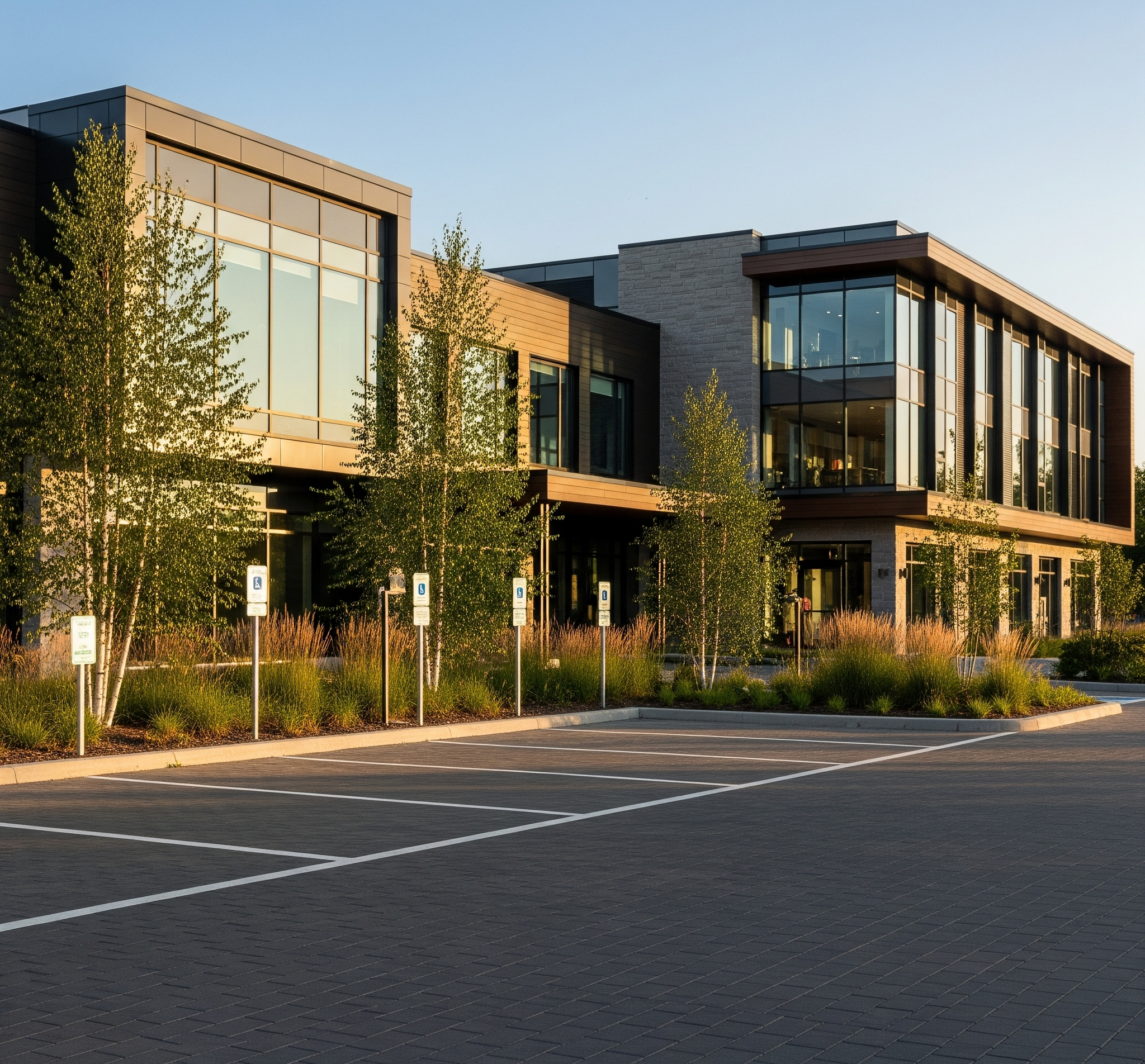
Ontario is not Georgia. The Greater Toronto Area experiences one of the most punishing thermal cycles of any major metropolitan area in the developed world. In Etobicoke alone, a commercial plaza surface can endure 80 to 120 freeze-thaw cycles per winter—80 to 120 instances where water trapped inside the concrete matrix or beneath the paver joints freezes, expands by approximately 9% in volume, and then thaws, leaving behind microscopic voids that accumulate into visible damage over successive seasons.
When you combine that thermal assault with the massive volumes of sodium chloride and calcium chloride de-icing salt that commercial property managers spread on retail plazas and public walkways every winter, and add the mechanical loading of commercial snowploughs scraping steel blades across the surface, the textbook lifespan numbers become meaningless. A poorly installed commercial plaza in the GTA—one built on an inadequate sub-base with low-quality concrete or budget pavers—can fail, crack, spall, and become a genuine trip hazard in under five years.
That is not an exaggeration. We have walked onto commercial properties across Etobicoke and the broader GTA where the hardscape was installed three or four years earlier and already looked like it had endured two decades of neglect. Spalled concrete surfaces with exposed aggregate where the top layer has peeled away. Interlocking pavers that have heaved 40 to 50mm out of plane because the sub-base drainage failed and frost heave pushed them upward. Control joints in poured slabs that have opened into 15mm cracks because the granular base was never compacted to specification. These are not unusual scenarios. They are the default outcome when commercial hardscaping is installed without proper engineering.
This guide breaks down exactly why commercial plazas and public walkways fail prematurely in Canadian climate, what the true lifespan numbers are when the work is done properly, and what separates a 5-year failure from a 40-year investment.
The Lifespan Variables: Sub-Base, Salt, and Traffic
When a commercial property owner asks us how long their plaza will last, the instinct is to answer with a number. Fifteen years. Twenty-five years. Thirty years. But the honest answer is that lifespan is not a property of the surface material alone. It is the product of at least four interdependent variables, and if any one of them is deficient, the entire system fails far earlier than the surface material's theoretical capacity.
Variable 1: The Sub-Base (Everything You Cannot See)
If there is one sentence in this entire guide that matters more than any other, it is this: the lifespan of any commercial hardscape is determined by what is underneath it, not what is on top of it.
The sub-base is the engineered foundation beneath the visible paver or concrete surface. On a properly engineered commercial plaza, the sub-base is typically a 300 to 450mm deep reservoir of clear-crushed granular stone (19mm or 50mm nominal size, depending on design requirements), compacted in controlled lifts, placed on top of a non-woven geotextile fabric that prevents the native soil from migrating upward into the granular layer. The purpose of this sub-base is twofold:
- Load distribution: The sub-base spreads the concentrated point loads from pedestrian traffic, vehicle tires, and snowplough blades across a wide area of the underlying native soil, preventing localised settlement and structural failure of the surface
- Drainage: The void spaces between the crushed stone particles create a massive water-management reservoir. When rain or snowmelt penetrates the surface joints, it drains through the sub-base and is channelled to perimeter drains, catch basins, or the native subsoil (if percolation rates permit). Critically, water does not sit against the bottom of the surface material. This is what prevents freeze-thaw damage. When water freezes beneath the surface, it expands and pushes the surface upward—this is frost heave. When the sub-base drains effectively, there is no water to freeze, and therefore no heave
On budget commercial installations—the kind that promise low square-metre pricing and aggressive timelines—the sub-base is typically 150mm or less of ungraded fill, sometimes recycled concrete aggregate of inconsistent gradation, placed in a single lift without proper compaction testing. This type of sub-base does not drain. It holds water. It freezes. It heaves. And the surface on top of it cracks, shifts, and fails within a handful of winters.
In Etobicoke, where the native soils along the Lake Ontario shoreline and the Humber River corridor often include significant clay content with very low percolation rates, sub-base drainage design is not optional—it is the single most critical engineering decision on any commercial hardscaping project. Clay does not drain. If the sub-base is not designed to manage 100% of the water infiltration internally (through granular storage and managed outflow), the water has nowhere to go except to freeze in place beneath your pavers.
Variable 2: De-Icing Salt (The Chemical Accelerator)
A commercial retail plaza in the GTA receives more de-icing chemical exposure per square metre than virtually any other hardscape application. Property managers in Etobicoke are legally and practically obligated to maintain slip-free pedestrian surfaces throughout the winter—one slip-and-fall lawsuit on an icy walkway can cost more than the entire hardscaping project. So the salt goes down. Heavily. Repeatedly. Sometimes daily during extended cold snaps.
The problem with salt is not that it melts ice. The problem is how it melts ice. When sodium chloride dissolves the surface ice, it creates a brine solution that depresses the freezing point of the water. This brine penetrates the surface pores of the concrete or the paver joints and seeps into the sub-surface layers. When the temperature drops below the brine's depressed freezing point (typically around -21°C for sodium chloride), the brine refreezes—but now it refreezes inside the concrete matrix or at the surface-to-bedding interface, precisely where expansion damage is most destructive.
The result is surface scaling—the progressive flaking and delamination of the top 3-5mm of the concrete surface. On a poured concrete plaza, scaling starts as minor surface roughening and progresses to full aggregate exposure within 3 to 5 winters of heavy salt application. On interlocking pavers, salt damage manifests differently—primarily as accelerated efflorescence (white salt deposits migrating to the surface), joint sand erosion, and in extreme cases, surface spalling of the paver face.
The engineering response to salt damage is not to avoid salt—that is not realistic on a commercial property in Ontario. The response is to specify materials that resist salt penetration: air-entrained concrete with a minimum 5-7% air void content (specified in CSA A23.1 for freeze-thaw exposure), or high-density interlocking pavers manufactured to CSA A231.2 standards with a minimum 50 MPa compressive strength and 300+ freeze-thaw cycle rating. Both of these material specifications create a microstructure that resists brine penetration and accommodates the internal expansion of freeze-thaw cycling without surface failure.
Variable 3: Traffic Loading (Pedestrian, Vehicle, and Plough)
A residential patio sees foot traffic from a family of four. A commercial retail plaza in Etobicoke might see thousands of pedestrian crossings per day, plus vehicle traffic in adjacent parking areas, delivery truck manoeuvring, and—most destructively—commercial snowplough blades scraping the surface multiple times per snowfall event.
Snowplough damage is uniquely problematic on commercial hardscapes. A steel plough blade dragged across a concrete surface at speed creates micro-abrasion that progressively wears the surface finish and exposes the aggregate. On stamped or coloured concrete, a single winter of aggressive ploughing can strip the colour layer and scoring lines into the surface. On interlocking pavers, plough blades catch on any paver that has heaved even slightly above the surrounding plane, chipping the leading edge of the raised paver and creating a cascade of damage as adjacent pavers are disturbed.
The traffic variable is why commercial hardscapes require fundamentally different material specifications than residential ones. Residential-grade 60mm pavers and 20 MPa concrete are not engineered for commercial traffic loads. Commercial plazas require 80mm minimum paver thickness (100mm for vehicle areas), 32 MPa minimum concrete strength (35 MPa preferred), and steel-reinforced concrete with properly engineered control joints at maximum 3m spacing to manage shrinkage cracking.
Variable 4: Maintenance (Or the Lack of It)
The most perfectly engineered commercial hardscape in the world will underperform its potential lifespan if it is not maintained. On interlocking paver systems, joint sand replenishment is the single most important maintenance task. The polymeric sand that fills the joints between pavers serves a structural function—it locks the pavers into a unified field that distributes load laterally and prevents individual pavers from shifting or rocking under traffic. When joint sand erodes (from rain, power washing, or plough action), the pavers lose interlock. Once interlock is lost, individual pavers begin to shift, creating gaps, lipping, and ultimately trip hazards.
On poured concrete, crack sealing and joint maintenance are the critical tasks. Every control joint cut into a concrete slab is a designed weak point intended to control where cracking occurs. These joints must be sealed with a flexible backer rod and polyurethane sealant that prevents water from entering the joint and reaching the sub-base. When joint sealant fails and water penetrates, the sub-base beneath the joint erodes, creating a void that the slab settles into—producing the stepped, uneven joints that characterise poorly maintained commercial concrete.
"We have never seen a commercial hardscape fail because the surface material wore out. Every failure we have ever documented traces back to the sub-base, the drainage, the salt exposure, or the maintenance program—or all four simultaneously."
Concrete vs. Interlocking Pavers: The 40-Year Horizon
Now that we have established the variables, let us apply them to the two dominant commercial hardscaping materials and talk real numbers.
Poured Concrete: The 15-to-20-Year Reality
Standard commercial poured concrete—32 MPa, air-entrained, steel-reinforced, poured on a properly compacted granular sub-base, with control joints at 3m centres and a broom finish for slip resistance—has a realistic functional lifespan of 15 to 20 years in a Canadian freeze-thaw climate before it requires major intervention.
That does not mean the concrete disintegrates at year 15. It means that by year 15, the cumulative effects of freeze-thaw cycling, salt scaling, traffic wear, and joint deterioration will have produced enough surface degradation and structural movement that the plaza no longer looks or performs to an acceptable commercial standard. Specifically:
- Years 1-5: The concrete performs well. Surface may show minor curing discolouration and early efflorescence. Control joints remain intact. Surface scaling is minimal if the mix design was properly air-entrained
- Years 5-10: Surface scaling begins in areas of heavy salt exposure. Fine cracks appear at control joints and may extend beyond joints if spacing was inadequate. Colour and surface finish show wear. The concrete still performs structurally, but aesthetically, it has aged significantly
- Years 10-15: Scaling becomes more pronounced. Joint sealant is failing or gone entirely. Water is entering the sub-base through joints, accelerating sub-base erosion and producing localised settlement. Some sections may show 5-10mm of differential settlement between adjacent panels. The surface is developing visible wear patterns—darker areas where oil has stained, lighter areas where scaling has exposed aggregate
- Years 15-20: The plaza requires significant intervention. Options at this stage are partial replacement (remove and repour the worst sections, which never match the existing colour or texture), full overlay (bonded concrete overlay, thin-set pavers, or asphalt resurfacing), or full removal and replacement. Most commercial property owners choose to live with the deterioration until year 20-25 and then execute a full reinstallation
The key weakness of concrete in a commercial freeze-thaw environment is that it is a rigid system. A concrete slab cannot accommodate movement. When the sub-base shifts due to frost heave, the slab cracks. When one section settles and the adjacent section does not, the differential creates a stepped joint. Cracks and stepped joints are not cosmetic issues on a commercial plaza—they are trip hazards that expose the property owner to liability, and they are water entry points that accelerate the sub-base deterioration in a self-reinforcing cycle of damage.
Interlocking Pavers: The 30-to-40-Year Horizon
Heavily engineered, high-density commercial interlocking pavers—80mm minimum thickness, 50+ MPa compressive strength, through-mix integral colour, laid on a deep clear-stone drainage base with a properly graded bedding layer and polymeric joint sand—have a realistic functional lifespan of 30 to 40 years in a Canadian freeze-thaw climate.
The reason pavers outperform poured concrete by this margin is fundamentally mechanical, not material. Both concrete and interlocking pavers are made from essentially the same substance—cementitious material with aggregate and pigment. The difference is structural behaviour:
- Flexible vs. rigid: An interlocking paver field is a flexible pavement system. Each individual paver is a discrete unit separated from its neighbours by sand-filled joints. When the sub-base experiences frost heave, the pavers move with it—they rise slightly, shift laterally a few millimetres, and then return to approximately their original position when the ground thaws. The joints absorb the movement. A concrete slab subjected to the same heave cracks, because a rigid monolithic slab cannot flex
- Repairability: When a section of poured concrete fails, the repair is demolition and replacement of the entire panel—a loud, disruptive, dusty process that requires sawcutting, jackhammering, excavation, formwork, pouring, curing, and typically 7-14 days before the area can be reopened to traffic. When a section of interlocking pavers needs attention, the affected pavers are lifted, the bedding corrected, and the same pavers reinstalled—typically completed in a single day with minimal disruption to tenants and customers. This repairability is the single greatest economic advantage of pavers in a commercial environment
- No surface scaling: High-density commercial pavers manufactured to CSA A231.2 standards are pressed at extremely high pressures (typically 2,000+ tonnes of hydraulic force), producing a surface density that resists salt penetration and freeze-thaw cycling far more effectively than cast-in-place concrete, which is poured, vibrated, and trowelled on-site under field conditions that are inherently less controlled than a factory environment
- Aesthetic longevity: Through-mix integral colour pavers look essentially the same at year 20 as they did at year 2. There is no colour layer to wear off, no surface finish to erode, no stamped pattern to fade. The paver is the same colour and texture at any depth, so even surface abrasion from snowplough blades does not change the visual appearance. A poured concrete surface, by contrast, shows its age transparently—every scar, stain, patch, and repair is permanently visible
On commercial properties across Etobicoke—along the Queensway corridor, the Bloor West Village retail stretch, the Kipling-Islington commercial district—we see this comparison playing out in real time. Poured concrete plazas installed in the mid-2000s are at or past their functional lifespan, showing extensive scaling, settlement, and cracking. Interlocking paver installations from the same era, when properly maintained, are still performing and still looking respectable. The pavers that are failing are invariably the ones installed on shallow, inadequate sub-bases by contractors who treated commercial paver installation like an oversized residential driveway project.
"Concrete fights the frost. Pavers dance with it. In a climate that delivers 80 to 120 freeze-thaw cycles every winter, the surface that knows how to move is the surface that survives."
The Cinintiriks Approach: Engineering for the 40-Year Horizon
At Cinintiriks, we do not sell hardscaping. We engineer longevity. Every commercial plaza and public walkway we design and install in Etobicoke and across the GTA is built to a specification we call The Cinintiriks Standard—a set of material, structural, and drainage requirements that are non-negotiable on every commercial project, regardless of budget pressure or competitive bidding.
The Cinintiriks Standard: Commercial Hardscape Specification
1. Deep Clear-Stone Drainage Base (Minimum 375mm): Every commercial paver installation includes a minimum 375mm clear-stone sub-base (19mm or 50mm clear crushed stone with no fines) placed on non-woven geotextile fabric. In areas of Etobicoke with heavy clay soils—particularly south of Bloor near the lakefront and along the Humber River corridor—we increase this to 450-500mm to provide additional drainage capacity and frost heave buffer. This sub-base is not decorative. It is a structural drainage reservoir that manages every drop of water that enters the system, ensuring that no water sits against the bottom of the paver surface during freeze conditions.
2. High-Density Commercial Pavers (CSA A231.2 Certified): We specify 80mm minimum thickness (100mm for vehicle-accessible areas and fire routes), with a minimum 50 MPa compressive strength and a manufacturer-certified freeze-thaw rating of 300+ cycles. Every paver is through-mix integral colour—no surface-applied coatings that wear off. We source exclusively from Canadian manufacturers (Unilock, Oaks, Permacon, Techo-Bloc) whose products carry full CSA certification and whose production consistency we have verified over years of commercial installations.
3. Structural Concrete Specification (Where Applicable): On projects that include poured concrete elements (slabs, curbs, foundations, retaining walls), we specify 32 MPa minimum compressive strength, 5-7% air entrainment per CSA A23.1 exposure class C-1 (freeze-thaw with de-icing chemicals), steel-reinforced with 15M rebar at 300mm centres both ways, and control joints at a maximum of 3m spacing. We do not pour low-MPa residential-grade concrete on commercial projects. The cost difference between a 25 MPa mix and a 32 MPa mix is approximately $8-$12 per cubic metre—a negligible premium that buys a decade of additional service life.
4. Engineered Drainage Integration: The sub-base drainage is designed in coordination with the property's overall stormwater management system. Perimeter drains, catch basins, and outflow connections are sized to handle the full design storm event (typically the 100-year storm for commercial properties in the City of Toronto's jurisdiction). Water management is not an afterthought on a Cinintiriks project—it is the foundation of the entire design.
5. Compaction Testing and Quality Control: Every lift of granular base material is compacted to a minimum 95% Standard Proctor density and verified with nuclear density testing on projects exceeding 500m². We do not rely on visual inspection or operator judgement to determine compaction adequacy. If the compaction test fails, the lift is re-compacted and re-tested. This is the kind of quality control step that budget contractors skip because it costs time and money. It is also the single most common root cause of premature sub-base failure on commercial hardscapes.
6. Lifetime Maintenance Program: Every Cinintiriks commercial installation includes a documented maintenance schedule specifying annual joint sand inspection and replenishment, bi-annual power washing, sealer reapplication every 3-5 years, and a visual inspection protocol for identifying early signs of settlement, heave, or drainage issues before they become costly repairs. We build the hardscape to last 40 years, and we provide the maintenance roadmap to ensure it actually achieves that lifespan.
The difference between The Cinintiriks Standard and a conventional commercial hardscaping specification is the difference between engineering for the first winter and engineering for the fortieth winter. A poorly engineered plaza might look identical to a Cinintiriks installation on day one. By year five, the difference is visible. By year ten, it is dramatic. By year fifteen, the poorly engineered plaza is being quoted for full replacement while the Cinintiriks installation is still performing, still draining, and still presenting the kind of premium aesthetic that protects property values and attracts quality tenants.
Stop replacing your commercial walkways every decade. Contact Cinintiriks for heavily engineered, high-lifespan commercial hardscaping in Etobicoke and across the GTA.
FAQ: Commercial Plaza & Walkway Lifespan
How often should commercial concrete in a retail plaza be replaced in Ontario?
In Ontario's freeze-thaw climate, properly specified commercial concrete (32 MPa, air-entrained, steel-reinforced) on a well-compacted granular sub-base typically requires major rehabilitation or full replacement every 15 to 20 years. Minor maintenance—crack sealing, joint re-caulking, localised patching of scaled areas—should be performed annually. However, the 15-to-20-year window assumes the concrete was specified and installed correctly in the first place. We regularly see commercial concrete in the GTA that requires major intervention within 5 to 8 years because the original mix design lacked sufficient air entrainment (the microscopic air bubbles that accommodate internal ice expansion), the sub-base was too shallow, or control joints were spaced too far apart. If you are inheriting a commercial property and the concrete is showing surface scaling, extensive cracking, or differential settlement at joints, it is worth having a structural evaluation performed to determine whether you are looking at maintenance-level repairs or a full-replacement timeline. The cost of patching a plaza that needs replacing is money spent twice.
Does applying a commercial-grade sealer increase the lifespan of a public walkway?
Yes, but with a critical distinction: the right sealer type matters enormously, and a sealer does not fix structural deficiencies. A penetrating silane/siloxane sealer (not a film-forming topical sealer) applied to commercial concrete or interlocking pavers provides a hydrophobic barrier that reduces water absorption by 80-95%. Since freeze-thaw damage is fundamentally a water-expansion problem, reducing water infiltration directly reduces freeze-thaw damage. On commercial concrete, a penetrating sealer can extend the pre-scaling service life by 5 to 8 years compared to unsealed concrete in the same salt-exposure environment. On interlocking pavers, a penetrating paver sealer protects joint sand from erosion and reduces efflorescence staining. The sealer must be reapplied every 3 to 5 years on horizontal surfaces (more frequently on high-traffic pedestrian zones). Film-forming topical sealers (the glossy, wet-look coatings) are not appropriate for commercial pedestrian surfaces—they create a slippery film when wet, they peel and yellow under UV exposure, and they trap moisture beneath the film, which can actually accelerate freeze-thaw damage by preventing the concrete from drying out between weather events. We specify penetrating sealers exclusively on all commercial projects.
Why do commercial interlocking pavers last longer than poured concrete in a freeze-thaw climate?
The fundamental reason is structural flexibility. A poured concrete slab is a rigid monolithic structure. It cannot flex, bend, or accommodate ground movement without cracking. In Ontario's freeze-thaw climate, where the ground beneath any hardscape surface heaves upward in winter and settles back in spring, a rigid slab absorbs all of that movement as stress—stress that eventually exceeds the concrete's tensile strength and produces cracks. Each crack becomes a water entry point, which accelerates sub-base damage, which produces more movement, which produces more cracks. It is a self-reinforcing failure cycle. An interlocking paver system, by contrast, is a flexible articulated surface. Each paver is an independent unit that can move slightly relative to its neighbours. The sand-filled joints act as flexible hinges that absorb ground movement without concentrating stress. When frost heave raises a section of pavers 10mm, the pavers rise as a group and settle back as a group. No cracking occurs because there is no rigid structure to crack. Additionally, commercial pavers are factory-manufactured under hydraulic pressures exceeding 2,000 tonnes, producing a surface density and strength that exceeds anything achievable with field-poured concrete. A CSA A231.2 certified paver has been tested to survive 300+ simulated freeze-thaw cycles before showing any surface degradation—the equivalent of approximately 3 to 4 full Ontario winters of continuous cycling. In practice, properly installed commercial pavers routinely exceed this rating because real-world exposure is less severe than the accelerated laboratory test protocol. The combination of flexible behaviour, superior material density, and non-destructive repairability is why we consistently specify interlocking pavers as the preferred surface for commercial plazas and public walkways across Etobicoke and the GTA.
The Final Word
The average lifespan of a commercial plaza or public walkway in Canadian climate is not a fixed number. It is a direct reflection of the engineering decisions made before the first paver was laid or the first truck of concrete was poured. A budget installation on a shallow sub-base with low-grade materials might give you five years before it becomes an embarrassment and a liability. A properly engineered interlocking paver system on a deep, well-drained clear-stone base, built with CSA-certified materials and maintained according to a documented schedule, will serve your Etobicoke property for 30 to 40 years—looking premium, performing structurally, and protecting your investment through every winter the Canadian climate can deliver.
The question is not how much your plaza costs per square metre to install. The question is how much it costs per square metre per year of service life. And on that metric—the only metric that matters for a long-term commercial investment—the heavily engineered solution wins every time.
That is The Cinintiriks Standard. Not the cheapest. Not the fastest. The one that is still performing at year 40.