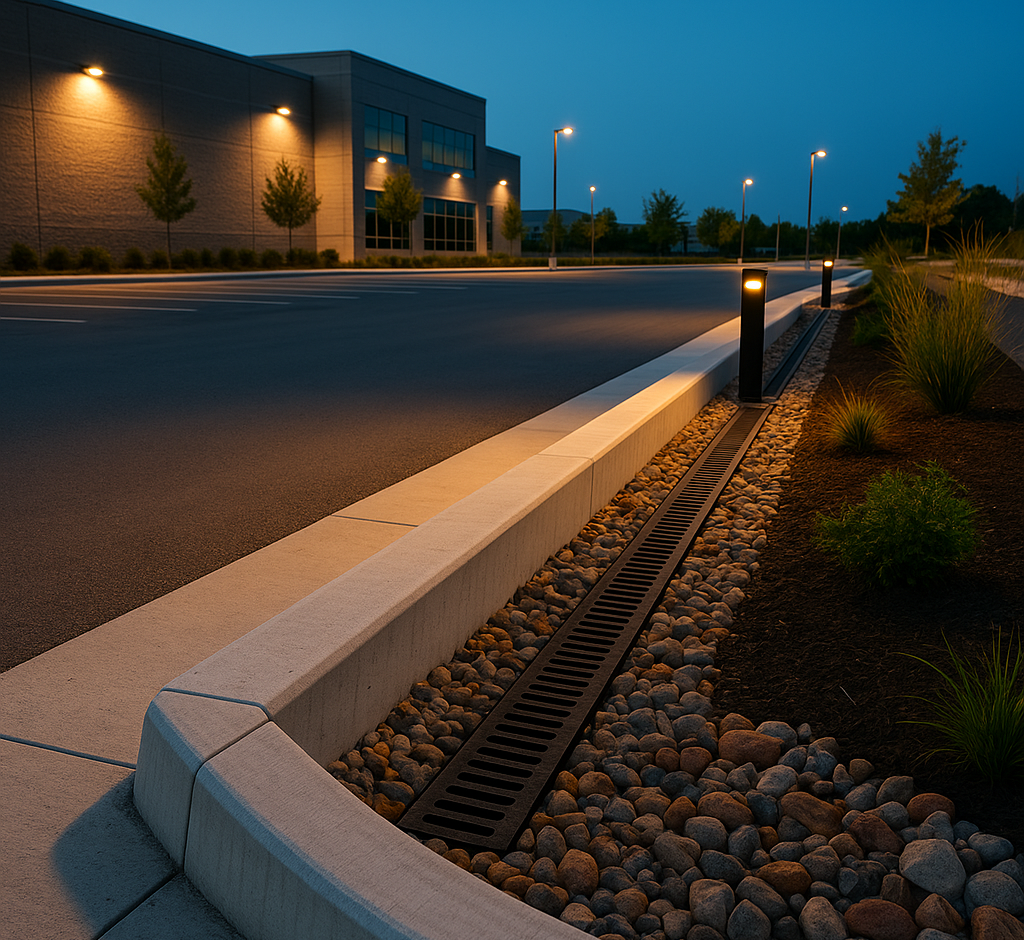
And the single system that determines whether a truck yard achieves all of these requirements or fails at every one of them is drainage. Not the surface. Not the concrete thickness. Not the rebar schedule. Drainage. Because a truck yard with perfect concrete and inadequate drainage will destroy itself from the inside out: water standing on the surface infiltrates cracks and joints, saturates the sub-base, and creates the conditions for the two most expensive failure modes in industrial hardscaping—hydraulic sub-base washout and frost heave. A truck yard with adequate concrete and excellent drainage will perform for decades, because the water never gets the chance to do what water does.
This guide covers the engineering principles, the hardware specifications, the grading requirements, and the regulatory compliance framework for designing a drainage system that will keep a GTA truck yard dry, safe, and structurally sound for 25-30+ years.
The Heavyweight Challenge: Why Truck Yards Fail
Before discussing solutions, it is worth understanding the specific failure mechanism that makes truck yard drainage fundamentally different from any other commercial drainage application.
Hydraulic Sub-Base Washout
When a 36,000 kg truck rolls over a puddle of standing water on a concrete surface, the axle load is not just compressing the concrete. It is compressing the water. Water is virtually incompressible, which means the truck's weight converts the standing puddle into a high-pressure injection system that forces water into every crack, every joint, and every microscopic pathway leading into the sub-base beneath the slab.
Once water reaches the granular sub-base, the same axle-load pumping action drives it through the gravel matrix at high velocity, carrying fine particles with it. Each truck pass erodes a small amount of material from the base. Over thousands of truck passes per day, the erosion is cumulative and progressive. A void forms beneath the slab. The void grows. The concrete above it, now spanning an unsupported gap, deflects under the next axle load. The deflection cracks the slab. The crack allows more water in. The water accelerates the erosion. Within a single season, what started as a shallow puddle has become a collapsed slab section over a washed-out void—a sinkhole in a working truck yard.
This failure mode is unique to heavy-traffic industrial surfaces. A residential driveway with the same puddle will absorb a fraction of the hydraulic force because a passenger vehicle's axle load is 1/10th of a loaded transport. A retail plaza walkway will never experience the pumping action because pedestrians do not generate hydraulic pressure. But a truck yard with standing water is a pump system where every axle pass drives destructive force into the foundation.
"In a truck yard, a puddle is not an inconvenience. It is a sinkhole in its early stage."
The Foundation of Flow: Laser Grading
Every piece of drainage hardware in a truck yard—every catch basin, every trench drain, every pipe run—is useless if the surface is not graded to move the water to it. Gravity is the engine of every drainage system, and precision grading is the steering.
The Grading Specification
A truck yard surface must be graded at a minimum 1.5% to 2% slope (3/16 to 1/4 inch per foot) toward the nearest drainage collection point (catch basin, trench drain, or channel drain). This slope must be continuous and consistent across the entire surface—no flat spots, no reversals, no undulations—and it must be achieved within a tolerance of ±3mm (1/8 inch) over any 3-metre run.
On a truck yard, the grading tolerance is not a quality preference. It is a structural necessity. A deviation of 1/2 inch in the wrong direction over a 30-foot section creates a depression that traps 50-100 litres of water after a rain event. That trapped water, subjected to the hydraulic pumping of truck traffic, initiates the sub-base washout cycle that leads to slab failure. The difference between a truck yard that drains and one that doesn't is measured in millimetres.
Laser-Guided Placement
Achieving this tolerance on a large-format industrial pour (truck yards typically range from 5,000 to 50,000+ square feet) requires laser-guided screed equipment. The concrete is placed and struck off with a laser-controlled screed that references a pre-surveyed elevation grid, maintaining the design grade across the entire placement to within the specified tolerance. Manual screeding— acceptable on a residential driveway or a small patio—cannot achieve the flatness and grade consistency required on an industrial-scale surface where even minor deviations create water traps beneath loaded truck tires.
Crown and Valley Design
The grading design for a truck yard typically follows one of two patterns:
Crown design: The surface is highest at the centre of the yard and slopes downward toward catch basins at the perimeter. This is effective for open yards where the perimeter is accessible and where drainage infrastructure can be placed along the yard edges without interfering with truck maneuvering.
Valley design: The surface slopes from the perimeter downward toward a central spine of catch basins or a linear trench drain running the length of the yard. This is preferred for narrow or rectangular yards where the travel distance from the farthest point to the perimeter would require a grade that is too steep for safe truck operations. A central collection spine cuts the travel distance in half, allowing a lower grade slope while still achieving rapid water removal.
The choice between crown and valley is determined by the yard geometry, the building locations (water must never slope toward a loading dock or building foundation), and the connection points to the municipal storm sewer. This is not a contractor decision. It is an engineering decision that must be coordinated with the site's overall stormwater management plan.
Industrial-Grade Drainage Hardware
A truck yard's drainage hardware must survive the same axle loads that the surface concrete absorbs—indefinitely, without failure, without displacement, and without maintenance frequency that disrupts yard operations. Standard residential and light-commercial drainage products will not survive in this environment.
Heavy-Duty Catch Basins
Catch basins in a truck yard must be pre-cast reinforced concrete, not plastic, not corrugated HDPE, and not polymer concrete. The basin must withstand the direct passage of loaded trucks across its frame without deflecting, cracking, or settling below the surrounding surface grade (a settled catch basin creates a depression that pools water—the exact problem it was installed to solve).
Specification:
- Pre-cast reinforced concrete construction, CSA A257 compliant
- Internal dimensions: minimum 600mm x 600mm (24" x 24") for standard yard basins; 900mm x 900mm (36" x 36") for high-volume collection points
- Sump depth: minimum 600mm (24") below the outlet invert to trap sediment, debris, and hydrocarbons before they enter the pipe system
- Frame and grate: Class E or F rated (H-20/HS-20 load rating or higher) cast ductile iron, rated for a minimum 36,000 kg (80,000 lb) wheel load. Standard Class C residential grates are rated for approximately 5,000 kg—a loaded truck axle will crush them on the first pass
- Frame set flush with the finished concrete grade, shimmed and grouted to prevent rocking and to maintain a smooth, trip-free surface transition
In Markham, where the Highway 404 and Steeles Avenue industrial corridors contain some of the GTA's busiest distribution and logistics yards, we have assessed truck yards where the original catch basins were residential- grade polymer units installed by the site's original developer to minimize construction cost. Within 3-5 years, the polymer basins had cracked under truck traffic, the grates had deformed and become trip hazards, and the sumps had collapsed, allowing unfiltered runoff (including diesel fuel and hydraulic fluid) to discharge directly into the storm sewer. The replacement cost—sawcutting the surrounding concrete, removing the failed units, installing pre-cast reinforced basins with proper frames, and re-pouring the concrete apron around each basin—was nearly three times the cost of installing the correct units from the outset.
Trench Drains (Channel Drains)
Trench drains are linear drainage channels recessed into the concrete surface, covered with a load-rated grate, and connected to the subsurface pipe network. They are the most effective hardware for capturing sheet flow across wide expanses of concrete—and in a truck yard, they serve two critical functions:
Loading dock apron drainage. The concrete apron in front of a loading dock is the most hydraulically vulnerable zone in any industrial facility. It slopes toward the building (to allow trailers to back into the dock at the correct height), which means every drop of rain that falls on the apron flows toward the building wall and the dock leveller pit. A trench drain installed at the base of the apron slope—directly in front of the dock doors—intercepts this flow before it reaches the building, capturing it and redirecting it to the storm system.
Perimeter and cross-yard interception. In a valley-design yard, a continuous trench drain running the length of the central valley collects sheet flow from both sides of the yard and conveys it to catch basins at intervals along the run. This eliminates the need for the water to travel long distances across the surface before reaching a point drain, reducing the volume of standing water at any given moment.
Specification:
- Channel body: pre-cast polymer concrete or reinforced fibreglass, with integral slope (factory-built fall) or set on a graded sub-base to maintain flow
- Channel width: minimum 200mm (8") for standard collection; 300mm (12") for high-volume dock apron applications
- Grate: Class E/F rated ductile iron, bolted to the frame (not set-in), with anti-slip surface profile. Bolted grates prevent displacement from truck tire contact and vibration
- Joints sealed with manufacturer-specified flexible sealant to prevent water bypass at channel connections
Oil-Water Separators
Truck yards generate contaminated stormwater runoff. Diesel fuel, hydraulic fluid, engine oil, antifreeze, brake dust, and tire residue are deposited on the surface by every vehicle and washed into the drainage system by every rain event. In most GTA municipalities, discharging this contaminated runoff directly into the municipal storm sewer without treatment violates the local sewer use bylaw and Ontario's Environmental Protection Act.
An oil-water separator (OWS) is a treatment device installed in the drainage pipe network, upstream of the discharge point to the municipal system. It operates on the principle of gravity separation: oily water enters the unit, flows through a series of baffled chambers at low velocity, and the lighter hydrocarbons float to the surface while the cleaner water passes through to the outlet. The trapped hydrocarbons are periodically pumped out by a licensed waste hauler.
Specification for truck yards:
- Minimum two-chamber (coalescing plate) design for effective separation of emulsified hydrocarbons
- Sized for the peak design flow rate of the contributing drainage area (typically calculated for a 5-year or 10-year storm event, depending on the municipal requirement)
- Sediment storage capacity sized for the expected sediment load (truck yards generate significantly more sediment than standard parking areas)
- Access manholes at each chamber for inspection and pump-out
- Registered with the municipality and subject to periodic compliance inspection
The Subsurface Pipe Network
Catch basins and trench drains collect the water. The pipe network conveys it to the discharge point. In a truck yard, the pipe network operates under unique constraints that do not apply to standard commercial systems:
Burial depth. All pipes must be buried below the frost penetration depth for the GTA (a minimum of 1.2 metres / 4 feet below finished grade) to prevent ice blockage during winter. A frozen drainage pipe in a truck yard during a January rain-on-snow event creates an immediate flooding emergency with no backup path for the water.
Traffic loading. Pipes beneath truck traffic zones must be installed in a granular envelope (150mm of compacted clear stone above, below, and on both sides of the pipe) to distribute axle loads around the pipe rather than transmitting them directly to the pipe crown. Non- pressure PVC (schedule 40) or reinforced concrete pipe (CSA A257, Class 3 or higher) are standard specifications. Corrugated HDPE, while common in residential and light-commercial applications, is vulnerable to deflection under sustained heavy truck loads and is not recommended beneath active truck lanes.
Pipe sizing. The pipe diameter is calculated from the contributing drainage area, the design storm intensity (typically the 10-year storm for Ontario industrial sites), and the pipe gradient. Under-sized pipes surcharge during heavy rain events, causing water to back up through catch basins and flood the yard surface. Given the cost and disruption of replacing an undersized pipe buried 4 feet beneath an active truck yard, oversizing by one pipe diameter increment (e.g., specifying 300mm where the calculation calls for 250mm) is inexpensive insurance against future capacity issues.
The Cinintiriks Approach: Transport-Grade Drainage Engineering
At Cinintiriks, truck yard drainage is not a secondary system installed after the concrete work. It is the primary engineering system around which the entire yard is designed. Our Cinintiriks Standard for Industrial Drainage integrates every component—grading, hardware, pipes, treatment, and sub-base protection—into a single coordinated system.
1. Pre-Construction Survey and Flow Modelling: Before any design work begins, we survey the existing site topography, soil conditions, and municipal storm sewer connection points. We model the stormwater flow volumes for the design storm (10-year intensity for the GTA) and calculate the required catch basin count, trench drain capacity, pipe sizes, and OWS capacity. The drainage design is not estimated. It is engineered from measured data.
2. Heavy-Duty Sub-Base Engineering: Every industrial zone receives a minimum 18-20 inch compacted Granular A sub-base over heavy-duty geotextile separation fabric. The geotextile prevents native clay from migrating into the granular base, which would clog the drainage pathways and reintroduce the moisture retention that enables frost heave. The granular base is installed in 4-inch lifts, each independently compacted to 98%+ Standard Proctor Density (higher than our commercial standard, reflecting the higher axle loads). A 2-inch HPB capillary break layer over the compacted base prevents subsurface moisture from reaching the slab soffit.
3. Laser-Controlled Concrete Placement: All truck yard concrete is placed at a minimum 200mm (8 inches) thickness with 15M rebar at 300mm centres, top and bottom mat, on a laser-verified grade. The concrete is specified at 35+ MPa 28-day strength with 5-7% entrained air (CSA A23.1 Class C-1) and a maximum water-to-cement ratio of 0.40. Tight joint spacing (3-metre maximum on truck lanes) with load-transfer dowels at every contraction joint prevents differential settlement between adjacent panels under axle loading.
4. Industrial-Grade Drainage Hardware: All catch basins are pre-cast reinforced concrete with Class F ductile iron frames and grates. All trench drains are bolted-grate, Class F rated polymer-concrete channel systems. All connections are sealed and watertight. Every hardware unit is set flush with the finished concrete grade and verified with a straightedge to confirm zero rocking or lipping that could become a tire hazard or a water trap.
5. Environmental Compliance: Every truck yard drainage system we install includes a properly sized oil-water separator, a sediment management plan, and documentation sufficient for municipal registration and compliance inspection. We coordinate with the local municipality (permits, connection approvals, inspection scheduling) as part of the project scope—not as an afterthought that delays occupancy or triggers bylaw enforcement.
6. Maintenance Protocol and Documentation: At project handover, we provide the facility operator with a complete drainage system manual: as-built drawings showing all catch basin locations, pipe runs, and OWS location; a maintenance schedule (pump-out frequency for sumps and OWS, grate inspection intervals, joint sealant inspection schedule); and a recommended winter operations protocol for de-icing and snow staging that protects the drainage infrastructure.
Winter Operations: The Drainage-Ice Connection
In the GTA, truck yard drainage is not solely a rain management system. For five months of the year, it is an ice prevention system. Every drop of water that remains on the surface of a truck yard at 0°C becomes a potential accident scene at -5°C. A loaded transport truck with a gross vehicle weight of 36,000 kg sliding on ice generates forces that no bollard, no curb, and no barrier wall can reliably contain.
Where Ice Forms First
Ice forms preferentially in the same locations where water collects: low spots, poorly graded zones, catch basin surrounds where the frame has settled below grade, trench drain grate depressions, and at the base of slopes where flow concentrates. These are exactly the areas where grading precision and hardware installation quality determine whether the drainage system prevents ice or creates it.
A catch basin that is 1/4 inch below the surrounding grade creates a puddle around its perimeter every time the snow melts. That puddle freezes overnight. The next morning, every truck that crosses it is rolling over a sheet of ice at the exact location where it would turn to align with a loading dock or exit the yard. This is not a maintenance failure. It is a construction deficiency that was built into the system from day one.
Snow Staging and Melt Management
Truck yards require large volumes of snow to be staged (piled) on-site during winter. The location of snow staging areas must be coordinated with the drainage design: snowmelt must flow toward catch basins, not toward loading docks, building foundations, or areas where trucks park and idle. Snow piled over a catch basin blocks the basin entirely, causing meltwater to pool around the pile and freeze as it spreads. Snow piled at the high point of a graded surface melts and flows down-slope to a basin as intended. Snow staging location is a drainage design parameter, not an afterthought delegated to the snow removal contractor.
Stormwater Management and Regulatory Compliance
Industrial truck yards in the GTA are subject to stormwater management requirements that go beyond simply getting the water off the surface and into the sewer. Most municipalities in the GTA (including Toronto, Vaughan, Markham, Mississauga, and others) require that new industrial developments and significant redevelopments implement stormwater quantity and quality controls on-site before discharge.
Quantity control (detention): Peak stormwater flow rates from the site must be attenuated (reduced) to pre-development levels or to a municipal-specified release rate. This is typically achieved through underground detention tanks or oversized pipe storage that accepts stormwater during peak flow and releases it to the municipal system at a controlled rate through a flow-restricting orifice.
Quality control (treatment): Runoff from industrial sites must receive treatment for total suspended solids (TSS) and hydrocarbons before discharge. Oil-water separators address hydrocarbon removal. Sediment chambers (deep sumps in catch basins) and hydrodynamic separators address TSS removal. Some municipalities require 80% TSS removal efficiency, which may necessitate proprietary treatment units beyond standard catch basin sumps.
Non-compliance with stormwater regulations can result in delays to occupancy permits, municipal orders to install retroactive treatment systems (at 2-3x the cost of incorporating them into the original design), and environmental enforcement actions under the Ontario Water Resources Act for unpermitted discharges.
The Cost of Getting Drainage Wrong
Truck yard drainage is expensive to install correctly. A complete system for a 20,000 sqft truck yard—including laser grading, pre-cast catch basins, trench drains at loading docks, subsurface pipe network, OWS, and stormwater detention—typically represents 15-25% of the total yard construction budget, or $40,000-$120,000 depending on the site conditions and regulatory requirements.
The cost of getting it wrong is multiples of that figure:
- Slab failure from sub-base washout: Saw-cutting and removing the failed section, excavating the washed-out base, rebuilding the granular and re-pouring 200mm industrial concrete costs $80-$150/sqft —versus $25-$40/sqft for the original installation. On a 2,000 sqft failure zone, the remediation cost is $160,000-$300,000.
- Environmental remediation: If contaminated runoff (diesel, hydraulic fluid) enters the storm sewer or groundwater due to a failed or missing OWS, the remediation cost (soil testing, excavation, treatment, regulatory compliance documentation) starts at $50,000 and can reach $500,000+ for significant contamination events.
- Slip-and-fall liability: A personal injury claim from a truck driver, dock worker, or visitor who falls on ice caused by inadequate drainage typically settles for $50,000-$500,000 depending on the severity of the injury. The cost of the entire drainage system is often less than a single serious injury claim.
- Operational disruption: Repairing a failed truck yard drainage system in an active facility requires phased construction, temporary traffic rerouting, and potentially reduced dock capacity during the repair period. For a distribution centre processing $100,000+/day in throughput, even a 10% capacity reduction during a 4-week repair represents $280,000+ in lost productivity.
Don't let standing water destroy your industrial lot and create massive liability. Contact Cinintiriks for heavily engineered, transport-grade drainage solutions.
FAQ: Truck Yard Drainage
How often do commercial catch basins in a truck yard need to be pumped out and cleaned?
A minimum of twice per year: once in late spring (after snowmelt debris accumulation) and once in late fall (before freeze-up). High-traffic yards or yards with significant sediment sources (gravel shoulders, unpaved staging areas, adjacent construction) may require quarterly cleaning. The sump chamber in a properly designed catch basin traps sediment, debris, and hydrocarbons below the outlet pipe invert, preventing them from entering the pipe network. But the sump has a finite capacity. If sediment accumulates to the outlet invert level, it begins passing into the pipe system, reducing pipe capacity and potentially clogging the system. More critically, if hydrocarbons accumulate above the outlet level, they discharge directly into the municipal storm sewer —a bylaw violation that triggers enforcement action. We recommend visual inspection of every catch basin monthly (a 30-second task: lift the grate, observe the water level and sump condition) and scheduled pump- out when the sediment depth reaches 50% of the sump depth.
Can I install a trench drain without completely tearing up my existing concrete pad?
Yes, but with critical conditions. A trench drain can be retrofit-installed into an existing concrete pad by saw- cutting a channel through the existing slab at the required location, removing the cut section, excavating to the required trench depth, forming and pouring the trench base, setting the channel body and grate, and patching the concrete on both sides of the channel. This is a viable approach when the existing slab is in good structural condition (no widespread cracking, heaving, or settlement) and the trench location aligns with a logical flow path on the existing grading. However, there are limitations: the retrofit trench can only connect to an existing pipe network at a point where a pipe run can be installed without disrupting the entire yard, and the existing grading must direct water toward the trench location (if the yard is graded in the opposite direction, the trench will collect nothing). A retrofit trench drain costs approximately 40-60% more per linear foot than a trench installed during new construction, because of the saw-cutting, demolition, and concrete patching involved. But it is significantly less expensive and less disruptive than tearing up the entire pad to install a new drainage system.
What happens if my truck yard doesn't have enough natural slope to move the water?
Then the slope must be created or the collection points must be
brought to the water. There are three approaches for flat or
near-flat industrial sites:
1. Re-grading the concrete surface: If the existing
concrete is at end-of-life and due for replacement, the new slab is
poured at an engineered grade with the required 1.5-2% fall, regardless
of the underlying site topography. The concrete itself creates the
slope.
2. Increasing catch basin density: On a flat yard where
the maximum achievable slope is 0.5-1%, the solution is to reduce the
travel distance from any point on the yard to the nearest drain. Instead
of relying on long-distance sheet flow, which requires steeper grades,
more catch basins are installed at closer spacing (15-20 foot centres
instead of 30-50 foot centres), so that water only needs to travel a
short distance down a shallow slope before it's captured.
3. Subsurface pump systems: In the rare case where
the site is lower than the municipal storm sewer connection (a scenario
that occurs only on deeply excavated sites or sites adjacent to elevated
municipal infrastructure), a stormwater pumping station collects the
yard drainage in a below-grade wet well and pumps it up to the storm
sewer discharge elevation. Pump systems add capital cost ($25,000-
$75,000) and ongoing maintenance (power, pump service, float switch
monitoring), but they are the only solution when gravity drainage is
physically impossible.
The Final Word
The best drainage design for a truck yard is the one that ensures water never stays on the surface long enough to matter. Not long enough to develop hydraulic pressure under an axle load. Not long enough to infiltrate a crack and reach the sub-base. Not long enough to freeze into a sheet of ice in front of a loading dock. And not long enough to carry contaminants into the municipal storm system without treatment.
Achieving this requires precision laser grading that moves water by gravity at every point on the yard, industrial-grade hardware that survives decades of transport truck loads, a subsurface pipe network buried below frost depth and sized for peak storm events, environmental treatment systems that satisfy regulatory requirements, and a sub-base that is engineered to resist the hydraulic forces that destroy inadequately drained yards from the inside out.
Every component is connected. The grading feeds the hardware. The hardware feeds the pipes. The pipes feed the treatment. The treatment feeds the discharge. And the sub-base protects everything above it from the water that the surface system did not capture fast enough. Remove any component and the system fails. Engineer every component correctly and the yard performs for a generation.