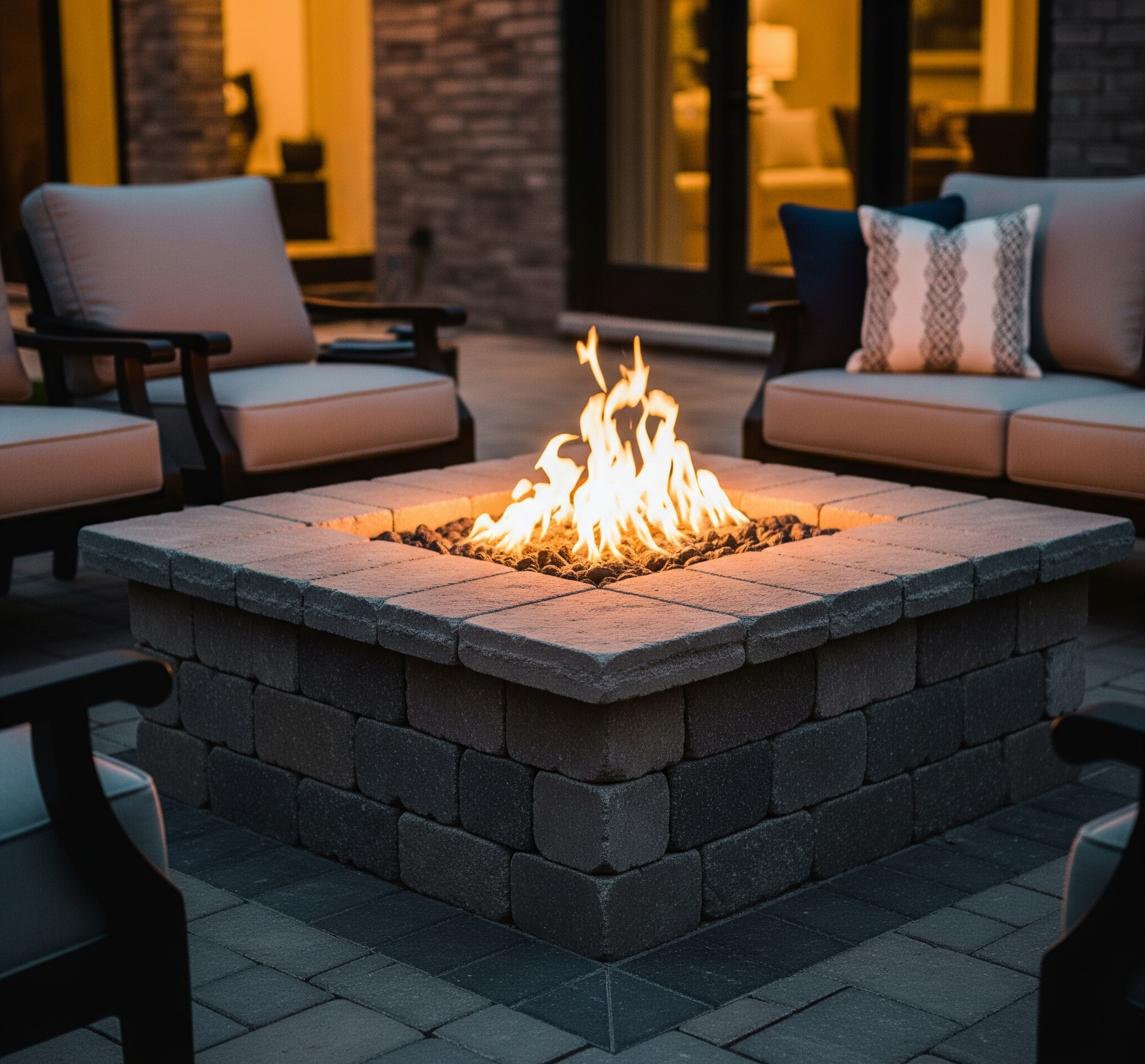
Every other material commonly sold for retaining walls in the GTA—pressure-treated timber, poured concrete, dry-stacked armour stone, railway ties, and crib walls—either rots, cracks, shifts, or requires engineering compromises that make them inferior to properly installed segmental block systems for permanent earth retention in this climate.
That is not opinion. It is material science tested by the harshest winter climate in any major Canadian metropolitan area. Let me walk you through each material, explain exactly why it fails or compromises, and then explain precisely why segmental concrete blocks have become the undisputed industry standard for structural retaining walls across Toronto and the GTA.
The Freeze-Thaw Test: Ontario’s Material Destroyer
Before comparing materials, you must understand the specific environmental forces that a retaining wall endures in Ontario. A material that performs perfectly in Vancouver, Atlanta, or London will be pulverised in Toronto. The difference is the freeze-thaw cycle.
In a typical Toronto winter, the ambient temperature oscillates above and below 0°C 40-60+ times between November and April. Each oscillation is a freeze-thaw cycle: water trapped in the soil, in the wall material pores, and in the joint spaces freezes, expands by 9%, and generates enormous internal pressure. When it thaws, the expanded void fills with more water. When it refreezes, the expansion is greater. Cycle after cycle, the material is progressively fractured, heaved, shifted, and degraded from the inside out.
Simultaneously, the saturated soil behind the wall is generating hydrostatic pressure—the weight of the water held within the soil mass, pressing laterally against the back of the wall. Toronto’s dominant soil type is Leda clay (glacial marine clay), a notoriously slow-draining, heavy, and expansive soil that holds enormous volumes of water for extended periods. Properties along the Don Valley, Humber River valley, Highland Creek corridor, and the Scarborough Bluffs sit on deep clay deposits that remain saturated well into the spring and early summer, subjecting retaining walls to sustained lateral water pressure for months at a time.
Any material used for a retaining wall in this province must resist both forces simultaneously: hydrostatic pressure pushing the wall outward, and freeze-thaw cycling trying to fracture the wall material and heave the wall foundation upward. Materials that cannot do both will fail. The question is not whether they fail, but how quickly.
Material 1: Pressure-Treated Timber — The Temporary Illusion
Pressure-treated timber (typically 6×6 or 8×8 landscape timbers, or stacked 2×6 / 2×8 boards with deadman tie-backs) is the most common material used in budget retaining walls across Ontario. It is also the material with the highest failure rate.
Why It Fails
- Rot: Pressure-treatment (ACQ or CA-B preservative infused under pressure) slows but does not prevent wood decomposition. In ground contact in Ontario’s wet clay soil, the preservative leaches out over time, and the wood fibres are attacked by brown rot and soft rot fungi that thrive in the sustained-moisture, freeze-thaw environment. The rot starts at the buried portions and soil-contact surfaces—exactly the structural zones that carry the earth-retention loads. By year 8-12, the buried timbers have lost 40-60% of their original cross-sectional strength, even though the visible face may still appear largely intact
- Warp and twist: Repeated wetting and drying cycles (summer heat drying the exposed face while the buried face remains saturated) cause the timbers to warp, twist, bow, and cup as the wood fibres expand and contract unevenly. A timber wall that was installed plumb and straight develops visible curvature within 3-5 years, and by year 8-10 the wall has a pronounced lean that signals active structural failure
- Spike and fastener failure: Timber retaining walls rely on galvanised landscape spikes, lag bolts, and deadman tie-back connections to hold the stacked timbers together and anchor them to the retained soil. In Ontario’s freeze-thaw environment, the timber expands and contracts around the fasteners, progressively loosening the connections over time. Additionally, the galvanised coating on the spikes degrades in the acidic, wet soil, and the steel begins to corrode. By year 10-12, many of the fastener connections have lost significant holding power, allowing the timbers to shift independently under earth pressure
- No drainage integration: Most timber retaining walls are installed without a proper drainage system (weeping tile, clear stone backfill, filter fabric). The hydrostatic pressure builds unchecked behind the wall, and the saturated soil is in continuous contact with the wood, accelerating rot and increasing the lateral force that the deteriorating wall must resist
Expected lifespan in Ontario: 8-15 years before structural failure. Replacement cost: 120-150% of original build cost (demolition + hazardous CCA lumber disposal + new construction).
Material 2: Poured Concrete — Strong but Brittle
Poured-in-place (cast-in-place) concrete retaining walls are the traditional structural engineering solution for earth retention. They are extremely strong in compression and can be designed to resist very high lateral earth pressures. They are the standard for highway infrastructure, bridge abutments, and heavy commercial applications. But on residential and light commercial properties in Toronto, poured concrete walls present significant challenges.
The Cracking Problem
Concrete is strong in compression but weak in tension. When the frost heaves the soil beneath and behind the wall, it imposes bending forces and point loads on the monolithic concrete slab that generate tensile stress in the concrete. Concrete responds to tensile stress by cracking. Not by flexing. Not by shifting. By cracking.
In a climate with minimal freeze-thaw, these cracks are minor and largely cosmetic. In Toronto, with 40-60+ freeze-thaw cycles per winter, each crack becomes a water entry point. Water penetrates the crack, freezes inside the concrete mass, expands, and widens the crack. Cycle after cycle, hairline cracks become structural cracks that propagate through the wall, eventually compromising the structural integrity of the section.
The Footing Requirement
To resist frost heave, a poured concrete retaining wall requires a massive reinforced concrete footing founded below the frost line (1.2 metres in Toronto). The footing must be wide enough and heavy enough to resist both the lateral earth pressure and the vertical frost-heave forces. Typical footing dimensions for a 1.2m (4-foot) poured concrete retaining wall: 600-900mm wide by 300-450mm thick, with #15M or #20M steel rebar reinforcement. The footing alone is a significant excavation, formwork, and concrete cost—often representing 30-40% of the total wall cost.
The Aesthetic Challenge
A poured concrete retaining wall is a flat grey slab. It has no texture, no colour depth, and no visual interest. On a luxury Toronto property where the patio is Warm Off-White interlocking pavers with Deep Charcoal borders, where the outdoor kitchen is clad in natural stone veneer, and where the fire table is a custom-fabricated masonry feature, a flat grey concrete wall looks like infrastructure, not architecture.
Yes, you can apply stone veneer or stucco to the face of a poured concrete wall. But veneer applied to concrete in a freeze-thaw climate requires mechanical fastening systems, drainage planes, and weep holes to prevent moisture entrapment behind the veneer—adding cost and complexity. And if the underlying concrete wall cracks (which it will in Ontario), the crack telegraphs through the veneer, creating a visible crack line on the finished face.
Best suited for: Highway infrastructure, commercial basement walls, applications where the wall will be buried or hidden. Not the optimal choice for: Exposed residential and commercial landscape walls where aesthetics, freeze-thaw performance, and cost-efficiency are all priorities.
Material 3: Armour Stone (Natural Boulders) — Beautiful but Limited
Armour stone retaining walls—large, flat-faced natural boulders stacked and interlocked by gravity—have a powerful visual appeal. They communicate natural permanence, geological weight, and rugged luxury. On the right property and in the right application, an armour stone wall is stunning.
But armour stone has significant structural limitations that restrict its suitability for many retaining wall applications.
- Height limitation: Armour stone walls are pure gravity walls. They rely entirely on the mass of the boulders to resist lateral earth pressure. They cannot be reinforced with geogrid because the irregular stone surfaces do not provide a flat, uniform bearing plane for geogrid sheets. This limits their effective structural height to approximately 900mm-1,200mm (3-4 feet) in most soil conditions without P.Eng. specific design. Taller armour stone walls require terracing (multiple shorter walls with planting beds between them), which consumes significantly more horizontal space on the property
- Precision limitations: Natural boulders have irregular faces and variable dimensions. Unlike manufactured blocks (which are produced to precise dimensional tolerances of ±2mm), each armour stone is unique. This means the wall face has variable joint widths, irregular step-backs, and uneven cap lines that communicate a naturalistic, rustic aesthetic. On a luxury property where the design language is clean, modern, and geometric—straight paver lines, crisp border edges, precise step risers—an irregular armour stone wall can look stylistically disconnected from the surrounding hardscape
- Equipment requirements: Armour stone boulders typically weigh 500-2,500 kg (1,000-5,500 lbs) each. Placing them requires an excavator with a hydraulic thumb or a crane. On Toronto properties with restricted access (narrow side yards, overhead wires, mature tree canopy), the equipment logistics can add substantial cost and may make armour stone installation physically impossible
- Drainage challenges: The irregular contact surfaces between stacked armour stones make it difficult to install a conventional weeping tile and clear stone backfill system in the tight, irregular spaces behind the stones. Some installers omit drainage entirely on armour stone walls, relying on the open joints between the stones to allow water to weep through. This works in well-draining sandy soils but fails in Toronto’s heavy clay, where the water volume overwhelms the joint drainage capacity and builds hydrostatic pressure behind the wall
Best suited for: Naturalistic landscape features, low-height terracing (under 900mm), properties with rustic or organic design language. Not the optimal choice for: Walls over 1.2m, modern/geometric design contexts, properties with heavy clay soil and poor drainage, or restricted-access sites.
Material 4: Railway Ties and Crib Walls — Obsolete
Used railway ties (creosote-treated timbers salvaged from decommissioned rail lines) were once common in Ontario retaining walls. They are now effectively obsolete for new construction due to:
- Environmental regulations: Creosote is a listed carcinogen under Ontario and federal environmental regulations. Used railway ties leach creosote into the surrounding soil, contaminating the ground and creating potential liability under the Environmental Protection Act
- Rot and degradation: Despite the creosote treatment, railway ties in ground contact in Ontario deteriorate within 10-20 years (faster than the treated timber alternative, because the creosote has already partially degraded during the tie’s previous life in rail service)
- Structural unpredictability: Salvaged ties have unknown remaining structural capacity. The internal wood may have hidden checks, splits, and rot that are not visible on the surface
Timber crib walls (prefabricated timber grid structures filled with granular material) share the same rot and durability limitations as landscape timbers, with the added disadvantage of being visually industrial and nearly impossible to integrate into a luxury residential landscape aesthetic.
Our recommendation: Do not build new retaining walls from either material.
The Champion: Segmental Concrete Blocks
High-density, dry-stacked segmental concrete retaining wall blocks are the definitive material for structural earth retention in Ontario’s climate. They are the only material that simultaneously delivers structural permanence, freeze-thaw resilience, geogrid compatibility, drainage integration, dimensional precision, and luxury-grade aesthetics.
Why They Survive Ontario
- Freeze-thaw resilience (the flex factor):
This is the critical advantage. Segmental blocks are
dry-stacked—they are placed directly
on top of each other without mortar, cement, or adhesive
between courses (adhesive is used only on the top cap
course). The blocks are held in alignment by an
integrated lip or pin system on the back
edge that locks each course to the course below, creating
a controlled setback (batter) of 5-15mm per course.
Because the blocks are not rigidly bonded together, the wall system has controlled flexibility. When the frost heaves beneath the wall, the block courses micro-adjust independently—each course can shift a fraction of a millimetre relative to the courses above and below without generating the destructive tensile stress that cracks monolithic concrete. When the frost recedes, the blocks settle back into their original positions, guided by the lip/pin alignment system and the gravity load of the courses above.
A poured concrete wall fights the frost and cracks. A segmental block wall moves with the frost and survives. This is the fundamental material advantage in a climate with 40-60+ freeze-thaw cycles per winter - Material density and durability: Quality segmental retaining wall blocks are manufactured from high-density concrete with a compressive strength of 28-35 MPa and a unit density of 2,100-2,300 kg/m³. They are produced in climate-controlled manufacturing facilities with automated batching, moulding, and curing that ensures consistent density, dimensional accuracy (±2mm tolerance), and colourfastness. The concrete mix design includes air-entraining admixtures that create a controlled network of microscopic air bubbles within the concrete matrix. These air voids provide relief space for the 9% expansion that occurs when water in the pores freezes, preventing the internal hydraulic fracturing (spalling) that destroys non-air-entrained concrete in Ontario’s climate. Air-entrained segmental blocks are rated for 300+ freeze-thaw cycles without significant surface degradation—a 5-7 year supply of freeze-thaw resistance per cycle year
- Geogrid compatibility: The flat, dimensionally precise top surface of each block course provides a uniform bearing plane for geogrid sheets. Geogrid is placed between courses at specified intervals (every 2-3 courses) and extends back into the retained soil mass, creating a mechanically stabilised earth (MSE) wall that can retain heights of 3-6+ metres (with P.Eng. design). No other commonly available residential/commercial wall material provides this geogrid integration capability at this scale
- Integrated drainage design: The regular, modular shape of segmental blocks creates a consistent, predictable space behind the wall for the drainage assembly (weeping tile, clear stone backfill, filter fabric). The drainage system can be installed to precise specifications because the wall geometry is uniform and dimensionally controlled. There are no irregular gaps, no variable contact surfaces, no guesswork
The Aesthetic Superiority
Modern segmental retaining wall blocks are manufactured in a range of textures, face profiles, and colours that transform a structural element into an architectural statement.
- Split-face texture: A rough, natural stone-like surface created by splitting the block during manufacturing, exposing the aggregate interior. This produces a rich, textured face that communicates weight, permanence, and natural material authenticity
- Smooth-face / honed texture: A clean, contemporary face for modern architectural contexts. Pairs with geometric paver patterns and minimalist landscape design
- Tumbled texture: Edges are mechanically tumbled to produce a worn, aged appearance that softens the block geometry and creates a relaxed, established aesthetic
- Colour range: Available in Deep Charcoal, Onyx Black, Natural Grey, Sandstone Tan, Coastal Buff, and blended multi-tone options. The colour is produced by iron-oxide pigments integrated throughout the concrete mix (not just on the surface), ensuring that the colour does not chip, peel, or wear off with surface abrasion
For the Cinintiriks signature palette, we specify Deep Charcoal split-face segmental blocks for all retaining walls. The deep, saturated Charcoal tone visually grounds the wall against the landscape—it is the architectural base of the outdoor composition. The Warm Off-White patio surface above the wall reads as lighter, brighter, and more expansive because the Charcoal wall beneath it provides the dark tonal counterweight. The Rich Walnut pergola columns and decking elements introduce the warm mid-tone that bridges the dark and light. The three-tone palette (Charcoal base, Off-White field, Walnut accent) creates a cohesive, resort-grade visual hierarchy where the retaining wall is not just structural. It is the defining aesthetic anchor of the entire property.
“A Charcoal segmental block wall is not infrastructure to be hidden. It is a design element to be celebrated. The wall is the foundation—visually and structurally—of everything above it.”
Expected Lifespans: The Comparison
For property owners comparing materials, the lifespan comparison in Ontario’s freeze-thaw climate is definitive:
- Pressure-treated timber: 8-15 years before structural failure. Requires full demolition and replacement (including hazardous waste disposal of CCA lumber)
- Railway ties: 10-20 years (with environmental contamination risk throughout). Effectively obsolete for new construction
- Poured concrete (with reinforced footing): 25-50 years, but with progressive cracking, efflorescence, and aesthetic degradation starting within 5-10 years. Cosmetic maintenance (crack sealing, waterproofing, potential veneer repair) required throughout
- Armour stone: 30-50+ years structurally, but limited to low heights (under 1.2m without engineered terracing) and restricted to naturalistic aesthetic contexts
- Segmental concrete blocks (with proper drainage and geogrid): 50-75+ years. The blocks themselves are rated for 300+ freeze-thaw cycles. The geogrid is inert polymer with no degradation timeline. The clear stone drainage does not clog if properly installed with filter fabric. The wall system, as a whole, has no inherent expiration date—it is limited only by the lifespan of the materials themselves, which exceeds the useful life of most residential and commercial properties
The Cinintiriks Approach: Permanence Is the Only Standard
At Cinintiriks, we build retaining walls to a single standard: permanent. We do not offer timber walls. We do not offer railway tie walls. We do not offer crib walls. We do not build structures that will require replacement within the ownership horizon of the property.
The Cinintiriks Standard: Retaining Wall Materials
1. Exclusively Premium Segmental Concrete Blocks: Every Cinintiriks retaining wall is constructed from high-density, air-entrained segmental concrete blocks manufactured by established Canadian producers (Permacon, Unilock, Techo-Bloc, Borealis by Brampton Brick) with minimum 28 MPa compressive strength, ±2mm dimensional tolerance, and 300+ freeze-thaw cycle ratings. We do not use imported blocks of unknown specification, secondary manufacturers, or builder-grade products with compromised density or air-entrainment.
2. Deep Charcoal Split-Face as Signature Block: Our standard specification for exposed retaining walls is Deep Charcoal split-face—the block that anchors the Cinintiriks three-tone palette (Charcoal base, Warm Off-White field, Rich Walnut accent). Alternative colours and textures are available for projects where the design context requires a different approach, but Charcoal split-face is our default recommendation because it delivers the most visually powerful, timeless, and maintenance-free wall face for Toronto properties.
3. Full Drainage and Geogrid on Every Structural Wall: Every wall over 600mm receives perforated weeping tile, 300-600mm clear stone backfill, non-woven geotextile filter fabric, and geogrid reinforcement at engineered intervals (for walls over 1.0m). We do not build retaining walls without drainage. The hydrostatic pressure behind a wall in Toronto’s clay soil will destroy any material—including segmental blocks—if the drainage system is omitted. The blocks are the visible face. The drainage is the reason it stands.
4. P.Eng. Engineering for Walls Over 1.0m: All walls exceeding 1.0 metre in exposed height are designed by a licensed Ontario Professional Engineer with stamped structural drawings specifying block type, batter angle, geogrid type, spacing, and length, base depth, and drainage system. The City of Toronto building permit is obtained by our team as part of the project scope.
5. Natural Stone or Precast Cap: Every wall is finished with a complementary cap (coping) stone—either natural limestone, precast concrete, or a matching colour cap block—adhesived to the top course with construction adhesive. The cap stone provides a finished top edge, sheds water away from the wall face, and creates a visual terminus that communicates intentional, completed design.
6. Integrated Lighting and Utility Conduit: Where specified, low-voltage LED lighting conduits, speaker wire chases, and irrigation line penetrations are designed into the wall construction at the blueprint stage. Wire paths run through the hollow cores of the segmental blocks and emerge at pre-planned fixture locations. No surface-mounted wires. No afterthought drill-holes. Lighting infrastructure is built into the wall structure, not bolted onto it.
Don’t waste money on a timber wall that will rot in five years. Contact Cinintiriks for a permanent, luxury segmental block retaining wall in Toronto.
FAQ: Retaining Wall Materials in Ontario
Why do segmental retaining wall blocks not need mortar or cement to hold them together?
Because the blocks are designed to be held in alignment by gravity, geometry, and mechanical interlock—not by adhesive bond. Each segmental block has a moulded lip or pin slot on its rear edge that engages with the block below, creating a controlled setback (batter) of 5-15mm per course and preventing forward sliding. The blocks above are held down by their own weight (each block weighs 25-50 kg) plus the weight of every block above them. The geogrid sheets (on reinforced walls) extend from between the block courses deep into the retained soil, creating a mechanical tie-back that actively resists the overturning force of the earth pressure. This dry-stack system is not a compromise. It is a deliberate engineering advantage. In a freeze-thaw climate like Ontario’s, a mortared wall is rigid—it cannot accommodate the micro-movements caused by frost heave without cracking. A dry-stacked segmental block wall is semi-flexible—each course can shift independently by fractions of a millimetre, absorbing the frost-heave movement without generating destructive stress. This controlled flexibility is the reason segmental block walls outlast poured concrete and mortared stone walls by decades in Ontario’s climate.
How long will a pressure-treated wood retaining wall last compared to concrete blocks in Ontario?
Pressure-treated timber: 8-15 years. Segmental concrete blocks: 50-75+ years. The difference is not marginal. It is generational. Pressure-treated timber in ground contact in Ontario’s wet clay soil and freeze-thaw climate deteriorates progressively through rot (fungal decomposition of the wood fibres), warp (differential moisture expansion and contraction), and fastener failure (corrosion of galvanised spikes and loosening of connections through repeated thermal cycling). By year 8-12, the buried portions of the timbers have typically lost 40-60% of their structural cross-section, and the wall begins to lean, bulge, and eventually collapse under the lateral earth pressure. Replacing a failed timber wall costs 120-150% of the original build cost because the demolition and hazardous waste disposal (CCA-treated lumber) add costs that are not present on a new-build project. Over a 50-year property horizon, a timber wall requires 3-4 replacement cycles at escalating costs. A segmental block wall with proper drainage and geogrid requires zero. The initial cost of the segmental block wall is approximately 50-70% more than the timber wall. The lifetime cost is 60-70% less.
Can I use natural armour stone boulders instead of concrete blocks for a retaining wall?
In certain applications, yes. As a universal replacement for segmental blocks, no. Armour stone retaining walls are pure gravity walls—they rely entirely on the mass of the boulders (typically 500-2,500 kg each) to resist the lateral earth pressure. They cannot be reinforced with geogrid because the irregular stone surfaces do not provide the flat, uniform bearing plane that geogrid requires to function. This limits armour stone walls to approximately 900mm-1,200mm (3-4 feet) of retained height in most soil conditions without terracing. For taller retention requirements, you would need multiple terraced armour stone walls separated by planting beds—consuming significantly more horizontal property space. Armour stone also requires heavy equipment (excavator with hydraulic thumb or crane) for placement, which can be challenging or impossible on Toronto properties with narrow side-yard access, overhead utility lines, or mature trees. Aesthetically, armour stone is best suited for naturalistic, rustic, or organic landscape designs. On properties with modern, geometric hardscaping (clean paver lines, crisp borders, contemporary outdoor kitchens), the irregular, rough-hewn character of armour stone can look stylistically disconnected. Where armour stone shines: low-height terracing, garden bed retention, waterfront properties, and designs where a raw, geological aesthetic is the design intent. For everything else—especially walls over 1.2m, modern design contexts, and clay-soil properties—segmental concrete blocks are the superior solution.
The Final Word
Ontario does not forgive material shortcuts. The freeze-thaw cycle is relentless. The clay soil is heavy and wet. The frost reaches 1.2 metres below grade. And gravity never takes a day off.
Timber rots. Poured concrete cracks. Armour stone is limited. Railway ties are obsolete. Segmental concrete blocks—air-entrained, dry-stacked, geogrid-reinforced, properly drained—flex with the frost, resist the pressure, and stand permanently.
That is The Cinintiriks Standard. Not the cheapest material. The last material your wall will ever need.