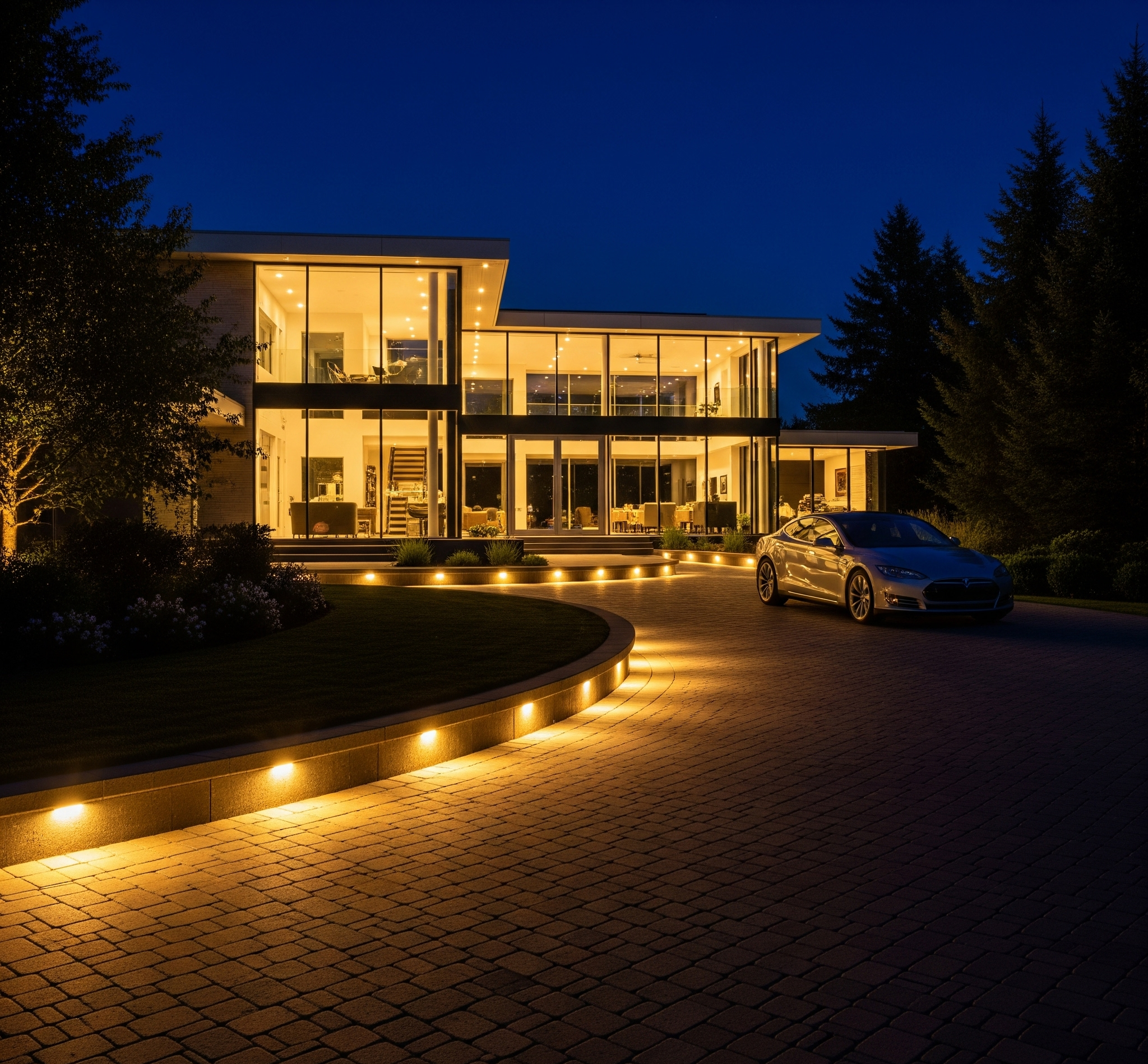
Right now, at this moment, your brand-new hardscape is absorbing water through its surface pores. UV radiation from the sun is beginning to fade the iron-oxide pigments that give your pavers their colour. The oil drip from your car on the driveway is wicking into the paver surface and will become a permanent dark stain within 48 hours. The BBQ grease splatter from last Saturday’s dinner party is soaking into the patio stone. And in four months, when the first de-icing salt is applied to your front walkway, the chloride brine will penetrate deep into the concrete pore network and begin the freeze-thaw spalling cycle that will destroy the top surface layer from the inside out.
Spending tens of thousands of dollars on a luxury hardscape and not sealing it is the equivalent of buying a $100,000 car and never changing the oil. The investment is real. The protection is absent. And the degradation is immediate, cumulative, and irreversible without a comprehensive, surface-specific sealing plan executed on the correct timeline.
This guide is that plan. Not a single product recommendation. Not a one-size-fits-all approach. A surface-by-surface, chemistry-by-chemistry, timing-by-timing protocol for protecting every square metre of hardscape on your residential property.
The Armour for Your Investment: Why Sealing Is Non-Negotiable
Unsealed hardscape surfaces face four simultaneous degradation forces in Ontario:
- UV radiation: The iron-oxide pigments that give manufactured concrete pavers their colour (the warm creams, the deep charcoals, the tans and browns) are stable but not immune to UV degradation. Over 3-5 years of unprotected sun exposure, the pigments fade, producing a washed-out, chalky appearance. The Warm Off-White that looked rich and intentional at installation begins to look like bleached-out grey. The Deep Charcoal that provided dramatic contrast begins to look like faded dark grey. The colour palette that was carefully selected, carefully coordinated, and carefully installed becomes a uniformly dull, low-contrast shadow of what it was designed to be
- Staining: Organic stains (leaf tannin, grass clippings, BBQ grease, food and beverage spills, bird droppings) and petroleum stains (motor oil, power steering fluid, brake fluid, gasoline drips) penetrate into unsealed paver and concrete pore networks and become permanent. Once a stain has penetrated below the surface (typically within 24-72 hours on an unsealed surface), it cannot be fully removed by surface cleaning alone. The stain is inside the material
- Freeze-thaw spalling: Water absorbed into the pore network freezes, expands by 9%, and generates internal hydraulic pressure that fractures the material matrix from the inside. Repeated cycling (40-60+ times per Ontario winter) causes the top 10-25mm of the surface to delaminate—a process called spalling. De-icing salt accelerates this damage by 3-5x because the brine penetrates deeper and creates differential freezing fronts
- Joint erosion (pavers only): On interlocking paver systems, the polymeric sand that fills the joints and locks the paver units together is gradually eroded by rain wash, foot traffic, and freeze-thaw cycling. As the polymeric sand erodes, the joints widen, the pavers loosen, and weeds, ants, and water gain access to the bedding layer below—destabilising the entire paver system from the joints down
A comprehensive sealing plan addresses all four of these degradation forces simultaneously. But—and this is the critical detail that separates a professional sealing program from a DIY disaster—each hardscape surface requires a different sealer chemistry applied at a different time using a different technique.
The Surface-Specific Strategy: Every Material Has Its Chemistry
Surface 1: Interlocking Concrete Pavers (Driveway, Patio, Walkway)
Interlocking pavers are the dominant surface on most luxury Bolton properties—the driveway, the rear patio, the front walkway, and the pool deck (if applicable). The sealer for interlocking pavers must accomplish two objectives simultaneously: protect the paver face and stabilise the polymeric sand joints.
The recommended chemistry: Joint-stabilising penetrating sealer.
This is a specialty product category designed specifically for interlocking paver systems. It combines the hydrophobic penetrating chemistry (silane/siloxane or modified polyurethane) that protects the paver face with a joint-binding component that penetrates the polymeric sand joints and re-hardens, locking the sand in place and preventing erosion.
- Finish options: Available in natural (invisible), matte, semi-gloss, and high-gloss (wet look). For luxury residential applications, natural or matte finish is the professional choice. It preserves the natural colour of the Warm Off-White field pavers and the Deep Charcoal borders without adding any artificial sheen. The pavers look exactly as they did at installation—just permanently protected. High-gloss “wet look” finishes darken the surface and produce a plastic-like shine that diminishes with wear, producing an uneven patchy appearance within 18-24 months on driveways and high-traffic patio zones
- UV inhibitors: Quality joint-stabilising sealers include UV-absorbing additives that reduce the UV exposure reaching the iron-oxide pigments in the paver surface. This dramatically slows colour fading, preserving the original colour intensity for 5-8 years before the first noticeable fade (compared to 2-3 years on unsealed pavers). On a property where the colour palette (Off-White and Charcoal) is a deliberate design element, UV protection is not cosmetic—it is colour preservation for the architectural intent of the design
- Stain resistance: The hydrophobic barrier prevents oil, grease, wine, food, and organic stains from penetrating the paver surface. Spills bead up on the sealed surface and can be wiped or rinsed off before absorption occurs. This is critical on the driveway (oil drips), the patio dining zone (food and beverage spills), and the outdoor kitchen zone (BBQ grease)
- Joint lock: The sealer penetrates the polymeric sand joints and re-bonds the sand particles, creating a hardened, water-resistant joint face that resists rain wash erosion, weed penetration, and ant tunnelling. This is the most underappreciated benefit of paver sealing—it extends the life of the polymeric sand installation by 3-5 years between re-sanding cycles
Surface 2: Poured Concrete (Walkways, Garage Apron, Steps)
Poured concrete surfaces on a Bolton residential property typically include the front walkway, side-yard utility path, garage apron (the transition slab between the driveway pavers and the garage floor), and poured concrete stair treads or landing pads. These surfaces are not interlocking pavers—they have no joints, no polymeric sand, and no bedding layer. They are monolithic concrete slabs with a broom-finished or exposed aggregate surface texture.
The recommended chemistry: Penetrating silane/siloxane sealer.
This is the same base chemistry used in commercial walkway sealing—a blend of silane (small molecular penetrant) and siloxane (larger molecular pore-bridging agent) that soaks into the concrete pore network, bonds to the pore walls, and creates a hydrophobic barrier 3-6mm below the surface.
- Appearance: Unchanged. Penetrating silane/siloxane sealers do not alter the surface colour, texture, or sheen. The broom-finished concrete looks exactly the same. The exposed aggregate concrete looks exactly the same. There is no darkening, no gloss, no wet look. The sealer is completely invisible
- Traction: 100% preserved. Because the sealer is inside the pore network, not on top of the surface, the micro-texture that provides pedestrian traction is fully maintained. This is especially critical on the front walkway and steps, which are used in all weather conditions including rain, snow, and ice
- Salt protection: The primary function of silane/siloxane sealing on concrete is chloride ion exclusion. The hydrophobic barrier blocks de-icing salt brine from penetrating the pore network, preventing the salt-accelerated freeze-thaw spalling that destroys unsealed concrete within 3-5 Ontario winters. On the front walkway and garage apron of a Bolton home—the two surfaces that receive the heaviest salt application during winter—this is the single most important protective measure
- No joint stabilisation needed: Silane/siloxane sealers do not provide joint locking (there are no joints to lock on monolithic concrete). Do not use a joint-stabilising paver sealer on poured concrete—the joint-binding chemistry can leave a visible film residue on the smooth concrete surface that traps dirt, yellows with UV exposure, and is extremely difficult to remove
Surface 3: Natural Stone (Veneer, Caps, Treads, Accent Features)
Natural stone on a residential property typically appears as wall veneer (on retaining walls, outdoor kitchen islands, fire table shells, and pillar faces), wall caps and coping (on retaining walls and seating walls), staircase treads and risers, and accent features (fireplace surrounds, water feature cladding). Natural stone presents unique sealing challenges because of its extreme variability in porosity, mineral composition, and surface finish.
The recommended chemistry: Impregnating natural stone sealer (silicone-based or fluoropolymer-based).
- Limestone & sandstone (high porosity, 5-20%): These stones absorb water and stains rapidly. They require a deep-penetrating impregnating sealer that saturates the stone’s pore network to maximum depth. Application typically requires 3-4 coats (wet-on-wet, 10-minute intervals) to achieve full saturation on highly porous limestone
- Granite (low porosity, 0.5-3%): Dense granite absorbs very slowly and requires a low-viscosity impregnating sealer that can penetrate the tight pore structure. One or two coats are typically sufficient. Over-application on granite can leave surface residue that hazes and must be buffed off
- Flagstone and slate (variable porosity): These stones require case-by-case assessment. A test application on an inconspicuous area is recommended to verify penetration depth, colour change (some sealers slightly darken certain flagstone colours), and surface finish before committing to the full application
Natural stone sealers are not interchangeable with paver sealers or concrete sealers. Using a paver joint-stabilising sealer on natural stone will leave a plastic-like film on the stone surface. Using a silane/siloxane concrete sealer on certain natural stones can cause spalling of the stone face if the sealer traps moisture behind the treated zone. Each stone type requires its own chemistry. No shortcuts.
“Three surfaces, three chemistries, three application protocols. The sealer that protects your driveway pavers will damage your limestone veneer. The sealer that protects your concrete walkway will leave a film on your granite caps. One product for everything is not a plan. It is a guaranteed failure.”
The Timing and Preparation: The Deep Clean
Sealer chemistry is only half the equation. The other half is when you seal and how you prepare the surface before sealing. These two variables determine whether the sealer performs to its 5-8 year specification or fails within 12 months.
The Mandatory Waiting Period (New Installations)
- New interlocking pavers: Minimum 60-90 days. Newly manufactured concrete pavers undergo a natural chemical process called efflorescence during their first weeks and months of outdoor exposure. Free calcium hydroxide within the concrete migrates to the surface and reacts with atmospheric CO₂ to form calcium carbonate—a white, powdery deposit that appears as a chalky haze. This is normal, temporary, and harmless. But if you seal before the efflorescence cycle completes, you trap the calcium hydroxide beneath the sealer film, permanently locking in the white haze. The sealed surface will have a permanent milky discolouration that cannot be removed without stripping the sealer entirely. On a Bolton property installed in July, the optimal sealing window is late September to early October—90 days after installation, before the first freeze
- New poured concrete: Minimum 28 days. Concrete must achieve its design compressive strength (typically 28 MPa at 28 days) before sealer application. Sealing before the concrete has cured creates a moisture barrier on the surface that disrupts the hydration process, preventing the concrete from reaching full strength. Premature sealing is not just cosmetically risky; it is structurally compromising
- New natural stone: 7-14 days. Natural stone veneer and treads installed with mortar bed require the mortar to cure before sealing. Mortar cure time is typically 7-14 days in warm weather. If the stone is dry-laid (no mortar), sealing can proceed as soon as the stone is clean
Surface Preparation: Pressure Wash and Chemical Treatment
Before any sealer touches any surface, the surface must be aggressively cleaned. Sealer does not discriminate—it seals in whatever is on or in the surface at the time of application. If the surface has dirt, oil stains, leaf tannin stains, mildew, algae, or efflorescence residue, the sealer will lock those contaminants into the material permanently.
The professional cleaning protocol:
- Step 1: Chemical pre-treatment. Surface-specific cleaning solutions are applied to target specific contaminants. Oil-dissolving degreasers for driveway petroleum stains. Oxygen-bleach solutions for organic growth (algae, mildew, moss) on shaded walkways and north-facing retaining walls. Efflorescence removers (mild phosphoric acid solutions) for residual calcium carbonate haze on new pavers. Each chemical is surface-specific—the acid-based efflorescence remover that works on concrete pavers will etch and damage limestone and marble
- Step 2: Hot water pressure washing. Commercial-grade pressure washing at 3,000-4,000 PSI with a surface cleaner attachment (not a fan-tip wand, which etches lines into the surface) removes the chemically loosened contaminants and flushes them from the surface pores. Hot water (60-80°C) is dramatically more effective than cold water at dissolving grease, removing biological growth, and flushing pore-level contaminants. On Bolton properties with mature tree canopy—particularly in the established neighbourhoods along King Street, Humber Station Road, and the heritage-district residential streets—leaf tannin staining and shaded-surface algae growth are especially heavy and require thorough hot-water treatment
- Step 3: Drying period. After pressure washing, the surface must dry for a minimum of 24-48 hours (longer in cool or humid conditions) to allow residual water to evaporate from the pore network. Sealing a wet surface prevents proper penetration and causes milky hazing in film-forming sealers. A moisture meter test (surface moisture below 4-5%) confirms readiness for sealer application
The Deep Clean on Existing (Previously Sealed) Surfaces
If the property has existing surfaces that were sealed previously and are due for re-sealing, the preparation is more involved. The old sealer must be evaluated: is it still adhering, or has it delaminated? For penetrating sealers, the old sealer has dissipated naturally into the pore walls and the new application simply refreshes the hydrophobic barrier—no stripping required. For topical (film-forming) sealers, the old film must be chemically stripped or mechanically abraded before a new application, because applying new sealer over degraded topical sealer creates a multi-layer film that yellows, peels, and traps moisture.
The Whole-Property Sealing Timeline
With three surface types, three sealer chemistries, and different cure-time requirements, the sealing of a complete Bolton property’s hardscape is not a single-day event. It is a phased timeline coordinated around installation dates, cure periods, weather windows, and logical surface sequencing.
A typical timeline for a Bolton property installed in mid-June:
- Day 1 (mid-June): Hardscape installation complete. All surfaces are new. No sealing yet. The cure clock starts
- Weeks 1-2 (late June): Natural stone veneer mortar cures. Stone surfaces become eligible for sealing
- Week 4 (mid-July): Poured concrete walkways and garage apron reach 28-day cure. Concrete surfaces become eligible for sealing
- Weeks 8-12 (mid-August to mid-September): Interlocking pavers complete primary efflorescence cycle. Paver surfaces become eligible for sealing. Visual inspection confirms efflorescence has cleared
- The Sealing Window (late September to early
October): All surfaces have completed their
cure and efflorescence periods. The weather is optimal
for sealing: warm days (15-25°C), low humidity, and
the extended dry periods typical of Bolton’s
late-September Indian summer weather
before the October rains begin. This is the
target sealing week. The entire property
can be sealed in a coordinated 2-3 day campaign:
- Day 1: Deep clean all surfaces (chemical pre-treatment + pressure wash)
- Day 2: Drying (verify moisture meter readings on all surfaces)
- Day 3: Apply natural stone impregnating sealer to all stone surfaces (fastest to dry, least traffic disruption). Apply penetrating silane/siloxane to poured concrete surfaces. Apply joint-stabilising paver sealer to all interlocking paver surfaces (longest cure time, applied last so foot traffic restrictions are minimised)
The property enters its first Ontario winter fully sealed, fully protected, and fully prepared for the 40-60 freeze-thaw cycles, the salt applications, and the UV exposure it will experience over the next 5-8 years before resealing is required.
The Cinintiriks Approach: We Don’t Just Build Luxury. We Protect It.
At Cinintiriks, the sealing plan is not a separate conversation that happens after the build. It is an integrated component of the project plan that is documented, scheduled, and budgeted from the initial design proposal. Every Bolton property we build includes a written post-installation sealing protocol as part of the project deliverables.
The Cinintiriks Standard: Whole-Property Sealing Protocol
1. Surface-Specific Sealer Specification at Design Phase: During the design proposal, we identify every hardscape surface on the property and specify the exact sealer product, chemistry type, finish level, and coverage rate for each surface. The client receives a sealer specification sheet as part of the project package—not a vague recommendation, but a precise product-by-surface matrix with manufacturer, product name, solids content, and application rate.
2. Cure-Period Calendar: We provide a written cure-period timeline based on the actual installation dates of each surface. The timeline specifies the earliest eligible sealing date for each surface type (7-14 days for natural stone, 28 days for poured concrete, 60-90 days for interlocking pavers) and identifies the optimal coordinated sealing window when all surfaces are eligible simultaneously.
3. Professional Deep Clean Before Every Application: Every Cinintiriks sealing application begins with a full-property deep clean: surface-specific chemical pre-treatment, commercial hot-water pressure washing at 3,000-4,000 PSI with surface cleaner attachment, and a verified 24-48 hour drying period with moisture meter confirmation. We do not seal over dirt. We do not seal over stains. We do not seal over moisture.
4. Natural/Matte Finish as Default: Unless a client specifically requests otherwise, all Cinintiriks paver sealing applications are specified in natural or matte finish. We do not default to high-gloss wet-look sealers because the gloss degrades unevenly under traffic, producing a patchy, worn appearance within 18-24 months. Natural finish preserves the original colour and texture of the Warm Off-White and Charcoal palette exactly as designed.
5. Written Resealing Schedule: Every client receives a written maintenance schedule that specifies the resealing interval for each surface type on their property: 3-5 years for high-traffic paver surfaces (driveway, main patio), 5-7 years for low-traffic paver surfaces (side walkways, garden terraces), 5-8 years for poured concrete, and 5-10 years for natural stone (depending on stone type and exposure). The schedule includes the recommended month (September-October for Bolton properties) and a reminder to contact our team for the annual water bead test to verify ongoing hydrophobic performance.
6. Annual Inspection and Bead Test: Cinintiriks offers an annual fall inspection service for our Bolton and GTA clients. Each September, we visit the property, perform the water bead test on every sealed surface (pour water, observe bead formation versus absorption), document the results photographically, and advise on whether resealing is needed before winter. This annual touchpoint ensures the property enters every Ontario winter with verified protection. No guessing. No missed cycles.
Don’t let your luxury hardscape degrade and fade over the winter. Contact Cinintiriks for a comprehensive, professional sealing and maintenance plan for your Bolton home.
FAQ: Residential Hardscape Sealing
How long do I have to wait before sealing a brand new interlocking driveway?
A minimum of 60-90 days after installation. Newly manufactured concrete pavers undergo a natural process called efflorescence during their first weeks of outdoor exposure. Free calcium hydroxide inside the concrete migrates to the surface and reacts with atmospheric CO₂ to form a white, powdery calcium carbonate deposit. This chalky haze is normal, temporary, and harmless—it naturally dissipates over 60-90 days as the surface stabilises. If you seal before the efflorescence completes, the sealer traps the calcium hydroxide beneath the sealed layer, producing a permanent milky discolouration that cannot be removed without stripping the entire sealer application. For a Bolton driveway installed in June, the earliest safe sealing date is late August to early September; the optimal date considering weather and scheduling is typically late September to early October—after efflorescence has fully cleared and before the first freeze. For poured concrete surfaces (walkways, garage aprons), the minimum waiting period is shorter: 28 days, which is the standard initial cure period for concrete to reach design strength. For natural stone veneer set in mortar, the waiting period is 7-14 days for mortar cure. On a new Bolton property with all three surface types, the interlocking pavers are the last surface to become eligible for sealing—so their 60-90 day efflorescence timeline typically drives the schedule for the entire property.
Can I use the exact same sealer for my concrete walkways and my natural stone patio?
No. You should not, and in many cases you physically cannot without causing damage. Concrete walkways and natural stone are fundamentally different materials with different porosity profiles, different mineral compositions, and different chemical sensitivities. Poured concrete is best protected with a penetrating silane/siloxane sealer that soaks 3-6mm into the concrete pore network, blocks salt brine intrusion, and maintains 100% surface traction without altering appearance. Natural stone (limestone, sandstone, granite, flagstone) requires an impregnating stone-specific sealer (silicone-based or fluoropolymer-based) formulated for the specific porosity and mineral chemistry of the stone type. Using a concrete silane/siloxane sealer on certain natural stones can cause moisture entrapment behind the treated zone, leading to subsurface spalling of the stone face—the exact damage the sealer was supposed to prevent. Using a natural stone sealer on concrete generally produces inadequate penetration depth because stone sealers are formulated for different pore sizes. And if you have interlocking pavers, that is a third chemistry entirely: a joint-stabilising paver sealer that protects the paver face and locks the polymeric sand joints. Three surfaces. Three chemistries. No exceptions.
How often should I reapply sealer to my outdoor living surfaces in Ontario?
Resealing frequency depends on the surface type, traffic intensity, sun exposure, and salt exposure of each area. General guidelines for Ontario residential properties: Interlocking paver driveways (heavy traffic, heavy salt): every 3-5 years. Interlocking paver patios (moderate traffic, minimal salt): every 5-7 years. Poured concrete walkways (moderate traffic, moderate salt): every 5-8 years. Natural stone veneer and caps (low traffic, minimal salt): every 5-10 years depending on stone porosity and exposure. The most reliable indicator of resealing timing is the water bead test: pour a small amount of water on the sealed surface. If it beads up into distinct droplets and does not darken the surface, the hydrophobic barrier is still performing. If the water absorbs and darkens the surface within 30-60 seconds, the protection has been depleted and resealing is due. Perform this test every September on every sealed surface, before the first winter salt application. It takes five minutes and tells you exactly which surfaces need attention. The cost of resealing on schedule is a fraction—less than 5%—of the cost of repairing the spalling, staining, and joint erosion damage that occurs when a surface enters an Ontario winter without protection.
The Final Word
A comprehensive residential sealing plan is not complicated. It is precise. Three surface types. Three chemistries. One coordinated deep-clean and application campaign, timed to the cure-period calendar and the late-September weather window. Repeated on a surface-specific schedule every 3-8 years, verified annually with a five-minute water bead test.
The result: your Warm Off-White pavers stay warm and white. Your Deep Charcoal borders stay deep and dark. Your natural stone veneer stays rich and textured. Your concrete stays flat and intact. Your polymeric sand stays locked in the joints. And your $120,000 hardscape investment looks as intentional, as composed, and as flawless in year ten as it did the day it was installed.
That is The Cinintiriks Standard. Not built and abandoned. Built and armoured.