The wide range reflects the wide range of starting conditions, property sizes, and finish expectations. A 500 m² commercial frontage with modestly overgrown shrubs and a few dead ornamentals is a different project than a 3,000 m² multi-building commercial campus with 20-year-old neglected landscaping, massive root balls embedded in compacted clay, and a property owner who wants the site to look like it belongs on a corporate headquarters tour by next quarter.
This guide breaks down every cost component of a full commercial planting renovation in Oakville—transparently, with real numbers—so that property owners, managers, and developers can budget accurately, compare quotes intelligently, and understand exactly what they are paying for (and what cheap quotes are leaving out).
The ROI of Curb Appeal: Why This Investment Exists
Before we discuss what a renovation costs, let us discuss what not renovating costs.
Commercial landscaping is not decoration. It is a revenue signal. The landscape is the first thing a prospective tenant, customer, client, or investor sees when they approach the property. And that first impression forms in 7-10 seconds— before they read the signage, before they enter the lobby, before they meet anyone. What they see in those seconds is the landscape.
If what they see is dead juniper hedges, overgrown yews blocking windows, bare soil patches where shrubs used to be, and a row of spindly trees that were planted 15 years ago and never maintained, the signal is clear: this property is neglected. The management does not invest. The building's systems are probably as tired as its landscaping.
That impression translates directly into financial outcomes:
- Lease rates: Commercial properties with well-maintained, high-quality landscaping command 7-15% higher lease rates than comparable properties with poor landscaping (Urban Land Institute research)
- Vacancy rates: Properties with premium curb appeal experience 50-75% shorter vacancy periods between tenants
- Property valuation: Mature, well-designed commercial landscapes add 10-15% to assessed property value—a figure that, on a $3-5 million commercial property, represents $300,000-$750,000 of recoverable value
A $100,000 planting renovation on a $4 million commercial property that improves the landscape from "neglected" to "premium" can produce a 3-7× return through increased lease rates, reduced vacancy, and improved assessed value. The renovation pays for itself. The question is not whether to do it. The question is how much to invest for maximum impact.
Phase 1: Demolition and Disposal—The Hidden Cost
This is the cost that cheap quotes either minimise, understate, or omit entirely. And it is typically 15-25% of the total project cost.
A "full renovation" means removing everything that currently exists in the planting beds: overgrown shrubs, dead trees, spent perennials, depleted mulch, root balls, stumps, and—critically —the exhausted soil itself. This is not garden cleanup. This is demolition.
What Demolition Actually Involves
Shrub and tree removal. Overgrown commercial shrubs (yews, junipers, cedars, boxwoods) that have been in the ground for 10-20 years develop root systems that are astonishingly large. A 15-year-old yew hedge that is 1.2 metres tall and 6 metres long has a root mass that extends 600-900mm deep and 300-500mm beyond the visible canopy in every direction. Removing it by hand is impractical. It requires a mini-excavator or skid steer with a grapple bucket to lever the root balls out of the clay, break them apart, and load them into disposal bins.
Ornamental trees with 50-100mm caliper trunks (common in 15-20 year old commercial landscapes) have root balls that weigh 200-500 kg. Removing them involves cutting the trunk at ground level (chainsaw work), grinding the stump to 150-200mm below grade (stump grinder), and either extracting the root ball (if the bed is being fully excavated) or grinding it in place (if the root ball can remain below the new soil profile). Stump grinding alone costs $150-$500 per stump depending on size and access.
Disposal. Twenty-year-old commercial landscaping produces a staggering volume of waste. A typical 1,000 m² commercial planting renovation generates 15-40 cubic yards of organic waste (removed plants, root balls, old mulch, depleted soil). Commercial bin rentals for organic waste cost $400-$800 per 20-yard bin (including haulage and tipping fees). A large renovation may fill 2-4 bins, totalling $800-$3,200 in disposal alone.
Soil removal. This is the cost most cheap quotes deliberately exclude. If the existing planting beds have been in place for 15-20 years, the soil is depleted, compacted, and contaminated. It has lost its organic content, its drainage capacity, and its nutrient profile. Planting expensive new material in dead soil is like putting premium fuel in an engine with no oil. The plants will struggle, decline, and require expensive intervention to survive. Full renovation means excavating the top 300-450mm of existing bed soil and replacing it with premium, nutrient-rich planting mix. The excavated soil must be loaded, hauled, and disposed of—adding $3,000-$12,000 to the project depending on bed area and soil conditions.
Demolition Cost Summary
For a typical 1,000 m² commercial planting renovation:
- Shrub and small tree removal (machine): $3,000-$8,000
- Large tree removal and stump grinding: $1,000-$5,000
- Organic waste disposal (bins): $800-$3,200
- Depleted soil excavation and disposal: $3,000-$12,000
Total demolition phase: $7,800-$28,200.
"If a quote for a 'full renovation' doesn't include a line item for soil removal and replacement, it isn't a renovation. It's planting new material in dead ground and hoping for the best."
Phase 2: Soil Engineering—The Foundation of Everything
Once the existing material is removed and the beds are excavated to depth, the empty beds need to be filled with soil that actually supports plant life.
Premium Triple Mix
The industry standard for commercial planting beds is triple mix: a blended soil composed of approximately 40% screened topsoil, 30% compost (aged manure or leaf compost), and 30% peat moss or coarse sand (depending on whether the priority is moisture retention or drainage). Triple mix provides the nutrient density, drainage capacity, and biological activity that newly installed plants need to establish roots rapidly.
The cost of premium triple mix, delivered to a commercial site in the GTA, is approximately $45-$65 per cubic yard for material, plus $15-$25 per cubic yard for delivery (tandem or tri-axle dump truck). A 1,000 m² bed area at 350mm depth requires approximately 350 cubic metres (roughly 460 cubic yards) of triple mix.
Material and delivery cost: $27,600-$41,400 for a 1,000 m² bed at 350mm depth.
In Oakville, where many commercial properties along the Lakeshore Road, Trafalgar Road, and Speers Road corridors sit on heavy Halton clay, the drainage component of the soil blend is particularly critical. The native clay beneath the beds drains poorly—holding water around root zones and promoting root rot in species not adapted to saturated conditions. Our Oakville blends incorporate a higher percentage of coarse sand (35-40% versus the standard 30%) and include under-drainage (100mm perforated pipe in a clear stone trench at the base of the bed, connected to the property's storm system) to ensure that the investment in premium soil is not undermined by the clay beneath it.
Soil Amendments
Beyond the base triple mix, specific soil amendments may be required depending on the planting palette:
- Mycorrhizal inoculant: $200-$600 per project (applied directly to root balls at planting). Mycorrhizal fungi form symbiotic relationships with plant roots, extending the effective root absorption area by 100-1,000× and dramatically improving nutrient uptake and drought resistance during the critical establishment period
- Bone meal: $100-$300 per project (mixed into the planting hole). Slow-release phosphorus for root development
- Acidifying amendments (sulphur, peat): $200-$800 per project. Required for acid-loving species (rhododendrons, azaleas, blueberries) that require soil pH below 5.5
- Granular slow-release fertiliser: $150-$400 per project (incorporated into the top 50mm of the bed at completion)
Phase 3: Plant Material—Specimens vs. Saplings
This is where the budget decision has the most visible and most lasting impact. The difference between a renovation that looks "just planted" and one that looks "established" is entirely a function of plant size at installation.
The Sapling Approach (Budget)
Small, young plant material—25-30mm caliper trees, #2 or #3 container shrubs, 1-gallon perennials—is inexpensive to purchase:
- 25-30mm caliper deciduous tree: $150-$350
- #2 container shrub (2-gallon): $25-$60
- 1-gallon perennial: $8-$15
The problem: these plants look tiny in a commercial context. A 25mm caliper maple planted in front of a two-storey commercial building is visually insignificant—a stick in a parking lot. It will take 5-8 years to develop a canopy that provides meaningful visual impact. A #2 boxwood planted as a hedge will take 3-5 years to fill in and form a continuous screen. During those years, the landscape looks sparse, immature, and not commensurate with a premium commercial property.
The sapling approach is appropriate for long-hold properties (institutional buildings, owner-occupied facilities) where the owner is willing to wait years for the landscape to mature. It is not appropriate for income-producing properties where curb appeal directly affects lease rates and tenant retention.
The Specimen Approach (Premium)
Large, mature plant material—60-100mm caliper trees, #15 to #25 container or balled-and-burlapped shrubs, 3-gallon perennials in established clumps—delivers instant visual impact:
- 60mm caliper deciduous tree (balled & burlapped): $1,200-$2,500
- 70mm caliper deciduous tree (B&B): $2,500-$4,500
- 100mm caliper specimen tree (B&B, crane-set): $5,000-$8,000+
- #15 container shrub (15-gallon, 900-1,200mm height): $150-$400
- #25 container shrub (25-gallon, 1,200-1,500mm height): $350-$800
- 3-gallon perennial (established clump): $20-$35
A 70mm caliper Freeman Maple planted in front of the same two-storey building has a 4-5 metre height, a 3-4 metre canopy spread, and a visual presence that reads as established from the day it is installed. A #25 boxwood hedge is 1,200-1,500mm tall and already dense—it provides an immediate privacy screen and a finished geometric line.
The cost difference is significant: a single 70mm caliper tree costs 10-15× more than a 25mm sapling. But the visual impact difference is immediate versus 5-8 years delayed, and for income-producing commercial properties, the delay has a real financial cost in lost lease premium and extended vacancy.
Delivery and Installation
Large caliper trees are heavy. A 70mm caliper balled-and-burlapped tree has a root ball that weighs 400-700 kg. A 100mm caliper specimen can have a root ball exceeding 1,500 kg. These cannot be carried by hand. They require equipment:
- Mini-excavator with tree forks: $1,200-$2,500 per day (for 50-70mm caliper trees)
- Boom truck or crane: $2,000-$5,000 per day (for 80-100mm+ specimens or trees in locations inaccessible to ground equipment)
- Delivery from nursery: $500-$2,000 per load (flatbed or lowboy trailer), depending on distance and quantity
Installation labour for large caliper trees is specialised work. The planting hole must be 2-3× the diameter of the root ball and exactly the depth of the root ball (not deeper— planting too deep is the single most common cause of transplant death in large trees). The tree must be set precisely plumb, staked with 3-point guying (using flexible webbing, not wire through hose, which damages bark), and mulched with a 75-100mm ring of aged hardwood bark.
We recently completed a comprehensive planting renovation for a multi-tenant commercial property in Woodbridge, along the Highway 7 corridor, that illustrates the specimen approach at scale. The property had 25 years of neglected landscaping— overgrown yew hedges that had swallowed the ground-floor windows, dead ornamental pears that dropped fruit on the walkways every fall, and patches of bare soil where perennial beds had given up entirely. We removed everything, excavated 350mm of depleted soil from 1,800 m² of bed area, replaced it with Oakville-grade triple mix (high sand content for the heavy clay conditions that Woodbridge shares with Oakville), and installed a palette of twelve 70mm caliper Autumn Blaze maples, forty-eight #25 Green Velvet boxwoods, and 600 Karl Foerster ornamental grasses. The property looked like a corporate campus on installation day. The leasing office reported three new tenant inquiries within the first month that specifically referenced the "new look" of the property as a factor in their interest. That is the specimen approach working exactly as intended.
Phase 4: Hardscape Integration
A planting renovation is not exclusively about plants. The structural elements that define, contain, and protect the planting beds are just as critical to the long-term appearance and function of the landscape.
- Concrete curbing and bed edging: $15-$30 per linear metre, installed. Provides permanent bed definition, separates planting beds from turf and pavement, and prevents mulch migration
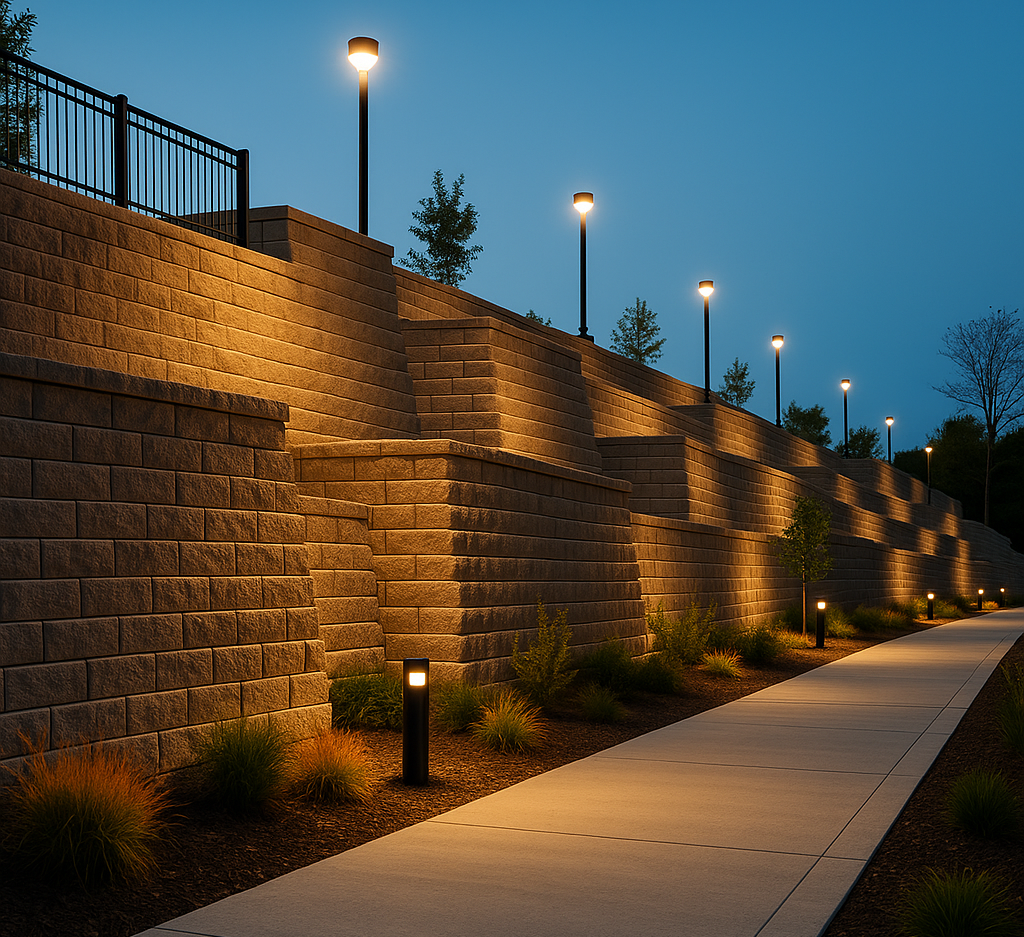
- Natural stone or precast retaining walls (for raised beds): $250-$600 per linear metre per foot of height. Raised beds improve drainage, provide architectural definition, and protect plantings from salt runoff
- Decorative aggregate borders: $8-$15 per m² (material and installation). Clean, permanent borders around planting beds that reduce edge maintenance and provide a visual transition between plantings and pavement
- Premium mulch: $65-$95 per cubic yard, installed at 75-100mm depth. Aged, double-shredded hardwood bark (not dyed, not rubber)
Phase 5: Irrigation
A full planting renovation without irrigation is a gamble. New plantings—especially large caliper trees that have just been transplanted with significant root disturbance—require consistent deep watering for 12-24 months after installation to establish root systems in the new soil. Relying on natural rainfall in Ontario's summer (which delivers extended dry periods of 10-21 days in July and August with regularity) is irresponsible when the plant material investment alone may exceed $50,000.
- New commercial irrigation system (backflow preventer, controller, zone valves, mainline, laterals, drip lines for beds, rotary heads for turf): $15,000-$40,000 depending on area, zone count, and water source
- Retrofit/repair of existing irrigation system: $3,000-$12,000 (if the existing system is salvageable but needs head replacements, zone additions, or controller upgrade)
- Drip irrigation for beds only (no turf zones): $5,000-$15,000
Total Project Cost: The Complete Picture
Assembling all phases for a typical 1,000 m² commercial planting renovation in Oakville:
Budget Approach (Sapling Material, Basic Soil, No Irrigation)
- Demolition and disposal: $7,800-$15,000
- Soil replacement (standard triple mix): $15,000-$25,000
- Plant material (saplings/small containers): $8,000-$15,000
- Hardscape edging and mulch: $5,000-$10,000
- Labour: $8,000-$15,000
Total: $43,800-$80,000
Result: a clean, freshly planted landscape that looks sparse and young for 3-5 years before reaching visual maturity.
Premium Approach (Specimen Material, Engineered Soil, Full Irrigation)
- Demolition and disposal: $12,000-$28,200
- Soil replacement (premium blend with amendments): $25,000-$41,400
- Plant material (large caliper trees, specimen shrubs): $40,000-$100,000+
- Delivery and equipment (crane/boom truck): $3,000-$10,000
- Hardscape edging, retaining walls, mulch: $10,000-$25,000
- Irrigation system: $15,000-$40,000
- Labour: $15,000-$30,000
Total: $120,000-$274,600
Result: an instant-impact, mature-looking landscape that reads as "established" from day one and begins generating lease premium and tenant interest immediately.
The Cinintiriks Approach: Transparent, Comprehensive, Engineered
Every Cinintiriks commercial planting renovation quote includes every cost component listed above—no exclusions, no surprises, no "we didn't include the soil" or "disposal is extra." Our quotes are structured so that the property owner can see exactly what each dollar is buying:
1. Comprehensive Demolition: We include full removal of all existing plant material, root ball extraction, stump grinding, mulch removal, and complete depleted soil excavation to a minimum depth of 350mm. We own the disposal—our bins, our haulage, our tipping fees. There is no "we'll remove the shrubs but you need to arrange disposal" handoff.
2. Engineered Soil: Our planting beds receive a custom-blended triple mix specified for the site's subgrade conditions (higher sand content for clay sites like Oakville and Woodbridge, higher compost content for sandy sites). Every bed includes under-drainage (100mm perforated pipe in clear stone) if the subgrade is clay, ensuring root zone drainage that the plants need and the native soil will not provide.
3. Specimen-Grade Plant Material: We source from inspected nurseries (not wholesale brokers who ship sight-unseen). Every tree is personally selected by our team for form, crown symmetry, trunk character, and root ball quality. We do not accept nursery "seconds" or wind-damaged stock. Our standard caliper for commercial trees is 60-70mm minimum—large enough for immediate visual impact, manageable enough for efficient installation without crane mobilisation on most sites.
4. Climate-Resilient Species: Every species in our Oakville commercial palette is rated for Zone 4b (one full zone hardier than the local 5b-6a). We select for salt tolerance (for plantings adjacent to salted pavement), drought tolerance (for reduced irrigation dependency after establishment), and four-season interest (species that provide spring bloom, summer foliage, fall colour, and winter architectural structure).
5. Installation Warranty: Every Cinintiriks commercial planting installation includes a one-year survival warranty. Any tree or shrub that does not survive the first full growing season (from the installation date through the following September) is replaced at no additional cost. This warranty is our accountability mechanism—it ensures that our species selection, soil engineering, and installation practices are aligned with survival outcomes, not simply with aesthetic appearance on planting day.
Don't trust your property value to a vague, low-ball estimate. Contact Cinintiriks for a fully transparent, comprehensive commercial planting renovation quote in Oakville or Woodbridge.
FAQ: Commercial Planting Renovation Costs
Is it cheaper to renovate commercial landscaping in phases or all at once?
All at once is almost always more cost-effective. Phased renovation appears cheaper in the short term because each phase has a smaller invoice, but the total cost across all phases is typically 20-35% higher than a single comprehensive renovation. The reasons are cumulative: multiple mobilisations (each phase requires equipment delivery, setup, and removal—$2,000-$5,000 per mobilisation), repeated site restoration (each phase leaves interface zones between completed and incomplete areas that must be dressed and protected), material inefficiency (soil, mulch, and aggregate deliveries have fixed delivery costs regardless of quantity— one large delivery is cheaper per unit than three small ones), and design fragmentation (a phased renovation often results in visual inconsistency between phases, with Phase 1 plantings 2-3 years more mature than Phase 3 plantings, creating an awkward visual mismatch that undermines the "renovated" look). The only scenario where phasing is justified is when budget constraints prevent a single-phase execution —in which case, we design the entire renovation as a master plan and execute it in two phases maximum (front of property first, sides and rear second), minimising the number of mobilisations and the visual mismatch between phases.
Does the cost of a commercial planting renovation include a new irrigation system?
It depends on the contractor. With Cinintiriks, yes— if the site requires it. Many landscape contractors quote the planting scope only and exclude irrigation entirely, leaving the property owner to discover—after $80,000 of new plants are in the ground—that there is no systematic way to water them. Our renovation quotes always include an irrigation assessment. If the existing system is functional and adequate for the new planting layout (which is uncommon after a full renovation, because the bed locations and plant types have changed), we note it and no cost is added. If the existing system is obsolete, damaged, or inadequate (which is the case on most 20+ year old commercial properties), we include the cost of a new drip-based irrigation system ($5,000-$15,000 for bed-only coverage; $15,000-$40,000 for full-site coverage including turf zones) as a line item in the renovation quote. The property owner can see the cost and decide whether to include it. Our strong recommendation: always include it. The irrigation system costs 10-15% of the total renovation budget and protects 100% of the plant material investment. Losing a single 70mm caliper tree to drought ($2,500-$4,500 replacement cost, plus crane time, plus disruption) because of a missing $12,000 irrigation system is a particularly expensive regret.
How much does a mature, 70mm caliper tree cost compared to a young sapling?
The price difference is substantial and reflects the 10-15 years of nursery care invested in growing the tree to specimen size. A 25-30mm caliper deciduous tree (the standard "sapling" specification for budget projects) costs $150-$350 at the nursery. A 70mm caliper specimen of the same species costs $2,500-$4,500—roughly 10-15× the sapling price. But the specimen arrives with a 4-5 metre height, a 3-4 metre canopy spread, and a trunk diameter that visually anchors a commercial building frontage. The sapling arrives at 2-2.5 metres tall with a canopy you can cover with an umbrella. There is no middle ground in visual impact—the specimen looks established; the sapling looks like a landscaper was here last week. Beyond the purchase price, the installation cost for a 70mm specimen is also higher: the root ball weighs 400-700 kg and requires a mini-excavator or boom truck to place ($1,200-$2,500 per day for equipment), versus hand-planting a sapling at marginal incremental labour cost. Total installed cost for a 70mm caliper specimen tree: $3,500-$6,000. Total installed cost for a 25mm sapling: $250-$500. The financial question is: how much is 5-8 years of visual maturity worth to your property's lease rates, tenant retention, and first-impression signal? On an income-producing commercial property, the answer is usually "considerably more than the price difference between the two trees."
The Final Word
A full commercial planting renovation is not a gardening project. It is a capital investment with measurable financial returns, executed through heavy civil landscaping work that requires demolition equipment, engineered soil, premium plant material, and systematic irrigation. The cost reflects the scope, and the scope reflects the reality that transforming a neglected commercial landscape into a premium revenue-generating asset involves far more than digging holes and dropping plants.
The cheap quotes leave out the soil. They leave out the disposal. They leave out the irrigation. They plant small material in depleted ground and walk away with a cheque, leaving the property owner to discover over the next 12 months that half the plants are dying, the beds are sinking, and the landscape still does not look like it belongs on a premium commercial property.
The honest quote includes everything. It is higher. And it delivers what the cheap quote promised but cannot: a commercial landscape that looks established from day one, survives its first winter, and begins paying for itself through the lease rates and tenant quality that premium curb appeal attracts.
That is the renovation. That is the cost. And that is the return.