Your instinct is correct. And ignoring it is one of the most expensive mistakes in commercial landscaping.
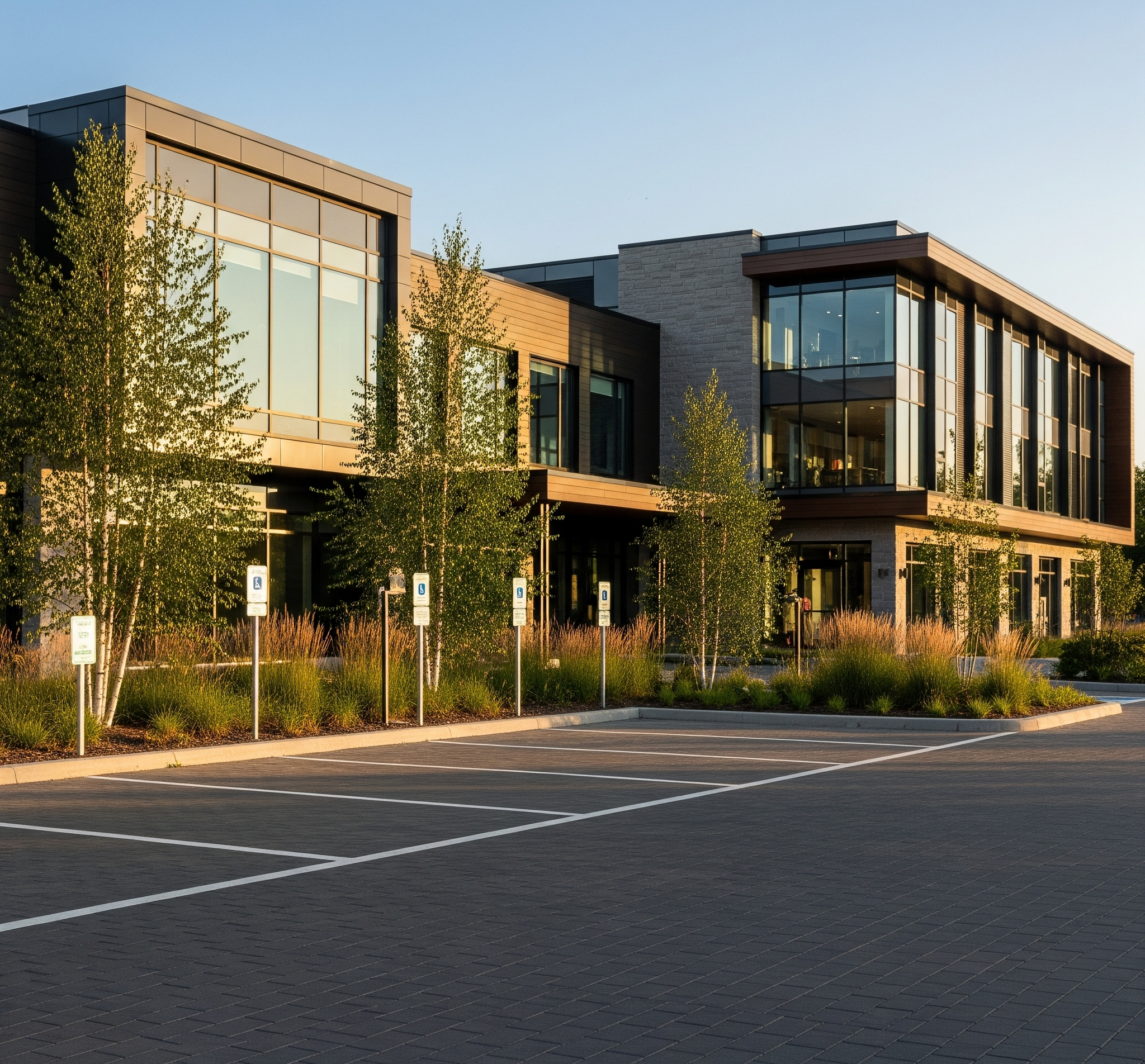
Rolling out a single species of sod across an entire commercial property without accounting for the microclimates —the dramatically different sun exposure, wind patterns, soil moisture, and foot traffic that exist from one zone of the property to another—guarantees that some areas will thrive while others fail. The sunny boulevard will look immaculate. The shaded courtyard will thin, weaken, and eventually die. Or the shade-tolerant species chosen for the courtyard will survive beautifully in the shadows and get trampled to death on the high-traffic pedestrian walkway.
The two grass species that dominate commercial turf specification in southern Ontario—Kentucky Bluegrass (Poa pratensis) and Fine Fescue (a group of species including Creeping Red Fescue, Chewings Fescue, Hard Fescue, and Sheep Fescue)—are both cool-season grasses native to or naturalised in Ontario’s climate. They both survive Toronto’s winters. They are both available as commercially harvested sod. But their biological behaviours, environmental tolerances, and maintenance demands are so fundamentally different that choosing the wrong one for a given area of your property is not merely sub-optimal. It is a catastrophic misallocation of tens of thousands of dollars that will require complete removal and replacement within one to three seasons.
This guide breaks down both species in the detail that commercial property owners and managers actually need: not the marketing language from a sod-farm brochure, but the operational, engineering-level reality of how each species performs on a Toronto commercial site.
Kentucky Bluegrass: The High-Maintenance Showpiece
Kentucky Bluegrass is the default specification for commercial turf in the Greater Toronto Area, and for good reason. It produces the dense, deep green, carpet-like lawn that defines “premium commercial landscaping” in the minds of property owners, tenants, and visitors. When properly maintained, a Kentucky Bluegrass lawn on a Toronto commercial property is visually stunning— uniform, vibrant, and immaculate.
The biology behind that visual result is what makes Bluegrass both the best choice for certain applications and the worst choice for others.
Growth Habit: The Rhizome Advantage
Kentucky Bluegrass spreads by underground rhizomes —horizontal stems that grow beneath the soil surface, emerging at intervals to produce new grass plants. This rhizomatous growth habit gives Bluegrass two extraordinary commercial advantages:
- Self-repair. When an area of Bluegrass turf is damaged—by foot traffic, vehicle impact, dog urine, ice-melt chemical burns, or any other localised injury—the surrounding healthy grass sends rhizomes into the damaged area and fills it in from the edges inward. A bare patch 25–50 mm in diameter on a healthy Bluegrass lawn will close itself within 2–4 weeks during the growing season without any intervention. A patch 100 mm in diameter may take 4–6 weeks. No other commercially available cool-season grass in Ontario self-repairs at this rate
- Density. The rhizomes produce an interlocking root-and-shoot matrix that creates an extremely dense turf canopy. This density crowds out weed seedlings (there is physically no space for a weed to establish), resists erosion (the root mat stabilises the soil surface), and produces the smooth, uniform “carpet” visual that commercial properties require at their highest-visibility frontages
Traffic Tolerance
Kentucky Bluegrass has moderate to high traffic tolerance among cool-season grasses. Its rhizomatous recovery mechanism means that even areas receiving regular pedestrian traffic—walkway edges, building entrances, playground perimeters, event staging areas—recover continuously between use periods. On a Toronto commercial property where green space adjacent to parking lots, sidewalks, and building entrances receives hundreds of daily pedestrian crossings, Bluegrass is the only cool-season sod species that can maintain a presentable density under that pressure through its self-repair capability.
The Liability: Water Demand
Here is where Kentucky Bluegrass becomes punishingly expensive on a commercial property. Bluegrass has a relatively shallow root system compared to Fescue species—typically rooting to 75–100 mm in GTA clay-based soils (deeper in sandy soils, but GTA commercial properties are predominantly clay). This shallow root zone means Bluegrass accesses a limited soil moisture reservoir and depends heavily on frequent irrigation to maintain active growth.
During a typical Toronto summer (July–August, 30–35°C, full sun), Kentucky Bluegrass requires approximately 30–40 mm of water per week from irrigation plus rainfall combined. On a 5,000 m² Bluegrass installation, that translates to 150,000–200,000 litres per week during peak demand. Over a 16-week summer irrigation season (May through September), the total water consumption is approximately 1.6–2.4 million litres.
Without that water, Kentucky Bluegrass enters summer dormancy: it stops growing, the leaf blades turn brown, and the plant conserves energy by shutting down all above-ground activity. Dormancy is a survival mechanism, not death—the crown and roots remain alive, and the grass will green up when temperatures moderate and moisture returns (typically September in Toronto). But on a commercial property where the turf is a brand-presentation asset, a brown, dormant lawn for six to eight weeks in the middle of summer is unacceptable.
The consequence: Kentucky Bluegrass on a commercial property requires a fully automated, multi-zone irrigation system running on a smart controller with weather-based ET adjustment. There is no alternative. Manual watering cannot deliver the volume. Relying on rainfall is a gamble that Toronto’s erratic summer precipitation patterns will lose. The irrigation system is not optional for Bluegrass. It is a mandatory operating cost for as long as the turf exists.
Other Characteristics
- Sun requirement: Kentucky Bluegrass requires a minimum of 6–8 hours of direct sun per day to maintain adequate density. In areas receiving less than 4 hours of direct sun, Bluegrass thins progressively, becomes wiry and open, and eventually fails entirely. This is a critical limitation on Toronto commercial properties where multi-storey buildings cast deep shadows across significant portions of the green space
- Mowing height: 60–75 mm (2.5–3 inches). Mowing below 50 mm weakens the plant and reduces root depth, increasing drought vulnerability
- Fertiliser requirement: 2–4 kg of nitrogen per 100 m² per year (moderate to high). Bluegrass is a nutrient-demanding species that produces its best density and colour with regular feeding
- Disease susceptibility: Moderate. Susceptible to brown patch (Rhizoctonia solani) during hot, humid conditions and dollar spot (Clarireedia jacksonii) during warm, prolonged leaf-wetness periods. Both diseases are exacerbated by over-watering and poor air circulation— conditions common in enclosed commercial courtyards
“Kentucky Bluegrass is the showpiece. It self-repairs, it crowds out weeds, and it looks impeccable. But it drinks like nothing else in the ground, and without an automated irrigation system it will go dormant and brown by mid-July.”
Fine Fescue: The Engineered Survivor
Fine Fescue is not a single species but a group of closely related species that share a common set of characteristics making them the tactical opposite of Kentucky Bluegrass in almost every category. The commercially relevant Fine Fescue species in Ontario:
- Creeping Red Fescue (Festuca rubra)—the most common in commercial sod blends, spreads by short rhizomes and produces a fine-textured, medium-density turf
- Chewings Fescue (Festuca rubra subsp. commutata)—a bunch-type (non-spreading) Fescue with very fine texture and excellent shade tolerance
- Hard Fescue (Festuca brevipila)—the most drought-tolerant of the group, extremely low maintenance, slower to establish but extraordinarily persistent once rooted
- Sheep Fescue (Festuca ovina)—the most stress-tolerant, fine-textured, and low-growing, used primarily in naturalised or unmowed commercial areas
Growth Habit: Deep Roots, No Spread
Unlike Bluegrass, most Fine Fescue species are bunch-type grasses (with the exception of Creeping Red Fescue, which has short, slow-spreading rhizomes). They grow in individual clumps that tiller (produce new shoots from the crown) but do not send aggressive rhizomes across the soil to colonise bare areas. This growth habit has two major consequences:
- No self-repair. A bare patch in a Fine Fescue lawn does not fill in from the edges. The bunch-type plants adjacent to the bare patch will tiller and thicken slightly, but the patch itself will remain open unless it is overseeded or re-sodded. On a commercial property where localised damage is routine (foot traffic, vehicle tracking, dog urine, ice-melt burns), the inability to self-repair is a significant maintenance consideration
- Slower visual recovery. Because Fescue does not spread into damaged areas, visual recovery from any turf injury depends entirely on overseeding or re-sodding the affected area. The repair is manual, not biological
The Advantage: Drought Tolerance and Deep Rooting
Fine Fescue roots to 150–250 mm in GTA soils—roughly double the root depth of Kentucky Bluegrass. This deeper root system accesses a significantly larger soil moisture reservoir, which fundamentally changes the irrigation equation:
- Weekly water requirement: Fine Fescue requires approximately 15–25 mm of water per week during Toronto’s peak summer, compared to Bluegrass’s 30–40 mm. That is 35–50% less water for the same coverage area
- Drought survival: Fine Fescue can survive 3–4 weeks without irrigation during a Toronto summer drought before entering dormancy, compared to Bluegrass’s 10–14 days. And Fescue dormancy is less visually severe— it tends to fade to a straw-yellow rather than the deep brown of dormant Bluegrass, and it recovers faster when moisture returns
- Irrigation system implications: On large, peripheral commercial zones where installing a full automated irrigation system is cost-prohibitive (distant property edges, narrow median strips, naturalised buffer zones), Fine Fescue can survive on natural rainfall alone in a normal Toronto summer. It will not look as lush as an irrigated Bluegrass lawn, but it will remain green and alive through all but the most extreme drought events
Shade Tolerance
This is where Fine Fescue dominates the species comparison. While Kentucky Bluegrass requires 6–8 hours of direct sun per day, Fine Fescue species (particularly Chewings Fescue and Creeping Red Fescue) perform well with as little as 3–4 hours of dappled or filtered sunlight. In deeply shaded commercial courtyards, north-facing building walls, under dense tree canopy, and in narrow corridors between multi-storey buildings—environments that are extremely common on Toronto commercial properties— Fine Fescue is the only viable sod species that will maintain a green, functional turf cover.
A Kentucky Bluegrass sod installed in a shaded courtyard receiving 3 hours of sun per day will look acceptable for the first season (the sod was grown at the farm in full sun and still carries the energy reserves from that environment). By the second season, the Bluegrass will have thinned to the point where bare soil is visible between the grass plants. By the third season, the turf is effectively gone—replaced by moss, bare mud, and weeds. The $15,000–$25,000 spent on sodding that courtyard is a total loss.
Traffic Tolerance
Fine Fescue has low to moderate traffic tolerance. Its bunch-type growth habit means that plants that are crushed, torn, or worn away by foot traffic do not regenerate from underground rhizomes. Once a Fescue plant is killed, the gap it leaves is permanent until it is overseeded.
On commercial properties, this means Fine Fescue is not appropriate for:
- Building entrance frontages with heavy daily pedestrian traffic
- Walkway-adjacent turf strips where people regularly shortcut across the grass
- Event staging areas or any surface that experiences periodic concentrated foot traffic
- Playground or recreational areas
Fine Fescue is appropriate for:
- Peripheral property edges with minimal foot traffic
- Shaded courtyards and building corridors with restricted access
- Naturalised buffer zones along property boundaries
- Median strips and traffic islands where foot traffic is essentially zero
- Sloped areas where low maintenance and erosion control are the primary functions
Other Characteristics
- Mowing height: 75–100 mm (3–4 inches). Fescue prefers a higher mowing height than Bluegrass and can actually be left unmowed in naturalised commercial settings, growing to a tidy 150–200 mm and producing a meadow-like aesthetic
- Fertiliser requirement: 0.5–1.5 kg of nitrogen per 100 m² per year (low). Fine Fescue actually performs worse with heavy fertilisation— excess nitrogen produces rapid, weak growth that is more susceptible to heat stress and disease. Under- feeding Fescue is better than overfeeding it
- Disease susceptibility: Low. Fine Fescue is notably resistant to most common turf diseases in Ontario, including dollar spot and brown patch. Its lower fertility requirement and deeper root system create conditions less favourable to fungal pathogens
- Texture: Very fine, narrow leaf blades. Fine Fescue produces a softer, slightly “wilder” visual compared to the dense, manicured carpet of Bluegrass. Some commercial clients prefer this naturalistic aesthetic; others find it too informal for high-visibility entrance areas
“Fine Fescue goes where Kentucky Bluegrass cannot survive: deep shade, no irrigation, poor soil, neglect. But ask it to withstand 500 daily footfalls on a building entrance, and it will be gone by September.”
The Head-to-Head Comparison
For clarity, here is the direct performance comparison across every commercial decision criterion:
- Sun requirement: Bluegrass: 6–8 hours. Fescue: 3–4 hours
- Shade tolerance: Bluegrass: Poor. Fescue: Excellent
- Drought tolerance: Bluegrass: Low (dormancy in 10–14 days). Fescue: High (dormancy in 3–4 weeks)
- Weekly water demand (summer): Bluegrass: 30–40 mm. Fescue: 15–25 mm
- Root depth (GTA soils): Bluegrass: 75–100 mm. Fescue: 150–250 mm
- Traffic tolerance: Bluegrass: Moderate–High. Fescue: Low–Moderate
- Self-repair capability: Bluegrass: Excellent (rhizomes). Fescue: None (bunch-type)
- Fertiliser requirement: Bluegrass: 2–4 kg N/100 m²/year. Fescue: 0.5–1.5 kg N/100 m²/year
- Mowing height: Bluegrass: 60–75 mm. Fescue: 75–100 mm
- Disease resistance: Bluegrass: Moderate. Fescue: High
- Visual density: Bluegrass: Carpet-like, manicured. Fescue: Fine-textured, naturalistic
- Irrigation system required: Bluegrass: Yes, mandatory. Fescue: Optional (beneficial but not required for survival)
- Annual maintenance cost (per m²): Bluegrass: Higher (irrigation + fertiliser + disease management). Fescue: 40–60% lower
The Strategic Decision: Zoning by Species
The answer to “which species should I choose?” on a commercial property is almost never “one or the other for the entire site.” It is “both, strategically deployed.”
A properly engineered commercial turf plan treats the property as a collection of microclimates, each with its own sun exposure, traffic pattern, irrigation access, and visual priority. Each microclimate receives the species that is biologically matched to its conditions:
- High-visibility, full-sun, irrigated entrance frontages: Kentucky Bluegrass. This is the showpiece zone. It will receive the heaviest foot traffic, the most visual scrutiny, and the full support of the automated irrigation system. Bluegrass delivers the dense, immaculate visual here
- Shaded courtyards and building corridors: Fine Fescue (Chewings or Creeping Red). Less than 4 hours of sun eliminates Bluegrass from consideration. Fescue thrives here with minimal intervention
- Peripheral property edges and buffer zones: Fine Fescue (Hard Fescue or Sheep Fescue). These areas are low-traffic, low-visibility, and often outside the reach of the irrigation system. Fescue survives here on natural rainfall. Bluegrass would go dormant and brown within two weeks of a dry spell
- Sloped or graded areas: Fine Fescue. Its deeper root system provides superior erosion control on slopes, and its lower water demand means irrigation runoff (a common problem on slopes) is less of a concern
- Open, irrigated green spaces with moderate traffic: Bluegrass/Fescue blend. A sod blend containing 60–70% Kentucky Bluegrass and 30–40% Creeping Red Fescue produces a turf that has the visual density and self-repair of Bluegrass with the drought insurance and shade tolerance of the Fescue component. This blend is the workhorse specification for large, general-purpose commercial green spaces across the GTA that receive moderate traffic and variable sun exposure
The Cinintiriks Approach: Microclimate-Matched Turf Engineering
At Cinintiriks, species selection is not a single line on a sod order form. It is the output of a comprehensive microclimate and topographical survey performed on your Toronto commercial property before any turf is specified.
1. Microclimate Mapping: We survey every proposed turf zone on the property and document the sun exposure (hours of direct sun at summer solstice, accounting for building shadows, tree canopy, and adjacent structures), drainage patterns (slope, surface flow direction, proximity to catch basins), anticipated foot traffic intensity (pedestrian counts extrapolated from building use and entrance locations), and irrigation access (proximity to the planned irrigation mainline and zone boundaries). Each zone is classified on the microclimate map as full sun, partial shade, or deep shade; high traffic, moderate traffic, or low traffic; and irrigated or non-irrigated.
2. Species Specification by Zone: From the microclimate map, we specify the sod species for each zone: 100% Kentucky Bluegrass for irrigated, full-sun, high-traffic showpiece zones. 100% Fine Fescue for shaded, low-traffic, or non-irrigated peripheral zones. Bluegrass/Fescue blend for transitional zones with moderate sun and moderate traffic. The species specification is documented on the grading and planting plan and coordinated with the sod farm so each zone’s sod is harvested and delivered separately.
3. Irrigation Hydro-Zoning Alignment: The irrigation system’s hydro-zones are aligned to the turf species zones. Bluegrass zones receive higher-volume, more frequent watering schedules. Fescue zones receive lower-volume, less frequent schedules. Blended zones receive an intermediate schedule. The smart controller manages each species zone independently, delivering the precise water requirement for each grass type without over-watering the Fescue (which promotes disease) or under-watering the Bluegrass (which triggers dormancy).
4. Aesthetic Integration: Species transitions between Bluegrass and Fescue zones are positioned at natural visual boundaries —building edges, walkway borders, grade changes, and hardscape transitions—so the slight difference in colour and texture between the species reads as intentional design rather than a visible seam. The turf zones frame our signature deep Charcoal and Warm Off-White structural hardscapes with vibrant, species-appropriate green that is biologically matched to its environment and engineered to thrive permanently.
Don’t waste tens of thousands of dollars installing the wrong commercial sod for your property’s microclimate. Contact Cinintiriks for heavily engineered, species-specific commercial turf solutions in Toronto and across the GTA.
FAQ: Fine Fescue vs. Kentucky Bluegrass for Commercial Use
Which commercial grass requires more automated irrigation during an Ontario summer?
Kentucky Bluegrass, by a significant margin. Bluegrass requires approximately 30–40 mm of water per week during Toronto’s peak summer (July–August) to maintain active growth and green colour. Fine Fescue requires approximately 15–25 mm per week— roughly 35–50% less. Over a full 16-week irrigation season on a 5,000 m² property, the difference is approximately 400,000– 750,000 litres of water. At Toronto’s current commercial water rates, that translates to a seasonal water-cost difference of $2,000–$4,000 for the same coverage area. More critically, Bluegrass enters summer dormancy (turns brown) within 10–14 days of an irrigation interruption, while Fescue can survive 3–4 weeks without supplemental water before showing significant stress. If your property has zones where irrigation infrastructure is prohibitively expensive to install (distant property edges, median islands, narrow strips), Fine Fescue is the only species that can maintain green cover without a piped water supply. Bluegrass in the same location would require either a dedicated irrigation lateral (expensive) or acceptance of mid-summer dormancy (unacceptable on most commercial frontages). The right approach on most Toronto commercial properties is to irrigate the Bluegrass showpiece zones fully and specify Fine Fescue for the zones outside the irrigation system’s reach.
Can I mix Kentucky Bluegrass and Fine Fescue on the same commercial property?
Yes, and you should. In fact, the highest-performing commercial turf installations in the GTA use both species, deployed strategically across the property by zone. The key is to avoid mixing species randomly or assuming a single blended sod will perform equally everywhere. There are two approaches. (1) Zone-specific mono-stand: Each defined zone receives a single species—pure Bluegrass for irrigated, sunny, high-traffic areas and pure Fescue for shaded, low-traffic, or unirrigated areas. The species transition occurs at a natural visual boundary (walkway, building edge, grade change). The advantage is maximum species optimisation for each zone’s conditions. The disadvantage is a visible texture and colour difference at the species boundary (Fescue is finer-textured and slightly lighter green than Bluegrass). (2) Blended sod: A commercially available sod blend containing 60–70% Kentucky Bluegrass and 30–40% Creeping Red Fescue is used across transitional zones. The blend self-sorts over time: in sunny areas, the Bluegrass dominates and the Fescue fades to a minor component; in shaded areas, the Fescue component thrives while the Bluegrass thins out. The result is a turf that adapts to its local conditions biologically without the property manager needing to overseed or re-sod when conditions change. The blend is the most commonly specified commercial sod in the GTA for general-purpose green space precisely because of this adaptive behaviour. At Cinintiriks, we use zone-specific mono- stands at the extremes (deep shade: pure Fescue; entrance frontage: pure Bluegrass) and the Bluegrass/ Fescue blend across the transitional general-purpose areas, producing a unified visual across the entire property while optimising biological performance in every zone.
Which type of sod is better for heavily shaded commercial building courtyards?
Fine Fescue, with no close second. Heavily shaded commercial courtyards in Toronto are among the most challenging turf environments in commercial landscaping. They typically receive 2–4 hours of direct sun (often only dappled, filtered light through canopy gaps or reflected off adjacent building walls), have restricted air circulation (enclosed on three or four sides by building walls), and experience moisture extremes— either perpetually damp from restricted evaporation or extremely dry under building overhangs that shield the soil from rainfall. Kentucky Bluegrass in these conditions will thin progressively from the first season and fail completely by year two or three. The rhizomatous self-repair that makes Bluegrass so valuable in full sun does not function in deep shade because the plant lacks the photosynthetic energy to produce vigorous rhizomes. Chewings Fescue and Creeping Red Fescue are the recommended species for shaded courtyards. They produce a fine-textured, medium-density turf that maintains green colour and reasonable density on 3–4 hours of dappled light. They require minimal fertilisation in shade (excess nitrogen in shade produces weak, disease-prone growth), higher mowing height (75–100 mm, which maximises leaf area for photosynthesis in low-light conditions), and careful irrigation (shaded areas dry more slowly, so irrigation frequency should be lower than for sun zones to prevent fungal disease). If the courtyard receives less than 2 hours of any sunlight, even Fine Fescue will struggle, and the realistic turf option at that light level is a shade-tolerant ground cover (such as pachysandra or vinca) rather than any grass species. A Cinintiriks microclimate survey measures the actual light levels in every courtyard zone so the species specification is based on data, not guesswork.
The Final Word
Kentucky Bluegrass and Fine Fescue are not competing products. They are complementary tools in the commercial turf engineer’s toolkit, each designed for conditions where the other fails. The property owner who installs nothing but Bluegrass will lose every shaded area. The property owner who installs nothing but Fescue will watch every high-traffic area wear down to bare soil. The property owner who installs both species, strategically matched to the microclimates of the site, gets a property where every zone is covered by a turf that is biologically engineered to thrive in its specific environment.
The right species in the right place is not more expensive. It is the only approach that prevents the devastatingly expensive cycle of installing, watching die, removing, and reinstalling the wrong grass in the wrong location.
Specify smart. Zone by condition. Match the biology to the microclimate. And build green spaces that stay green.