The Ultimate Hardscaping Debate: Two Philosophies, One Foundation
Before we discuss aesthetics, color, or cost—before we even look at the surface—we need to understand the engineering distinction at the core of this decision. Because everything that follows—how each surface performs, how it fails, how it ages, and how it is repaired—flows directly from one fundamental structural difference.
Stamped concrete is a rigid pavement system. It is a single, continuous monolithic slab of reinforced concrete, poured as a liquid and cured into one enormous stone. It moves as one mass. It resists force as one unit. And when it fails, it fails as one unit.
Interlocking pavers are a flexible pavement system. They are hundreds or thousands of individual manufactured units—each one a small, precisely shaped concrete or clay brick—placed side by side on a compacted bedding layer. The joints between them, filled with polymeric sand, allow the entire surface to flex, breathe, and absorb differential movement without catastrophic failure.
This distinction—rigid versus flexible—is not a minor technical footnote. It is the single most important concept in this entire guide, because it determines how each surface interacts with frost, with soil movement, with water, and with time. Every advantage and every disadvantage of each material traces back to this one structural truth.
The Case for Stamped Concrete: The Seamless Canvas
There is a reason stamped concrete has become the aspirational surface for luxury driveways and patios across Ontario. When it's done right—and we cannot emphasise that caveat strongly enough—it is breathtaking. A well-executed stamped concrete installation creates the illusion of a continuous, unbroken expanse of hand-laid natural stone. Ashlar slate, Roman cobblestone, European fan, large-format flagstone—the texture and depth mimic the real materials so convincingly that guests often mistake it for the genuine article.
The Seamless Advantage
The defining aesthetic strength of stamped concrete is precisely what its name implies: it has no real joints. The "grout lines" you see in a stamped driveway are an illusion—shallow impressions stamped into the fresh concrete with textured mats. They are decorative, not structural. Underneath that texture, the surface is one continuous slab. This means there are no gaps for weeds to colonize. There are no voids for ant colonies to mine out. There is no polymeric sand to wash away or top up. For homeowners who despise the sight of dandelions pushing through their driveway joints, stamped concrete is an immediate and permanent answer to the weed problem.
The visual scale is another advantage. Because the surface is monolithic, there is a visual continuity and grandeur that individual pavers simply cannot replicate. A 1,200-square-foot stamped driveway in a deep charcoal Ashlar Slate pattern, sealed to a high gloss, has a presence—an almost liquid quality of reflection—that is unmistakably premium. It reads as one cohesive artwork, not as a mosaic of individual pieces.
The Honest Reality: Control Joints and Micro-Cracks
Now, here is where we must be completely transparent, because this is the part that many stamped concrete contractors gloss over entirely. And glossing over it is an act of professional negligence.
Stamped concrete will develop cracks. Not "might." Will. This is not a defect. It is physics. Concrete shrinks as it cures. Concrete expands and contracts with temperature fluctuations. And in the GTA, where the annual temperature delta exceeds 60 degrees Celsius—from minus thirty in a January cold snap to plus thirty-five on an August afternoon—the thermal stress on a rigid slab is enormous.
This is precisely why control joints are engineered into every legitimate stamped concrete installation. Control joints are deliberate, pre-cut grooves scored into the fresh concrete at strategic intervals (typically every 8 to 12 feet) that act as intentional weak points. They dictate where the inevitable shrinkage cracking occurs, directing it along a clean, disguised line rather than allowing it to carve an ugly, random path across your Ashlar pattern. A skilled installer will align these control joints with the decorative "grout lines" of the stamp pattern so they become virtually invisible.
Beyond control joints, fine hairline micro-cracks are a natural characteristic of any concrete slab in a freeze-thaw climate. These are cosmetic, not structural. They do not affect the integrity of the driveway. However, they are visible upon very close inspection, and they are one of those realities that homeowners who expect absolute perfection need to understand before they commit to this material. A properly sealed surface will minimize their visibility significantly, as the sealer fills and bridges these microscopic fissures.
Colour: The Integral Advantage
At Cinintiriks, every stamped concrete project uses integral colour— the pigment is mixed directly into the concrete at the batch plant, meaning the colour runs through the full depth of the slab. Chip a corner, and it is the same Walnut or Charcoal all the way through. This is fundamentally different from the cheap approach of spraying colour onto the surface only (a topical stain), which wears off rapidly under traffic and snow removal. Integral colour is permanent by nature.
On top of the integral base, a secondary release agent is applied during stamping. This is a contrasting powder or liquid that prevents the stamp mats from sticking to the wet concrete, and it simultaneously creates the subtle antiquing effect—those beautiful dark highlights in the low points of the texture—that gives stamped concrete its depth and dimension. The interplay of integral base and release accent is what separates a flat, one-dimensional stamped slab from a rich, layered one that genuinely fools the eye.
The Case for Interlock Pavers: The Modular System
Interlocking pavers represent a fundamentally different philosophy of hardscaping, and it is a philosophy that has been refined over centuries. The concept is ancient—Roman roads were built on individual stone units set into compacted bases—and the modern manufactured paver is essentially the same idea perfected with 21st-century engineering and materials science.
The Flexibility Advantage
The defining structural advantage of an interlock system is its ability to absorb differential movement without cracking. In the GTA, where frost penetrates 4 to 5 feet deep during a severe winter, the ground beneath any hardscape surface will heave and settle—sometimes dramatically. A monolithic concrete slab resists this movement until it can't, at which point it cracks. An interlock surface, by contrast, consists of thousands of individual units resting on a bedding layer, connected only by the polymeric sand in the joints. When the ground shifts, the pavers shift with it—each one adjusting individually by fractions of a millimetre. The surface may undulate slightly during a heavy frost heave, but it does not break. And when the ground settles back in spring, the pavers settle back with it.
This is not theoretical. We see it every spring on our client inspections. A stamped concrete driveway that experienced significant frost heave over the winter may have a new crack that requires sealing and monitoring. An interlock driveway that experienced the same frost heave on the same soil may show a slight ripple that self-corrects, or at worst requires a localized re-levelling of a few pavers. The rigid system absorbs stress until it fractures; the flexible system distributes stress across every joint.
The Repairability Advantage
This is arguably the most compelling practical advantage of interlock pavers, and it's one that becomes increasingly significant as the years pass.
Imagine a utility company needs to access a water line that runs beneath your driveway. With stamped concrete, the contractor cuts a section of the slab with a concrete saw, removes the pieces, completes the utility repair, and then pours a patch of new concrete. That patch will never match the surrounding surface. The colour will be different. The texture will be different. The sealer will age differently. The evidence of the repair is permanent and impossible to disguise convincingly. It is, to be frank, an eyesore.
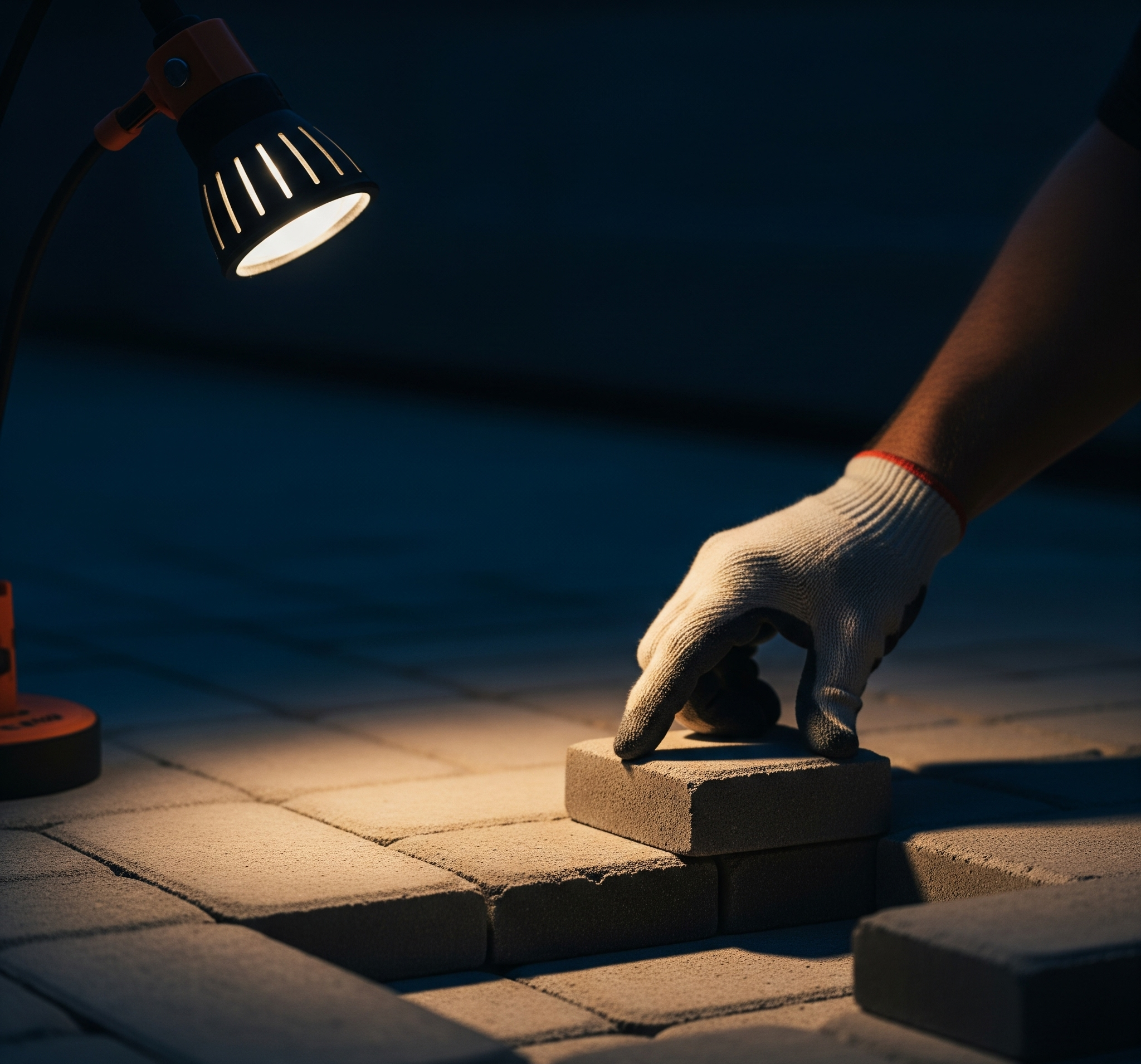
With interlock pavers, the process is elegant. The installer lifts the individual pavers from the affected area, stacks them aside, the utility work is completed, the bedding is re-compacted, and the same original pavers are placed back in exactly the same positions. When the polymeric sand is swept back into the joints and the surface is compacted, it is virtually indistinguishable from the day it was installed. No patches. No colour mismatch. No evidence of intervention. The modularity of the system means any section can be accessed and restored to factory condition at any time.
This repairability extends to damage as well. If a single paver is cracked by a dropped tool, a falling tree branch, or the impact of a snowplow blade, that one paver can be popped out and replaced individually. The cost is negligible. With stamped concrete, the same kind of impact damage may require a section of the slab to be saw-cut and replaced —a far more costly and visually imperfect repair.
The Maintenance Reality: Polymeric Sand and Weeds
Let us be equally honest about the challenges of interlock, because this is where the romanticised vision meets the everyday reality of ownership.
The joints between pavers are filled with polymeric sand—a specially engineered sand mixed with polymer binders that, once activated with water, hardens into a semi-rigid filler that resists water flow, insect intrusion, and weed growth. It is a remarkable product when properly installed. But it is not permanent.
Over time—typically 3 to 5 years, depending on traffic and exposure—polymeric sand degrades. UV radiation breaks down the polymer binder. Pressure washing (especially at excessive PSI or with a fan nozzle aimed directly into the joints) blasts it out. Heavy rain events erode the edges. Repeated freeze-thaw cycles fracture the bond. As the polymeric sand deteriorates, the joints become vulnerable. Weed seeds, carried by wind, settle into the gaps and germinate. Ant colonies, sensing the void, begin mining the sand out of the joints, creating small mounds on the surface.
The solution is periodic re-sanding—a maintenance process where the joints are cleaned out, fresh polymeric sand is swept in, compacted, and re-activated. This is typically needed every 3 to 5 years. It is not difficult work, but it is essential, and homeowners who neglect it will find their interlock driveway increasingly plagued by weeds, shifting pavers, and joint erosion. A neglected interlock surface can look dramatically worse than a neglected concrete surface, precisely because the joints telegraph every instance of deferred maintenance.
Aesthetic Range
Modern interlocking pavers offer an extraordinary range of shapes, sizes, colours, textures, and laying patterns. From the clean, contemporary lines of a large-format, smooth-faced paver in dark graphite—the kind you might see gracing the entrance of a luxury boutique hotel in Oakville—to the timeless, old-world charm of a tumbled cobblestone in warm terracotta, the palette is vast. Multi-piece random patterns, herringbone layouts, soldier course borders, circular feature inserts—the design permutations are essentially infinite.
Where pavers distinguish themselves from stamped concrete is in colour authenticity. A high-quality paver is coloured through its entire body. The surface aggregate, the cement matrix, the underlying core—it is all pigmented. And because each individual paver is manufactured in a controlled factory environment, the colour consistency batch-to-batch is exceptional. There is also a subtlety to the colour variation: most premium paver lines incorporate a gentle range of tonal variation from unit to unit, creating a natural, organic aesthetic that avoids the sometimes "too uniform" look of a single-colour stamped slab.
Head-to-Head: The Practical Comparison
Durability in Ontario's Climate
Both materials, when installed correctly, can deliver decades of service life. But they age differently, and they fail differently.
Stamped concrete in a properly engineered 32+ MPa air-entrained mix with steel reinforcement will resist the freeze-thaw cycle admirably. Its primary vulnerability is the sealer coat, which degrades under UV and must be reapplied every 2 to 3 years. Without resealing, the surface loses its colour depth, becomes porous, and becomes susceptible to salt damage and spalling. The concrete itself can last 30+ years; the sealer coating requires perpetual renewal.
Interlocking pavers, particularly those rated at 8,000+ PSI compressive strength (the standard for premium Canadian manufacturers like Unilock, Techo-Bloc, and Permacon), are extraordinarily durable against freeze-thaw. Each individual unit has been cured under intense pressure and heat in a factory, giving it a density and crystalline structure that exceeds poured-in-place concrete. The pavers themselves rarely fail; it is the system—the bedding, the joints, the edge restraints—that requires ongoing maintenance.
Long-Term Maintenance Commitment
This is where the honest conversation happens, and it is a conversation many homeowners have not had with their previous contractors.
Stamped concrete maintenance: Reseal every 2-3 years (solvent-based acrylic with anti-slip additive). Inspect control joints annually for sealant failure. Address any new cracks promptly with flexible sealant to prevent water infiltration. Clean surface annually with a light pressure wash (under 2,500 PSI to protect the sealer).
Interlock paver maintenance: Inspect polymeric sand annually; re-sand as needed (typically every 3-5 years). Address any settled or shifted pavers promptly by lifting, re-bedding, and re-compacting. Spot-treat any weed breakthrough immediately. Seal the surface optionally every 3-5 years for enhanced colour and stain resistance (recommended but not structurally mandatory).
Neither material is "maintenance-free." Anyone who tells you otherwise is selling you something. The question is which type of maintenance aligns with your lifestyle and your tolerance for periodic upkeep.
Snow Removal Considerations
In the GTA, your driveway will be plowed, shovelled, or blown clear of snow approximately 25 to 40 times per winter. This is a significant factor that is often overlooked during the material selection process.
Stamped concrete, with its continuous, smooth-textured surface, is highly plow-friendly. A rubber-edged snowplow blade glides across it with minimal resistance. The risk of damage from plowing is low, provided the plow operator is careful at control joints and the concrete edges.
Interlock pavers, while structurally robust, have a vulnerability at the joints. An aggressive metal plow blade, set too low, can catch the edge of a raised paver and chip it. Worse, repeated plowing can gradually push polymeric sand out of the joints, accelerating the need for re-sanding. We always recommend rubber-edged blades for interlock surfaces. Additionally, slightly textured or tumbled pavers accumulate a thin layer of packed ice in the surface dimples that smooth concrete does not, which can require additional salt or sand application for traction.
The Cinintiriks Approach: Engineering the Foundation
Here is the truth that we build our entire reputation on: whether you choose stamped concrete or interlocking pavers, the surface will utterly fail if the foundation beneath it is cheap.
We have seen it hundreds of times. Beautiful $20,000 stamped driveways cracked in half within two winters because the contractor skimped on excavation. Gorgeous $25,000 interlock installations sinking and heaving within 18 months because the base was only 4 inches of loose gravel instead of a properly engineered sub-base.
The Cinintiriks Standard for foundation engineering is identical regardless of the surface material you choose:
1. Deep Excavation (16-24 inches): We excavate well below the frost line penetration zone, removing all native soil—especially the expansive clay soils prevalent across York Region and Peel. Nothing is left to chance. The excavation depth is tailored to the specific soil conditions of your property, verified with on-site inspection.
2. Geotextile Fabric Separation: A non-woven geotextile fabric is laid at the bottom of the excavation. This prevents the native clay from migrating upward into the granular base over time (a phenomenon called "contamination" that progressively weakens the base by introducing fines that hold water and heave).
3. Granular A Base (12-16 inches, Compacted in Lifts): We install Granular A limestone aggregate in 4-inch lifts, each one individually compacted with a 5,000+ lb plate compactor to 95%+ Standard Proctor Density. This is not a pile of gravel dumped and tamped once. It is a layered, engineered structural pad that distributes load and drains water aggressively.
4. High-Performance Bedding (HPB) Screed Layer: For interlock installations, a final 1-inch layer of HPB (a finely graded, angular limestone chip) is precision-screeded to exact elevation. This is the layer the pavers sit directly upon. Its angular particle shape locks together under compaction, creating a stable, non-shifting platform that round-particle concrete sand cannot replicate.
5. Proper Grading & Drainage: Every surface we install is graded to a minimum 2% slope away from structures, ensuring water sheds efficiently and never pools on or against the surface. Drainage is not an afterthought; it is engineered from the first line of the plan.
This foundation protocol is non-negotiable. It represents the invisible 70% of the project budget that determines whether the visible 30%—the beautiful surface you actually see and walk on—lasts 5 years or 35 years.
"The surface is the showroom. The foundation is the engineering. One without the other is a liability."
Making the Right Choice for Your Property
So, after all of this, which should you choose? The honest answer is that it depends on your specific property, your aesthetic vision, and your relationship with ongoing maintenance. There is no universally "better" material—only the right material for your situation.
Choose Stamped Concrete If:
- You prioritize a seamless, expansive, weed-free aesthetic with no visible joints
- You prefer the deep, wet-look gloss of a sealed surface
- You are committed to periodic resealing every 2-3 years
- Your property has stable, well-drained soil with minimal frost heave history
- You value a surface that is exceptionally easy to plow and sweep
- Underground utility access beneath the surface is unlikely
Choose Interlock Pavers If:
- You value modularity and the ability to repair or access any section without evidence
- Your property sits on challenging soil (heavy clay, high water table, known frost heave)
- You want the broadest possible range of shapes, colours, and laying patterns
- You prefer a surface whose individual units are factory-engineered to 8,000+ PSI
- You are comfortable with periodic re-sanding and joint maintenance
- You want the option to expand, redesign, or reconfigure the layout in the future
Or Choose Both
Increasingly, we are designing properties that incorporate both materials in a complementary composition. A sweeping stamped concrete driveway that transitions into an intimate interlock paver patio in the backyard. A paver walkway with soldier course borders that frames a stamped concrete landing at the front entry. By combining the seamless grandeur of stamped concrete with the textural warmth and repairability of pavers, you get the best of both philosophies—and you create a property that has genuine architectural character.
Not sure which material fits your property's architecture and lifestyle? Contact Cinintiriks for a custom material consultation and 3D design.
FAQ: Stamped Concrete vs. Interlock Pavers
Which is more expensive upfront: stamped concrete or interlocking pavers?
In the Greater Toronto Area market, a premium stamped concrete installation typically runs between $18 and $28 per square foot, all-in (excavation, base, pour, stamp, colour, and seal). A comparable premium interlock paver installation runs between $22 and $38 per square foot, depending on the paver selection and pattern complexity. So yes, interlock is generally 20-40% more expensive at the point of installation. However, the lifetime cost calculation is more nuanced. Stamped concrete requires resealing every 2-3 years ($1.50-$3.00/sq ft per reseal), and any significant crack repair can be costly. Interlock requires periodic re-sanding and occasional re-levelling, but the individual component repairability means that maintenance costs tend to be lower and more predictable over a 20+ year horizon. The "cheaper" option upfront is not always the cheaper option over the life of the asset.
Which material is better for a pool deck in the GTA?
For pool decks, we lean strongly toward interlocking pavers, and the reasons are primarily practical. First, temperature: stamped concrete, especially in dark colours, absorbs and radiates heat aggressively under the summer sun. Bare feet on a dark, sealed concrete pool deck at 2 PM in July can be genuinely uncomfortable. Pavers, particularly in lighter colours and with textured surfaces, tend to stay cooler underfoot. Second, slip resistance: the natural texture and joints of an interlock surface provide inherently better traction when wet than a sealed, glossy stamped surface (though anti-slip additives can mitigate this on concrete). Third, drainage: water naturally percolates through the joints of an interlock system, reducing pooling around the pool coping. Fourth, repairability: pool deck surfaces are exposed to chlorinated water, sunscreen oils, and heavy foot traffic. The ability to pop out and replace a damaged or stained paver without visible patching is a significant long-term advantage. That said, a stamped concrete pool deck can be stunning—particularly in large, open designs where the seamless aesthetic is most impactful—provided it is specified with light colours, anti-slip additive, and meticulous sealer maintenance.
Which adds more resale value to my home?
Both materials, when installed to a high standard, add meaningful curb appeal and perceived value. However, the real estate data across the GTA consistently shows that well-maintained interlock pavers tend to command a slight premium in buyer perception. The reasons are largely psychological: buyers associate interlocking pavers with higher initial investment (which is generally accurate), and the modular repairability gives them confidence that future maintenance will be manageable. Conversely, a stamped concrete driveway that shows visible sealer wear, fading, or cracking can actively detract from curb appeal more severely than a similarly aged but un-sealed paver surface, because the imperfections on concrete are more visually prominent against the intended "flawless" finish. The bottom line: either material adds value, but only if it is impeccably maintained at the time of sale. A neglected surface of either type will hurt, not help, your listing.
The Final Word
The choice between stamped concrete and interlocking pavers is not about one being objectively superior. It is about alignment—between the material's characteristics and your property's soil conditions, your design vision, your maintenance commitment, and your long-term plans for the home. Both materials, under the Cinintiriks Standard of foundation engineering and installation precision, will deliver decades of beauty and performance.
The mistake is not choosing one over the other. The mistake is choosing either without insisting on the engineered foundation beneath it. The surface is the promise. The foundation is the guarantee.