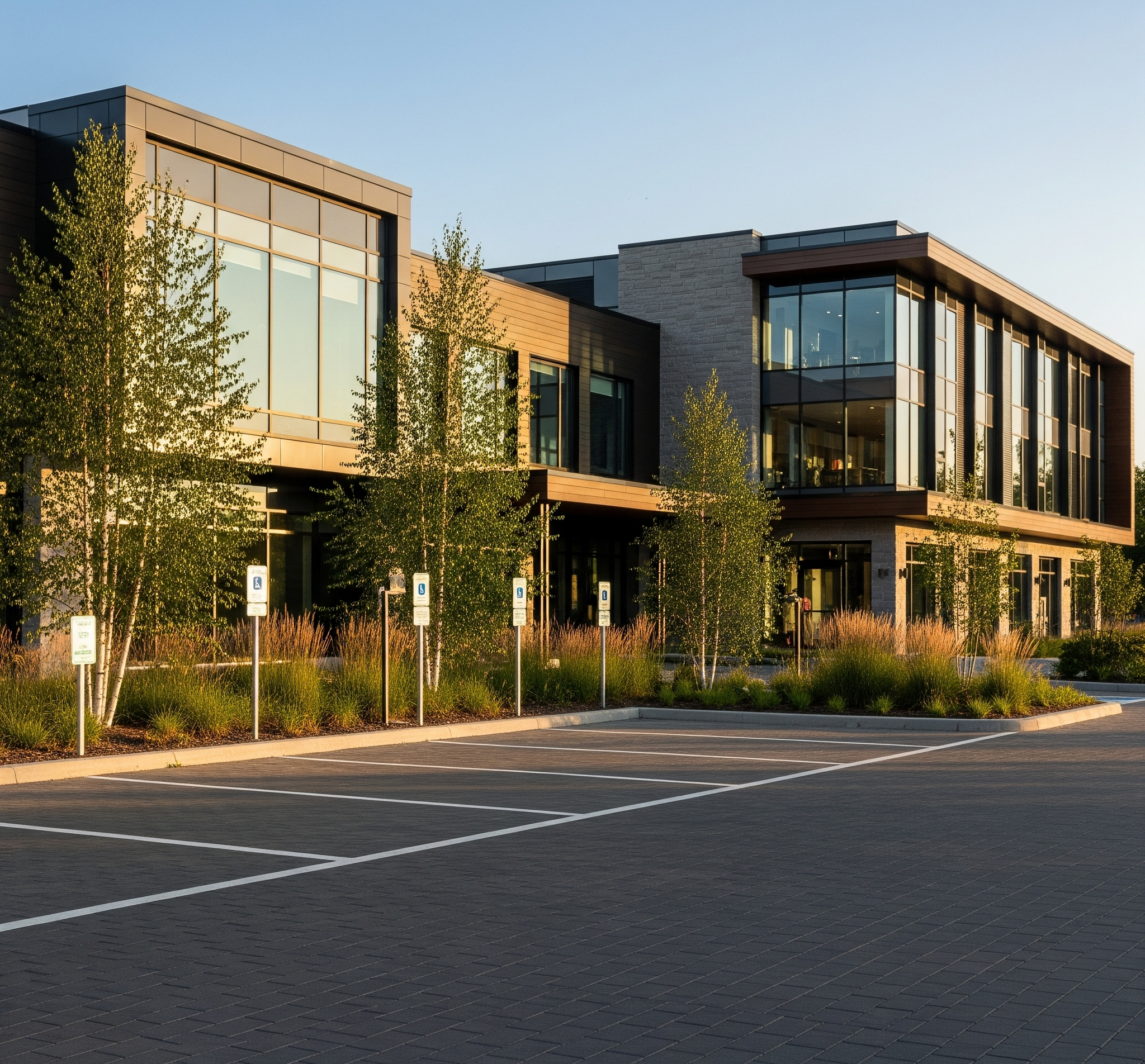
A blocked catch basin does not send a warning. It does not slow down gradually. One heavy rain event on a lot with fully blocked drainage produces a flash flood across the parking surface—thousands of litres of water with nowhere to go, spreading into tenant entrances, submerging vehicle undercarriages, destroying merchandise in ground-floor retail units, and creating a slip-and-fall landscape that will generate insurance claims for months. In winter, that same standing water freezes into a sheet of black ice that turns the entire lot into a liability minefield.
At the sub-surface level, the damage is worse. Water that cannot exit through the drainage system saturates the granular sub-base beneath the asphalt. Saturated sub-base loses its bearing capacity. The pavement above it deflects under vehicle loading. Cracks form. Water enters the cracks. The freeze-thaw cycle fractures the asphalt from within. Potholes appear, expand, and multiply. What began as a $2,000 catch basin cleaning has escalated into a $200,000 parking lot reconstruction—because nobody scheduled the cleaning.
This guide details the standard maintenance schedule that prevents that escalation. It is the minimum civil maintenance calendar for commercial drainage systems in Ontario, grounded in engineering best practice, municipal compliance, and the operational reality of managing paved commercial properties in Toronto’s extreme freeze-thaw climate.
The Invisible Liability: Why Drainage Maintenance Is Structural Preservation
Commercial property owners who defer drainage maintenance are not saving money. They are accelerating the destruction of their most expensive infrastructure asset—the paved surface itself.
The relationship between drainage performance and pavement lifespan is not correlative. It is directly causal. Water is the primary destructor of asphalt and concrete surfaces. Every failure mode that shortens pavement life—frost heaving, sub-base erosion, binder stripping, alligator cracking, pothole formation—is either caused by or accelerated by water that the drainage system failed to remove from the pavement structure.
In Toronto, the scale of the water management challenge is substantial. The city receives over 830 mm of annual precipitation across approximately 130 rain days, plus the equivalent of approximately 150–200 mm of additional water volume from snowmelt during the spring thaw. A 5,000 m² commercial parking lot in Toronto receives, on average, 5,000 cubic metres of water per year—five million litres falling directly onto the paved surface, every one of which must flow across the surface, enter a catch basin or trench drain, travel through underground pipes, and discharge into the municipal stormwater system.
If any component of that chain—basin, pipe, or discharge point—is blocked, restricted, or collapsed, the water backs up. And backed-up water on a paved surface is not a temporary inconvenience. It is a progressive, compounding infrastructure failure that accelerates with every season of neglect.
Drainage maintenance is not cleaning. It is structural preservation. Every dollar spent on scheduled drainage maintenance is a dollar that prevents premature pavement failure. The economics are not ambiguous.
The Bi-Annual Civil Schedule: Spring and Fall
The absolute minimum maintenance frequency for commercial drainage systems in Ontario is twice per year: once in spring (April–May) and once in fall (October–November). These two maintenance windows align with the two seasonal transitions that place the heaviest loading on the drainage system and produce the two most common failure triggers.
Spring Maintenance (April–May): The Post-Winter Purge
The spring maintenance window is the most critical of the year. After five months of Ontario winter, the drainage system is carrying a massive accumulated burden of debris from the winter maintenance operations that keep the parking lot safe during ice and snow season.
What is in the catch basins after winter:
- Traction sand and road salt. Commercial parking lots in Toronto consume 2–8 tonnes of traction sand and 1–4 tonnes of de-icing salt per winter season, depending on lot size and the frequency of application. During snowmelt, a significant percentage of this material washes across the surface and settles into the catch basin sumps. A single catch basin on a heavily sanded lot can accumulate 50–200 kg of sand and sediment over the course of one winter. When the sump fills beyond its design capacity, incoming sediment passes through the sump and enters the outlet pipe. Sand in the outlet pipe settles at the low points of the pipe run, progressively reducing the pipe diameter and flow capacity until the pipe is effectively blocked
- Debris from winter damage. Broken asphalt fragments from snowplow strikes, concrete chips from curb impacts, gravel displaced from landscaping beds, and litter trapped by snow accumulation all wash into the catch basins during the spring melt. Larger debris can physically block the basin outlet pipe entrance, causing immediate basin backup during the first heavy spring rain
- Salt-dissolved minerals. Road salt (sodium chloride) in solution attacks the mortar joints between concrete catch basin sections and the sealant at pipe connections, accelerating structural deterioration that may not be visible from the surface but progressively weakens the basin and creates pathways for groundwater infiltration and soil migration into the basin
The spring maintenance protocol:
- Hydro-vac extraction. A combination vacuum truck / pressure washer unit (hydro-vac) is the standard tool for commercial catch basin cleaning. The vacuum hose extracts the accumulated sediment, sand, gravel, and debris from the basin sump. The pressure washer flushes the sump walls, the basin bench (the sloped internal shelf that directs flow toward the outlet), and the outlet pipe entrance to remove adhered material and verify flow through the outlet. Each basin typically requires 15–30 minutes of cleaning time, depending on the volume of accumulated material
- Pipe jetting. After the basins are cleaned, the outlet pipes are high-pressure water jetted from each basin to the next downstream connection point. A jetting nozzle is inserted into the pipe and propelled downstream by high-pressure water (typically 2,000–4,000 PSI), which scrubs the pipe walls and flushes accumulated sediment toward the downstream basin or discharge point. This step is frequently skipped by contractors who clean only the basins themselves. Cleaning the basins without jetting the pipes leaves the sediment that has already entered the pipes in place, where it continues to restrict flow capacity
- Flow verification. After cleaning and jetting, a flow test is conducted: water is introduced into each basin (either by hose or by directing surface runoff into the basin) and the flow rate and exit at the downstream point is visually confirmed. If the flow rate is slow or absent despite cleaning, the pipe may have a structural issue (collapse, root intrusion, offset joint) that requires further investigation, typically by CCTV pipe camera inspection
- Structural inspection. While the basins are open and cleaned, the technician inspects the structural condition of the basin walls, floor, bench, outlet pipe connection, and the adjustment rings and frame at the top of the basin. This visual inspection identifies cracking, joint separation, ring settlement, frame rotation, and concrete spalling that indicate structural deterioration requiring repair
Fall Maintenance (October–November): The Pre-Winter Preparation
The fall maintenance window serves a different purpose than spring. The primary contaminant is not sand and salt—it is organic debris. Toronto’s autumn leaf drop deposits an enormous volume of leaves, twigs, seeds, and organic matter onto paved surfaces. This debris is carried by rain into catch basins and trench drains, where it accumulates in the sump and, more critically, at the basin grate and the outlet pipe entrance.
Why fall maintenance is urgent:
- Organic debris is different from mineral sediment. Sand and gravel settle to the bottom of the sump and sit inertly. Leaves and organic matter mat together at the grate surface, the bench surface, and the outlet pipe entrance, forming a fibrous plug that blocks water flow far more effectively than an equivalent volume of loose sediment. A single autumn storm can deposit enough leaf material to completely block a catch basin grate in a lot with adjacent tree canopy
- The timing is critical. Fall cleaning must be completed before the first sustained freeze (typically late November to early December in Toronto). Once overnight temperatures drop below 0°C consistently, organic debris in the basins freezes into a solid mass that cannot be extracted by vacuum truck. The frozen mass occupies sump volume, blocks flow paths, and remains in place until the spring thaw—which means the drainage system enters winter in a compromised state. Any mid-winter thaw event (which occurs multiple times per typical Toronto winter) produces surface melt that the compromised system cannot handle, resulting in ponding and refreezing into black ice
- Municipal compliance. Sediment and organic debris that passes through commercial catch basins and enters the municipal stormwater system can trigger enforcement under Toronto’s Sewer Use Bylaw (Municipal Code Chapter 681) and Ontario’s Environmental Protection Act. Municipal stormwater systems discharge into rivers, lakes, and Lake Ontario. Excessive sediment loading from poorly maintained private catch basins contributes to environmental degradation and can result in orders to comply, fines, and mandatory remediation at the property owner’s expense. Proactive cleaning is not just good maintenance practice—it is a regulatory obligation
The fall maintenance protocol:
- Grate clearing. All catch basin grates are physically cleared of leaf accumulation and surface debris. On properties with heavy tree canopy, grate clearing may need to be performed 2–3 times during the peak leaf-drop period (mid-October to mid-November) to prevent grate-level blockage between the full cleaning visits
- Sump extraction. Hydro-vac extraction of all accumulated organic debris from the basin sumps, following the same protocol as spring cleaning
- Trench drain clearing. Trench drains (channel drains) are particularly susceptible to leaf blockage because their grate slots are narrower than catch basin grates. Leaves mat across the grate surface and block water entry within hours of a heavy leaf fall. Fall maintenance includes removal and cleaning of all trench drain grate sections, extraction of debris from the channel body, and flushing of the outlet pipes
- Flow verification. Identical to the spring protocol: water is introduced into each basin and drain, and flow-through to the discharge point is confirmed
“A catch basin cleaned in November costs $200. A catch basin ignored until it floods in March costs $20,000 in emergency repair and $50,000 in liability exposure. The schedule is not optional.”
Beyond the Bi-Annual: Monthly and Situational Inspections
The bi-annual spring and fall cleanings are the minimum standard. For high-traffic commercial properties in Toronto—grocery-anchored retail plazas, big-box retail centres, multi-tenant commercial complexes, and any property with significant tree canopy adjacent to the paved surface— the maintenance calendar should include additional monthly and event-driven inspections.
- Monthly visual inspections (year-round): A property manager or maintenance contractor walks the lot after a significant rain event and visually checks every catch basin and trench drain for ponding around the grate (indicating restricted inflow), grate-level debris accumulation, grate settlement or displacement, and standing water on the pavement surface that was not present previously. This visual check takes 30–60 minutes on a typical commercial lot and costs nothing beyond the walker’s time. It is the early-warning system that identifies developing problems before they become emergencies
- Post-storm inspections: After any significant rain event (25 mm+ in 24 hours), a targeted inspection of all drainage components is prudent. Heavy rain events can displace grate frames, wash large debris into basin inlets, and expose drainage deficiencies (ponding zones, slow-draining areas) that are not apparent during normal weather
- Post-construction inspections: Any construction activity on or adjacent to the property (building renovation, utility installation, adjacent-lot development) can introduce construction debris (concrete fragments, soil, gravel, construction waste) into the drainage system. A drainage inspection and cleaning should be scheduled immediately after any construction activity that may have impacted the drainage infrastructure
Inspecting the Structural Integrity: Rings, Grates, and the Infrastructure Beneath
Drainage maintenance is not solely about removing sediment and debris. It is an annual structural audit of the physical components that comprise the drainage system. The freeze-thaw forces and mechanical loads that commercial drainage structures endure in Toronto are severe, and the structural deterioration they cause is progressive, largely invisible from the surface, and catastrophic when it reaches failure point.
Concrete Adjustment Rings
The concrete adjustment rings are the stacked concrete cylinders (typically 50–150 mm tall) that sit on top of the catch basin riser sections and support the cast-iron grate frame at finished surface elevation. They are the most structurally vulnerable component of the entire basin assembly, for two reasons:
- Freeze-thaw fracturing. Water infiltrates the mortar joints between the adjustment rings, freezes, expands, and fractures the mortar. Over multiple freeze-thaw cycles (Toronto experiences approximately 40–60 freeze-thaw transitions per winter), the mortar joints progressively deteriorate, the rings shift laterally, and the structural column that supports the grate frame destabilises. The grate begins to rock under vehicle traffic. The rocking accelerates the ring displacement. The surrounding asphalt, which is keyed against the basin frame for edge support, begins to crack and separate from the frame. Left untreated, the entire ring stack collapses inward, the grate and frame drop into the basin, and the surrounding asphalt caves in to create a sinkhole that swallows vehicle tires and creates an extreme trip-and-fall hazard
- Snowplow impact. Snowplow blades operating at speed across a parking lot surface can clip the protruding edge of a cast-iron grate frame, transmitting enormous lateral force into the adjustment ring stack. A single hard plow strike can crack a ring, rotate the frame, and initiate the displacement sequence that leads to eventual collapse. On a Toronto commercial lot that is plowed 30–50 times per winter, the cumulative impact loading on exposed grate frames is substantial
Inspection protocol: During each bi-annual maintenance visit, the technician physically inspects every grate frame for rocking, rotation, and settlement. A frame that rocks more than 3 mm under foot pressure, or that has settled more than 6 mm below the surrounding pavement surface, is flagged for immediate repair. The repair involves removing the grate and frame, disassembling the deteriorated ring stack, rebuilding with new adjustment rings set in fresh mortar (or polymer-modified mortar for enhanced freeze-thaw resistance), and resetting the frame flush with the surrounding surface. Cost per basin: typically $500–$1,500, depending on the extent of ring deterioration. Cost of ignoring it until the basin collapses: $5,000–$15,000 for full basin excavation, ring replacement, grate re-installation, and asphalt restoration of the surrounding sinkhole.
Cast-Iron Grates and Frames
Cast-iron grates and frames are mechanically durable but not indestructible. The failure modes to inspect for:
- Cracked grate bars. Repeated heavy-vehicle loading (delivery trucks, waste haulers) can fatigue and crack individual grate bars, creating openings large enough for a pedestrian’s heel or foot to enter—a direct trip-and-fall hazard. Cracked grates should be replaced immediately
- Frame corrosion. Road salt accelerates cast- iron corrosion, particularly at the frame-to-ring contact surface where salt-laden water pools. Advanced corrosion reduces the frame’s load-bearing capacity and can cause frame fracture under heavy vehicle loading. Frames showing significant section loss (visible thinning, pitting, or flaking) should be replaced
- Missing or displaced grates. Grates that have been displaced by snowplow strikes or removed and not replaced after cleaning create an open basin hazard —an unprotected hole in the parking lot surface that a pedestrian can step into. This is an immediate, high-severity trip-and-fall risk that requires emergency correction
Pipe Infrastructure
The underground pipe network connecting catch basins to the municipal stormwater system should be inspected with a CCTV pipe camera at least once every five years, or immediately if flow testing during routine maintenance reveals restricted flow despite clean basins and jetted pipes. CCTV inspection identifies:
- Root intrusion. Tree roots penetrate pipe joints and grow inside the pipe, progressively reducing diameter and eventually blocking the pipe entirely. Root intrusion is extremely common on Toronto properties with mature trees within 10 metres of the drainage pipe alignment
- Pipe collapse or deformation. Corrugated metal pipes (common in older installations) corrode from the invert up, eventually losing structural integrity and collapsing. Older concrete pipes can crack and offset at joints due to ground movement or settlement
- Joint separation. Pipes that have separated at joints allow soil to migrate into the pipe (further restricting flow) and water to exfiltrate into the surrounding soil (creating sub-surface voids that can cause surface settlement above the pipe alignment)
The Cinintiriks Approach: Proactive Heavy Civil Maintenance
Cinintiriks does not wait for a catastrophic flood to act. We engineer proactive, documented commercial drainage maintenance programs for our Toronto and GTA commercial clients—systematic, scheduled, and auditable protocols that keep the drainage infrastructure in verified working condition year-round.
1. Annual Maintenance Contract: Every Cinintiriks commercial drainage client receives a written annual maintenance schedule specifying the exact scope and timing of each service visit: spring hydro-vac cleaning (April–May), fall organic-debris extraction (October–November), and interim inspections as dictated by the property’s specific risk profile (tree canopy exposure, traffic volume, construction activity). The schedule is designed around the property’s operational calendar—cleaning visits are scheduled during low-traffic periods to minimise disruption to tenants and customers.
2. Hydro-Vac & Pipe Jetting: We do not clean basins and skip the pipes. Every Cinintiriks drainage maintenance visit includes full sump extraction, bench flushing, and downstream pipe jetting on every basin and drain in the scope. We carry the sediment through the entire system, confirm flow at every downstream point, and document any flow restriction that requires further investigation. The extracted material is disposed of at licensed receiving facilities in compliance with Ontario Regulation 406/19 and Toronto’s Sewer Use Bylaw.
3. Structural Inspection & Condition Reporting: Every maintenance visit includes a basin-by-basin structural inspection of grate frames, adjustment rings, basin walls, pipe connections, and visible pipe condition. Each basin is assessed on a three-tier condition scale: Green (fully functional, no issues), Yellow (early deterioration detected, repair recommended within 12 months), and Red (structural deficiency, repair required before next winter). The inspection report is delivered to the property manager within 48 hours of the service visit, with photographs, condition ratings, and prioritised repair recommendations.
4. CCTV Pipe Inspection: On a five-year cycle (or as triggered by flow-test anomalies), we conduct robotic CCTV camera inspection of the underground pipe network, documenting pipe condition, root intrusion, joint integrity, and structural capacity. The video record and condition report become part of the property’s permanent maintenance documentation— critical evidence for insurance purposes, property transactions, and regulatory compliance.
5. Emergency Response: For Cinintiriks annual maintenance clients, we provide priority emergency response for drainage failures that occur between scheduled maintenance visits. A burst pipe, a collapsed basin, or a sudden flooding event during a major storm is mobilised within 24 hours on a priority basis, with the maintenance history and inspection reports already on file to guide the root-cause diagnosis. Knowing the system’s condition history allows us to diagnose and resolve emergency failures faster—because we are not discovering the system for the first time during the crisis.
Don’t wait for a collapsed catch basin or a flooded parking lot. Contact Cinintiriks for a heavily engineered, proactive commercial drainage maintenance plan in Toronto and across the GTA.
FAQ: Commercial Drainage Maintenance
How often should a commercial catch basin be pumped out in Ontario?
The baseline standard is twice per year: once in spring (April–May) after the winter sand and salt accumulation, and once in fall (October–November) after the peak leaf-drop season. This bi-annual schedule is the minimum for any commercial property in Ontario with paved parking and developed drainage. For properties with elevated sediment loading —lots adjacent to construction sites, properties with heavy tree canopy, retail plazas with high winter sanding frequency, or lots servicing heavy vehicles that track debris onto the surface—a quarterly schedule (spring, summer, fall, and pre-winter) is recommended. The determining factor is sediment accumulation rate: if a basin sump is more than 50% full at any inspection interval, the interval is too long and should be shortened. A sump that reaches capacity between scheduled cleanings is allowing sediment to pass into the outlet pipes, which is the beginning of the pipe-restriction failure sequence that leads to surface flooding. Many Toronto commercial property managers we work with have adopted a spring + fall + one summer mid-cycle schedule (three visits per year) as the optimal balance of cost and protection for medium-traffic commercial lots with moderate tree exposure. The cost of each visit is typically $150–$350 per catch basin for hydro-vac extraction and pipe jetting (volume discounts apply on lots with 10+ basins). On a lot with 15 basins, the annual maintenance cost at three visits per year is approximately $5,000–$10,000— a fraction of the cost of a single emergency flood-recovery mobilisation, let alone the pavement damage and liability claims that the flooding would generate.
Can a severely clogged trench drain cause the surrounding asphalt to sink and fail?
Yes, through two mechanisms. (1) Surface water saturation. A trench drain that is blocked at the grate level (debris matting across the grate slots) or at the outlet (sediment blocking the pipe connection) no longer intercepts surface water. The water that was supposed to enter the drain instead ponds on the adjacent pavement surface. Standing water infiltrates the asphalt through surface cracks and the joint between the drain frame and the asphalt edge. Once water reaches the granular sub-base beneath the asphalt, it saturates the granular material, reducing its bearing capacity. The asphalt above the saturated zone deflects under vehicle loading, developing depressions and cracks that admit more water, accelerating the cycle. In winter, the saturated sub-base freezes and heaves, lifting the adjacent asphalt and fracturing it. The spring thaw produces rapid settlement as the ice releases, leaving the asphalt in a permanently sunken, cracked, and failed condition around the drain. (2) Subsurface erosion. If the drain’s outlet pipe has separated at a joint (a common failure in older installations), water exiting the drain enters the surrounding soil rather than travelling through the pipe to the catch basin. This exfiltrated water erodes the granular sub-base material, creating a void beneath the asphalt that is invisible from the surface. The asphalt above the void is now spanning an unsupported gap. Vehicle loading applies flexural stress that the unsupported asphalt cannot withstand, and the surface collapses—often suddenly and dramatically— creating a sinkhole-type failure that can be 300–500 mm deep and 1–2 metres wide. This is one of the more expensive failures to repair, because the void must be excavated, the failed pipe section must be replaced, the granular base must be rebuilt and compacted, and the asphalt must be restored. Total cost: typically $8,000–$25,000 per failure location. All of it preventable with a $200 trench drain cleaning visit.
What happens if a commercial property completely ignores its stormwater maintenance schedule?
The consequences are progressive, predictable, and expensive. Year 1–2: Catch basin sumps fill to capacity. Sediment begins passing into outlet pipes. Surface drainage slows noticeably during heavy rain events. Ponding zones appear in areas that previously drained normally. Year 2–3: Outlet pipes are significantly restricted by accumulated sediment. Catch basins back up during moderate rain events. Standing water persists for hours or days after rain. The first black-ice incidents occur in ponding zones during winter. Pavement around ponding zones begins showing accelerated cracking and surface deterioration. Year 3–5: Multiple basins are effectively non-functional. Large ponding zones exist across the lot. Pavement in ponding zones has developed alligator cracking, potholes, and sub-base failures. Slip- and-fall claims increase. Vehicle damage complaints increase. Tenants voice formal complaints. Insurance premiums increase due to claims history. The property is in potential violation of Toronto’s Sewer Use Bylaw and potentially subject to municipal enforcement. Year 5+: The drainage system requires complete rehabilitation—pipe jetting, root cutting, possible pipe replacement, basin rebuilds— at a cost that is 10–20 times the cumulative cost of the annual maintenance that would have prevented the deterioration. Sections of the parking lot require full reconstruction (removal and replacement of asphalt and sub-base) due to water damage that cannot be repaired at the surface level. The total cost of five years of neglect on a medium-sized Toronto commercial lot (50–80 basins) typically ranges from $100,000 to $400,000 in combined drainage rehabilitation, pavement repair, liability claim costs, and insurance premium increases. The total cost of five years of proactive bi-annual maintenance on the same lot: approximately $25,000–$50,000. The ratio speaks for itself.
The Final Word
Drainage maintenance is the most cost-effective investment a commercial property owner can make in pavement preservation, liability reduction, and tenant satisfaction. It is also the most overlooked, because the system that benefits from it is entirely underground, entirely invisible, and entirely silent —right up to the moment it fails.
The schedule is straightforward: spring and fall, every year, without exception. The scope is specific: hydro-vac extraction, pipe jetting, flow verification, and structural inspection on every basin, drain, and pipe segment. The documentation is essential: condition reports, photographs, and repair recommendations that protect you legally, inform your capital planning, and demonstrate reasonable care under Ontario’s Occupiers’ Liability Act.
The drainage schedule is not a suggestion. It is the minimum engineering standard for preserving commercial infrastructure in a climate that puts five million litres of water per year on every 5,000 m² of surface you own.
Schedule the maintenance. Document the inspections. Protect the infrastructure. The water does not wait, and neither should you.