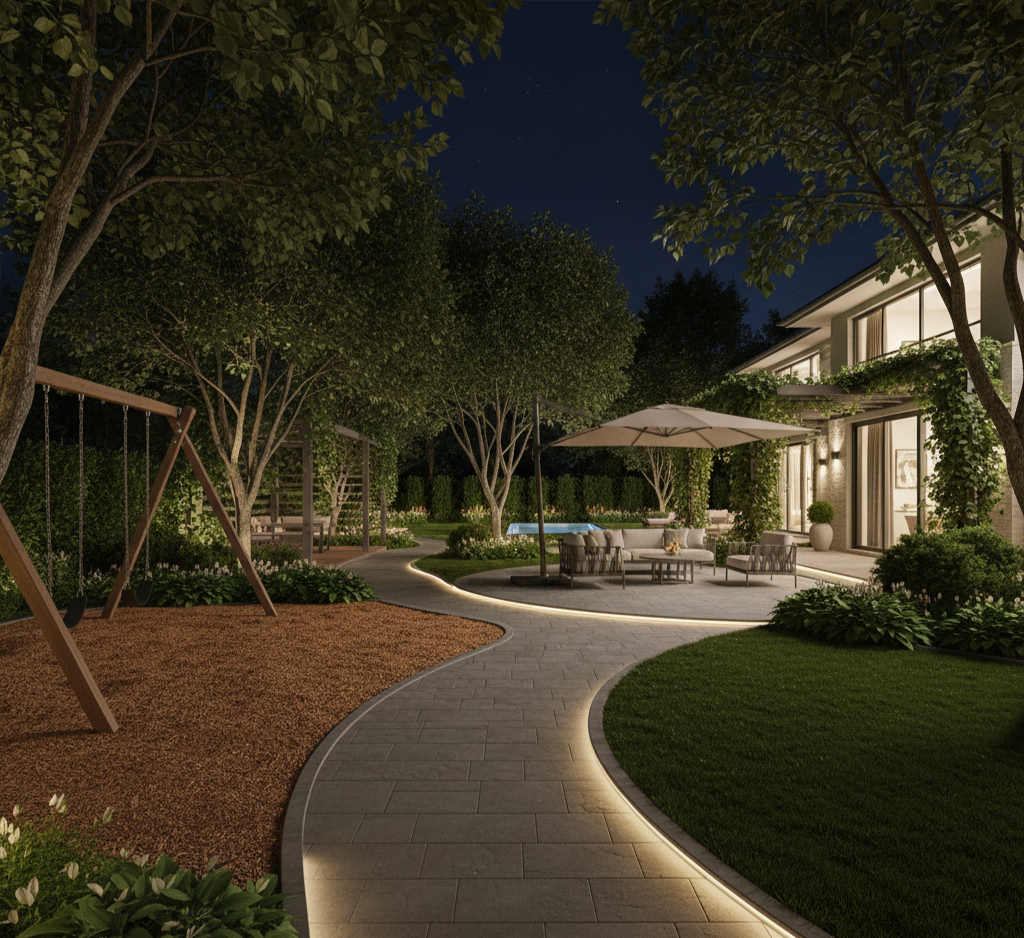
The Legal Liability of Gravity
Let us address the brutal reality of commercial playground construction in Ontario. Gravity is uncompromising, and children fall. When they do, the surface they strike dictates the difference between a brushed knee and a catastrophic, life-altering head injury. Because of this, playground surfacing is governed by the rigorous CSA Z614 standard for Children’s Playspaces and Equipment. This standard explicitly defines the impact attenuation (shock-absorbing) properties required for any surface located within the use zone of play equipment.
There is a catastrophic mistake that amateur contractors and uninformed facility managers make: assuming that standard residential landscaping materials are acceptable for commercial play areas. Utilizing unapproved materials—such as standard residential bark mulch, shallow pea gravel, or thin layers of decorative sand—is a direct violation of safety protocols. Failing to meet the Critical Fall Height (CFH) impact attenuation metrics opens a Scarborough facility to devastating lawsuits, severe penalties, and immediate closure by municipal inspectors or insurance auditors. The material must be engineered, tested, and certified to absorb the kinetic energy of a falling child from the highest designated play surface of the specific equipment it surrounds.
The Engineering: EWF vs. PIP Rubber & The Sub-Base Secret
When engineering a compliant playground in the Greater Toronto Area, the industry relies on two primary acceptable solutions: Engineered Wood Fiber (EWF) and Poured-in-Place (PIP) rubber. Demystifying the heavy civil mechanics of these materials is crucial for making an informed, long-term investment.
Engineered Wood Fiber (EWF) is not standard wood chips. It is a highly specific, mechanically processed wood product designed to knit together, forming a firm, slip-resistant, and impact-absorbing surface. It must meet ASTM F1292 for impact attenuation and ASTM F2075 for purity. While EWF is more budget-friendly initially, it requires relentless, ongoing maintenance. It displaces under heavy traffic (especially under swings and slide exits), requiring constant raking and frequent topping-up to maintain the legally required depth. If the depth falls below the engineered threshold, the facility is immediately non-compliant and legally exposed.
Poured-in-Place (PIP) Rubber is the gold standard for high-end commercial park construction, schools, and daycare facilities. PIP rubber provides a premium, accessible, and seamless surface. It consists of a dual-layer system: a thick, shock-absorbing base layer of recycled SBR rubber (the depth of which is mathematically calibrated to the specific Critical Fall Height of the equipment), topped by a highly durable, coloured EPDM rubber wear layer. It requires almost zero ongoing maintenance, does not displace, and provides unparalleled longevity.
However, the success of a PIP rubber surface relies entirely on what you cannot see. The secret to PIP longevity is the heavy civil engineering beneath it. Detail the absolute necessity of excavating the native soil and engineering a heavily compacted, laser-graded clear stone sub-base with integrated trench drains. If a PIP rubber surface does not have heavy civil drainage beneath it, water will pool within the rubber matrix or the sub-grade. When that trapped water freezes during the first brutal Canadian winter in Scarborough, the expanding ice will violently heave and tear the expensive rubber surface apart, completely destroying a six-figure investment in a single season. Flawless sub-grade hydrology is non-negotiable.
The Accessibility Standard (AODA Compliance)
Beyond impact attenuation, we must discuss the modern legal requirements for inclusive play under the Accessibility for Ontarians with Disabilities Act (AODA). Commercial and municipal playgrounds must be accessible to all children and caregivers, including those utilizing mobility devices such as wheelchairs or walkers.
This is precisely why traditional deep sand or loose pea gravel is no longer acceptable for high-end commercial projects; mobility devices simply sink and become trapped in loose-fill materials. EWF can meet accessibility standards if rigorously maintained and compacted, but it is challenging to keep compliant over time. Firm, impact-absorbing PIP rubber surfaces are the ultimate solution for inclusive design. They allow for full wheelchair accessibility across the entire play zone, creating a seamless, flush transition from our expansive, contrasting concrete or interlocking paver walkways directly into the play zone without any structural barriers or trip hazards.
The Cinintiriks Approach
This brings us to "The Cinintiriks Standard." We are not a company that simply dumps rubber on dirt and calls it a playground. We are heavy civil hardscaping and landscaping specialists. We understand that a safe, long-lasting playground is a complex structural system.
We execute surgical, heavy civil site preparation specifically tailored for properties in Scarborough and the broader GTA. We manage the hydrology by engineering deep, clear-stone drainage reservoirs and installing rigid PVC sub-drains to permanently route water away from the play zone. We build bulletproof, mechanically compacted sub-bases that will not settle or heave. Finally, we install fully compliant, luxury-grade safety surfacing that not only meets but exceeds CSA Z614 requirements. We protect the children who play on our surfaces, and we legally shield the organizations that hire us.
FAQ: Commercial Playground Safety Surfacing
What is the difference between standard landscaping wood chips and Engineered Wood Fiber (EWF)?
Standard landscaping wood chips or bark mulch are designed for aesthetic garden beds. They contain twigs, leaves, and varying sizes of wood that degrade quickly, hold moisture, and do not provide predictable impact absorption. Engineered Wood Fiber (EWF) is a highly regulated, manufactured product. The wood is mechanically processed to specific dimensions so that the fibers intertwine and "knit" together, creating a firm, slip-resistant surface that absorbs impact according to ASTM F1292 standards. EWF is also tested for purity to ensure it does not contain hazardous tramp metals, toxic wood species, or excessive dust.
How deep does the sub-base drainage layer need to be under a Poured-in-Place rubber surface?
The depth of the sub-base is determined by the native soil conditions and the hydrological requirements of the specific site, but under "The Cinintiriks Standard" in the GTA, we typically excavate a minimum of 6 to 8 inches (150mm to 200mm) for the drainage sub-base. This excavation is filled with 3/4-inch clear washed stone and mechanically compacted. This clear stone layer provides a crucial 40% void space, acting as a massive underground reservoir that captures rainwater passing through the porous PIP rubber. Integrated perforated drain pipes within this stone layer then carry the water away to a positive outlet, ensuring the rubber never sits in standing water that could freeze and cause catastrophic frost heave.
How do you determine the Critical Fall Height (CFH) required for a specific piece of playground equipment?
The Critical Fall Height (CFH) is defined by the CSA Z614 standard and is determined by measuring the distance from the highest designated play surface (the highest point a child is intended to stand or sit on the equipment) to the protective surfacing below. For example, the CFH of a swing is measured from the pivot point of the swing structure, while the CFH of a platform is measured from the deck surface. Once the exact CFH is calculated, the safety surfacing material (whether PIP rubber or EWF) must be installed at a specific, tested depth proven to adequately absorb the impact of a fall from that exact height, ensuring the Head Injury Criterion (HIC) does not exceed fatal limits.
The Final Word
Don't leave your facility's safety and compliance to chance. Contact Cinintiriks for heavily engineered, CSA-compliant playground surfacing and hardscaping in Scarborough.