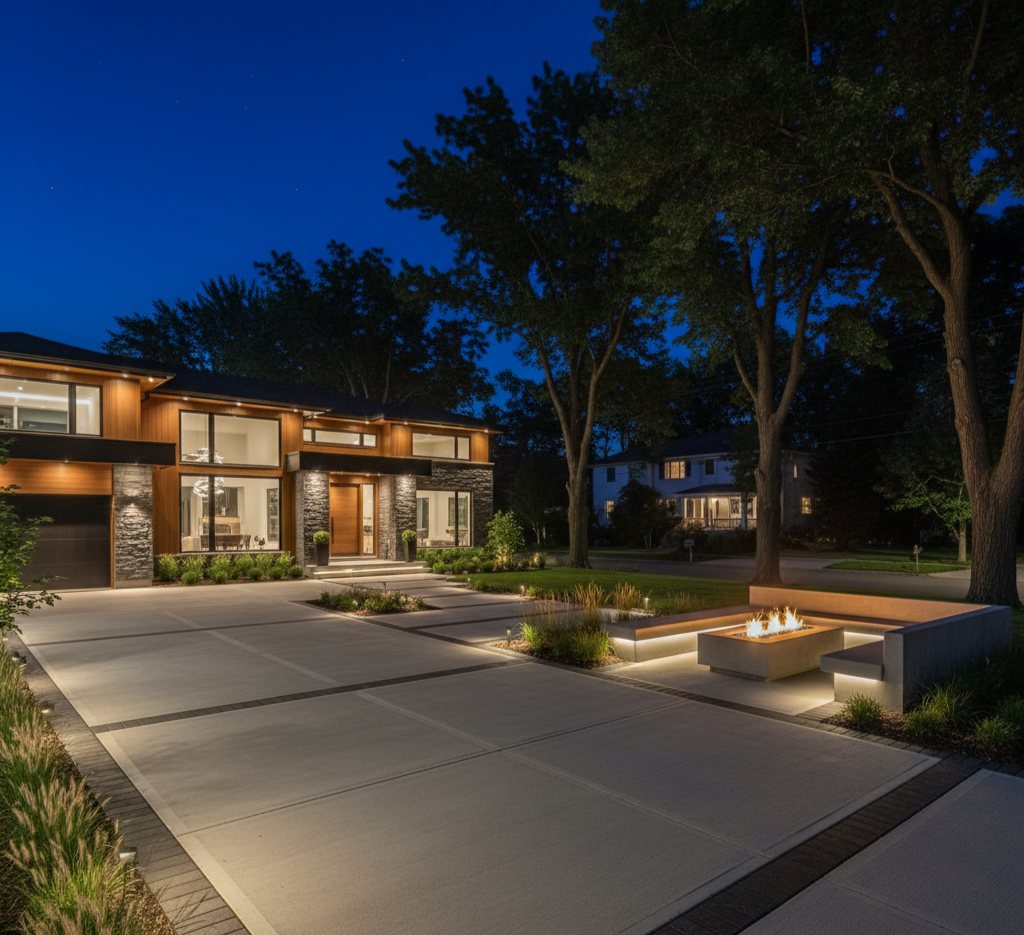
To treat the finish of your concrete as an afterthought is to compromise the integrity of the entire estate. In the luxury residential market of the Greater Toronto Area, the "finish" is not merely a texture; it is a performance layer that must reconcile two opposing forces: the desire for sophisticated, minimalist aesthetics and the brutal reality of our freeze-thaw climate.
This 2026 Design Edit explores the finishes that have stood the test of time, dissecting their engineering merits and their suitability for the discerning homeowner in Oakville, Toronto, Mississauga, and Vaughan.
The Palette of Permanence
Concrete is liquid stone. Its final form is dictated by the hand of the artisan during the critical window of curing. Unlike asphalt, which offers a binary choice (black or grey), concrete offers a spectrum of textures, light-reflectance values, and structural identities.
"A finish is not just looked at; it is lived on. It dictates traction in January and radiance in July."
1. The Modern Broom Finish (The Essentialist Choice)
Historically dismissed as "utilitarian," the broom finish has undergone a renaissance in modern architecture. In 2026, we are not speaking of the aggressive, high-friction ridges of a municipal sidewalk. We are speaking of "Micro-Brooming."
By utilizing horsehair or specialized nylon brushes, we create a texture that is visibly unidirectional but tactilely subtle. This finish catches the low morning sun, creating a linear shadow play that lengthens the perceived depth of the driveway. It is the preferred choice for ultra-modern, flat-roofed homes in North York where minimalism is the governing philosophy.
Performance Note: It offers the highest coefficient of friction (grip) of any finish, making it arguably the safest choice for steeply sloped driveways in the Hoggs Hollow or Escarpment areas.
2. Exposed Aggregate (The GTA Standard)
There is a reason exposed aggregate dominates the luxury market in Oakville and Burlington. It is the "Terrazzo of the Exterior."
The process involves a chemical retarder applied to the surface immediately after pouring. The next morning, the top millimeter of cement paste is power-washed away to reveal the skeletal structure of the concrete—the aggregate stones themselves.
The Aesthetic Advantage: It introduces natural variation. Depending on the mix design (local limestone, granite, or river rock), the driveway takes on an organic, speckled appearance that hides oil drops, tire marks, and organic debris incredibly well.
The Durability Factor: Because the surface is composed of stone rather than cement paste, it is inherently harder and more resistant to surface abrasion (spalling) caused by salt usage.
Design Trend: The "Monolithic Border"
In 2026, we rarely pour exposed aggregate edge-to-edge. The contemporary "Cinintiriks Signature" involves framing the exposed field with a 12-inch smooth or sand-blasted border. This "picture framing" technique provides architectural definition, separating the driveway from the softscape and elevating the installation from a slab to a designed feature.
3. Stamped Concrete (The Architectural Chameleon)
Stamped concrete requires a note of caution. The "Cobblestone" and "Random Rock" patterns of the early 2000s have undoubtedly dated. They often look synthetic, repeating the same texture every few feet.
However, modern stamping has evolved. We now utilize "Seamless Texture Skins" and large-format "Ashlar Slate" patterns. These tools impart the texture of natural stone without the busy, artificial grout lines. When combined with colour hardeners (dusted onto the wet surface) and antique release agents, the result can be indistinguishable from natural Wiarton flagstone.
Critical Warning: Stamped concrete relies on surface sealers to maintain its depth of colour. In winter, this can be slippery. We mitigate this by mixing a localized aluminum oxide grit into the final sealer coat, providing invisible traction.
Semantic Deep Dive: The Science of Selection
Choosing a finish is a negotiation between aesthetics and physics. When we consult with clients, we analyze specific variables that go beyond colour.
Traction & Safety (SR Values)
In Ontario, Slip Resistance (SR) is a legal and practical reality. A "hard-troweled" finish (smooth like a garage floor) is illegal for exterior use because it becomes an ice sheet in winter. Every finish we apply meets a specific roughness profile to ensure that a vehicle—or a guest in dress shoes—finds purchase even in sleet.
Color Integration: Integral vs. Surface
How do we achieve that charcoal or slate grey tone? There are two methods:
1. Integral Colour: The pigment is mixed into the concrete truck itself. The colour is consistent throughout the entire slab. If a chip occurs 20 years from now, the concrete underneath is still the same colour.
2. Colour Hardener: A powder thrown onto the wet surface and troweled in. This creates a surface that is denser and more vibrant than integral colour, but the colour is only 3-5mm deep. For high-traffic driveways, integral colour is generally the more robust choice for longevity.
GTA Areal Specifics: Planning for Location
The Oakville/Burlington Corridor:
Here, zoning bylaws often restrict the percentage of "hard surface" coverage. We frequently employ
"banded" designs where the concrete finish is broken up by strips of interlock or even artificial
turf to meet Permeable Surface guidelines while maintaining a modern aesthetic.
The Vaughan/Richmond Hill Clay Belt:
The heavy soil here demands flexibility. We often recommend finishes that can be easily repaired.
Exposed aggregate is forgiving; if a micro-crack appears, the texture masks it. A smooth, stamped
finish, by contrast, acts as a canvas for any imperfection.
Getting Quotes: The Right Questions
When vetting contractors, the "finish" is often where corners are cut. A "cheap" finish is rushed. It happens when a crew is understaffed and the concrete "gets away from them" (hardens too fast). They spray water on the surface to make it workable again, which weakens the top layer and leads to peeling (delamination) a year later.
Ask specifically: "Do you use evaporation retarders during the finishing process?" and "Do you hand-tool the control joints or saw-cut them?" (Saw-cutting, done the next day, provides cleaner, sharper lines).
FAQ: Expert Insights
Can I combine finishes?
Absolutely. The most stunning driveways use contrast. A textured brush finish for the main parking pad, framed by a high-gloss, smooth-troweled border (with grit for safety) creates a visual hierarchy.
How long should the finish cure?
While you can walk on it in 24 hours, the "finish" is chemically hardening for 28 days. We apply a cure-and-seal compound immediately, but the true sealer should often wait until the concrete has fully outgassed (dispersed its moisture).
Is polished concrete an option outdoors?
True polished concrete (ground with diamonds) is generally reserved for interiors. Outdoors, the UV light attacks the densifiers, and the lack of texture makes it dangerous in winter. We achieve a "polished look" using high-gloss sealers on smooth-troweled borders instead.
The Final Polish
The finish is the tactile interface of your home. It is what you see every time you pull into your driveway, and what you feel under your boots in winter or bare feet in summer. It deserves to be chosen with the same care as your hardwood flooring.
At CININTIRIKS, we do not just pour concrete; we curate surfaces. Our portfolio of finishes is designed to bridge the gap between structural endurance and architectural elegance.