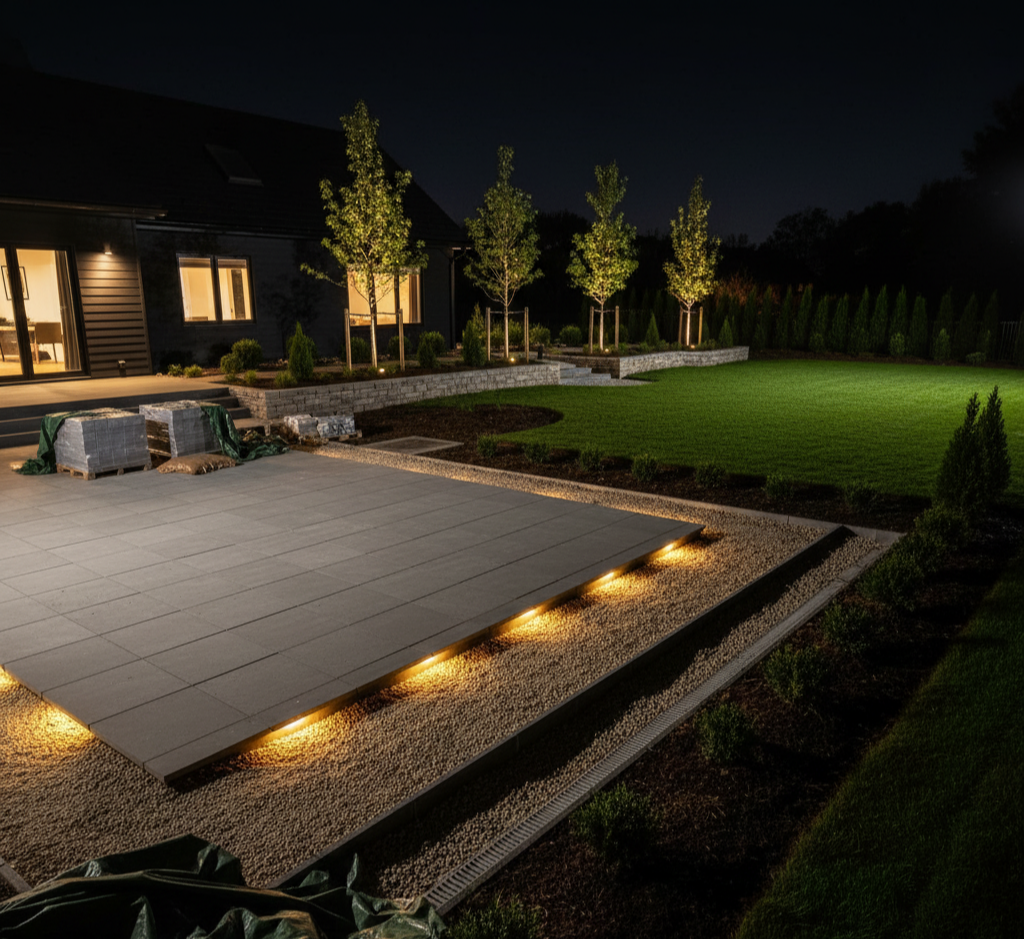
Your first instinct is suspicion. You are spending serious money. Why won’t they guarantee the entire scope for five years? Ten years? Isn’t that what a “premium” contractor should offer?
The honest answer—and the one that separates a trustworthy contractor from a predatory one—is that the warranty for organic and loose materials operates on a fundamentally different principle than the warranty for structural hardscaping. Not because the contractor is cutting corners. Because the materials themselves are governed by biology, weather, and gravity in ways that concrete and stone masonry are not. And any contractor who tells you otherwise is either ignorant of the science or deliberately misleading you to win your contract.
This guide explains exactly what a legitimate softscaping warranty should cover, what it cannot honestly cover, and how to distinguish a transparent, engineered warranty from a hollow marketing promise. If you are planning a mulch, topsoil, or decorative stone installation on a residential or commercial property in Toronto and the GTA, this is the warranty education that will save you from making an expensive trust mistake.
The Reality of Organic vs. Structural
Let us start with a comparison that clarifies the entire warranty conversation in thirty seconds.
A poured concrete retaining wall is an inorganic structure. It does not decompose. It does not attract insects. It does not change colour because of UV exposure (beyond minor surface lightening over decades). It does not migrate, shift, or settle when rain saturates the surrounding soil, because it is anchored on a frost-depth footing designed to resist exactly those forces. Its performance can be predicted with engineering calculations that have been validated over a century of civil construction. When a contractor warranties a concrete retaining wall for 10 or 15 years, they are making a promise grounded in physics and material science that the concrete industry can quantify with a high degree of certainty.
Now consider a bed of premium natural hardwood bark mulch. It is an organic material. It is designed to decompose. That is its biological function—to break down into humic matter that feeds the soil microbiome, improves soil structure, and nourishes the plantings it surrounds. A mulch that does not decompose (rubber mulch, dyed synthetic mulch) is not performing its horticultural function. The decomposition process is accelerated by moisture, by freeze-thaw cycling, and by the biological activity of the fungi, bacteria, and invertebrates that colonise the mulch layer within weeks of installation. In Toronto’s climate—with its 830 mm of annual precipitation, its 130+ freeze-thaw cycles, its hot, humid summers, and its prolonged snow cover—a premium natural mulch application has an effective service life of 12 to 24 months before it thins noticeably and requires a refresh.
No amount of engineering changes this. No premium installation technique extends the biological decomposition clock by more than a few months. A contractor who offers a five-year warranty on mulch colour and coverage is warranting something that the laws of organic chemistry make impossible to deliver. They will either refuse the claim when it comes, or they will fold their business long before year five arrives.
Topsoil presents a different but equally important distinction. Topsoil itself is not a manufactured product with a performance specification—it is a natural growing medium. Its nutrient content changes as plants consume it. Its structure compacts under foot traffic and equipment. Its elevation settles over time as organic matter decomposes and particles consolidate under gravity and rain impact. What can be warranted—and what must be warranted—is the grading: the precise elevation and slope at which the topsoil was placed relative to the home’s foundation, the property boundaries, and the drainage infrastructure. If the grading is done incorrectly, water pools against the house. That is a workmanship failure. That is warrantable.
Decorative stone—river rock, clear stone, limestone screenings, architectural boulders—is inorganic. It does not decompose. It does not fade significantly. In theory, the stone itself can last centuries. But the installation of decorative stone involves organic and geotechnical components (the substrate, the geotextile fabric, the interface with surrounding soil) that are subject to the same forces of settling, migration, and biological intrusion that affect all ground-level landscaping. The warranty on stone work is therefore a warranty on the civil preparation beneath the stone, not on the stone itself.
“We warranty the engineering. We cannot warranty the weather. That distinction is the difference between an honest contractor and a sales pitch.”
Workmanship Over Time: What the Warranty Actually Covers
A legitimate softscaping warranty from a professional contractor in Toronto should cover specific, measurable, verifiable aspects of the installation execution. These are not vague promises about “satisfaction” or “quality.” They are engineering commitments that can be inspected, measured, and confirmed with physical tools.
Topsoil Grading Warranty
This is the most critical component of any softscaping warranty, and it is the one most frequently absent from amateur installations. The warranty should guarantee that the finished grade of all topsoil installed on the property achieves a minimum 2% positive slope away from all foundation walls for the first 1.8 metres (6 feet) of surrounding grade, as required by the Ontario Building Code.
What does this mean in practice? It means that if, within the warranty period, you observe water pooling against your foundation wall after a rain event—and the pooling is caused by the topsoil grade sloping toward the house rather than away from it— the contractor is obligated to return, re-grade the affected area, and restore the positive drainage slope at no additional cost. This is not a cosmetic issue. This is a structural protection issue. Negative grading causes hydrostatic pressure against the foundation, saturates the damp-proofing or waterproofing membrane, and, over time, leads to basement moisture intrusion, mould growth, and in severe cases, foundation wall deterioration.
In Toronto—where the clay-heavy soils of the Lake Iroquois plain dominate most residential lots south of the Oak Ridges Moraine—proper grading is not a luxury. It is the single most important drainage control your property has. Clay soil is effectively impermeable when saturated. Water that is directed toward the foundation by negative grading does not drain downward through the clay. It sits against the wall. And it stays there, doing damage, until someone corrects the grade.
A grading warranty should cover a minimum of one year from the completion date, which allows the topsoil to pass through one full cycle of Toronto’s seasons—the spring thaw and rain season, the summer heat and drying, the fall saturation, and the winter freeze. If the grade holds through one complete annual cycle without developing negative slope or significant settlement, the grading installation is performing as designed.
Geotextile and Stone Bed Preparation Warranty
For decorative stone installations, the warranty covers the civil preparation beneath the stone, not the appearance of the stone itself. Specifically, the warranty should guarantee:
- The geotextile fabric was installed correctly: Commercial-grade woven geotextile (minimum 110 g/m²), UV-stabilised, with 150 mm overlapping seams, pinned at 300 mm intervals. If the fabric separates at seams, tears due to manufacturing defect (not mechanical damage from the homeowner), or fails to prevent stone-into-soil migration within the warranty period, repair or reinstallation of the affected section is covered
- The excavation depth was correct: The substrate was excavated to the specified depth (typically 100–150 mm below finished stone grade), providing adequate basin depth for the stone to sit at the intended elevation without riding above the adjacent grade or being recessed too deeply
- The stone was placed at the specified depth: 50–75 mm (2–3 inches) of decorative stone, providing sufficient coverage to fully conceal the geotextile and deliver the visual density specified in the project scope. If areas of thin stone coverage are identified at walkthrough (exposing visible fabric), the contractor tops up those areas
- Positive drainage was maintained: The stone bed does not create ponding zones that trap water against the foundation, adjacent hardscape, or planting beds. Water sheds through the stone, through the permeable geotextile, and into the soil below without surface puddling
What this warranty does not cover is the appearance of the stone over time. River rock and clear stone may develop surface algae in shaded, moist areas. Limestone screenings may develop a white efflorescence bloom from calcium leaching. These are natural material behaviours, not workmanship defects. The warranty is on the engineering beneath the stone, not on the weather acting upon the surface of the stone.
Mulch Application Warranty
For mulch installations, the workmanship warranty covers:
- Depth compliance: Mulch was applied at the specified depth of 50–75 mm (2–3 inches) uniformly across the bed area. Areas of significantly thin or significantly excessive depth at the time of installation are remedied
- Foundation clearance: No mulch was placed above the weep hole line of the building envelope. A minimum 150 mm (6 inch) clearance below the bottom of the lowest weep holes was maintained at all points where mulch beds abut the building
- Trunk flare exposure: Mulch was pulled back 10–15 cm from the trunk flare of every tree and major shrub in the bed, preventing the “mulch volcano” condition that causes bark rot and cambium damage
- Bed edge definition: Mulch was contained within the defined bed edges (whether cut-edge, metal edging, or stone border) and does not spill onto adjacent lawn, hardscape, or drainage zones
The mulch workmanship warranty does not cover colour fading, depth reduction through decomposition, or weed growth within the mulched area. These are biological and environmental certainties, not installation defects. We will explain exactly why in the next section.
The Hard Truth About Weeds and Fading
This is the part of the warranty conversation that separates honest contractors from dishonest ones, and it is the part that most homeowners in Toronto find genuinely surprising when they hear the science behind it for the first time.
Why No Honest Contractor Warranties Against Weeds
Weeds appear in mulch beds and decorative stone beds through two completely independent pathways, and understanding the distinction is critical to understanding why a weed warranty is scientifically impossible to fulfil.
Pathway 1: Subsurface germination. Weed seeds already present in the soil beneath the mulch or stone germinate and push upward through the material. This pathway is effectively controlled by proper installation: in mulch beds, the correct 50–75 mm depth blocks enough light to suppress the vast majority of subsurface germination. In stone beds, a properly installed commercial-grade geotextile physically prevents roots from penetrating downward into the soil and shoots from pushing upward through the fabric. A professionally installed mulch or stone bed will reduce subsurface weed emergence by 85–95% compared to bare soil. This is the part of weed control that installation quality directly influences, and it is the part that workmanship covers.
Pathway 2: Surface germination. This is the pathway that makes a weed-free warranty impossible. Weed seeds arrive on top of the installed material continuously, from sources that no installation technique can control:
- Wind dispersal. Dandelion, thistle, and dozens of other common Ontario weed species produce seeds with feathery pappus structures designed to travel on air currents for hundreds of metres. These seeds land on every outdoor surface in Toronto, including freshly installed mulch and stone beds, within days of installation
- Bird dispersal. Frugivorous birds (robins, starlings, cedar waxwings) consume weed fruits and berries and deposit viable seeds in their droppings across every outdoor surface they frequent. A single robin dropping can contain dozens of viable weed seeds
- Rain splash. Heavy rain splashes weed seeds from adjacent lawns, gardens, and neighbouring properties into the mulch or stone bed. Seeds travel surprising distances in rainwater runoff—up to several metres in a single downpour event
- Organic debris accumulation. Over time, a thin layer of organic material (decomposed leaves, windblown soil, pollen, dust) accumulates on top of any outdoor surface. This layer is typically less than 5 mm thick after a full growing season, but it is sufficient to provide a rooting medium for airborne weed seeds. Weeds germinating in this debris layer are rooted in the accumulated material on top of the mulch or stone, not in the soil beneath it. They are surface-rooted, shallow, and pull out effortlessly with minimal effort—but they will appear, regardless of how perfect the installation is
The bottom line: a properly installed softscape bed dramatically reduces weed pressure from below. It cannot prevent weed seeds from arriving from above. A contractor who offers a “weed-free guarantee” on mulch or decorative stone is either planning to eat the cost of regular maintenance visits (which they will build into your installation price at a premium), or they are planning to deny the claim when weeds inevitably appear. Neither scenario serves you honestly.
Why Mulch Colour Fading Is Not a Defect
Premium natural hardwood bark mulch is installed with a rich, dark brown or black-brown colour that looks striking against green plantings and light-coloured building exteriors. Within three to six months, that colour will begin shifting toward a lighter, greyer brown. By twelve months, the mulch surface will have weathered to a uniform grey- brown that most homeowners describe as “faded.”
This is not fading. This is oxidation and UV weathering—the same process that turns a freshly cut piece of cedar from golden to silver-grey on a fence or deck. The surface lignin in the bark fibres breaks down under ultraviolet radiation, exposing the cellulose matrix beneath, which is naturally grey. Simultaneously, the tannins that give fresh bark its rich brown colour leach out with each rain event, staining the surrounding soil slightly but depleting the surface colour of the mulch.
This process is biologically desirable. It is the visible evidence that the mulch is doing its job: releasing tannins and humic acids into the soil, which lower pH (beneficial for acid-loving plantings like azaleas, rhododendrons, and hydrangeas), suppress certain soil pathogens, and contribute to the organic matter content that fuels healthy root-zone biology. A mulch that “stays dark” for years is either dyed (the colour is a synthetic coating that does not interact with soil biology) or is made from non-decomposing material (rubber, plastic strands), neither of which provides any horticultural benefit to the plantings beneath it.
The colour lifecycle of premium natural mulch in Toronto’s climate follows a predictable arc:
- Months 0–3: Rich, dark brown. Maximum visual impact
- Months 3–8: Medium brown. The colour lightens uniformly across the surface. Still attractive and visually distinct from soil
- Months 8–14: Grey-brown. The mulch has weathered to its stable colour. Depth has reduced slightly (from 75 mm to approximately 50–60 mm) due to compaction and surface decomposition
- Months 14–24: Thin grey. The mulch is approaching the end of its effective service life. Depth has reduced to 25–40 mm. Light penetration is increasing. Weed suppression is declining. A refresh application (adding a new 25–50 mm layer on top of the existing material) is recommended
This timeline is not a failure. It is the designed performance arc of an organic material doing its job. A warranty that covered colour would require the contractor to return and replace the mulch every six months, which is maintenance, not warranty work. Reputable contractors in Toronto include mulch refresh in their annual maintenance agreements, not in their installation warranties, because it is a scheduled service, not a defect correction.
The Cinintiriks Approach: Transparent, Engineered, Ironclad
At Cinintiriks, we do not sell warranty language designed to win contracts. We sell warranty language designed to survive contact with reality. Our softscaping warranty for mulch, topsoil, and decorative stone installations across Toronto and the GTA is built on three principles:
1. We Warranty What We Can Control. Our workmanship warranty covers every measurable, verifiable aspect of the installation that is within our control as contractors. Topsoil grading is laser-verified at the time of installation and warranted against negative grade (water flowing toward the foundation) for one full year. Geotextile installation beneath all decorative stone is warranted against seam separation, fabric failure, and stone-into-soil migration for one full year. Mulch depth and clearance (trunk flare setback, weep hole clearance, bed-edge containment) is warranted at the time of installation and verified at final walkthrough. If any workmanship specification fails within the warranty period, we return and correct it at our expense. No quibbling. No fine print. No claim-denial games.
2. We Disclose What We Cannot Control. We tell every Toronto client, in plain language, before any contract is signed: mulch will fade. Mulch will thin. Weeds will arrive from external sources. These are biological and environmental certainties that no installation technique eliminates. We explain the science. We set the expectation. And we offer annual maintenance programs (mulch refresh, stone-bed clearing, edge redefinition) as a separate, honestly priced service for clients who want their beds to look installation-fresh year after year. This is transparency. This is respect for your intelligence as a property owner.
3. We Engineer to Minimise Maintenance. The Cinintiriks Standard for softscaping is designed to push the maintenance interval as far as the material science allows. Laser-graded topsoil at verified 2%+ slope means water drains efficiently, which means the mulch layer stays drier, which means decomposition is slower, which means the mulch lasts longer before needing a refresh. Commercial-grade woven geotextile with a 15+ year UV-stabilised ground-contact rating under all decorative stone means the stone bed holds its elevation and remains weed-free from below for over a decade. Precision mulch depth at 50–75 mm (not the 100–150 mm that untrained landscapers pile on) means the mulch performs its moisture regulation and weed suppression functions without creating the anaerobic conditions that promote root rot and accelerate decomposition. Every specification in The Cinintiriks Standard is chosen not just for installation-day appearance, but for maximum service life between maintenance cycles.
4. Documented Specifications, Not Handshake Promises. Every Cinintiriks softscaping project produces a written specification document that details the topsoil grade angles, the geotextile product and weight used, the mulch type and depth applied, and the clearances maintained at foundation walls and tree trunks. This document is the warranty reference. If a warranty claim arises, the specifications are measured against the original documented standards. There is no ambiguity. There is no “he said, she said.” There are measurements, specifications, and verifiable facts.
Don’t fall for fake softscaping guarantees from fly-by-night contractors. Contact Cinintiriks for heavily engineered, transparently warrantied property enhancements in Toronto and across the GTA.
What to Watch For: Red Flags in Softscaping Warranties
Now that you understand what a legitimate softscaping warranty covers (and why), here are the warning signs that a competitor’s warranty is designed to win your contract rather than protect your investment:
“Five-year warranty on all landscaping work.” If the warranty lumps mulch, topsoil, and stone together with hardscaping under a single multi-year umbrella, it is almost certainly structured to be unenforceable. The mulch will be unrecognisable at year five. The contractor knows this. The warranty language is crafted to sound comprehensive without committing to specific, measurable performance criteria. When you file a claim at year three because the mulch beds are bare, you will be told that mulch “is not a permanent material” and that natural decomposition is excluded from coverage. They are correct—but they should have told you that before you signed, not after you complained.
“Guaranteed weed-free for two years.” As detailed above, this is scientifically impossible to deliver without ongoing maintenance visits. If the contractor is including biannual or quarterly weed-pulling visits in the warranty, that cost is embedded in your installation price—which means you are paying for a maintenance contract disguised as a warranty. That is not necessarily dishonest (if it is clearly disclosed), but it is not a “warranty” in any meaningful sense. It is a service agreement.
“Lifetime warranty on decorative stone.” The stone itself may indeed last a lifetime. A piece of river rock is, mineralogically, hundreds of millions of years old. Warranting it against material defect is meaningless. What matters is the installation beneath the stone: the excavation depth, the geotextile quality, the seam integrity, the drainage grading. If the “lifetime warranty” does not specifically describe the sub-grade preparation standards, it is warranting something (the rock’s existence) while ignoring the thing that will actually fail (the preparation beneath it).
No written specification document. If the contractor cannot provide a written record of what grade angle was set, what fabric was used, what mulch depth was achieved, and what clearances were maintained, the warranty is unenforceable regardless of what it says. A warranty without documented specifications is a opinions contest in the event of a dispute. Documented specifications make the warranty measurable, verifiable, and enforceable.
FAQ: Softscaping Warranties in Toronto
Why don’t landscaping companies offer a multi-year warranty on mulch colour?
Because mulch colour change is a biological certainty, not a workmanship defect, and warranting it would require the contractor to replace the mulch multiple times within the warranty period—which is a maintenance service, not a warranty correction. Premium natural hardwood bark mulch begins its colour shift from dark brown to grey-brown within 3–6 months of installation due to UV oxidation of surface lignin and leaching of natural tannins. This process is identical to the weathering of untreated cedar on a deck or fence—it is an inherent property of the organic material, not a defect. A contractor who warranties mulch colour for multiple years is either using dyed mulch (which uses synthetic colours that resist UV degradation but provide no horticultural benefit and can leach chemicals into the root zone) or is embedding the cost of multiple mulch replacements into your installation price without disclosing it. The honest approach is to explain the colour lifecycle upfront, install premium natural mulch for its genuine horticultural performance, and offer an annual mulch refresh program as a separate, transparently priced maintenance service. At Cinintiriks, our Toronto clients who want year-round colour intensity opt for our annual spring mulch refresh—a 25–50 mm top-up of fresh material that restores the dark colour while replenishing the decomposed depth. It is honest, effective, and priced as what it is: maintenance, not warranty repair.
Does a workmanship warranty cover weeds growing in my new decorative stone beds?
It depends entirely on where the weeds are rooted. If weeds are growing through the geotextile fabric—meaning their roots have penetrated the fabric and are anchored in the soil beneath the stone—this indicates a fabric failure (either a seam separation, a tear, or the use of an insufficient fabric weight that was too thin to resist root penetration) and is covered by a legitimate workmanship warranty. The contractor should return, identify the failure point, repair or replace the affected fabric section, and re-dress the stone. However, if weeds are growing on top of the stone, rooted in the thin layer of organic debris (decomposed leaves, windblown soil, pollen silt) that accumulates on any outdoor surface over time, this is not a workmanship defect. These surface-rooted weeds are caused by airborne seed dispersal from wind, birds, and rain splash—sources that no installation technique can prevent. The distinguishing test is simple: pull the weed. If it comes out easily with a shallow root cluster sitting on top of the fabric, it is surface-rooted and not a warranty issue. If it resists pulling and the root extends down through the fabric into the soil, it is a fabric failure and should be reported to your contractor for warranty service. On well-installed stone beds with proper commercial-grade geotextile, virtually all weed growth after year one will be surface-rooted and effortless to maintain.
How can I ensure my newly applied topsoil doesn’t wash away before the grass grows?
Topsoil erosion between installation and turf establishment is one of the most common frustrations Toronto homeowners experience, and it is almost entirely preventable with the right installation sequence. The key is timing and stabilisation. First, topsoil should never be final-graded during peak rain season (typically late March through May in Toronto) without an immediate stabilisation step. If sod is being laid, it should go down within 24–48 hours of final grading—the sod mat physically anchors the topsoil surface and prevents rain erosion. If seeding is the plan, the seeded area should be covered with erosion-control blanket (a woven jute or coconut-fibre mat that is staked to the soil surface) or, at minimum, a generous application of straw mulch that breaks the impact of raindrops and slows surface water flow. On sloped areas—anything steeper than 3:1 (33% grade)—erosion blanket is mandatory, not optional. Without it, the first moderate rainstorm will sheet-wash the topsoil downhill, carrying the grass seed with it and depositing both in a muddy pile at the bottom of the slope. Additionally, the topsoil itself must be lightly rolled or tamped after final grading to close surface voids and establish initial consolidation. Loose, fluffy topsoil (the way it comes off the truck) has an extremely low erosion threshold—even a moderate rain event can dislodge uncompacted surface particles. A single pass with a water-filled lawn roller compresses the surface enough to resist light rain while still maintaining the soil porosity needed for seed germination and root establishment. At Cinintiriks, our Toronto sod and seed installations include topsoil stabilisation as a standard step, not an add-on. Erosion blanket on slopes, immediate sod placement on flat grades, and roller compaction on every final-graded surface. The topsoil stays where we put it.
The Final Word
The warranty you should expect for mulch, topsoil, and decorative stone is not the warranty that sounds the most impressive on paper. It is the warranty that accurately reflects the science of the materials and specifically commits to measurable workmanship standards.
Mulch will fade. Mulch will decompose. Weeds will arrive from external sources. No warranty changes these realities. What a warranty can and should guarantee is that the topsoil was graded at laser-verified positive slope, that the geotextile beneath the stone is commercial-grade and correctly installed, that the mulch was applied at the correct depth with proper foundation and trunk-flare clearances, and that the contractor stands behind every measurable specification of the installation for a clearly defined period.
That is a real warranty. Not a marketing slogan. Not a five-year promise that evaporates the moment you file a claim. A documented, verifiable, enforceable commitment to the quality of the work that was performed.
At Cinintiriks, that is the only kind of warranty we issue. Because it is the only kind worth the paper it is written on.