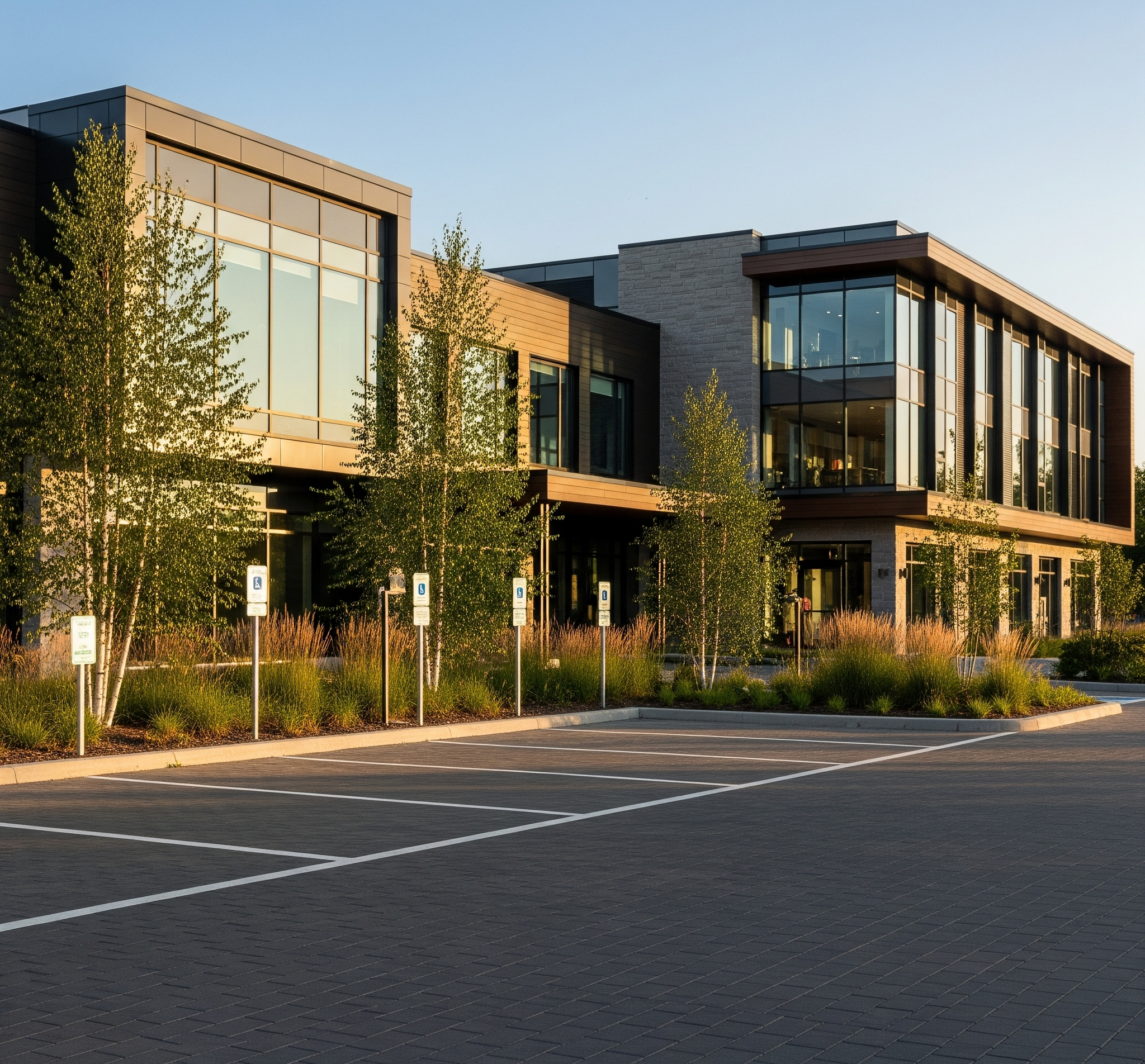
The $2.50 quote is the cost of sod plus labour to roll it out. That is all. It does not include the cost of ripping up the construction-compacted sub-grade. It does not include importing the 750 cubic yards of premium topsoil needed to give the roots a viable growing medium. It does not include laser grading that topsoil to the correct elevations for stormwater drainage. And it emphatically does not include the fully automated, trenched irrigation system that is the only thing standing between your new sod and total burnout within the first 14 days.
The $2.50 contractor is going to roll Kentucky Bluegrass directly onto compacted clay, hand-water it with a hose for two days, and leave. By the time you notice the brown edges three weeks later, that contractor will be unavailable for comment. By the time the entire lot is dead and needs to be ripped out and redone properly, you will have spent the cost of the cheap installation plus the cost of the proper installation—paying twice to get what you should have gotten once.
This guide breaks down exactly where the money goes in a legitimate, heavily engineered commercial sod installation in Vaughan, Markham, and across the Greater Toronto Area, so you know precisely what you are paying for and, more importantly, what you are not paying for when a quote seems too good to be true.
The Illusion of “Price Per Square Foot”
The fundamental problem with quoting commercial sod installation by the square foot is that it encourages the comparison of radically different scopes of work as though they were the same product. A “sod quote” can mean anything from rolling grass onto bare dirt with no preparation to a full civil engineering package with deep soil remediation, precision grading, automated irrigation installation, establishment monitoring, and a written performance warranty.
Here is what a complete, professionally engineered commercial sod installation actually includes:
- Site clearing and sub-grade preparation
- Mechanical de-compaction of native soil
- Premium topsoil import, placement, and fine grading
- Automated irrigation system design, trenching, and installation
- Sod procurement, delivery logistics, and installation
- Establishment irrigation programming and monitoring
- Post-installation quality verification
A contractor who quotes only the sod and labour is quoting one line item out of seven. The other six line items are where 60–70% of the total project cost lives. Comparing that single-line-item quote against a comprehensive quote is not comparing apples to apples. It is comparing a raw apple to a finished pie and wondering why the pie costs more.
“A per-square-foot sod quote without a defined scope of work is not a quote. It is a number on a napkin, and it will cost you twice when the sod dies on top of unprepared soil.”
Cost Component 1: Site Clearing and Sub-Grade Preparation
On a new commercial development in Vaughan or Markham, the turf areas are typically the last spaces to be finished. By the time the building is complete, the parking lot is paved, the sidewalks are poured, and the landscaping crew arrives, the designated green space has been used for months as a construction staging yard. Heavy equipment has driven across it. Material pallets have sat on it. Excavation spoils have been dumped on it and partially removed. The surface is a compacted mess of clay, construction debris, gravel, and whatever else was left behind.
Before any topsoil or sod arrives, this surface must be cleared, rough-graded, and mechanically de-compacted.
- Site clearing: Removal of construction debris, rocks larger than 50 mm, temporary gravel pads, and any material that is not native soil. On a property where the green space was used as a staging area, this step alone may generate 5–15 truckloads of material to be hauled off site. Cost: $2,000–$8,000 depending on volume and disposal requirements
- Rough grading: A skid steer or compact excavator establishes the approximate finish grade, working the surface to within ±50 mm of the target elevation. This step creates the basic drainage contours (slopes toward catch basins, swales, or property edges) and removes any major high or low spots. Cost: $1,500–$5,000 for properties in the 3,000–5,000 m² range
- Mechanical de-compaction: The critical step. A vibratory ripper or rotary tiller breaks the compaction layer in the native clay to a depth of 150–200 mm, allowing the imported topsoil to bond with the sub-grade rather than sitting as a separate layer on top of an impermeable pan. Without de-compaction, the topsoil perches on the clay like a floating island: water pools at the clay interface, roots cannot penetrate into the clay layer, and the entire topsoil bed is vulnerable to shifting, settling, and drainage failure. Cost: $1,500–$4,000
Total sub-grade preparation: $5,000–$17,000 for a typical mid-size commercial property. This is the cost that the $2.50/sqft contractor eliminates by skipping it entirely—rolling sod directly onto the compacted, debris-contaminated sub-grade and hoping for the best.
Cost Component 2: Premium Topsoil Import and Laser Grading
The topsoil is the single largest material cost in a commercial sod installation, and it is the component most commonly under-specified, under-quoted, or omitted entirely by budget contractors.
Topsoil Volume
A commercial sod installation requires a minimum of 100–150 mm (4–6 inches) of premium topsoil across the entire sodded area. The volume math for a 5,000 m² property:
- 5,000 m² × 0.15 m depth = 750 m³ of topsoil
- At a bulk density of approximately 1,200 kg/m³, that is approximately 900 tonnes (90 truckloads at 10 tonnes per truck)
The logistics of receiving, placing, and grading 90 truckloads of topsoil on a commercial site in Markham are not trivial. The material must be staged without interfering with building access, loaded into a skid steer or wheel loader, spread across the prepared sub-grade in lifts, and graded to the finished elevation—all while coordinating with the other trades still finishing site work.
Topsoil Specification
Not all topsoil is the same, and the difference between premium screened topsoil and the cheapest available material is the difference between sod that establishes permanent roots and sod that sits on a nutrient-dead, poorly draining substrate and slowly declines.
- Premium triple-screened blended topsoil: Screened to 12 mm, blended with composted organic matter to achieve 4–8% organic content, 40–60% sand, <15% clay, pH 6.0–7.0. This is the specification that produces the moisture-retaining, well-draining, nutrient-rich root zone that Kentucky Bluegrass requires. Cost (GTA, delivered): $45–$65 per m³ (approximately $55/m³ average for Vaughan and Markham delivery distances from major soil yards in the region)
- Budget unscreened fill: Whatever material the supplier has available—often construction fill blended with clay, minimal organic content, rocks, roots, and inconsistent pH. Cost: $20–$30 per m³. The savings of $25–$35 per cubic metre on 750 m³ saves approximately $19,000–$26,000 on the project budget. It also produces a root zone that drains poorly, compacts within one season, provides inadequate nutrients, and condemns the sod to a slow, three-year decline into a patchy, weed-infested remnant of the turf you paid for
Premium topsoil cost for 5,000 m² at 150 mm depth: $33,750–$48,750 (material only, delivered).
Laser Grading
Once placed, the topsoil must be laser-graded to the precise finished elevation. On a commercial property, this is done with a laser-guided grading attachment on a skid steer, controlled by a laser transmitter that establishes a reference plane across the site. The operator grades the topsoil to ±10 mm of the target elevation—a tolerance that is impossible to achieve by eye or with a string line over large areas.
Why does precision matter? Because stormwater drainage on a commercial property is not optional. The City of Vaughan, the City of Markham, and the City of Toronto all require that surface water drain away from buildings, toward catch basins and swales, and off the property without pooling on adjacent properties. A turf grade that is 50 mm off in one area creates a low spot that ponds water, drowns the sod, and creates a muddy, unusable area that the property owner complains about for years.
Laser grading cost: $3,000–$8,000 for a 5,000 m² property, depending on complexity (slope transitions, grade changes around buildings and walkways, tie-in to existing hard surfaces).
Total topsoil and grading: $36,750–$56,750 for a 5,000 m² property. This is the largest single cost category in the project—and the one that budget contractors eliminate by using cheap fill, skipping laser grading, or reducing the topsoil depth to 50 mm (which is insufficient for permanent root development in GTA clay soils).
“Sixty percent of the cost of a commercial sod installation is buried underground before the first roll of grass arrives on site. That underground investment is the only reason the grass above it survives.”
Cost Component 3: Automated Irrigation System
On a commercial property of any meaningful size, automated irrigation is not a line item you can defer, value-engineer out, or replace with a hose and a caretaker. It is the life-support system that determines whether your sod investment establishes or dies. We covered the detailed engineering of commercial irrigation systems in our companion guide, “What Irrigation Is Needed After Commercial Sod Installation?” Here, we focus on the cost.
Irrigation System Components and Costs
- Water supply connection and backflow prevention: Connection to the building’s domestic water supply or a dedicated irrigation meter, with a reduced-pressure backflow preventer (required by the Ontario Building Code and municipal bylaws in Vaughan, Markham, and Toronto to prevent irrigation water from contaminating the potable water supply). Cost: $1,500–$3,500 (including installation and annual testing)
- Controller: A weather-based smart controller with ET adjustment, rain sensor integration, and remote monitoring capability. Commercial models with 16–48 zone capacity suitable for mid-size to large properties. Cost: $1,200–$3,500 (installed)
- Mainline and lateral piping: Schedule 40 PVC mainline (50–75 mm), poly lateral lines (25–40 mm), zone valves, valve boxes, and all fittings. Installed by vibratory plow or open trenching. This is the most labour-intensive component of the irrigation system—the pipe network runs beneath the entire sodded area. Cost: $15,000–$35,000 for a 5,000 m² system with 12–20 zones (material and labour)
- Sprinkler heads: Commercial gear-driven rotary heads with check valves, stainless steel retract springs, and swing-joint riser assemblies. A 5,000 m² property with 12–15 m head spacing requires approximately 80–120 heads. Cost: $8,000–$15,000 (material and installation)
- Rain sensor and flow sensor: $300–$800 (installed)
- System commissioning and programming: Zone-by-zone flow testing, coverage verification (catch-cup tests), controller programming for establishment and mature-turf schedules, client training. $1,000–$2,500
Total automated irrigation system: $27,000–$60,300 for a 5,000 m² commercial property. The range depends on the number of zones, head density, pipe distances from the water source, and the complexity of the hydro-zoning layout.
This is the cost that budget contractors omit from their sod quotes because it doubles the project price. And without it, the sod is dead within two weeks of a hot Vaughan or Markham summer.
Cost Component 4: Sod Procurement, Delivery, and Installation
Finally, the cost that most people think is the entire cost: the grass itself and the labour to roll it out.
- Sod material (Kentucky Bluegrass, farm-cut): Wholesale commercial pricing for premium Kentucky Bluegrass sod from southern Ontario sod farms, delivered to Vaughan or Markham commercial sites: $2.00–$3.50 per m² ($0.19–$0.33 per sqft). For 5,000 m²: $10,000–$17,500 (material only, delivered). Pricing varies with order volume (larger orders = lower per-unit cost), delivery distance, and seasonal demand (peak demand in May–June commands higher prices than mid-summer or fall)
- Installation labour: A commercial sod crew (typically 4–8 workers) installs approximately 400–800 m² per day per crew, depending on site conditions, access constraints, and whether the sod is rolled (large rolls for open areas) or palletised (small rolls for detail areas near buildings and curves). A 5,000 m² installation takes approximately 7–12 crew-days. Cost: $12,000–$25,000 (labour only, including foreman supervision and quality control)
- Farm-to-site logistics: For summer installations, staggered delivery coordination with the sod farm to ensure no pallet sits on site longer than 2–3 hours. Multiple daily deliveries, timed to crew installation speed. Cost: $1,500–$4,000 (delivery surcharge for staggered scheduling beyond standard drop-ship delivery)
Total sod procurement, delivery, and installation: $23,500–$46,500 for 5,000 m².
The Complete Cost Picture
Assembling all four cost components for a 5,000 m² (approximately 54,000 sqft) commercial sod installation in Vaughan or Markham:
- Sub-grade preparation: $5,000–$17,000
- Premium topsoil and laser grading: $36,750–$56,750
- Automated irrigation system: $27,000–$60,300
- Sod procurement, delivery, and installation: $23,500–$46,500
Total project cost: $92,250–$180,550
Cost per square metre: $18.45–$36.11 ($1.71–$3.35 per sqft)
Now compare that to the $2.50/sqft quote that included only the sod roll and basic labour. The $2.50 quote covered approximately $23,500–$46,500 of a $92,250–$180,550 project. It was quoting 25–30% of the actual scope. The remaining 70–75%—the sub-grade work, the topsoil, the irrigation—was either not included or not performed.
And when that 25–30% installation fails (because it will fail—sod on compacted clay without topsoil and without irrigation does not survive in GTA conditions), the cost to remove the dead sod, perform the soil and irrigation work that should have been done initially, and reinstall sod is typically 20–40% higher than the cost of doing it correctly the first time, because the remediation includes ripping up and disposing of the failed turf and potentially repairing damage to adjacent hardscapes and drainage infrastructure caused by the poor grading.
The Cinintiriks Approach: Transparent, Comprehensive, Engineered
At Cinintiriks, our commercial sod quotes in Toronto, Vaughan, and Markham are scope-complete from the first meeting. We do not quote the sod and hide the civil work. We do not present a low number and add change orders for “unforeseen” soil conditions that were entirely foreseeable. We do not exclude irrigation from the landscape scope and leave the property manager to figure out how to keep 5,000 square metres of fresh turf alive with a garden hose.
Our proposal includes every component, priced transparently:
1. Detailed Scope of Work: Every line item listed, specified, and priced. Sub-grade preparation. Topsoil specification (organic content, sand content, pH, screening, depth). Laser grading to surveyed elevations. Irrigation system design (zone count, head type, controller model, sensor specification). Sod species and farm source. Installation labour. Staggered delivery logistics. Establishment monitoring. The client knows exactly what they are paying for before a single piece of equipment arrives on site.
2. Topsoil Quality Guarantee: We source premium triple-screened blended topsoil from certified suppliers with documented soil analysis reports. The organic content, sand/clay ratio, pH, and screening specification are verified before delivery. We do not accept “whatever the yard has available” and neither should you. The topsoil report is included in your project documentation.
3. Pre-Sod Irrigation Installation: The complete automated irrigation system is designed, installed, tested, and commissioned before the topsoil is final-graded and the sod is delivered. The system is operational on sod installation day. Zone-by-zone activation begins within 30–60 minutes of sod placement. This is the Cinintiriks standard, and it is the only sequence that guarantees establishment success.
4. 14-Day Establishment Monitoring: For every commercial sod installation, our turf management team monitors the establishment through the full 14-day critical window: daily soil-moisture verification, controller schedule adjustments based on weather conditions, sod-lift root checks, and corrective action for any area showing stress. The client receives a written establishment report at day 14 confirming root development status across the property.
5. Aesthetic Integration: The finished turf elevation is laser-graded to produce a flush, clean transition against our signature deep Charcoal and Warm Off-White commercial hardscapes. The sod edge against a paver border is a precision detail—no lip, no gap, no exposed topsoil. The green-against-pale contrast is the Cinintiriks visual signature on commercial properties across Vaughan, Markham, and Toronto, and it is engineered from the grading stage, not corrected after the fact.
Don’t waste tens of thousands of dollars on a cheap turf quote that skips the soil engineering. Contact Cinintiriks for a transparent, heavily engineered commercial sod installation in Toronto, Vaughan, or Markham.
FAQ: Commercial Sod Installation Costs
Why does commercial sod installation cost significantly more per square foot than residential?
Scale changes everything, but not in the direction most people assume. On a residential property with 200 m² of sod, the homeowner might spend $2,000 on topsoil, $1,500 on sod, and $800 on labour—a total of $4,300, or roughly $2.00/sqft all-in. That price works because the homeowner can hand-water 200 m² with a hose, the topsoil volume is small enough to spread by wheelbarrow, and there is no irrigation system cost. On a commercial property with 5,000 m² of sod, the engineering requirements scale non-linearly. You cannot hand-water 5,000 m²—an automated irrigation system is mandatory, adding $27,000–$60,000. You cannot spread 750 m³ of topsoil by wheelbarrow— you need heavy equipment, laser grading, and coordinated deliveries, adding significant mobilisation and labour costs. You cannot have a caretaker walk the property with a hose three times a day during establishment— you need a smart controller running programmed micro- cycles across 12–20 zones. The individual material costs (sod per m², topsoil per m³) are actually lower at commercial volumes due to wholesale pricing. But the infrastructure costs—irrigation, heavy equipment, laser grading, logistical coordination—add entire cost categories that do not exist at the residential scale. The result: commercial sod installation in Vaughan or Markham typically costs $1.70–$3.35 per sqft all-in (including soil, irrigation, and installation), compared to $1.50–$2.50 per sqft for residential where no irrigation is included. The per-square-foot difference looks modest, but on 54,000 sqft, even a $1.00/sqft difference represents $54,000 of additional scope.
Does a commercial sodding quote usually include the cost of installing an automated sprinkler system?
It should. It usually does not. This is the single most common source of budget surprises in commercial landscaping. Many contractors— particularly those whose primary business is residential landscaping and who are attempting their first commercial project—quote the sod installation as a standalone scope and expect the property owner to arrange irrigation separately. The problem: if the irrigation is “arranged separately,” it is typically arranged after the sod is installed, which means the sod spends its critical first 14 days either un-irrigated or inadequately hand-watered while the irrigation contractor designs, permits, orders, and installs the system. By the time the sprinklers are running, the sod establishment window has passed and the turf is already damaged or dead. A legitimate commercial sod quote must include the irrigation system as an integral, co-installed component of the project, not as an afterthought. The irrigation must be in the ground and operational before the sod arrives. If your quote shows $2.50/sqft for “sod supply and install” and a separate line item titled “irrigation system (by others),” you are looking at a project structure that is designed to fail. At Cinintiriks, the irrigation system is part of the base scope on every commercial sod installation in Toronto, Vaughan, and Markham. It is never excluded, optional, or deferred.
How much premium topsoil needs to be imported before laying sod on a commercial property?
The minimum specification for permanent turf establishment on GTA clay soils is 100 mm (4 inches) of premium topsoil. On properties where the native soil is heavily compacted construction fill, or in high- visibility areas where the turf must achieve premium density and colour, we specify 150 mm (6 inches). The volume math scales rapidly at commercial sizes: a 3,000 m² property at 150 mm depth requires 450 m³ of topsoil (approximately 54 truckloads). A 5,000 m² property requires 750 m³ (approximately 90 truckloads). A 10,000 m² property at a major commercial development in Markham or Vaughan may require 1,500 m³ (approximately 180 truckloads). The topsoil must be premium triple- screened blended material with documented organic content (4–8%), sand content (40–60%), clay content (<15%), and pH (6.0–7.0). Budget topsoil that does not meet these parameters will save $20–$35 per cubic metre on the initial purchase and cost the property owner the entire sod replacement within 2–3 seasons when the turf fails due to drainage problems, nutrient deficiency, or compaction in the inferior soil. On a 5,000 m² property, the topsoil savings from using budget material is approximately $19,000–$26,000. The sod replacement cost when the turf fails is approximately $35,000–$65,000 (removal of dead turf + new sod + installation labour). The arithmetic is ruthless and unambiguous.
The Final Word
The cost of commercial sod installation in Vaughan, Markham, and across the Greater Toronto Area is not a mystery. It is a function of four clearly defined and fully quantifiable components: sub-grade preparation, premium topsoil engineering, automated irrigation, and sod procurement and installation. Any quote that collapses these four components into a single per-square-foot number is hiding something. Any quote that omits one or more of them is guaranteeing failure.
The sod itself is the cheapest part of the project. The engineering beneath it is what keeps it alive. And the contractor who is transparent about that engineering— who shows you every line item, specifies every material, and prices every component openly—is the contractor who is building a green space that will still be green five years from now.
Ask for the full scope. Demand the specifications. Compare complete proposals, not napkin numbers. And build it once, correctly.